At Abossey Okai, Accra’s spare parts district, a trader unpacks a container that left Guangzhou six weeks earlier: brake pads, filters, bearings, wiring harnesses, enough stock to supply a dozen mechanics for a month. He priced the deal off his supplier’s invoice. He is about to learn that invoice was never the real number.
Importing from China to Ghana is not a niche hustle, it is the backbone of how goods actually reach Ghanaian markets. Bilateral trade between the two countries hit a record USD 14.1 billion in 2025, up 19.3% on the year before, and China is now Ghana’s single largest source of imports, accounting for 22.7% of everything the country brings in. That scale creates real openings for traders willing to do the arithmetic properly, and real losses for the ones who don’t.
The trap is always the same: pricing off the supplier’s FOB quote and forgetting that Ghana Customs (GRA) adds duty, ECOWAS and AU levies, a processing fee, then NHIL, GETFund, and VAT on top, all before freight, insurance, and clearing agent costs. This guide walks through six real businesses built on Chinese imports, with GHS startup costs computed the same way GRA actually calculates them.
Need a Freelancer for This?
Hire verified talent on Fiverr — starting from $5. No contracts, no hassle.
Browse Fiverr Freelancers →Before you commit to a supplier, run your own numbers. → Use the free Ghana Import Duty Calculator at MetricSuite.tools to calculate this instantly, no signup required.
For the full breakdown of every levy in this stack, see True Cost of Importing into Ghana. If you’re comparing against East African sourcing costs, our M-Pesa Fees 2026 guide covers Kenya’s transaction cost picture.
1. Phone & Electronics Accessories (Circle Market)
Kwame Nkrumah Circle is Accra’s electronics accessory hub, phone cases, chargers, earbuds, power banks, screen protectors, sold by the thousand to retailers who resell across the city and beyond. Demand tracks Ghana’s phone penetration, which keeps climbing every year, and margins on accessories are far better than on the phones themselves.
Startup cost (finished electronics, 20% duty band):
- FOB value: USD 2,500 / Freight: USD 350 / Insurance: USD 25 → CIF: USD 2,875 (GHS 44,563 at GHS 15.50/USD)
- Customs duty (20%): GHS 8,913 / Processing, ECOWAS, AU: GHS 758 / NHIL + GETFund: GHS 2,712 / VAT: GHS 8,135
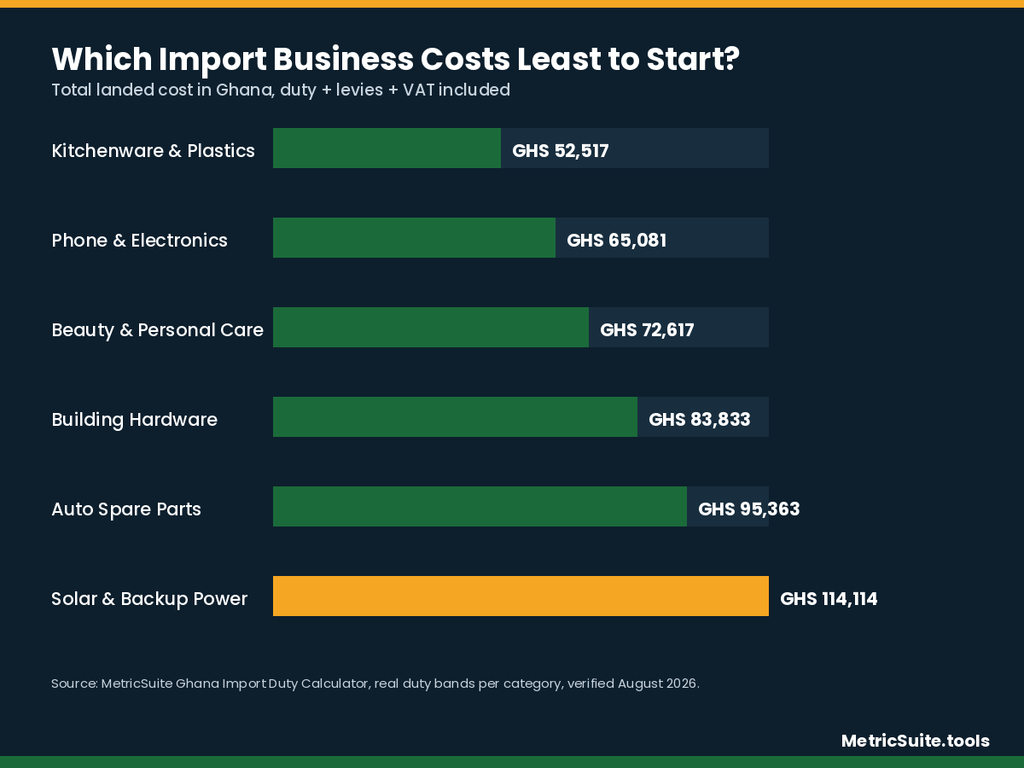
- Total landed cost: GHS 65,081 (about USD 4,199)
Retail markup on accessories commonly runs 80-120% at Circle. A GHS 65,081 landed shipment reselling at even a conservative 90% markup returns roughly GHS 123,650 in revenue, GHS 58,569 gross profit before rent and staff, inside a single 60-90 day sell-through cycle if you’re stocking fast-moving items.
First steps:
- Get exact HS codes from your supplier before ordering, “electronics accessories” spans multiple duty bands
- Start with 3-4 SKUs that already move at Circle, don’t diversify on your first container
- Confirm your supplier’s Alibaba trade assurance covers the full order before wiring payment
2. Auto Spare Parts (Abossey Okai)
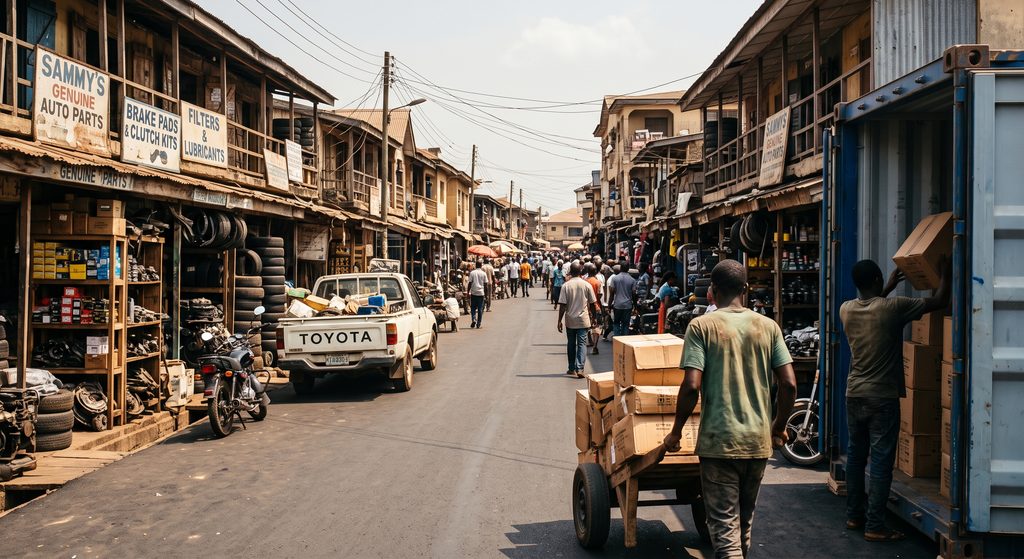
Abossey Okai is West Africa’s reference point for auto parts, mechanics from across Ghana and neighbouring countries buy here first. Most fast-moving parts, filters, belts, bearings, gaskets, classify as intermediate goods under GRA’s tariff schedule.
Startup cost (intermediate goods, 10% duty band):
- FOB value: USD 4,000 / Freight: USD 550 / Insurance: USD 40 → CIF: USD 4,590 (GHS 71,145)
- Customs duty (10%): GHS 7,115 / Processing, ECOWAS, AU: GHS 1,209 / NHIL + GETFund: GHS 3,974 / VAT: GHS 11,920
- Total landed cost: GHS 95,363 (about USD 6,152)
Spare parts margins run 40-70% depending on part category, brake components and filters at the higher end. A full container of mixed fast-movers can turn over within 90 days if you’re supplying repeat mechanic customers rather than one-off retail buyers.
First steps:
- Verify duty classification per part category, brake pads and electronic sensors often sit in different bands
- Build relationships with 3-5 mechanics who’ll commit to repeat orders before your first shipment lands
- Budget separately for a licensed clearing agent, misclassified auto parts are a common cause of GRA delays
3. Building Hardware & Tools (Agbogbloshie/Kaneshie)
Ghana’s construction sector has stayed active through 2026, and the hardware trade around Agbogbloshie and Kaneshie supplies everything from hand tools to fittings to small power equipment for that pipeline. Basic hardware generally falls into GRA’s intermediate goods band.
Startup cost (intermediate goods, 10% duty band):
- FOB value: USD 3,500 / Freight: USD 500 / Insurance: USD 35 → CIF: USD 4,035 (GHS 62,543)
- Customs duty (10%): GHS 6,254 / Processing, ECOWAS, AU: GHS 1,063 / NHIL + GETFund: GHS 3,494 / VAT: GHS 10,479
- Total landed cost: GHS 83,833 (about USD 5,409)
Hardware margins sit lower than electronics, typically 25-40%, but volume and repeat contractor business make up for it. Small power tools (drills, grinders) often classify as finished consumer goods at 20% rather than 10%, confirm before you price.
First steps:
- Get a written HS classification from your supplier for every product line, not a verbal quote
- Start with hand tools before power tools, the duty math is simpler and the margin per unit is more forgiving of mistakes
- Line up at least one contractor client willing to place a standing order before you commit capital
4. Solar & Backup Power Equipment
Ghana’s grid reliability has been an ongoing concern for years, and solar inverters, batteries, and panels sourced from China have become one of the more resilient import categories as households and small businesses hedge against outages. Many core components classify under GRA’s lower duty bands as capital goods or raw materials, though finished panels and premium inverters can sit higher, always confirm the exact HS code.
Startup cost (capital goods, 5% duty band):
- FOB value: USD 5,000 / Freight: USD 700 / Insurance: USD 50 → CIF: USD 5,750 (GHS 89,125)
- Customs duty (5%): GHS 4,456 / Processing, ECOWAS, AU: GHS 1,515 / NHIL + GETFund: GHS 4,754 / VAT: GHS 14,264
- Total landed cost: GHS 114,114 (about USD 7,362)
This is a higher entry cost than the other categories here, but backup power equipment holds value well and sells to a customer base actively looking to solve a real, recurring problem, which supports steadier margins, typically 30-50%, over a longer sales window than fast-fashion-style imports.
First steps:
- Confirm installation support or partner with a local electrician before you sell, backup power systems are a service sale, not just a product sale
- Check warranty terms with your supplier directly, batteries are the most common failure point
- Verify the exact HS code for panels versus inverters versus batteries separately, they often sit in different duty bands
5. Kitchenware & Household Plastics
Household plastics and kitchenware move steadily through Makola and neighbourhood markets across Accra and beyond, low unit cost, high repeat purchase, and simple enough to start with modest capital.
Startup cost (finished consumer goods, 20% duty band):
- FOB value: USD 2,000 / Freight: USD 300 / Insurance: USD 20 → CIF: USD 2,320 (GHS 35,960)
- Customs duty (20%): GHS 7,192 / Processing, ECOWAS, AU: GHS 612 / NHIL + GETFund: GHS 2,188 / VAT: GHS 6,565
- Total landed cost: GHS 52,517 (about USD 3,388)
This is the lowest entry cost of the six businesses here, which makes it a reasonable starting point if you’re testing importing for the first time. Margins run 50-80% at market stalls, with fast turnover on everyday items.
First steps:
- Order small on your first shipment to test which specific items move at your target market before scaling up
- Package in bulk-friendly units, market traders buying to resell want cartons, not loose pieces
- → Use the free African Multi-Currency Pricing Calculator at MetricSuite.tools to set retail prices that protect your margin, no signup required.
6. Beauty & Personal Care Products
Wigs, extensions, cosmetics, and personal care items sourced from China supply a large and steady share of Ghana’s beauty retail trade, particularly around Accra’s salons and beauty supply stores.
Startup cost (finished consumer goods, 20% duty band):
- FOB value: USD 2,800 / Freight: USD 380 / Insurance: USD 28 → CIF: USD 3,208 (GHS 49,724)
- Customs duty (20%): GHS 9,945 / Processing, ECOWAS, AU: GHS 845 / NHIL + GETFund: GHS 3,026 / VAT: GHS 9,077
- Total landed cost: GHS 72,617 (about USD 4,685)
Beauty products carry some of the strongest margins on this list, 60-100% is common on wigs and extensions sold through salon partnerships, since customers are paying for both product and trust in quality.
First steps:
- Request product samples before committing to a full order, quality variance between Chinese suppliers is significant in this category
- Partner with 2-3 salons for consignment or wholesale before opening general retail
- Confirm any cosmetics-specific import requirements with the FDA Ghana before shipping, some personal care categories need pre-import approval
Conclusion
Every business on this list works. The difference between the trader who profits and the one who doesn’t is rarely the product, it’s whether they calculated the real landed cost before they quoted a customer or committed capital to a supplier. Pick one category, run the actual numbers against GRA’s current duty stack, and test a small first order before you scale.
→ Use the free Ghana Import Duty Calculator at MetricSuite.tools to model your exact landed cost before you place your next order, no signup required.
Key Takeaways
- Ghana-China trade hit a record USD 14.1 billion in 2025, up 19.3%, with China now Ghana’s single largest import source at 22.7% of total imports.
- Landed cost is always higher than your supplier’s FOB quote, duty, ECOWAS and AU levies, a processing fee, then NHIL, GETFund, and VAT all stack on top.
- Duty rate depends on HS code, not product category guesswork, the same general item can sit in a 5%, 10%, or 20% band depending on exact classification.
- Lower-capital categories (kitchenware, accessories) let you test importing before committing to higher-cost categories like solar equipment or spare parts.
- Margins vary widely by category, beauty products and electronics accessories run highest, hardware and spare parts run lower but benefit from repeat business.
FAQ
How much does it cost to import from China to Ghana?
It depends on your product’s duty band and shipment size, but expect total landed cost (duty, ECOWAS and AU levies, processing fee, NHIL, GETFund, and VAT combined) to add roughly 45-70% on top of your CIF value, higher for goods in the 20% or 35% duty bands.
What is the cheapest thing to import from China to Ghana?
Goods classified in GRA’s 0% or 5% duty bands, essential goods, raw materials, and some capital goods, carry the lowest landed cost. Finished consumer goods at 20% and protected categories at 35% cost significantly more.
Do I need a licensed customs broker to import from China to Ghana?
It’s not legally required for every shipment, but strongly recommended. A licensed customs house broker knows current HS classifications and GRA’s ICUMS process, and can prevent costly misclassification or clearance delays at Tema.
How long does it take to import goods from China to Ghana?
Ocean freight typically takes 4-6 weeks from major Chinese ports to Tema, plus clearance time that varies from a few days to several weeks depending on documentation and whether your shipment is flagged for physical examination.
Does China’s zero-tariff policy reduce the cost of importing into Ghana?
No. The zero-tariff policy that took effect 1 May 2026 removes duties on Ghanaian exports going to China, it does not change what Ghana Customs charges on goods coming from China into Ghana.
References
- Ghana-China trade hits record $14.1b in 2025, Ghana Business News, May 2026
- Ghana-China trade hits US$14.1 billion amid push for deeper cooperation, The Business & Financial Times, May 2026
- Customs Tariffs and Levies, Ghana Revenue Authority (official ECOWAS CET bands)
- Ghana Import Duty Calculator, MetricSuite.tools, methodology verified August 2026