The Caribbean received an estimated US$20.9 billion in remittances in 2025, according to IDB regional estimates. Jamaica alone took in a record US$3.49 billion, about 15% of GDP. Most of that money pays for rent, food and school fees. Very little becomes ownership.
That gap is the case for Caribbean diaspora investing. In 2026, governments started building instruments to close it:
- Guyana announced a diaspora bond in May 2026 for overseas Guyanese to fund public infrastructure. Terms are still pending.
- Guyana and Barbados announced the proposed Trident Arrow Investment Fund, open to citizens of both countries, covering utilities, technology and agro-processing.
- Jamaica gained a regulated route for small investors: Blue Mahoe Capital opened a US equity crowdfunding offering for housing development, with a US$100 minimum.
For an investor in Toronto, London or New York, the question is practical. What does it cost to participate, where are the returns, and which country fits your capital and risk tolerance?
Need a Freelancer for This?
Hire verified talent on Fiverr — starting from $5. No contracts, no hassle.
Browse Fiverr Freelancers →Registration Costs: Jamaica, Trinidad, Guyana and Barbados
Before you invest, you need a legal structure. Government filing fees vary widely across the four largest English-speaking Caribbean markets.
| Country | Sole trader | Company (government fees) | Approx. USD (company) |
|---|---|---|---|
| Jamaica | J$2,500 (~US$16) | J$27,000 | ~US$171 |
| Trinidad and Tobago | TT$20 + TT$220 certificate | ~TT$600 filing | ~US$88 |
| Guyana | n/a | G$63,900 | ~US$305 |
| Barbados | n/a | BBD 780 (incl. name reservation) | ~US$390 |
USD figures are approximate at September 2026 rates. Legal and compliance fees are extra.
What the table does not show is professional fees. In Trinidad, total setup with legal and compliance support runs about TT$3,785 (~US$560). In Guyana, attorney fees add roughly G$150,000 (~US$720) plus VAT. Barbados charges BBD 3,000 (~US$1,500) to register an external company.
The practical read:
- Testing a small venture: Jamaica’s J$2,500 sole trader registration is the lowest-risk entry.
- Forming a company: Trinidad has the lowest government filing fees. Barbados has the highest.
- Hiring a lawyer: budget US$500 to US$1,000+ on top of fees in any of the four.
→ Use the free Caribbean Business Registration Cost Estimator at MetricSuite.tools to calculate this instantly, no signup required.
Guyana: The Highest-Growth Option
Guyana is the fastest-growing economy in the Western Hemisphere, and diaspora capital is already moving in.
- TriStar Shore Base: In February 2026, the Guyana Office for Investment (GO-Invest) facilitated a US$250 million diaspora-funded maritime project, led by US-based Guyanese investor Kris Persaud. Phase 1 (US$100 million) is operational, with two further phases planned for 2026.
- Local Content Act: The revised Act, effective January 2026, aims to let families and diaspora investors take part in the oil and gas supply chain, not just large firms.
- Diaspora bond: President Irfaan Ali announced it on May 26, 2026, during Guyana’s 60th Independence celebrations. As of late September, the government had not published size, returns or eligibility. In a September 24 New York address, Ali said a dedicated diaspora investment vehicle was coming soon, naming the planned fertiliser plant and gas bottling facility as possible projects.
The risk: oil economies are volatile, infrastructure timelines slip, and the flagship instruments are announced but not yet open. Guyana suits investors with a higher risk tolerance and patience for execution.
Jamaica: Real Estate, Agriculture and the JSE
Jamaica’s pitch is different. It is a mature market with a stock exchange, a familiar legal system and the region’s strongest diaspora networks.
- Stock market: The Jamaica Stock Exchange (JSE) has been courting diaspora investors through overseas roadshows and diaspora conferences. The main friction is opening a Jamaican brokerage account from abroad.
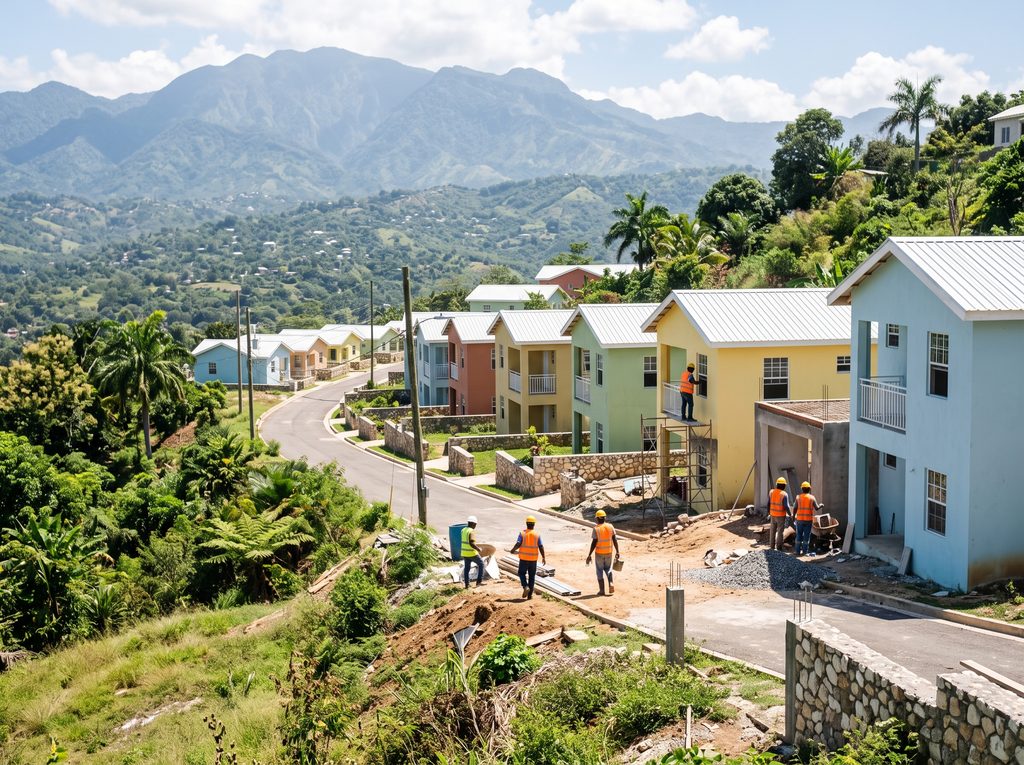
- Real estate: Historically where most diaspora capital goes. Blue Mahoe Capital’s Reg CF offering, launched June 11, 2026, sells shares at US$10 with a US$100 minimum, funding housing developments in Jamaica.
- Agriculture: The under-explored sector. Agro-Invest is recruiting diaspora investment, and cocoa, coconut and coffee are the commodities officials most often point to.
The trade-off: Jamaica is the most accessible market but also has the most competition for deals. Expect steady returns rather than frontier growth, which suits investors who prioritise capital preservation.
Trinidad and Tobago: Energy and Diversification
Trinidad’s economy runs on energy, but the investment case is diversification. The Trinidad and Tobago Investment Promotion Agency (InvesTT) targets priority sectors including:
- Agribusiness and manufacturing
- Downstream energy and cleantech
- Tourism and creative industries
- IT, financial services and maritime
The country is also pursuing renewable energy and data centre investment. For diaspora investors, Trinidad offers the region’s most developed financial services sector and an English common law system.
The trade-off: heavier dependence on hydrocarbon revenue than Jamaica or Barbados, which means more exposure to energy price swings. It fits investors with experience in energy, manufacturing or logistics.
Barbados: Regulatory Certainty
Barbados has one of the highest per-capita incomes in CARICOM and the region’s most sophisticated regulatory environment.
- It is a partner in the proposed Trident Arrow Investment Fund with Guyana.
- Its limited farmland pushes agricultural investment toward hydroponics and aquaculture.
- The Welcome Stamp remote-work visa, launched in 2020, has kept demand for rental housing from long-stay visitors.
The trade-off: Barbados is the most expensive market for property and company setup. Returns are lower than Guyana’s, but so is the risk. It suits investors who want predictability.
What It Costs to Hire Local Staff
Employer statutory contributions sit on top of gross salary, and they vary by country.
| Country | Employer contribution | What it covers |
|---|---|---|
| Guyana | 8.4% | NIS |
| Trinidad and Tobago | 10.8% | NIS |
| Jamaica | 12.5% | NIS, NHT, Education Tax, HEART/NSTA |
| Barbados | 13.0% | NIS (12.75%) + Resilience and Regeneration Fund (0.25%) |
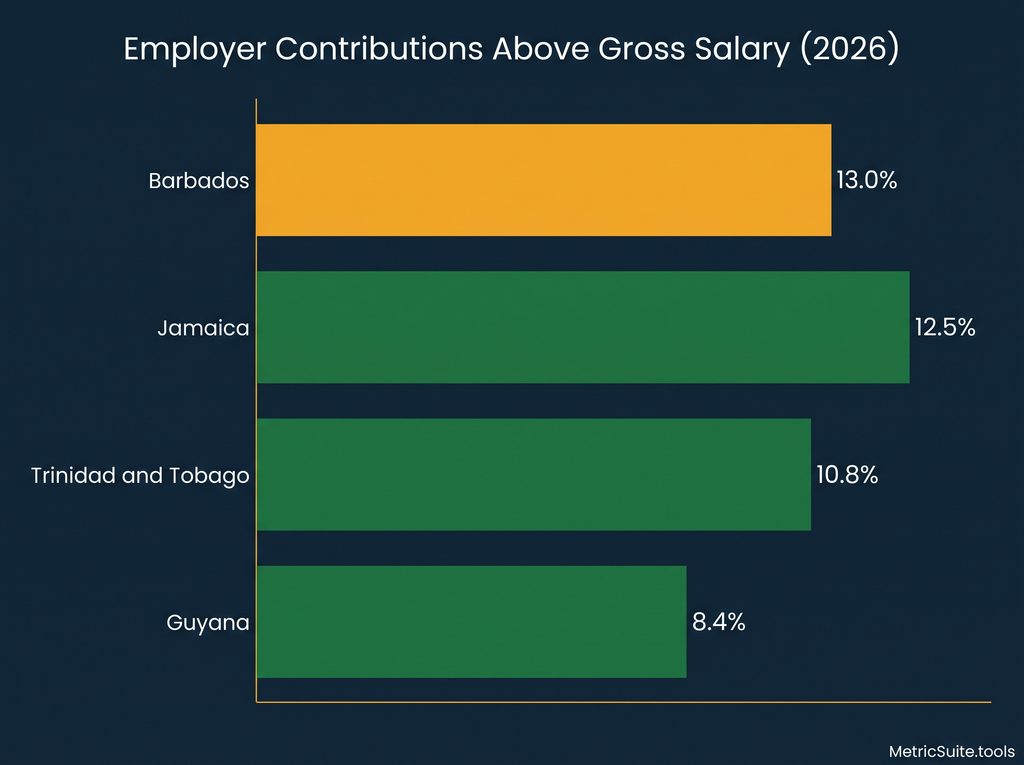
On a US$1,000 monthly salary, that is the difference between US$84 and US$130 a month in employer cost, before any benefits.
→ Use the free Caribbean Employee True Cost Calculator at MetricSuite.tools to calculate this instantly, no signup required.
Pair it with the Caribbean PAYE Take-Home Pay Calculator to see what your employee actually keeps after tax.
The CSME: What Free Movement Actually Gets You
The CARICOM Single Market and Economy (CSME) is meant to allow free movement of goods, services, skills and capital. In practice it is narrower than the name suggests.
- Full free movement of people applies only among four states that opted in from October 1, 2025: Barbados, Belize, Dominica, and St Vincent and the Grenadines.
- Skilled nationals in approved categories can work across participating states without a work permit. CARICOM has continued to add categories, including aviation personnel in 2026.
- The Bahamas is a CARICOM member but not part of the CSME. Haiti and Montserrat participate only partially.
The takeaway: CSME helps with labour mobility and with qualifying goods under Rules of Origin. It is not a single market like the EU. If your plan depends on moving goods or staff between islands, check each country’s rules.
→ Use the free CSME Tariff Lookup at MetricSuite.tools to calculate this instantly, no signup required.
Caribbean Diaspora Investing: Where to Start
Registration fees, employer contributions and CSME rules are knowable before you commit a dollar. Run them first.
- Pick your risk profile: Guyana for growth, Jamaica for access, Trinidad for industry, Barbados for stability.
- Price your structure: sole trader to test, company to scale, with legal fees included.
- Model one local hire at full employer cost before setting a salary.
This week, run your country shortlist through the Caribbean business tools and compare the total cost of entry side by side.
Key Takeaways
- The Caribbean receives around US$21 billion a year in remittances, but little of it becomes ownership.
- Guyana’s diaspora bond and the Guyana-Barbados Trident Arrow fund are announced, but terms are not yet public.
- Trinidad has the lowest government company filing fee. Barbados has the highest.
- Employer contributions range from 8.4% (Guyana) to 13% (Barbados) above gross salary.
- Full CSME free movement covers only four states, so check country rules before moving goods or staff.
Need help setting up your Caribbean business?
Hire vetted freelancers for business plans, financial models, bookkeeping and investor decks on Fiverr.
Find a Business Expert on FiverrAffiliate link. MetricSuite may earn a commission at no cost to you.
Frequently Asked Questions
What is the cheapest Caribbean country to register a business in?
For a sole trader, Jamaica at J$2,500 (about US$16). For a company, Trinidad and Tobago has the lowest government filing fees at around TT$600 (about US$88). Barbados is highest at BBD 780 (about US$390). Legal fees are extra in every case.
Can I invest in the Caribbean without moving there?
Yes. The Guyana diaspora bond, the Trident Arrow fund and Jamaica housing crowdfunding are all designed for overseas investors. The main friction is opening local bank or brokerage accounts and handling compliance from abroad.
Which Caribbean country has the best returns right now?
There is no single answer. Guyana has the highest growth and the highest risk. Jamaica has the most accessible markets. Barbados has the most regulatory stability. Trinidad has the strongest industrial base. Match the country to your risk tolerance and sector knowledge.
What is the Trident Arrow Investment Fund?
A proposed joint Guyana-Barbados fund, announced in May 2026, that would let ordinary citizens of both countries invest in infrastructure, utilities, technology and agro-processing. Guyana’s diaspora bond is a separate instrument.
How much does it cost to hire staff in the Caribbean?
Employer contributions add 8.4% (Guyana), 10.8% (Trinidad and Tobago), 12.5% (Jamaica) or 13% (Barbados) on top of gross salary.
Are remittances the same as investment?
No. Remittances pay for consumption such as rent, food and school fees. Investment buys ownership or a return. The 2026 policy push across the region is about converting more of that flow into ownership.
Sources
Remittances
- IDB, Remittances to Latin America and the Caribbean Ease After 2025 Surge
- News Americas, Caribbean Remittances by Major Countries (IDB 2025 estimates)
- Caribbean National Weekly, Caribbean remittances surge (Bank of Jamaica data)
Guyana
- Kaieteur News, GO-Invest facilitates US$250M diaspora-funded maritime infrastructure investment
- Guyana DPI, Gov’t to launch diaspora bond within one week
- News Room Guyana, Special investment venture for diaspora soon (Sept 25, 2026)
- INews Guyana (Local Content Act coverage)
Guyana and Barbados
- Guyana Chronicle, Guyana, Barbados eye new investment fund
- Kaieteur News, Guyana and Barbados to establish joint investment fund
Jamaica
- Blue Mahoe Capital, Caribbean real estate opens to retail investors via equity crowdfunding
- Jamaica Stock Exchange
- Jamaica Information Service (Agro-Invest diaspora agriculture)
- Jamaica Gleaner
Region
MetricSuite tools