
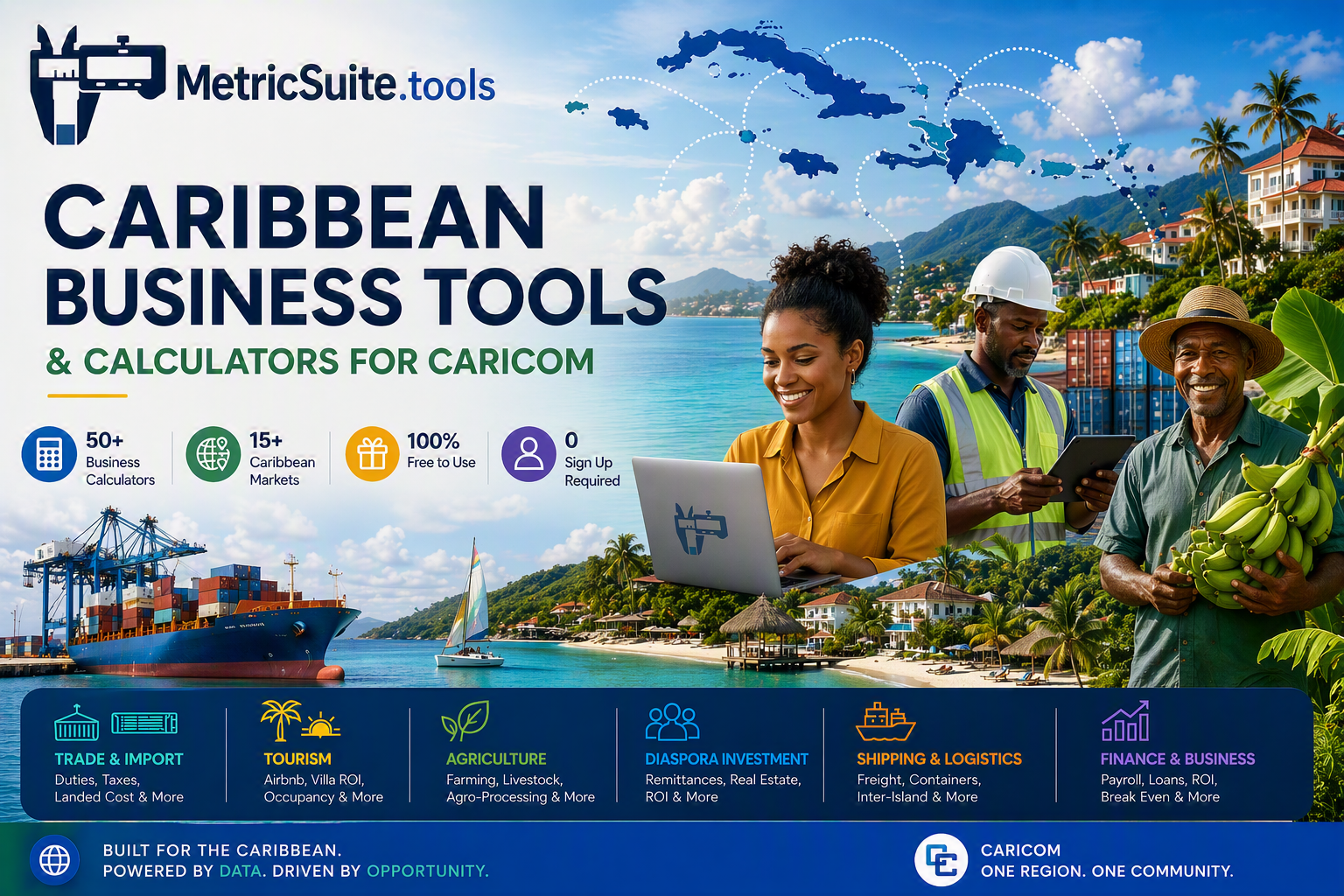
Free Caribbean Business Tools & Calculators, From Kingston to Port of Spain
Try pricing a shipment in Jamaican dollars when your supplier invoices in USD and your customer pays in Trinidad and Tobago dollars. Try working out what a container really costs to land in Kingston once GCT, the Environmental Levy, and port handling fees are added. Try comparing what Western Union charges against Wise for money sent from Toronto to Georgetown. Most people still do this math on the back of an invoice, or skip it and hope the numbers hold up.
These Caribbean business tools were built specifically for how business works across CARICOM. They cover the real calculations that importers in Kingston, freight forwarders shipping between islands, HR teams running payroll in Port of Spain, and diaspora investors sizing up a property deal in Georgetown need to get right. Everything runs in your browser, works on mobile, and costs nothing. No signup, no data collection, no subscriptions, just open and use.
Under CSME, goods and capital are supposed to move more freely between CARICOM’s member states, but knowing whether that applies to your shipment, and what it’s actually worth in duty saved, is a separate question. That’s what the CSME Tariff Lookup and the country specific duty calculators below are for, alongside tools for inter island shipping, payroll, remittances, and business registration costs across Jamaica, Trinidad and Tobago, Guyana, and Barbados. For the rules behind CSME itself, the CARICOM Secretariat publishes the full framework.”
What are the best business tools for Caribbean entrepreneurs?
Import duty calculators, shipping estimators, tourism profitability tools, payroll calculators, agricultural profitability calculators, and remittance comparison tools help Caribbean entrepreneurs make more informed business decisions.
What is CARICOM?
The Caribbean Community (CARICOM) is a regional integration framework comprising 15 Member States and 5 Associate Members. Its primary economic mechanism is the CSME (CARICOM Single Market and Economy), which seeks to facilitate the free movement of goods, services, people, and capital across the region to create a unified economic space.
How do I calculate import duties in the Caribbean?
Import duties are calculated based on the Cost, Insurance, and Freight (CIF) value of the goods, rather than just the raw purchase price. Total landed cost structures vary significantly by nation, typically requiring calculations for:
CET (Common External Tariff): The unified tariff rate applied to goods imported from outside CARICOM.
Internal Consumption Taxes: National taxes such as GCT (Jamaica), VAT (Trinidad & Tobago, Barbados), or Revenue Authority levies.
Environmental & Customs Levies: Flat or percentage-based processing fees applied at local ports of entry.
Can diaspora investors use these tools?
Yes. Diaspora investors require hard data to evaluate cross-border asset allocation. These tools provide transparent, ground-level analysis for cross-border investments, agrotech setups, commercial real estate developments, and logistics operations, stripping out guesswork when moving capital between North American hubs (CAD/USD) and Caribbean markets.
Which Caribbean countries are supported?
The platform supports calculations tailored to CARICOM Member States and Associate Members, including Jamaica, Trinidad & Tobago, Barbados, Guyana, Belize, the OECS states (Antigua & Barbuda, Dominica, Grenada, St. Lucia, St. Kitts & Nevis, St. Vincent & the Grenadines), the Bahamas, Suriname, Haiti, and northern associate territories like Bermuda and the Cayman Islands.
How can I estimate shipping costs between Caribbean islands?
Intra-regional shipping rates depend heavily on whether you are utilizing LCL (Less than Container Load), FCL (Full Container Load), or air freight. Costs are determined by cubic measurement (CBM) or deadweight tonnage, alongside fixed port handling fees, documentation costs, and bunker adjustment factors (BAF) unique to Caribbean carrier lines.
What industries are most profitable in the Caribbean?
What industries are most profitable in the Caribbean?
High-yield sectors across the region include:
Value-Added Agribusiness & Food Processing: Transforming raw agricultural outputs for export.
Eco-Tourism & Boutique Hospitality Operational Coaching: High-standard, culturally rooted service models.
Logistics & Supply Chain Infrastructure: E-commerce fulfillment hubs serving intra-island networks.
Renewable Energy & Tech Infrastructure: Micro-grid construction, software utilities, and localized IT infrastructure management.
Recent Blog Posts
 Sep 13, 2026
Ghana’s ICT Boom Is Creating a Two-Speed Economy: How to Position Your Business on the Right Side
A software developer in East Legon closes out August with three new client contracts and a waitlist. A…
Sep 13, 2026
Ghana’s ICT Boom Is Creating a Two-Speed Economy: How to Position Your Business on the Right Side
A software developer in East Legon closes out August with three new client contracts and a waitlist. A…
 Sep 12, 2026
Why 66% of Ugandan Businesses Die in Year One: The Financial Triggers Nobody Warns You About
Beatrice registered her import business in January. By June she had a shop in Kikuubo, three staff, and…
Sep 12, 2026
Why 66% of Ugandan Businesses Die in Year One: The Financial Triggers Nobody Warns You About
Beatrice registered her import business in January. By June she had a shop in Kikuubo, three staff, and…
 Sep 10, 2026
EU CATCH Certification: What Uganda Fish Exporters Need to Confirm With Their Buyer
Two things happened to Uganda’s fish export market within weeks of each other. On 10 January 2026, the…
Sep 10, 2026
EU CATCH Certification: What Uganda Fish Exporters Need to Confirm With Their Buyer
Two things happened to Uganda’s fish export market within weeks of each other. On 10 January 2026, the…
 Sep 10, 2026
Dangote IPO From the Diaspora: Fees, Funding Rails, and What Actually Works
The Dangote Petroleum Refinery IPO opened Nigeria’s capital market to retail investors in a way that has not…
Sep 10, 2026
Dangote IPO From the Diaspora: Fees, Funding Rails, and What Actually Works
The Dangote Petroleum Refinery IPO opened Nigeria’s capital market to retail investors in a way that has not…
 Sep 9, 2026
How to Start an Online Business in Nigeria: Costs, Payments & Profit
A Lagos seller opens an Instagram page, posts a product, and takes her first order within the hour.…
Sep 9, 2026
How to Start an Online Business in Nigeria: Costs, Payments & Profit
A Lagos seller opens an Instagram page, posts a product, and takes her first order within the hour.…