
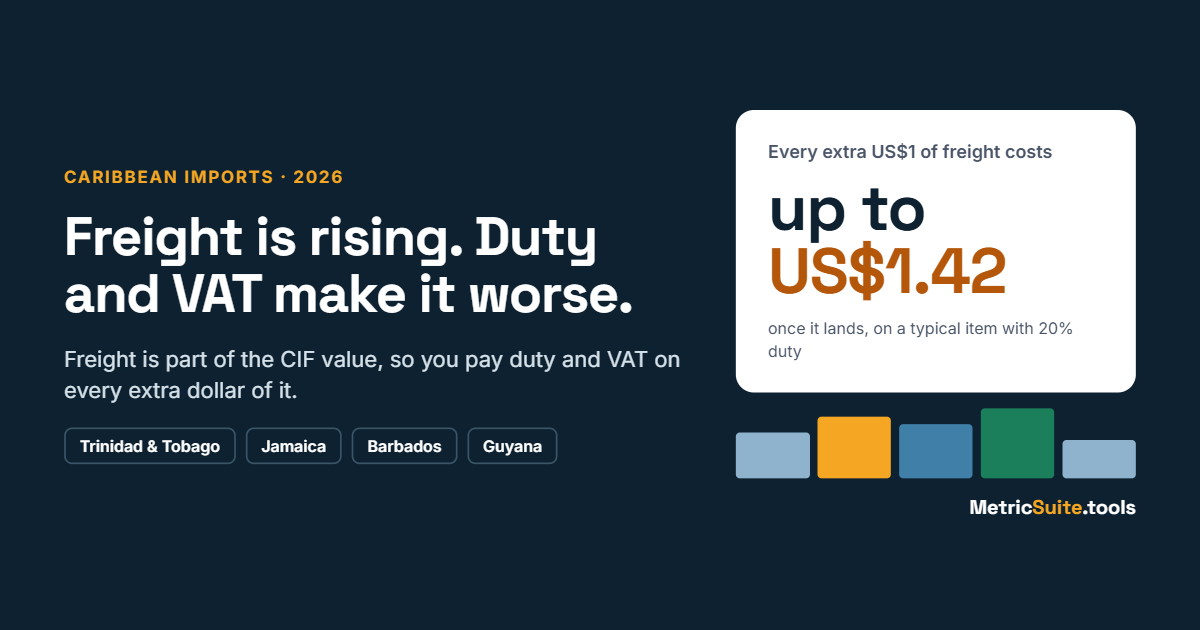
Quick answer: In Trinidad and Tobago, Jamaica, Barbados and Guyana, import duty and VAT are charged on the CIF value of your goods, and CIF includes freight. So when freight goes up, you also pay duty and VAT on the increase. On a typical item with 20% duty, every extra US$1 of freight costs you about US$1.35 to US$1.42 once the goods land.
Freight into the Caribbean is under pressure from several directions at once in late 2026. Here is what is happening, why it hits importers harder than the headline numbers suggest, and what you can do before your next shipment.
What is pushing Caribbean freight costs up
1. US port fees on Chinese-built ships
The United States has introduced port fees aimed at China’s dominance in shipbuilding and shipping. In April 2025 Washington granted exemptions that largely shielded Caribbean routes, covering smaller vessels and short voyages into US ports. Those exemptions are not permanent.
On October 29, 2026, the CARICOM Private Sector Organisation (CPSO) asked the Office of the US Trade Representative to make the Caribbean exemptions permanent. In its submission, the CPSO said the original fees could have raised freight costs between Florida and Caribbean ports by 50 to 60 percent. The wider measures are currently suspended under a US-China trade arrangement, and Washington is considering extending that suspension to January 9, 2027.
Why it matters: the number of carriers serving CARICOM regularly has fallen from more than 15 to five, and each of those five operates at least one Chinese-built vessel. The CPSO says no carrier has added a surcharge for these fees so far. The risk is what happens if the exemptions lapse.
2. Panama Canal restrictions
Low rainfall has forced the Panama Canal Authority to cut daily transits, down to 32 a day for bookings from September 15, 2026. Rainfall from May to August was 34% below average, and a 2026 to 2027 El Niño could squeeze water levels again in the January to April 2027 dry season.
The CPSO estimates US$8 billion to US$10 billion of CARICOM’s annual imports could be exposed, about a quarter to a third of the region’s non-fuel import bill. Major lines including CMA CGM, MSC and Hapag-Lloyd have already added surcharges on canal-dependent routes.
3. “Temporary” surcharges that stay
In Barbados, business groups warned in June 2026 that peak season surcharges used by shipping lines had effectively become a near-permanent increase in freight costs. Fuel-related bunker surcharges have also risen across Caribbean services this year.
Why a freight increase costs you more than the freight
Customs in all four countries calculates duty on CIF: the cost of the goods, plus insurance, plus freight. VAT (GCT in Jamaica) is then charged on CIF plus duty. That means freight is taxed twice: once through duty, and again through VAT on top of the duty.
Here is what one extra US dollar of freight really costs on an item with a 20% duty rate:
| Country | Taxes charged on freight | Cost of US$1 extra freight |
|---|---|---|
| Trinidad and Tobago | 20% duty, then 12.5% VAT | about US$1.35 |
| Jamaica | 20% duty, 15% GCT, 0.8% in levies | about US$1.39 |
| Barbados | 20% duty, 17.5% VAT, 1% Environmental Levy | about US$1.42 (see the freight cap below) |
| Guyana | 20% duty, then 14% VAT | about US$1.37 |
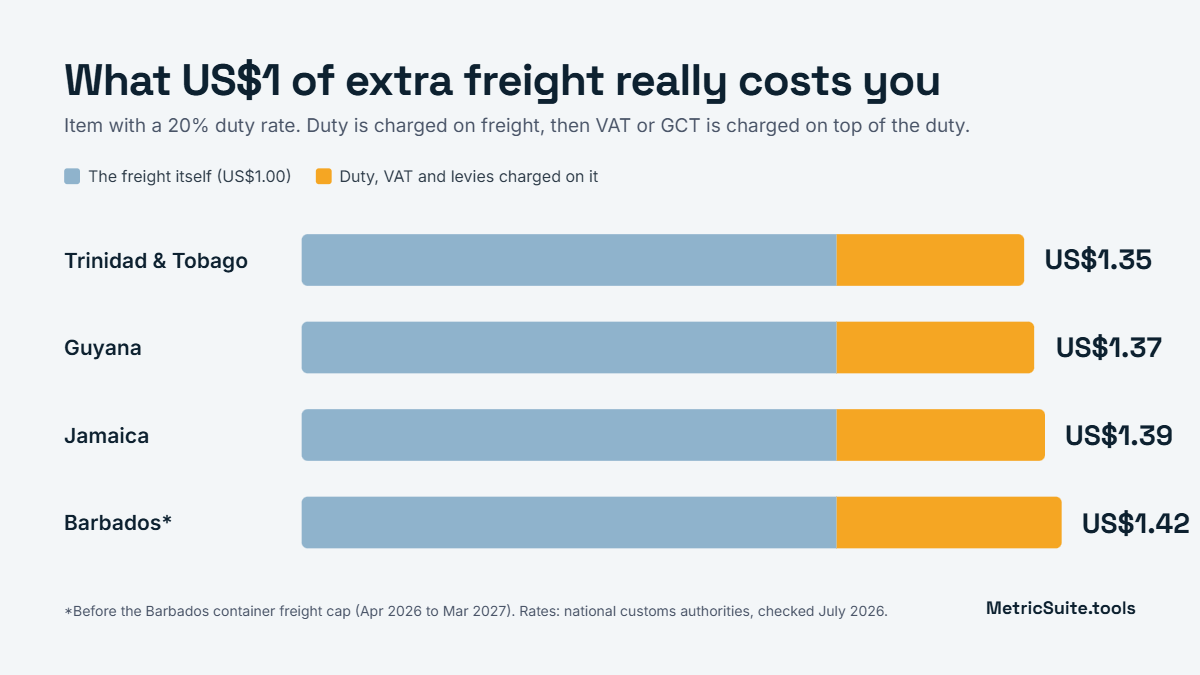
Your own figure depends on the duty rate for your product’s HS code. Items with 0% duty are only hit by VAT; items with 30% or 40% duty are hit harder.
Worked example: one shipment into Trinidad
A small reseller imports phone accessories from China: US$955 of goods, US$30 insurance, 20% duty, at TT$6.78 to the US dollar. Here is the same shipment with today’s freight and with freight 50% higher.
| Freight US$420 | Freight US$630 (+50%) | |
|---|---|---|
| CIF value | TT$9,525.90 | TT$10,949.70 |
| Duty (20%) | TT$1,905.18 | TT$2,189.94 |
| VAT (12.5%) | TT$1,428.88 | TT$1,642.46 |
| Landed cost before local fees | TT$12,859.97 | TT$14,782.10 |
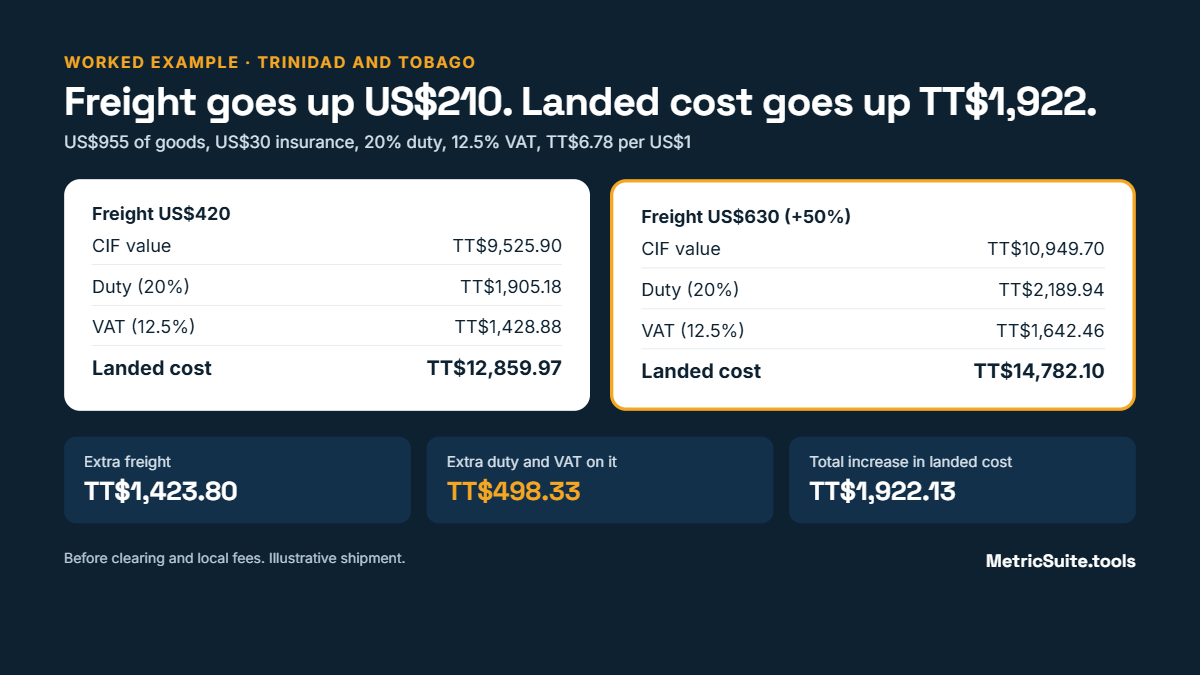
The freight bill went up by US$210, or TT$1,423.80. But the landed cost went up by TT$1,922.13. The extra TT$498.33 is duty and VAT charged on the higher freight.
If this reseller keeps the same selling prices, all of that comes out of their margin. On low-priced items with thin margins, that can be the difference between a profit and a loss.
Run your own shipment through the free Trinidad import duty calculator to see your numbers.
Barbados has a freight cap. Check if it applies to you
Barbados is the exception. From April 1, 2026 to March 31, 2027, the value used for duty and VAT calculations on a 20-foot container is capped at US$3,000, and US$6,000 for a 40-foot container. If you bring in full containers and your freight is above the cap, you pay duty and VAT on the capped amount, not the full freight bill. Ask your customs broker how it applies to your entries, especially for part loads.
Barbados also changed its online shopping thresholds from April 1, 2026: goods up to about BBD 150 enter free, goods between BBD 150 and 200 pay VAT only, and above that both duty and VAT apply.
What importers can do now
- Know your landed cost per item, not per shipment. A freight increase spreads across everything in the container. Some items can absorb it; low-margin ones cannot. Work it out item by item before you set prices.
- Ask your forwarder about surcharges in writing. The CPSO advises importers to talk to their shipping lines and logistics providers now about routing changes and surcharge exposure.
- Plan stock for the first quarter of 2027. The CPSO also recommends planning inventory for the end of 2026 and the 2027 dry season, expecting higher landed costs and lower stock levels.
- Reprice before the goods land, not after. If your margin target is 40%, the price you need is your landed cost per unit divided by 0.6. Set it when you place the order.
- Check whether your product’s duty rate is right. The duty rate multiplies everything above. A wrong HS code can cost you more than the freight increase.
Frequently asked questions
Is import duty charged on shipping costs in the Caribbean?
Yes. Trinidad and Tobago, Jamaica, Barbados and Guyana calculate duty on the CIF value, which includes freight and insurance. VAT or GCT is then charged on CIF plus duty. Barbados currently caps the freight value used for full containers.
How much do Caribbean freight costs add to my price?
It depends on your product’s duty rate and your country’s VAT rate. For a 20% duty item, each extra US$1 of freight adds about US$1.35 in Trinidad and Tobago, US$1.37 in Guyana, US$1.39 in Jamaica and US$1.42 in Barbados (before the container freight cap).
Will the US port fees definitely raise Caribbean freight?
Not yet. Caribbean routes have been largely exempt since April 2025, and the CPSO says no carrier has added a surcharge for the fees so far. The concern is that the exemptions are not permanent, which is why the region is asking the US to lock them in.
Work out your own numbers
Free calculators: Trinidad and Tobago · Jamaica · Barbados · Guyana
Import regularly? The Landed Cost & Profit Workbook logs every shipment, splits freight, duty, VAT and fees across each item, and shows the price you need to hit your target margin. Excel and Google Sheets, US$9.99.
See the Landed Cost WorkbookSources
- Jamaica Observer, “Freight fears: Caribbean seeks permanent shield from US shipping fees,” November 4, 2026: jamaicaobserver.com
- Guyana Chronicle, “Panama Canal restrictions place up to US$10B in CARICOM imports at risk,” September 10, 2026: guyanachronicle.com
- Barbados Today, 2026 Budget coverage on the container freight cap and online shopping thresholds: barbadostoday.bb
- Nation News, “Shipping fees ‘driving up prices’,” June 21, 2026: nationnews.com
- Duty and VAT rates: Customs and Excise Division (Trinidad and Tobago), Jamaica Customs Agency, Barbados Revenue Authority, Guyana Revenue Authority, as used in the MetricSuite calculators (last checked July 2026).
This article is general information, not customs or tax advice. Customs may assess different values or rates. Confirm your product’s HS code and duty rate with your customs authority or broker.