
You land a client in Toronto, a long-term contract on Upwork, or steady orders on Fiverr. The work is the easy part. Getting paid without losing a big slice to bank charges, or finding out your country is not supported, is where most freelancers in Africa and the Caribbean get stuck.
Payoneer solves that. One free account gives you USD, GBP and EUR account details that clients can pay like a local bank transfer, a direct payout link to the platforms that already pay you, and withdrawals to your own bank in more than 150 countries, including Uganda, Kenya, Ghana, Nigeria and Jamaica. This guide shows you how to open your account, get paid, bring the money home and keep fees low.
Disclosure: MetricSuite may earn a commission if you open a Payoneer account through the links on this page, at no cost to you. We recommend Payoneer because it works in every country we cover and leaves you more than a bank wire or PayPal.
Why Payoneer is our pick for freelancers in Africa and the Caribbean
- Real foreign account details. You get USD, GBP and EUR receiving accounts. A client in the US, UK or Europe pays you the same way they pay any local supplier, with no international wire needed.
- Built into the platforms that pay you. Upwork, Fiverr, Amazon and thousands of other marketplaces pay straight into Payoneer.
- Your money, in your own bank. Withdraw to a local bank account in Uganda, Kenya, Ghana, Nigeria, Jamaica and more than 150 other countries.
- Free between Payoneer users. If your client or agency also uses Payoneer, they can pay you at no cost.
- It works where the alternatives do not. Wise does not let residents of these five countries hold money or get account details to receive client payments. PayPal does not operate in Ghana, and Ugandan and Jamaican PayPal accounts cannot withdraw to a local bank. Payoneer works in all five.
- Regulated and safe. Payoneer is a licensed money transmitter in 51 US states and territories, and an e-money institution authorised by the Central Bank of Ireland and the UK’s Financial Conduct Authority. Customer money is kept in segregated, safeguarded accounts, and more than 4 million customers use it.
How much more you keep with Payoneer
Take a freelancer in Nairobi paid US$1,000 a month by a client abroad. With Payoneer, about KSh 125,600 lands in their bank account, 97.0% of the payment. A SWIFT wire to a Kenyan bank leaves about KSh 122,500, and PayPal about KSh 118,800.
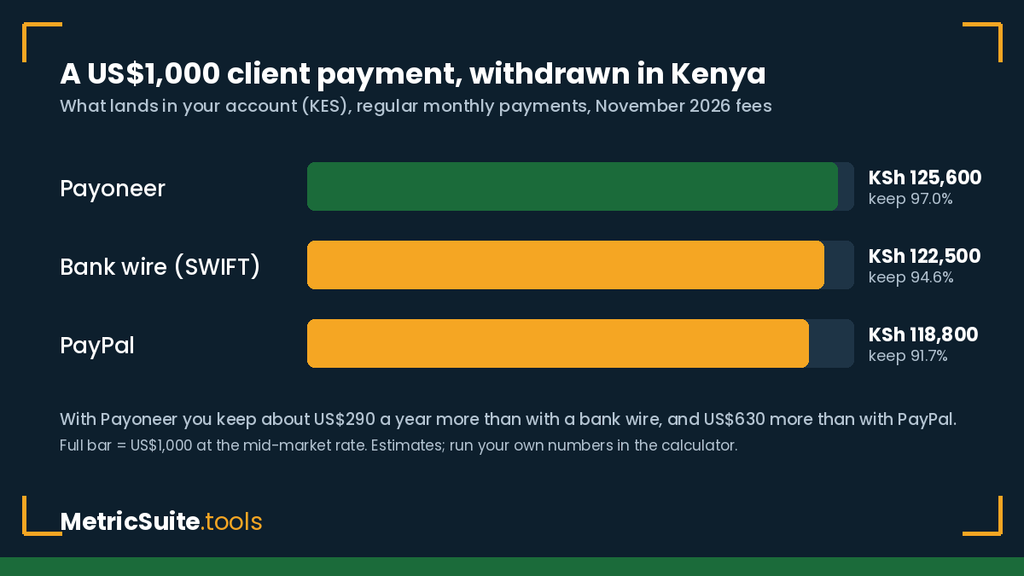
Over a year, that is about US$290 more than a bank wire and about US$630 more than PayPal, for the same work.
Assumptions: Payoneer 1% to receive and 2% to withdraw in Kenyan shillings. Bank wire US$25 in deducted charges and a 3% exchange margin. PayPal 4.40% plus US$0.30 to receive and about 4% to convert. Mid-market rate KSh 129.5 per US dollar.
Run your own amount, currency and country in the free Get Paid From Abroad Calculator.
How to open a Payoneer account, step by step
Opening an account is free and takes about 10 minutes online. Have your ID and bank details ready before you start.
- Sign up. Open your free Payoneer account here and choose the option that describes you best, such as freelancer or online seller.
- Enter your details exactly as they appear on your ID. A name that does not match your ID or bank account is the most common reason an application stalls.
- Add your local bank account. The account must be in your own name. Nigerian freelancers who want to hold dollars can add a domiciliary (USD) account.
- Upload your ID. Payoneer accepts a national ID card, passport or driving licence. Upload both sides, in colour, with no glare or fingers over the card. A scan works better than a photo.
- Show what you do. Freelancers link an active marketplace profile with job history. Website owners and affiliates show proof that they own the site. You do this under Settings, then Verification Center.
- Wait for approval. Payoneer emails you when your account is approved. Clear ID images and an active profile get you there fastest.
- Get your receiving account details. In your dashboard, open your receiving accounts to see your USD, GBP and EUR details. These are what you put on your invoices.
Four ways to get paid with Payoneer
1. From Upwork, Fiverr and other marketplaces. Choose Payoneer as your payout method on the platform. Upwork charges about US$2 per withdrawal to Payoneer, compared with US$50 for a wire transfer. If Upwork is your only source of work, also compare its Direct to Local Bank option (US$0.99 per transfer) and, in Kenya, its M-Pesa option. Payoneer pays off most when you also have clients outside Upwork.
2. From direct clients by bank transfer. Send your client your USD, GBP or EUR receiving account details. They pay you from their own bank as a domestic transfer. Payoneer charges 1% when the currency is not your local one.
3. From clients who want to pay by card. Send a payment request from your Payoneer account. Your client clicks a link and pays by card. This costs up to 3.99% plus US$0.49, so offer it to clients who will not pay any other way.
4. From other Payoneer users. Agencies, partners and clients with their own Payoneer account can pay you for free.
Use the Free Invoice Generator to put your receiving account details on a professional invoice.
Getting your money home

To withdraw, go to Withdraw, then To Bank Account, choose the balance and the amount, and confirm. Payoneer says to allow 3 to 5 business days. In practice, it often arrives sooner.
| You live in | Payoneer withdraws to | To get it onto mobile money |
|---|---|---|
| Uganda | Your Ugandan bank, in shillings | Stanbic and dfcu apps send to MTN MoMo and Airtel Money |
| Kenya | Your Kenyan bank, in shillings | Equity and KCB send instantly to M-Pesa |
| Ghana | Your Ghanaian bank, in cedis | Fidelity and Ecobank send to MTN MoMo |
| Nigeria | Your domiciliary (USD) or naira account | Convert dollars to naira when the rate suits you |
| Jamaica | Your Jamaican bank (a USD account saves you converting twice) | NCB customers can move money into the Lynk wallet |
Moving money from your bank to mobile money can carry its own fee. Check it with the Mobile Money Fees Calculator.
The Payoneer card
Eligible accounts can order a Payoneer Mastercard linked to their balance. It is useful for paying for things in dollars, such as software subscriptions, online ads and design tools, straight from what clients have paid you, without converting to local currency and back again. You can also take cash out at ATMs.
The card costs US$29.95 a year. ATM withdrawals cost US$3.15 plus up to 1.8%, or up to 3.5% if the currency is converted. Card availability depends on your country and account, so check the Cards section of your account once you are approved.
What Payoneer costs in 2026
| What you do | Fee |
|---|---|
| Receive from another Payoneer user | Free |
| Receive into your USD, GBP or EUR receiving account | 1% |
| Client pays by card through a payment request | Up to 3.99% + US$0.49 |
| Withdraw to your local bank in your own currency | 1.2% to 4% (a minimum fee of up to US$20 applies in some countries) |
| Annual account fee | US$29.95, only if you receive less than US$6,000 in 12 months |
| Payoneer card | US$29.95 a year, plus ATM and conversion fees |
Your exact fees are shown when you sign up and under Fees in your account.
How to pay less in Payoneer fees
- Receive US$6,000 or more a year. The annual account fee disappears. US$500 a month is enough.
- Ask clients to pay by bank transfer, not card. A bank transfer to your receiving account costs 1%. A card payment costs more than three times as much.
- Get paid Payoneer to Payoneer whenever you can. It is free.
- Withdraw larger amounts, less often, especially if a minimum withdrawal fee applies in your country.
- Spend dollars as dollars. Pay for USD subscriptions with your Payoneer card instead of converting to local currency and back.
- Check your withdrawal rate in your account. It can come down as your volume grows.
- Price your work to cover payment costs. The Freelance Day Rate Calculator builds them into your rate.
Is Payoneer safe?
Yes. Payoneer is regulated in the US, the EU and the UK, among other places. Customer money is held in segregated, safeguarded accounts, never loaned out, and its financial statements are audited by PwC. Accounts are protected with two-step verification and continuous fraud monitoring.
Protect yourself too. Only open your account at payoneer.com or through the official app. Nobody needs to open an account for you, and Payoneer will never ask for your password or verification codes by email, phone or WhatsApp.
Start getting paid properly
If you work with clients or platforms abroad, a Payoneer account is the simplest way to get paid in their currency and bring the money home to your own bank. It is free to open, works in Uganda, Kenya, Ghana, Nigeria and Jamaica, and leaves more in your pocket than a wire or PayPal.
More tools for freelancers and small businesses
- Get Paid From Abroad Calculator
- Freelance Day Rate Calculator
- Free Invoice Generator
- Mobile Money Fees Calculator
- Currency Converter
- Uganda Business Tools, Kenya, Ghana, Nigeria, Caribbean
Fees and features last checked November 2026. Payoneer’s fees can vary by country and account, and your exact fees are shown in your account.
FAQ
Is Payoneer available in Uganda, Kenya, Ghana, Nigeria and Jamaica?
Yes. You can open a Payoneer account in all five countries, receive payments in USD, GBP and EUR, and withdraw to a local bank account in your own name.
How do I open a Payoneer account?
Sign up free at Payoneer, enter your details exactly as they appear on your ID, add your local bank account, and upload a national ID, passport or driving licence. Freelancers also link an active marketplace profile. Payoneer emails you once your account is approved.
How much does Payoneer charge?
Receiving from another Payoneer user is free. Receiving into your USD, GBP or EUR account costs 1%, and a client card payment costs up to 3.99% plus US$0.49. Withdrawing to your local bank in your own currency costs 1.2% to 4%. There is a US$29.95 annual fee only if you receive less than US$6,000 in 12 months.
How long does a Payoneer withdrawal take?
Payoneer says to allow 3 to 5 business days for a withdrawal to your bank. In practice, it often arrives sooner.
Can I withdraw from Payoneer to M-Pesa or MTN Mobile Money?
Payoneer withdraws to your bank account. From there, banks such as Equity and KCB in Kenya send to M-Pesa, Stanbic and dfcu in Uganda send to MTN MoMo and Airtel Money, and Fidelity and Ecobank in Ghana send to MTN MoMo.
Is Payoneer better than PayPal for freelancers in Africa?
For most freelancers, yes. Payoneer works in Uganda, Kenya, Ghana, Nigeria and Jamaica, while PayPal does not operate in Ghana and cannot withdraw to local banks in Uganda or Jamaica. On a US$1,000 payment withdrawn in Kenya, Payoneer leaves about 97% compared with about 92% through PayPal.
Is Payoneer safe?
Yes. Payoneer is a licensed money transmitter in the US and an authorised e-money institution in Ireland and the UK. Customer money is held in segregated, safeguarded accounts, and accounts are protected with two-step verification.
Sources
- Payoneer fees (receiving, withdrawal, annual account fee of US$29.95 under US$6,000): https://www.payoneer.com/about/fees/
- Payoneer pricing (card fees, ATM fees, withdrawal 1.2% to 4%, minimum fee note): https://www.payoneer.com/pricing/
- Payoneer security center (licences, safeguarding, PwC audits, 4 million customers): https://payoneer.com/about/security-center
- Payoneer, how to submit required documents (ID types and verification tips): https://www.payoneer.com/resources/business/how-to-submit-your-required-documents-to-use-payoneers-global-payment-service
- Payoneer, how to withdraw funds to your bank account (steps, 3 to 5 business days, 150+ countries): https://www.payoneer.com/resources/business/how-to-withdraw-funds-from-payoneer-to-your-bank-account/
- ProGigFinder, how to receive Upwork payments in Uganda, Kenya, Nigeria and Ghana in 2026 (local withdrawals, bank to mobile money, timing): https://www.progigfinder.com/blog/how-to-receive-upwork-payments-in-uganda-kenya-nigeria-and-ghana-in-2026
- Elevate Pay, Upwork withdrawal fees in 2026 (Payoneer about US$2, wire US$50): https://www.elevatepay.co/blog/upwork-withdrawal-fees
- OneSafe, does Payoneer work in Jamaica: https://www.onesafe.io/blog/does-payoneer-work-in-jamaica
- Wise, where you need to live to hold money: https://wise.com/help/articles/2813542/where-do-i-need-to-live-to-hold-money-with-wise
- PayPal Kenya merchant fees: https://www.paypal.com/ke/webapps/mpp/merchant-fees
- WorldFirst, PayPal Business in Nigeria, Morocco, Kenya and Ghana: https://www.worldfirst.com/af/blog/business-banking-insights/paypal-business-nigeria-morocco-kenya/