
Most families spend about three quarters of what they receive from abroad on food, rent, school fees and medical bills. The remaining quarter, according to IFAD estimates, can be saved or invested. Across all developing countries that is more than US$100 billion a year. Nigeria alone received US$21.8 billion in 2025, Central Bank of Nigeria data show.
Our Remittance Savings Calculator shows what redirecting part of your money home could build over 10 or 20 years. This guide answers the next question: where should that share go? We compare six options on what they earn, what the currency can take back, how much control you keep from abroad, and how fast you can get the money out.
→ Use the free Remittance Savings Calculator at MetricSuite to calculate this instantly, no signup required.
One test for every option
Before you compare land with a house or a treasury bill with a shop, measure each one in the currency you earn. A rough rule:
Return in your currency ≈ return at home − how much the local currency falls against yours.
A 10% return in cedis is worth about 10% to you only if the cedi holds its value. If the cedi falls 12% that year, you are behind in dollar terms, even though the number at home went up.
This is not a theory. Over the last five years:
- The cedi went from about GH¢6.14 to the US dollar in December 2021 to about GH¢11.63 in early November 2026. A dollar’s worth of cedis then is worth about 53 US cents now, an average fall of about 12% a year. The ride was not smooth: the cedi gained about 32% against the dollar in the first 11 months of 2025, then lost about 9.5% in the first nine months of 2026.
- The naira went from about ₦411 to about ₦1,347 per dollar over the same period, an average fall of about 21% a year.
- The Kenyan shilling went from about KSh112 to about KSh130, an average fall of about 3% a year.
- The Jamaican dollar barely moved, from about J$155 to about J$159.
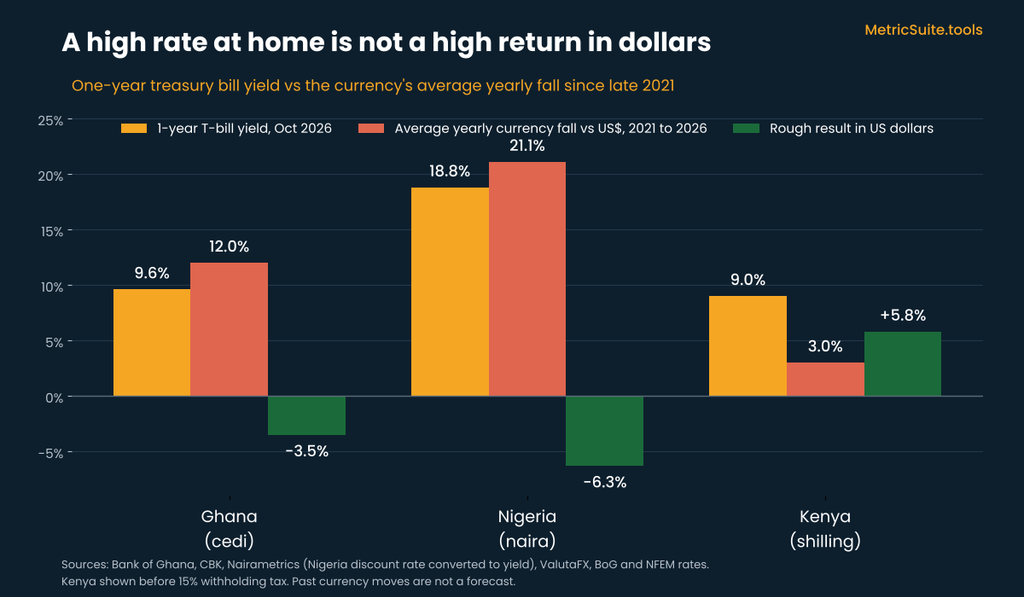
The past five years include two of the worst currency crises in Ghana and Nigeria in a generation, and they may not repeat. But they show why the currency deserves as much attention as the headline return. Check the Cedi Depreciation Buffer Calculator if you are planning in cedis, and use a conservative currency figure in the Remittance Savings Calculator.
The six options at a glance
| Option | What it earns | Currency risk | Control from abroad | Getting money out |
|---|---|---|---|---|
| Government bills and bonds at home | Fixed interest in local currency | High where the currency is weak | High if the account is in your name | Weeks to a year |
| Land | Rising value only, no income | High | Low unless titled and registered in your name | Slow, can take months |
| A house to live in or rent | Rent, or rent you no longer pay later | High | Low to medium, depends on the builder | Slow |
| A small business | Profit, if it works | High | Lowest of the six | Slow, and often only at a loss |
| A farm or livestock | Profit from harvests or sales | High | Low | Seasonal |
| Savings or investments where you live | Interest or market returns in your own currency | None | Full | Days |
1. Government bills and bonds at home
Treasury bills are the simplest way to earn interest at home without a manager, a builder or a relative in the middle. You lend to the government for 91, 182 or 364 days and get the full amount back at maturity.
What they pay right now (late October 2026 auctions):
- Ghana: about 4.6% for 91 days, 6.3% for 182 days and 9.6% for 364 days, at the 30 October tender.
- Kenya: about 8.75% for 91 days, 8.85% for 182 days and 9.03% for 364 days, at the 29 October auction, before a 15% withholding tax.
- Nigeria: the 364-day stop rate was 15.85% on 7 October. That is a discount rate, so the yield on the money you put in is higher, about 18.8% a year.
Diaspora access differs by country. Kenya’s Central Bank built its DhowCSD platform partly so Kenyans abroad can open an account and bid online, with a minimum of KSh100,000 for treasury bills. In other countries you may need a local bank account, a resident address or a licensed broker or fund manager. Confirm the rules for non-residents before you send money for this.
The catch is the currency. Run Ghana’s 9.6% one-year rate against the cedi’s 12% average yearly fall since 2021 and the result is a loss of a few percent a year in dollar terms. Do the same for Nigeria and the loss is larger. Kenya’s lower rate holds up better because the shilling has been steadier. If the next five years are calmer than the last five, the picture improves. Nobody can promise that.
Bills and bonds are not the same risk. When Ghana restructured its domestic debt in December 2022, the Finance Ministry exempted treasury bills and paid them in full at maturity. Domestic bonds were exchanged for new ones that paid no coupon in 2023. Short bills can be the safer end of a government’s debt.
Best for: money you want working at home for one to three years, a fund for a planned build or purchase, or interest to cover part of your family’s monthly support.
2. Land
Land is the most common diaspora purchase and the one most often lost. It pays no income, so your entire return depends on the plot rising in value faster than the currency falls. That can happen in fast-growing areas, but it has to happen to make the purchase pay.
The bigger risk is the title. Plots are sold twice, sold by someone with no right to sell, or bought without registration. The protections are the same everywhere:
- Search the title at the land registry yourself or through a lawyer you pay, not one the seller recommends.
- Register the land in your own name and keep the registered documents yourself.
- Pay through a traceable channel, never cash through a relative.
- Visit, or send someone independent, before the final payment.
Our diaspora repatriation tax and land guide covers buying land back home in more depth.
Best for: people who plan to build or retire on the plot within a few years and can verify the title properly.
3. A house to live in or rent
A house combines land with the hardest thing to manage from abroad: a building project. Its return is rent, or the rent you will not pay when you move back. Rent is paid in local currency, so the same currency test applies.
Most build losses come from the process, not the price: paying ahead of progress, trusting photos instead of inspections, and letting a relative run the money. Pay in stages tied to finished work, and have someone independent check each stage.
→ Use the free Ghana House Build Cost Calculator at MetricSuite to check a contractor’s quote, no signup required. Then read How to Build a House in Ghana From Abroad for the eight steps that protect your money.
Track every payment to your builder. The Build From Abroad Control Workbook logs each stage, payment and inspection in Excel or Google Sheets, so you can see what you have paid for and what has actually been built.
Best for: people who will live in the house, or who have a reliable way to manage tenants and maintenance.
4. A small business
A business can earn more than any other option on this list, and it can also lose everything. It is the hardest to see from abroad, because sales, stock and cash all move without you.
If this is your choice, treat it as a test, not an investment: only use money you can afford to lose, stage it, prefer businesses with repeat customers and digital payments, and keep business money separate from family support. Our guide to starting a business back home covers the controls in detail.
Best for: people with a specific idea, a trusted manager on a salary, and a budget they can lose.
5. A farm or livestock
Farms are popular because land, labour and buyers are close to home. They are also seasonal, exposed to weather and prices, and hard to verify. “The harvest was good” is not a number.
Before you fund a farm, get the acreage, seed, fertiliser, labour, transport, expected yield and selling price in writing, then check them yourself.
→ Use the free Crop Profit Calculator or the Livestock Profitability Calculator to model profit and break-even before you send money.
Best for: people with farming knowledge, or a relative already farming who reports real numbers.
6. Savings or investments where you live
This option builds nothing at home, and it is often the one people dismiss. It deserves a fair look. Money that stays where you earn it pays no transfer fee, no exchange rate margin and no cash-out fee, and carries no currency risk. You can reach it in days if your family has an emergency.
In the Remittance Savings Calculator, choose “Savings or investments where I live” and enter a realistic return. You may find that a modest return in your own currency matches a much higher one at home. Use the Compound Interest Calculator to test monthly deposits on their own.
Best for: an emergency fund for your family, money you may need within a year, or anyone not ready to manage an asset at home.
A worked example
Say you send US$500 a month, rising 3% a year, and redirect 20% of it (US$100 a month to start). You send through a digital service at the World Bank’s 4.59% average cost. Over 10 years you set aside about US$13,800.
We modelled three choices using the same method as the Remittance Savings Calculator:
| Where the 20% goes | Value after 10 years | Value after 20 years |
|---|---|---|
| House fund in Ghana, 10% local return, cedi falls 5% a year | about US$16,300 | about US$47,200 |
| Same house fund, cedi falls 12% a year (its 2021 to 2026 average) | about US$11,300 | about US$23,400 |
| Savings where you live at 4% a year, no transfer cost | about US$16,700 | about US$47,000 |
Three things stand out. A 10% return at home and a 4% return where you live can end up in the same place once currency and transfer costs are counted. If the cedi keeps falling at its recent pace, the house fund is worth less in dollars than the money you put in. And the house fund only wins if the currency is kinder than it has been.
None of that makes building at home a bad choice. A house you will live in is worth more to you than its dollar value. It means the decision should be made with the currency in view, not hidden behind a big local return.
Five rules that protect the money
- Put every asset in your own name. Land titles, treasury bill accounts, business registration and bank accounts.
- Pay suppliers directly. Pay the builder, the landowner or the broker, not a relative who passes the money on.
- Keep support and investment separate. Agree a fixed support figure first with the Black Tax Calculator, and send the investment share to a different account. Our guide to family financial support covers how to have that conversation.
- Stage the money. Release each payment after you see proof of the last one.
- Cut the transfer cost first. It is the one return you can lock in today. Compare providers with the Africa Remittance Comparison or the Caribbean Remittance Comparator.
Match the option to your plan
- Moving back within five years: land or a house you will live in, with savings where you live as the emergency fund.
- Staying abroad, want income for your parents: treasury bills at home in a country with a steadier currency, or savings where you live paid out monthly.
- Want to build a business: a small staged test with money you can lose, and nothing more until the numbers support it.
- Not sure yet: savings where you live, while you research. Waiting costs less than a bad plot.
Every diaspora tool is on the Diaspora Tools hub. Caribbean readers can also read Caribbean Diaspora Investing 2026.
This is general information, not financial, legal or investment advice. Rates, exchange rates and rules change. Confirm current figures with the official source and get qualified advice before you commit money.
Key Takeaways
- About a quarter of remittances can be saved or invested, according to IFAD. The question is where.
- Measure every option in the currency you earn: return at home minus the currency’s fall.
- Since late 2021 the cedi has fallen about 12% a year on average and the naira about 21%, more than their one-year treasury bill rates today.
- Treasury bills are the easiest option to control from abroad. Land and businesses are the hardest.
- Savings where you live pay no transfer cost and carry no currency risk, and can match a higher return at home.
- Whatever you choose, put it in your name, pay suppliers directly and keep it separate from family support.
FAQ
What is the best way to invest remittances?
There is no single best option. Compare each one on its return in the currency you earn, how much control you keep from abroad, and how fast you can get the money out. Treasury bills are easy to control, land and houses suit people moving back, and savings where you live avoid transfer costs and currency risk.
Can I buy treasury bills from abroad?
In some countries, yes. Kenyans abroad can open a Central Bank of Kenya DhowCSD account and bid online, with a minimum of KSh100,000 for treasury bills. Other countries may require a local bank account, a resident address or a licensed broker. Check the rules for non-residents first.
Why does currency matter if the return at home is high?
Because you measure your wealth in the currency you earn. If the local currency falls faster than the investment grows, you end up with less in dollars, pounds or Canadian dollars than you put in. Since late 2021 the cedi has fallen about 12% a year on average against the US dollar.
Is buying land back home a good investment?
It can be, if the title is clean, the land is registered in your name and the area is growing. Land pays no income, so the return depends entirely on its value rising faster than the currency falls. Title fraud is the biggest risk, so search and register the title yourself.
How much of what I send should I invest?
Start with a support figure your family can rely on, then invest only what is left over. The Remittance Savings Calculator lets you test different shares, such as 10% or 20%, and shows the first-month difference your family will see.
Should I keep savings abroad instead?
For an emergency fund or money you may need within a year, yes. Savings where you live pay no transfer fee or exchange rate margin and carry no currency risk. Over 10 or 20 years, a modest return where you live can match a much higher return at home.
SOURCES
- IFAD figures via UN: about 75% of remittances cover essentials, about 25% can be saved or invested (over US$100 billion a year): https://www.un.org/fr/node/94601
- Vanguard, Nigeria’s remittances at US$21.8 billion in 2025 (CBN data): https://www.vanguardngr.com/2026/05/diaspora-remittances-stabilises-at-21-8bn-in-2025-amid-global-pressures/
- World Bank, Remittance Prices Worldwide, Issue 54 (Q3 2025): https://remittanceprices.worldbank.org/sites/default/files/2026-04/RPW_main_report_and_annex_Q325.pdf
- Bank of Ghana, Tender 2031 results, 30 October 2026: https://www.bog.gov.gh/wp-content/uploads/2026/10/Auctresults-2031.pdf
- Business Radar, Kenya T-bill rates at the 29 October 2026 CBK auction: https://businessradar.co.ke/t-bill-rates-this-week-october-29-2026/
- Business Radar, Kenya treasury bills vs bonds (15% withholding tax on bills): https://businessradar.co.ke/?p=10735
- Serrari Group, how diaspora Kenyans invest through DhowCSD: https://serrarigroup.com/guides/wealth-builder/diaspora-kenyans-investing-in-treasury-bonds-from-abroad
- Nash Thuo, minimum KSh100,000 for Kenyan treasury bills: https://nashthuo.com/how-to-buy-treasury-bills-in-kenya/
- Nairametrics, Nigeria 364-day stop rate 15.85% (7 October 2026): https://nairametrics.com/2026/10/07/dmo-raises-n968-47-billion-as-364-day-stop-rate-falls-to-15-85-despite-strong-demand/
- Ghana Ministry of Finance, Domestic Debt Exchange launch statement (T-bills exempted): https://www.mofep.gov.gh/sites/default/files/basic-page/Domestic-Debt-Exchange-Launch.pdf
- Adom Online, BoG interbank rate GH¢11.63 (2 November 2026): https://www.adomonline.com/bog-governor-assures-ghanaians-of-cedi-stability-ahead-of-christmas/
- MyJoyOnline, cedi appreciation in 11 months of 2025: https://www.myjoyonline.com/cedi-records-32-appreciation-against-dollar-in-11-months-of-2025-bog/
- MyJoyOnline, cedi depreciation in nine months of 2026: https://www.myjoyonline.com/cedi-depreciates-by-9-5-in-nine-months-of-2026-bog/
- Within Nigeria, NFEM rate ₦1,346.93 (4 November 2026): https://www.withinnigeria.com/2026/11/04/dollar-to-naira-today-nov-4-2026-nfem-rate-%E2%82%A61346-black-market-%E2%82%A61390/?amp=1
- Serrari Group, USD/KES 129.92 (November 2026): https://serrarigroup.com/news
- Exchange-rates.org, USD/JMD 158.72 (15 October 2026): https://www.exchange-rates.org/converter/jmd-usd
- ValutaFX, USD/GHS 6.14 (December 2021): https://www.valutafx.com/history/usd-ghs-2021-12-07
- ValutaFX, USD/NGN 410.93 (18 November 2021): https://www.valutafx.com/history/usd-ngn-2021-11-18
- ValutaFX, USD/KES 111.63 (8 November 2021): https://www.valutafx.com/history/usd-kes-2021-11-08
- ValutaFX, USD/JMD 155.25 (8 November 2021): https://valutafx.com/history/usd-jmd-2021-11-08