
I grew up in Kingston and I still price this trip every year, for myself and for family asking what a week will really cost them.
How much does a trip to Jamaica cost once everything lands? Not the headline rate, the real number: the airfare, the room, the service charge the hotel adds and keeps, the General Consumption Tax on top of that, a room tax charged per night at check-out, the car from the airport, and the tips.
On our numbers, a week for two people runs from about US$3,220 on a guesthouse budget to about US$6,290 at an all-inclusive, with the flights included in both. The gap is almost entirely accommodation and the taxes that ride on it.
2027 is also a bad year to guess. Jamaica’s tourism taxes change on 1 April, and the island is still trading its way back from Hurricane Melissa with fewer hotel rooms and fewer airline seats than it had two years ago. Both of those move your number.
So how much does a trip to Jamaica cost: the short answer
Seven nights, two travellers, return airfare from the US east coast, before 1 April 2027:
| Stay type | Total for two | Per person | Per person, per day |
|---|---|---|---|
| Guesthouse or Airbnb | about US$3,220 | US$1,610 | US$230 |
| All-inclusive resort | about US$6,290 | US$3,145 | US$449 |
| Villa, two people | about US$6,600 | US$3,300 | US$471 |
Those are complete trips, not room rates. They include flights, transfers, food, one or two excursions, tips, insurance and something for shopping. Change any of it in the Jamaica Trip Budget Calculator and the total moves with you.
Why 2027 is not a normal year to price Jamaica
Hurricane Melissa took a large share of the island’s hotel rooms out of service, and the recovery has been real but uneven. By May 2026 around three quarters of hotel rooms had reopened and roughly 89% of attractions were operating. Industry projections put room inventory near 90% for the winter season, though some properties are still under reconstruction into 2027, and a cluster of large all-inclusives in the Montego Bay and Rose Hall area has had its reopening pushed into the first quarter.
Demand came back faster than supply. Preliminary figures through October 2026 show more than 1.8 million stopover visitors and more than 900,000 cruise passengers, pushing combined arrivals close to three million, with foreign exchange earnings around US$2.9 billion. Airline capacity has stayed below pre-Melissa levels while the flights that do operate run full.
Fewer rooms, fewer seats, and arrivals climbing back is the textbook setup for firm prices. Treat any rate you remember from 2024 as out of date, and book the flight earlier than you normally would.
Two practical consequences. Confirm your specific property is open before you budget around its rate, because “the resort is reopening” and “the resort is open” are different things. And if you are flexible on region, the north coast around Ocho Rios and the Kingston side came through the storm in better shape than the far west.
The taxes that are not in the advertised rate
Three charges sit on a Jamaican accommodation bill, and only one of them is a tip.
General Consumption Tax at 10%. Licensed tourism operators charge GCT at a reduced 10%, against the 15% standard rate the rest of the economy pays. Hotels, villas, tours and attractions all sit in that reduced band.
A service charge, usually 10%. This is not a tax and it is not a gratuity. The property adds it and the property keeps it, and GCT is then calculated on top of it. On a US$3,500 room bill that is US$350 of service charge and US$385 of GCT, so US$735 before anyone has carried a bag.
Guest Accommodation Room Tax. A flat US dollar charge on every occupied room for every night, banded by how many rooms the property has registered with the Jamaica Tourist Board: US$1 per room per night up to 50 rooms, US$2 from 51 to 100, and US$4 at 101 rooms and above. A family in two rooms at a big resort for a fortnight pays US$112 in room tax alone.
On top of that, every air arrival pays the US$20 Tourism Enhancement Fee. On a scheduled airline it is collected inside the ticket price, so most travellers never see it as a line item. Cruise passengers pay US$2.
1 April 2027 changes the maths
Two changes land on the same date, and both of them cost you money.
The reduced 10% GCT rate on tourism ends and moves to the standard 15%. The government deferred the increase by roughly thirteen months precisely because hotels take bookings so far ahead, which tells you how far in advance this is worth thinking about.
Short-term rentals come into GCT for the first time on that same date. Airbnb-style stays sat outside the GCT net entirely. From 1 April 2027 they are inside it.
So the people most affected are not only the ones at the big resorts. They are the ones who thought a private rental sidestepped the hotel taxes. On our guesthouse example the change adds around US$104 to a week for two. At the all-inclusive it adds around US$193. Those are not trip-ending numbers, but they are real, they are certain, and they are avoidable if your dates are flexible.
If you are choosing between late March and late April 2027, run both in the calculator and see what the date is worth before you decide.
Flights
Flights are the single biggest line on a budget trip and the most volatile. From the US east coast, budget around US$450 per person return as a starting point and expect to pay more at Christmas, over Easter and through the mid-December to mid-April high season. From the US midwest or west coast, start nearer US$520. From Canada, start around US$500. From the UK and Europe, start around US$750.
Those are planning figures, not quotes. With airlift still below pre-Melissa levels, get a real fare before you commit to the rest of the budget, and price Montego Bay and Kingston separately. Montego Bay serves the resort strip and usually wins on fare and on transfer time. Kingston makes sense if you are visiting family, doing business, or heading for Portland and the east.
All-inclusive, villa or guesthouse
All-inclusive is the easiest trip to budget and the hardest to compare. The rate is quoted per person per night, food and drink are in it, and your daily spend stops moving once you arrive. It suits a first trip, a honeymoon, and any group that would otherwise spend the week negotiating about dinner. The catch is that the price scales with every head you add.
A villa is quoted for the whole property per night, so it gets cheaper per person as the group grows. For two people it is usually the most expensive option on this list. For six it flips: on our numbers a week in a US$900 per night villa (six people, same flights, food and tips budgeted separately) works out around US$2,553 per person, against about US$3,110 per person for the same six people at an all-inclusive. The crossover sits somewhere around five or six travellers, and it moves depending on how much you drink.
A guesthouse or Airbnb is the cheapest accommodation line and the most expensive everything else, because every meal, taxi and excursion is now a separate purchase. It is the right answer for a longer stay, for anyone with family on the island, and for a scouting trip where you want to see how the place actually works rather than how the resort works. Remember that from April 2027 this option carries GCT too.
Getting around
The airport transfer is where budgets quietly leak. A private car from Montego Bay to Negril takes about an hour and fifty minutes and is priced per vehicle rather than per head, so it gets better value the more of you there are. A shared shuttle costs meaningfully less and takes two to three times as long, because it stops at other hotels first.
For moving between parishes, Knutsford Express runs scheduled coaches between the main towns and is the cheapest comfortable option if your luggage is reasonable. Route taxis are what Jamaicans actually use and they are cheaper again, but they run fixed routes and fill up, so understand how they work before you depend on them with a suitcase and a flight to catch.
If you are staying put at a resort, budget the return transfer and nothing else. If you are staying in a guesthouse and plan to move around, budget something every day: our guesthouse example carries US$25 a day for the party and it is still the second largest line after flights.
Food, drink and tips
Outside an all-inclusive, budget around US$45 per person per day for food and drink. That buys a mix of cook shops, patties and one proper restaurant meal, with the tourist strips sitting above it and local spots well below. Inside an all-inclusive, the same line drops to something small for meals off the resort.
Restaurant bills carry 15% GCT and usually a 10% service charge, so the menu price is not the bill. Check whether the service charge is already on before you add a tip to it.
Tipping policy varies by chain and some all-inclusives include gratuities in the rate, so read the booking. Where tips are expected, a set amount per person per day is easier to plan than a percentage, because you are not paying for meals one at a time. At a villa, staff gratuities are usually separate and often suggested as a percentage of the rental.
Where the money actually goes
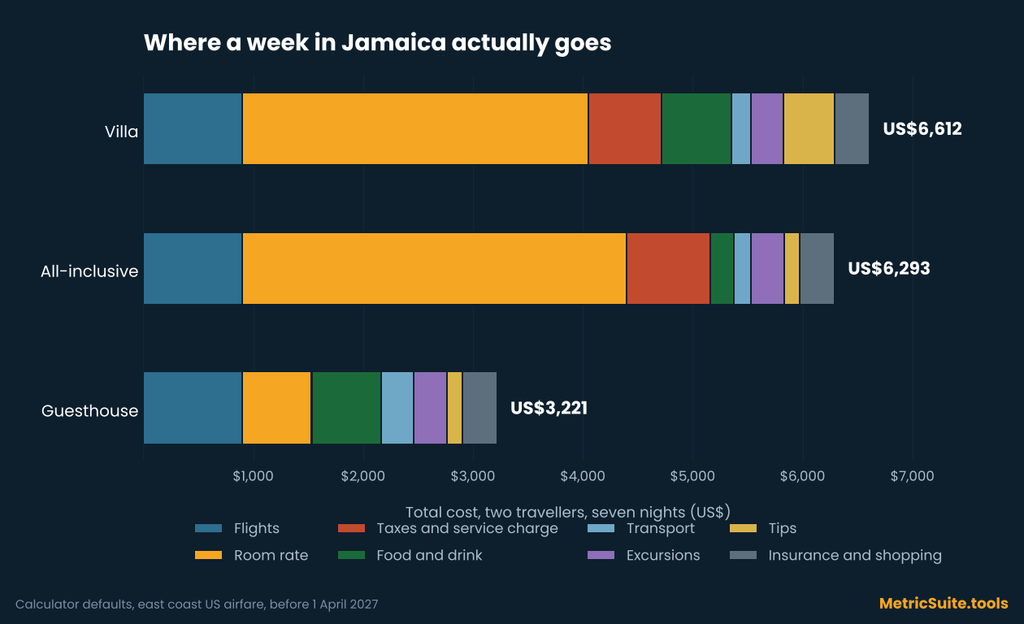
The breakdown matters more than the total, because it tells you which lever is worth pulling.
At an all-inclusive, accommodation and its taxes are about two thirds of the trip, so the only meaningful saving is the room rate or the season. At a guesthouse, flights are the biggest single line and accommodation is almost a rounding error, so the lever is the fare, not the bed.
Five ways to cut the cost without cutting the trip
- Move your dates out of high season. Mid-December to mid-April is peak. The same room in May or September is a different price.
- Travel before 1 April 2027 if you can. The GCT change is worth US$100 to US$200 on a week for two, and more on a longer stay or a bigger group.
- Size the group to the stay type. Two people at a villa is an expensive way to book. Six people at an all-inclusive is too.
- Take the coach, not the car. The Montego Bay to Negril transfer is one of the easiest lines to halve.
- Carry Jamaican dollars for everything off the resort. The rate at a hotel front desk is not the rate the Bank of Jamaica publishes. Check it with the Currency Converter before you change money.
Run your own numbers
Everything above is an average, and nobody takes an average holiday. The Jamaica Trip Budget Calculator takes your travellers, nights, stay type and rate, applies the right GCT rate and the correct room tax band, converts the total at the live USD to JMD rate, and has a toggle that shows you what the 1 April 2027 change does to your own trip.
If you want to hold the budget after you have built it, the Travel Money Command Center is the workbook that tracks it across currencies, with a daily burn rate and a runway against what you actually spend.
And if the trip is really a scouting trip, the rest of the toolkit is here: the Jamaica Import Duty Calculator for shipping your things, the Returning Resident Eligibility Checker for the concessions, the Caribbean Remittance Comparator for sending money ahead, and the Blaxit money plan if the visit is the first step in a move.
FAQ
How much does a trip to Jamaica cost for a week?
For two people over seven nights, including return airfare from the US east coast, transfers, food, excursions, tips and insurance, budget roughly US$3,220 on a guesthouse trip and roughly US$6,290 at an all-inclusive. That is about US$230 and US$450 per person per day. A villa for two sits slightly above the all-inclusive, but becomes the cheapest option per head once the group reaches about six.
What taxes do tourists pay in Jamaica?
General Consumption Tax at the reduced tourism rate of 10%, a service charge of usually 10% that the property adds and keeps, and the Guest Accommodation Room Tax of US$1, US$2 or US$4 per occupied room per night depending on the size of the property. Air arrivals also pay the US$20 Tourism Enhancement Fee, which is normally collected inside the ticket price.
Is GCT going up in Jamaica in 2027?
Yes. The reduced 10% GCT rate on tourism activities rises to the standard 15% rate on 1 April 2027. Short-term rentals, including Airbnb-style stays that were previously outside GCT entirely, also come into the tax on that date. On a week for two, the change is worth roughly US$100 to US$200 depending on where you stay.
Is Jamaica fully open after Hurricane Melissa?
Mostly, but not everywhere. Around three quarters of hotel rooms had reopened by May 2026 and roughly 89% of attractions were operating, with room inventory projected near 90% for the winter season. Several large all-inclusives in the Montego Bay and Rose Hall area have had their reopening pushed into the first quarter of 2027. Confirm your specific property is open before you book around it.
Is an all-inclusive cheaper than a villa in Jamaica?
It depends on the size of your group. An all-inclusive is priced per person, so the cost rises with every traveller. A villa is priced for the property, so the cost per head falls as the group grows. The crossover sits around five or six people, after which the villa wins even once you add food, drink and a driver.
Do I need to tip at an all-inclusive in Jamaica?
Policies vary and some resorts include gratuities in the rate, so check your booking first. Where tips are expected, budgeting a set amount per person per day is simpler than working in percentages. Note that the 10% service charge on your bill is not a tip: the property keeps it.
Should I take US dollars or Jamaican dollars to Jamaica?
Both. Resorts, tours and most tourist-facing businesses price in US dollars and will take them. Off the resort, in cook shops, route taxis and markets, you want Jamaican dollars, and you will get a better rate from a cambio than from a hotel front desk.
Sources
- Caribbean Journal, Jamaica tourism recovery, 2.34 million visitors and room inventory, 4 September 2026: https://www.caribjournal.com/2026/09/04/jamaica-tourism-climbing-back/
- Travel And Tour World, Jamaica arrivals near three million and winter outlook, 5 November 2026: https://www.travelandtourworld.com/news/article/qdxaxnz5fooy/
- Tax Administration Jamaica, Guest Accommodation Room Tax: https://www.jamaicatax.gov.jm/guest-accommodation-room-tax1
- PwC Worldwide Tax Summaries, Jamaica, Other taxes (GCT 15% standard, 10% tourism rate, rising to 15% on 1 April 2027): https://taxsummaries.pwc.com/jamaica/corporate/other-taxes
- EY Jamaica, Revenue Measures 2026/2027 summary, deferred tourism GCT increase: https://www.ey.com/content/dam/ey-unified-site/ey-com/en-jm/documents/ey-jm-revenue-measures-2026-2027-summary-20260213.pdf
- Jamaica Gleaner, Airbnb and short-term rentals face GCT from April 2027: https://jamaica-gleaner.com/article/news/20260430/airbnb-and-short-term-rentals-face-gct-april-2027
- Ministry of Tourism Jamaica, Tourism Enhancement Fee: https://www.mot.gov.jm/node/272
- Knutsford Express: https://knutsfordexpress.com/