
Street Food Businesses You Can Start in West Africa
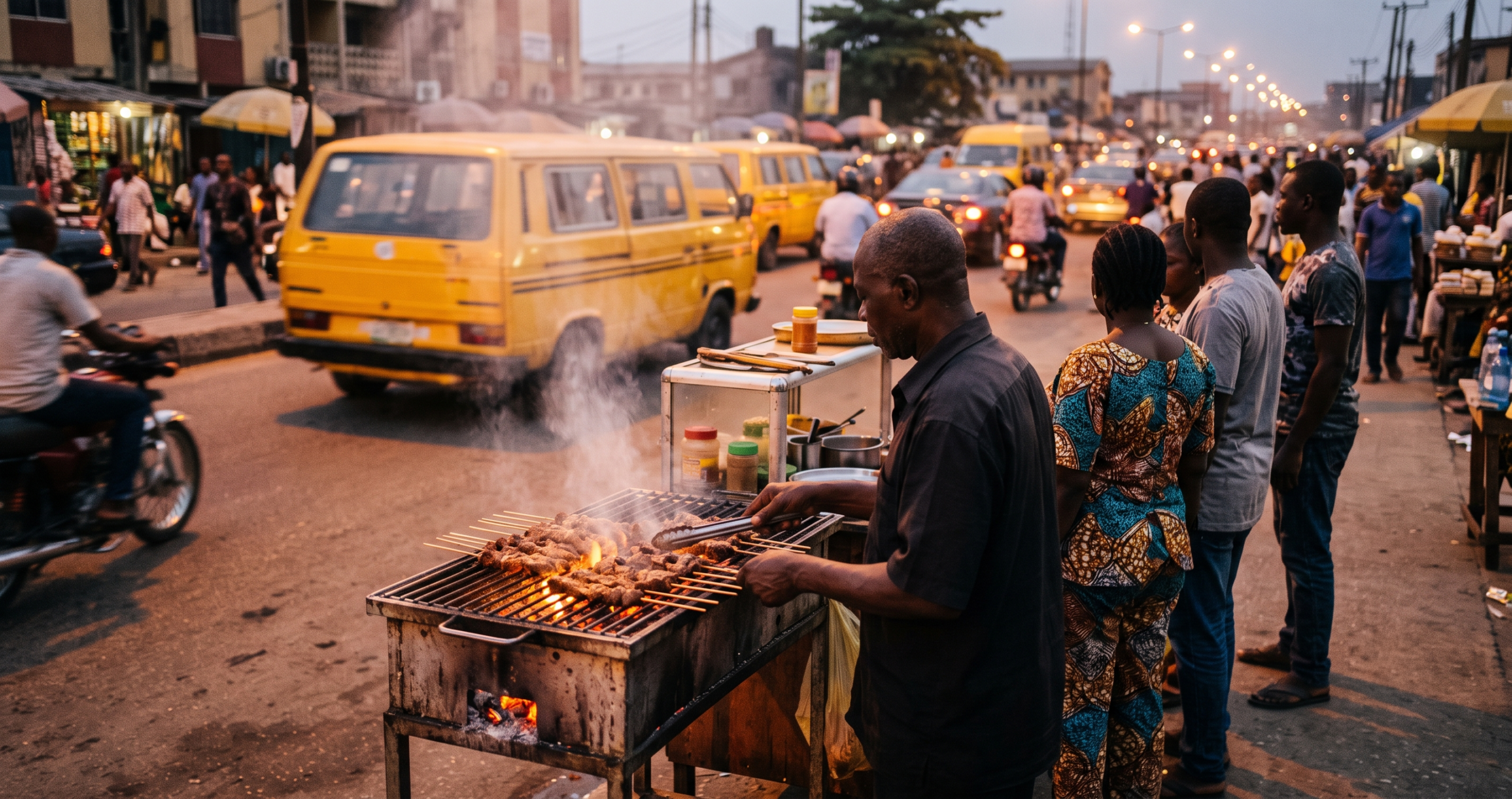
By 7 PM on any given weekday, the junctions across Lagos mainland are cloaked in the distinct, spicy smoke of the suya spot. A vendor stands over a long metal grill, rotating skewered beef over hot coals and dusting it with yaji (suya spice) for customers spending anywhere from NGN 1,000 to NGN 5,000 a ticket. A few hundred miles west in Accra, the evening rush surrounds the kelewele vendor deep-frying spiced plantains. Further along the coast in Abidjan, afternoon crowds gather for garba, fried tuna and cassava flakes served fast, cheap, and in high volumes.
This is the engine of the West African economy. The informal sector accounts for over 80% of employment in countries like Nigeria and Ghana. With massive youth populations entering the labor market annually, formal job creation simply cannot keep pace. Street food remains one of the most viable entry points into entrepreneurship because it relies on daily cash flow, requires low initial capital, and scales based on operational execution rather than expensive marketing.
This guide breaks down five street food businesses that work across Nigeria, Ghana, Ivory Coast, Senegal, Benin, and Togo. It includes real unit prices, startup costs converted between USD, NGN, GHS, and XOF, and a realistic 60 to 90-day revenue scenario. Success here requires strict supply chain discipline, securing ingredients at wholesale rather than retail prices, and standardizing your portions to protect margins.
Need a Freelancer for This?
Hire verified talent on Fiverr — starting from $5. No contracts, no hassle.
Browse Fiverr Freelancers →Before launching, determine exactly how many units you must sell daily to cover your baseline costs.
→ Use the free Street Vendor Profit Calculator at MetricSuite.tools to calculate this instantly, no signup required.
(Currency conversions below use projected 2026 averages: 1 USD ≈ NGN 1,500, GHS 14, and XOF 600.)
1. Suya / Chichinga Grill (Nigeria, Ghana, Togo)
Known as suya in Nigeria and chichinga in Ghana, this skewered, spiced, and grilled meat is the undisputed king of West African evening street food. It thrives on high foot traffic and proximity to nightlife or transport hubs. While beef is standard, chicken and goat variations allow for price tiering.
- Startup cost: Around $80 to $100 (NGN 120,000 to 150,000 / GHS 1,120 to 1,400 / XOF 48,000 to 60,000). This covers a custom-welded metal grill, charcoal, long skewers, a first batch of meat from the abattoir, onions, and bulk spices.
- 60 to 90 day scenario: Selling 70 sticks a day at an average of $1.00 each brings in roughly $70 daily. Meat is an expensive input, keeping margins around 35% to 40%. This yields about $25 to $28 in daily profit, or roughly $1,800 over 75 selling days.
- First steps:
- Secure a direct line to an abattoir or major butcher. Buying meat at retail market prices will destroy your margin.
- Perfect your spice blend. The yaji rub is the primary differentiator between a struggling vendor and one with a permanent queue.
- Set up operations strictly for the evening; daylight sales for this product are historically poor.
2. Kelewele / Alloco / Dodo Stand (Ghana, Ivory Coast, Nigeria, Benin)
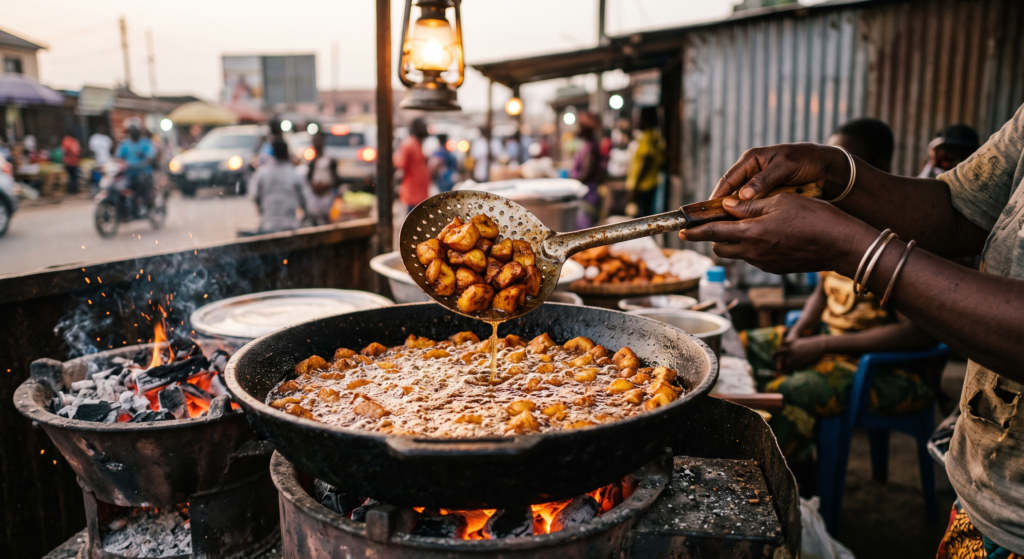
Fried plantain is ubiquitous across the region. In Ghana, it is diced and heavily spiced with ginger and chili (kelewele). In Ivory Coast and Francophone regions, it is served in larger chunks (alloco). In Nigeria, it is known as dodo. It is cheap to produce, fast to cook, and serves as both a primary snack and a side dish.
- Startup cost: About $45 (GHS 630 / XOF 27,000 / NGN 67,500). Requirements include a large deep frying pan, a slotted spoon, a charcoal stove or gas cylinder, cooking oil, spices, and a bulk purchase of plantains.
- 60 to 90 day scenario: At 50 portions sold daily averaging $0.80, revenue hits $40 a day. Cooking oil is the biggest margin leak, but with proper temperature control, margins sit at 45%. This nets about $18 a day, or $1,350 over 75 days.
- First steps:
- Source plantains directly from farm-gate suppliers or wholesale market trucks, not secondary resellers.
- Manage your cooking oil efficiently. Reusing oil too many times ruins the flavor, but changing it too often kills profitability.
- Pair the plantain with roasted peanuts or a small serving of grilled fish to increase the average ticket size.
3. Attiéké and Poisson Braisé (Ivory Coast, Senegal, Togo, Benin)
Attiéké (fermented cassava couscous) served with poisson braisé (charcoal-grilled fish) is a staple of Francophone West Africa, particularly in Abidjan and Dakar. It demands a slightly higher price point than basic snacks and serves as a heavy lunch or dinner, making it highly lucrative for vendors who can maintain food safety and consistent flavor.
- Startup cost: Around $110 (XOF 66,000 / NGN 165,000 / GHS 1,540). You need a grill for the fish, a steamer for the attiéké, fresh vegetables for the side salad, and bulk sourcing of fish (usually tilapia or mackerel).
- 60 to 90 day scenario: Selling 35 plates a day at an average of $2.50 generates about $87.50 daily. With a 35% margin (fish inputs are volatile), expect around $30 a day in profit, or $2,250 over 75 days.
- First steps:
- Establish a relationship with a cold-room wholesaler for frozen fish or a direct fisherman for fresh catch.
- Maintain strict hygiene. Because this is a full meal involving seafood and fresh vegetables, customer trust is your primary currency.
- Standardize the fish sizes to ensure uniform pricing and predictable daily costs.
4. Puff-Puff / Bofrot / Beignets Cart (Nigeria, Ghana, Senegal, Benin)
Deep-fried sweet dough is the ultimate volume play. Known as puff-puff in Nigeria, bofrot in Ghana, and beignets in Francophone countries, this is an entry-level street food with incredibly cheap raw materials (flour, yeast, sugar, water).
- Startup cost: Under $30 (NGN 45,000 / GHS 420 / XOF 18,000). The capital goes entirely toward a deep pot, a heat source, bulk flour, sugar, yeast, and frying oil.
- 60 to 90 day scenario: The unit price is exceptionally low (often $0.10 to $0.20 per piece), meaning you must sell in bulk. Selling 300 pieces a day brings in roughly $45. Flour and sugar are cheap, pushing margins to 50% or higher. Expect about $22 daily profit, or $1,650 over 75 days.
- First steps:
- Master the dough consistency and portioning. Hand-dropping the dough into oil must yield uniformly sized balls; oversized portions eat directly into your profits.
- Target the morning commuter rush or school dismissal times for maximum volume.
- Protect the raw ingredients from moisture and pests to prevent inventory loss.
5. The Combo Kiosk: Food & Local Drinks (Zobo / Bissap)
Scaling a street food business means increasing the average spend per customer. Once a primary food line (like Suya or Kelewele) is operational, adding chilled, locally brewed beverages like Zobo (Nigeria) or Bissap (Francophone West Africa/Ghana)—a spiced hibiscus tea—is the most logical expansion.
- Startup cost: $150 to $200 (NGN 225,000 to 300,000 / GHS 2,100 to 2,800 / XOF 90,000 to 120,000). This funds a structured kiosk, a cooler box with ice, raw hibiscus leaves, sugar, flavorings, and bulk plastic bottles, alongside your food setup.
- 60 to 90 day scenario: Bottling your own Zobo or Bissap yields massive margins (often 70%+) compared to reselling commercial sodas. If 40% of your 70 daily food customers add a $0.50 drink, that adds $14 in daily revenue with almost $10 in pure profit, pushing total kiosk profitability well past $1,000 a month.
- First steps:
- Invest in a heavy-duty cooler and reliable daily ice supply. Warm drinks will not sell.
- Standardize your beverage recipe. The ginger-to-sugar ratio must be consistent every single day.
- If accepting mobile money for transactions, compare provider fees. Frequent small payments incur hidden costs that bleed margins. → Use the free Mobile Money Fees Comparison tool at MetricSuite.tools to calculate this instantly, no signup required.
Conclusion
The difference between a failing street vendor and a highly profitable one is execution, not the product itself. Pick a concept that aligns with your capital and local supply chain. A puff-puff cart requires under $30 to start, while a high-volume combo kiosk demands upwards of $150. Both are scalable if you control your portion sizes and source ingredients at wholesale. Run your baseline numbers using the Street Vendor Profit Calculator, lock down a high-traffic location, and focus entirely on product consistency for the first 30 days.
Key Takeaways
- The informal sector is the backbone of West Africa’s employment; street food is a tested, high-turnover entry point, not a gamble.
- Dough-based snacks (Puff-Puff/Bofrot) offer the lowest barrier to entry (under $30) but require moving hundreds of units daily to generate meaningful cash flow.
- Meat and seafood operations (Suya, Poisson Braisé) require higher capital and strict supply-chain management to protect tighter margins.
- In-house beverage production (Zobo/Bissap) offers the highest profit margins and is the fastest way to scale the average ticket size of an existing stall.
- Calculate daily break-even unit requirements before purchasing equipment or inventory.
How much capital do I need to start a street food business in West Africa?
You can start a basic dough-based stall (Puff-puff/Bofrot) for under $30. Meat or fish-based setups like Suya or Attiéké require $80 to $110. A multi-product combo kiosk with coolers will require $150 to $200.
What is the biggest operational risk in West African street vending?
Input inflation and supply chain volatility. Fluctuating costs of cooking oil, wheat flour, and wholesale meat can wipe out margins overnight. Successful vendors standardize portions and buy inputs at farm-gate or wholesale prices.
Do I need a license to sell street food in Lagos, Accra, or Abidjan?
Yes, most municipal governments and local market unions require permits, daily ticketing, or health certificates. Requirements vary wildly by neighborhood (e.g., local government levies in Lagos). Verify the daily and monthly union fees for your specific corner before setting up.
How can I accept payments efficiently?
While cash remains king, mobile money (like MTN Mobile Money in Ghana/Ivory Coast or OPay/Palmpay in Nigeria) is essential. Ensure you account for transfer and withdrawal fees when calculating your daily net profits.
REFERENCES
- Reuters, “Informal economy remains lifeblood of West Africa’s job market” (2026).
- World Bank, “Youth Employment and the Informal Sector in Sub-Saharan Africa”: https://www.worldbank.org/en/region/afr/publication/youth-employment-in-sub-saharan-africa
- Business Day Nigeria, “The Economics of the Suya Business in Lagos”: https://businessday.ng/
- Graphic Online Ghana, “Street food vending: A lucrative business for the youth”: https://www.graphic.com.gh/
- Jeune Afrique, “L’économie du Garba à Abidjan”: https://www.jeuneafrique.com/
- Nairametrics, “How rising inflation is impacting Nigeria’s informal food vendors” (2026): https://nairametrics.com/
- Exchange-Rates.org, 2026 currency history: https://www.exchange-rates.org/