
5 Street Food Businesses You Can Start in Kenya, Uganda and Tanzania
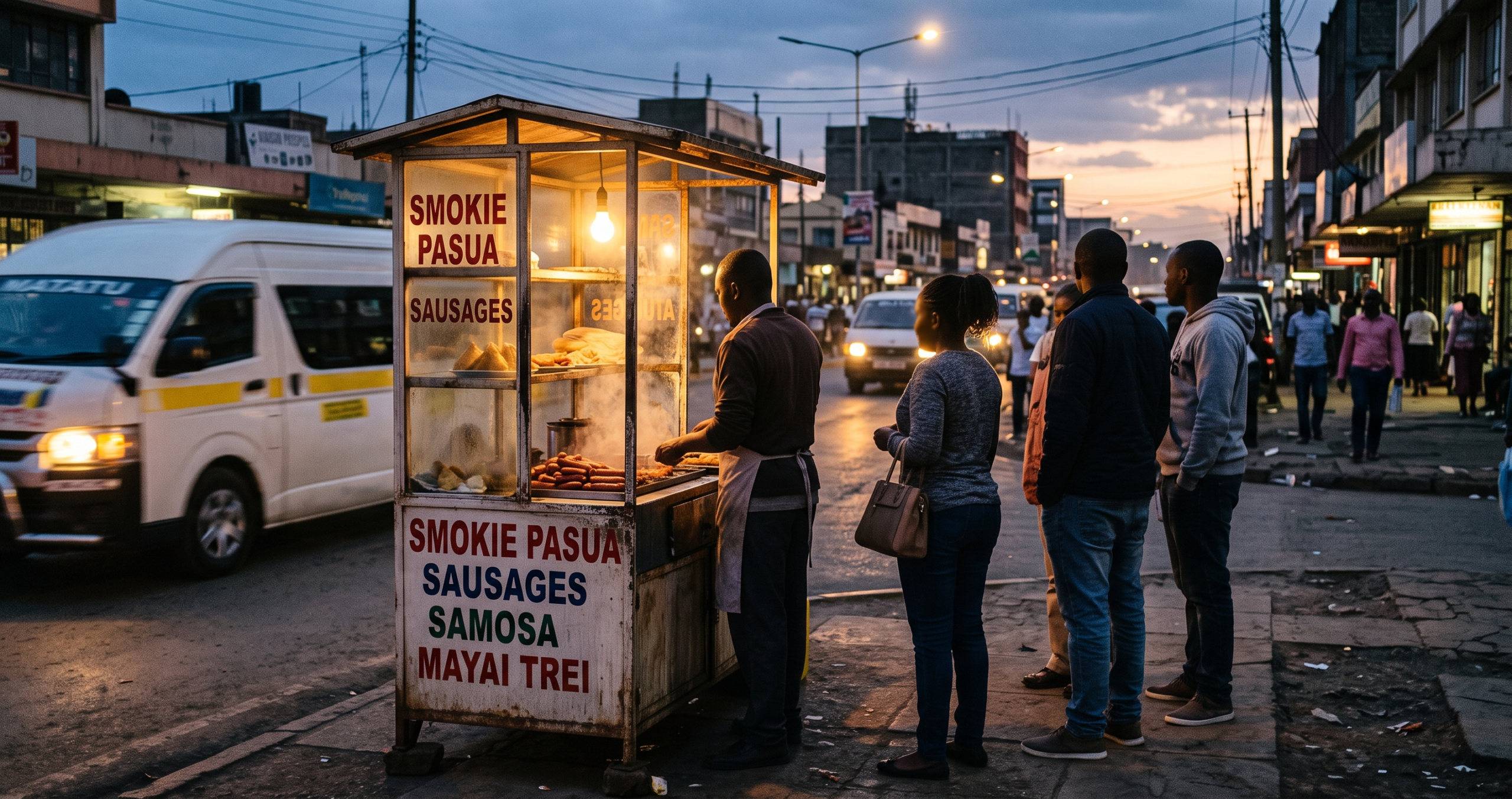
By 6pm on any weekday, the corner outside Nairobi’s Kencom bus stage fills with a queue that has nothing to do with matatus. It is the smokie pasua vendor, a metal display box glowing under a bare bulb, splitting open smoked sausages and stuffing them with kachumbari for shillings 30 to 35 a piece. Two hours west in Kampala, the same hustle plays out around a Rolex stall: eggs cracking into a hot pan, chapati rolling around the omelette, coins changing hands every ninety seconds. In Dar es Salaam, it is a mama lishe frying chapati by the hundred before the evening rush.
None of this is accidental. Kenya’s informal sector already dwarfs the formal sector, which employs just 3.5 million workers, while between 800,000 and 1 million youth enter the labour market every year and are absorbed mostly into informal enterprises like market vending, according to Kenya’s 2026 Economic Survey. Across the border, Uganda adds roughly 700,000 working-age adults annually against an economy that formally absorbs only a fraction of that, with the informal sector accounting for 91% of employment. Street food sits at the center of that reality: low capital, daily cash flow, and products East Africans already buy without persuasion.
This guide covers five street food businesses that work across Kenya, Uganda and Tanzania, with real prices, startup costs converted between USD, KES, UGX and TZS, and a realistic 60 to 90 day scenario for each. Before picking one, work out how many units you actually need to sell each day to cover your costs, especially if you plan to sell more than one product at your stall.
Need a Freelancer for This?
Hire verified talent on Fiverr — starting from $5. No contracts, no hassle.
Browse Fiverr Freelancers →→ Use the free Street Vendor Profit Calculator at MetricSuite.tools to calculate this instantly, no signup required.
(Currency conversions below use 2026 averages: 1 USD ≈ KES 130, UGX 3,700, and TZS 2,600.)
1. Smokie Pasua and Smocha Stall (Kenya)
Smokie pasua sells for around KES 30 to 35 across Nairobi’s CBD, with boiled egg around KES 20 to 25. Its newer cousin, the smocha (smokie wrapped in chapati), starts at KES 60 depending on the twist. Both took off because they are cheap to make, quick to eat standing up, and need no seating.
Startup cost: around $60 (KES 7,800 / UGX 222,000 / TZS 156,000) for a secondhand glass warmer box, charcoal jiko, sufuria, and a first batch of smokies, kachumbari vegetables and chapati.
60 to 90 day scenario: selling 35 smokie pasua and 10 smocha a day at a busy corner brings in roughly KES 1,770 ($13.60) daily. After ingredient costs, that is close to $6 a day in profit, or about $460 over 75 selling days, before stall fees.
First steps:
- Scout a high foot traffic corner (matatu stage, market gate, office block) and watch which hours actually draw a queue before committing.
- Buy smokies wholesale from a supplier serving several vendors, not retail supermarket prices.
- Add the smocha line only once the smokie pasua side is steady, since it needs its own chapati supply.
2. Rolex Stall (Uganda)
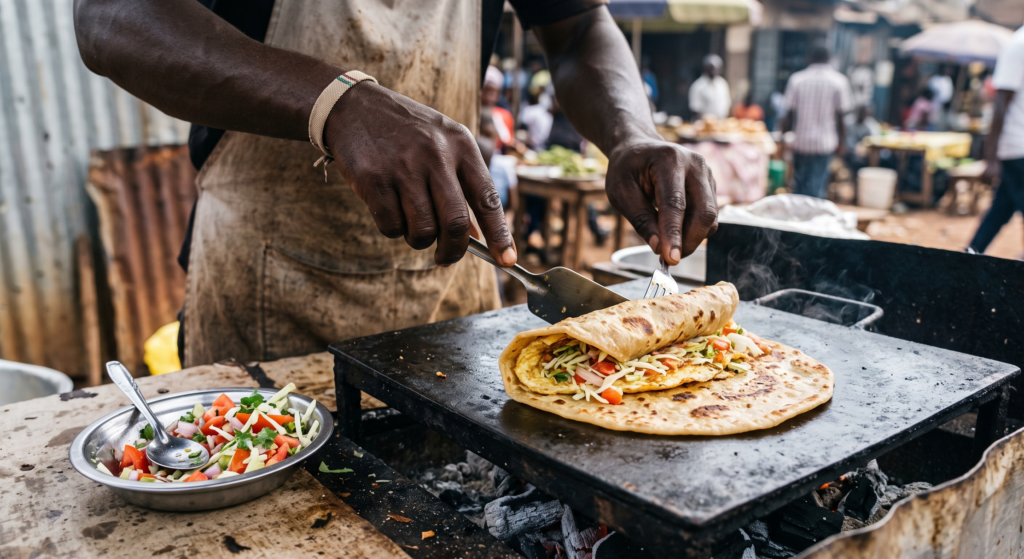
Uganda’s Rolex, an omelette rolled inside chapati, is the country’s most recognizable street food and one of its most accessible businesses. A basic Rolex can be had for as little as UGX 2,000, around $0.50, while upscale versions at Kampala restaurants run about $5.50. An estimated 100,000 vendors across Uganda sell Rolexes as their primary income source, and the entry cost is roughly UGX 50,000, about $13.50, for a jiko, frying pan, rolling board and a day’s stock of eggs, flour and oil.
Startup cost: about $13.50 (UGX 50,000 / KES 1,750 / TZS 35,000), the lowest of the five businesses here.
60 to 90 day scenario: at 40 Rolexes a day and UGX 2,500 average, that’s about $27 in daily revenue. Rising cooking oil and wheat costs have squeezed margins across the trade in recent years, so plan on roughly 40% margin, around $11 profit a day, or about $810 over 75 days.
First steps:
- Practice the roll before opening. A slow or messy Rolex loses repeat customers fast in a market with 100,000 competitors.
- Buy eggs and flour in small daily batches rather than bulk, since input costs have moved sharply in recent years.
- Set up near a boda-boda stage or office block to catch both the morning and lunch rush.
3. Mayai Pasua: the Boiled Egg Cart (Kenya, Uganda, Tanzania)
Mayai pasua, a boiled egg split and filled with kachumbari, chili and seasoning, is street food’s entry-level product across all three markets. It needs no meat supplier, which keeps the capital requirement below the smokie stall, and pairs naturally with it at the same stand.
Startup cost: about $25 (KES 3,300 / UGX 92,500 / TZS 65,000) for a cooking pot, charcoal jiko, a first batch of eggs and kachumbari vegetables.
60 to 90 day scenario: selling 60 eggs a day at KES 22 average brings in about $10 a day. With roughly 50% margin since eggs are a cheaper input than sausage, that’s around $5 profit a day, or about $380 over 75 days.
First steps:
- Pair the cart with an existing smokie or chapati vendor rather than starting solo. Egg carts do best alongside a complementary snack.
- Buy eggs at wholesale or farm-gate price, not retail shop price, to protect margin as egg prices rise.
- Track daily waste (cracked or unsold eggs) closely, since it’s the main margin leak in this business.
4. Chapati and Mandazi Vendor (Tanzania and Kenya)
Chapati has moved from an occasional treat to daily street food across the region. One Dar es Salaam vendor who started her business in 2020 now sells more than 100 chapatis a day at TZS 500 each, and says the trend has spread beyond bachelors to family orders. Across the region, street snacks including chapati typically run TZS 2,000 to 5,000, about $0.75 to $2.
Startup cost: about $35 (TZS 91,000 / KES 4,500 / UGX 129,500) for a griddle, rolling pin, flour, oil and a folding table.
60 to 90 day scenario: a new vendor selling 40 chapati a day at TZS 500 brings in about $7.70 daily. At roughly 40% margin, that’s about $3 profit a day, or $230 over 75 days, well below an established seller doing 100 a day, which shows the ceiling once a customer base builds.
First steps:
- Time production for the evening rush. Established vendors report sales climbing once people are done cooking for the day and want a shortcut.
- Keep dough portions consistent. Shrinking chapati size to cut flour costs, a common response to rising prices, pushes customers to the next stall.
- Pair chapati with beans, mbaazi or chai to lift the average ticket beyond a single piece.
5. The Combo Kiosk (Bundled Street Food and Drinks)
Once one line is profitable, the highest-leverage move is bundling. A kiosk selling two or three items above plus bottled water and soft drinks lifts the average ticket per customer without adding much capital, since customers buying a smokie or Rolex will usually add a drink if it’s sitting in a cooler in front of them.
Startup cost: about $150 to $200 (KES 20,000 to 26,000 / UGX 555,000 to 740,000 / TZS 390,000 to 520,000) for a larger cart or kiosk structure, a cooler box, initial stock across two to three food lines, and a case of bottled water and soda.
60 to 90 day scenario: bundling typically pushes daily revenue to $30 to $35 given the higher average ticket, with a blended margin around 40 to 45%, roughly $950 to $1,100 profit over 75 days. Bottled water alone carries a healthy markup over its wholesale case price for minimal extra effort compared to cooked items.
First steps:
- Buy bottled water and soft drinks by the case from a wholesaler, chill them, and mark up rather than reselling at wholesale price.
- If accepting mobile money for daily sales, compare provider costs first, since fees on frequent small transactions add up fast. → Use the free Mobile Money Fees Comparison tool at MetricSuite.tools to calculate this instantly, no signup required.
- Add one product line at a time. Start with two, add a third once volume is steady, rather than launching all five products on day one.
Conclusion
Pick the business that matches your capital and your location, not the one with the best margin on paper. A Rolex stall needs under $15 to open in Uganda, while a combo kiosk needs $150 or more, and both can be profitable in the right spot. Before buying any equipment, work out how many units you need to sell each day just to break even, then decide if that number is realistic for your corner. Run the numbers this week with the Street Vendor Profit Calculator, pick one product, and start small enough that a slow first month does not sink you.
Key Takeaways
- East Africa’s informal sector already absorbs most of the region’s youth entering the labour market each year, street food is a proven entry point, not an experiment.
- Uganda’s Rolex has the lowest startup cost of the five businesses here, about $13.50, and roughly 100,000 vendors already earn a living from it.
- Kenya’s smokie pasua and smocha combo shows the value of pairing two products under one stall once the first line is steady.
- Bundling several products with a drinks add-on lifts average ticket size without a large jump in capital.
- Calculate break-even units per day before buying equipment, not after.
How much money do I need to start a street food business in East Africa?
As little as $13.50 for a basic Rolex stall in Uganda, up to $150 to $200 for a combo kiosk selling multiple products plus drinks. Most single-product stalls fall between $25 and $60.
Is Uganda’s Rolex profitable in Kenya or Tanzania too?
The Rolex has started appearing in Kenya and neighboring markets as its popularity spreads beyond Uganda, though it remains most established in Kampala, where an estimated 100,000 vendors sell it daily.
Do I need a license or permit to sell street food?
Most cities in Kenya, Uganda and Tanzania require some form of vendor permit or hawker’s license from the local county or municipal authority. Requirements and fees vary by city and product, so check with your local authority before setting up.
What is the biggest risk in a street food business?
Rising input costs, particularly cooking oil and wheat flour, have squeezed margins across the region in recent years, which is why calculating your break-even point before you start matters more than picking the trendiest product.
Need help setting up a simple bookkeeping sheet, a logo, or a small business dashboard for your new stall? Find affordable freelance help on Fiverr.
REFERENCES
- The EastAfrican, “East African economies depend on informal jobs, but at a cost” (2026): https://www.theeastafrican.co.ke/tea/business-tech/east-african-economies-depend-on-informal-jobs-5535970
- Economic Policy Research Centre (Uganda), “Are Skills Mismatches Fuelling Africa’s Youth Unemployment Crisis?”: https://eprcug.org/blog/are-skills-mismatches-fuelling-africas-youth-unemployment-crisis/
- Daily Nation, “The cheap street food saving Nairobians from hunger pangs”: https://nation.africa/kenya/counties/nairobi/the-cheap-street-food-saving-nairobians-from-hunger-pangs-4040978
- Kenyans.co.ke, “5 Street Foods Whose Prices Have Shot Up”: https://www.kenyans.co.ke/news/76848-5-street-foods-whose-prices-have-shot
- The Kenya Times, “Top 10 Street Food Dominating Kenya In 2026”: https://thekenyatimes.com/latest-kenya-times-news/top-10-street-food-dominating-kenya-in-2026/
- ToasterDing, “Kenya’s Newest Food Sensation: Smocha Obsession”: https://toasterding.com/kenyas-newest-food-sensation-smocha-obsession/
- Safari Tailor, “What is a Rolex Uganda”: https://safaritailor.com/article/what-is-a-rolex-uganda
- Fodor’s, “Rolex Is the Greatest Ugandan Street Food”: https://www.fodors.com/world/africa-and-middle-east/uganda/experiences/news/this-rolex-isnt-a-watch-but-it-tastes-like-a-million-bucks
- CNN Travel, “The country where you don’t wear a rolex, you eat it”: https://www.cnn.com/travel/uganda-rolex-streetfood
- The Citizen (Tanzania), “Chapati: A snack turning into a popular meal in Dar es Salaam streets”: https://www.thecitizen.co.tz/tanzania/news/national/chapati-a-snack-turning-into-a-popular-meal-in-dar-es-salaam-streets-4573760
- TravelWithHello, “Tanzania Food Guide: What to Eat and How Much It Costs (2026)”: https://www.travelwithhello.com/blog/tanzania-food-dining-guide
- Exchange-Rates.org, USD/KES 2026 history: https://www.exchange-rates.org/exchange-rate-history/usd-kes-2026
- Trading Economics, USD/TZS: https://tradingeconomics.com/tanzania/currency