The number you see when you press send is rarely the number that lands on your family’s phone. Between your bank account in Canada, the UK or the US and a mobile money wallet in Accra or Kampala, up to four separate costs can trim the amount, and only some of them look like fees.
This guide explains each layer, shows what World Bank data says about the cost of sending money to Africa, and gives you a simple method to compare any provider by what the recipient actually gets. It is written for people sending from Canada, but the method works from anywhere.
The four costs between your account and their phone
- The transfer fee. The visible charge, either flat or a percentage. Some providers advertise zero fees on certain amounts or payout methods.
- The exchange rate margin. The gap between the mid-market rate (the real rate you see on a currency converter) and the rate the provider gives you. Wise says it uses the mid-market rate and shows its fee openly, while many providers earn their money inside the rate instead. This is the cost people overlook most often.
- The cash-out fee. If your family withdraws the money from a mobile money agent, the network charges for it. See our charts for MTN Uganda withdraw charges, MTN Ghana withdraw charges and Airtel Money charges in Uganda.
- Taxes. Uganda charges a 0.5 percent excise duty on the value of mobile money withdrawals, on top of the operator’s fees. Ghana scrapped its 1 percent E-levy on mobile money transfers from 2 April 2025.
How expensive is it to send money to Africa?
Sub-Saharan Africa is the most expensive region in the world to send money to. World Bank data cited in a South African Reserve Bank paper put the average cost of sending $200 to the region at about 8.8 percent in the first quarter of 2025, against a global average of about 6.5 percent. The UN target is 3 percent by 2030.
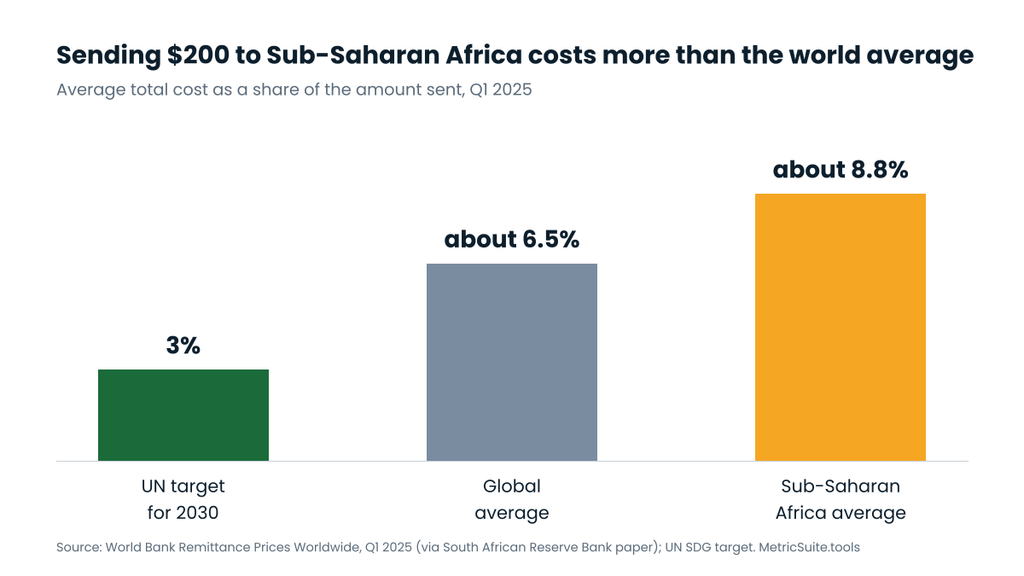
Average total cost of sending $200, Q1 2025, with the 2030 target. Sources: World Bank Remittance Prices Worldwide (via South African Reserve Bank paper); UN SDG target.
The channel you choose matters. In an earlier World Bank edition summarized by the Alliance for Financial Inclusion, the global average cost through mobile operators was 3.2 percent, against 10.4 percent through banks. And these are only averages: in 2023 the World Bank reported fees of up to 36 percent on some routes into the region. The gap between the cheapest and the most expensive provider on the same day is where you can save money.
Sending to Ghana
- No E-levy any more. The 1 percent E-levy on mobile money transfers and other electronic transactions was repealed with effect from 2 April 2025. Some older articles and provider pages still mention it, so treat those as out of date.
- Mobile money is the usual route. WorldRemit, for example, lists MTN, Airtel, Vodafone and Tigo mobile money accounts as payout options in Ghana.
- Watch the cedi. The exchange rate moves, which affects what your family can buy with the money. Our guide on how cedi depreciation affects Ghanaian households and businesses explains the pressure behind the rate.
- Plan for the cash-out. If your family withdraws at an agent, check the MTN Ghana fee chart so you know what they will actually keep.
Sending to Uganda
- Two main wallets. MTN Mobile Money and Airtel Money are the main payout options. WorldRemit also lists Warid Pesa accounts.
- Receiving is usually free, cashing out is not. Money arriving in the wallet is usually free from the operator side. Costs start when cash leaves the wallet: the operator’s withdrawal fee plus the 0.5 percent excise duty on the amount withdrawn, whether at an agent, an ATM or a bank counter. In 2026 the government declined to change the duty, and a proposal to halve it to 0.25 percent was shelved.
- Spending from the wallet avoids the withdrawal duty. If your family pays bills or merchants straight from the wallet instead of cashing out, they skip the withdrawal charge. Check the MTN Uganda fee chart and the Airtel Money Uganda charges before deciding.
Which type of provider fits your situation?
| Provider type | Works well for | Check before you send |
|---|---|---|
| Digital transfer apps (for example Wise, WorldRemit, Remitly) | Sending from your phone to a bank account or mobile money wallet, with the rate shown upfront | Not every provider pays out to every wallet. Confirm your payout method is available, then compare the final amount received |
| Canada-focused remittance companies (for example Remitbee) | Promotions on larger transfers. Remitbee advertises no fee on MTN Money transfers to Uganda above CAD 500 | Check the promotion’s conditions and compare the exchange rate, not just the fee |
| Banks | Convenience, or when you already hold funds there | Bank channels averaged the highest cost in World Bank data, so get a quote that shows the amount received |
| Cash pickup agents (for example Western Union) | Recipients with no wallet or bank account | Pickup requires travel, so compare the total cost against a wallet transfer first |
Provider names are examples, not endorsements. Fees and rates change daily, so run the comparison yourself before you send.
How to compare any provider in five steps
- Use the same test everywhere. Ask each provider for the same amount and the same payout method, for example CAD 500 to an MTN MoMo wallet.
- Check the mid-market rate. Look it up on a currency converter at the same moment.
- Write down the amount received. Note the local currency amount the provider says your recipient gets after all fees.
- Work out the total cost. Total cost % = (amount sent x mid-market rate – amount received) / (amount sent x mid-market rate) x 100.
- Add the cash-out cost. Subtract what your family will pay to withdraw, using the fee charts above.
A worked illustration (made-up round numbers, not a current rate): suppose the mid-market rate is 1 CAD = 10 GHS. Sending CAD 500 should be worth 5,000 GHS. Provider A says your recipient gets 4,850 GHS, a total cost of 150 GHS or 3 percent. Provider B says 4,950 GHS, a total cost of 50 GHS or 1 percent. The headline fee never appears in the calculation. The amount received decides.
Wise’s own Canada-to-Ghana pages have shown a total cost of roughly CAD 15 to 19 on a CAD 1,000 transfer paid from a Wise balance. Treat that as a snapshot, because the figure moves with the rate and the payment method.
Make sure the provider is legitimate
In Canada, money services businesses must register with FINTRAC before they begin operating, and you can check a company’s registration status in FINTRAC’s public Money Services Business Registry. Registration does not mean FINTRAC endorses a provider, but an unregistered company is a red flag. If you send from the UK, the US or elsewhere, check your own regulator’s register in the same way.
Small habits that save money
- Send fewer, larger transfers. A South African Reserve Bank presentation on World Bank data points out that fewer, larger transfers can cost less overall than many small ones, because flat fees weigh less on a bigger amount.
- Do a small test first. Send a small amount to a new wallet number before sending the full sum.
- Tell your family to keep money in the wallet where they can. Paying digitally avoids the cash-out charge.
- Compare again each time. Rates and promotions change, so last month’s cheapest option may not be this month’s.
Tools to run the numbers
- Africa Remittance Comparator to compare what your family receives across providers
- Caribbean Remittance Comparator if you are sending to the Caribbean
- MTN MoMo Fee Tracker for Uganda and Ghana to track cash-out costs
- Black Tax: what family support really costs and the Black Tax Calculator to plan regular support
This guide is for information only and is not financial advice. Fees, exchange rates and tax rules change, so confirm current details with the provider before you send.
FAQ
What is the cheapest way to send money from Canada to Ghana?
There is no single cheapest option. It changes with the amount, the payout method, how you pay and the day’s exchange rate. Compare the amount your recipient receives, not the fee. As a snapshot, Wise’s own Canada-to-Ghana pages have shown roughly CAD 15 to 19 in total cost on CAD 1,000 paid from a Wise balance, but always check a live quote.
Does Ghana still charge the E-levy on mobile money?
No. The 1 percent E-levy on mobile money transfers and other electronic transactions was repealed with effect from 2 April 2025.
Does my family pay to receive mobile money in Uganda?
Receiving money into the wallet is usually free from the operator side. Costs begin when the money is cashed out: the operator’s withdrawal fee plus a 0.5 percent excise duty on the amount withdrawn.
Is mobile money cheaper than a bank deposit?
On average it has been. An earlier World Bank edition summarized by the Alliance for Financial Inclusion put mobile operator channels at 3.2 percent and bank channels at 10.4 percent. Individual quotes vary, so compare before you send.
How do I check that a remittance company in Canada is registered?
Search FINTRAC’s Money Services Business Registry for the company name and check that its status is Registered. Registration is a legal requirement, not an endorsement.
Why does my recipient get less than I expected?
Usually because of the exchange rate margin, which is not shown as a fee, or because of cash-out charges. Use the five-step comparison above, or our Africa Remittance Comparator, to see the real total cost.
Sources (live URLs)
- South African Reserve Bank, Understanding Cost Patterns in Remittance Corridors of Sub-Saharan Africa (World Bank RPW Q1 2025 data): https://www.resbank.co.za/content/dam/sarb/what-we-do/payments-and-settlements/cross-border-payments-conference/documents/paper-cost-patterns-remittance.pdf
- South African Reserve Bank presentation, Remittance Cost Patterns: https://www.resbank.co.za/content/dam/sarb/what-we-do/payments-and-settlements/cross-border-payments-conference/documents/remittance-cost-patterns.pdf
- World Bank, Remittance Prices Worldwide: https://remittanceprices.worldbank.org
- Alliance for Financial Inclusion, cross-border remittance framework (mobile 3.2 percent vs bank 10.4 percent): https://issuu.com/afi-global/docs/afi_cross_border_framework_pm_aw2_digital
- Nairametrics, World Bank report on remittance costs to Sub-Saharan Africa (2023): https://nairametrics.com/?p=476267
- EY, Ghana E-levy repeal effective 2 April 2025: https://taxnews.ey.com/news/2025-0844-ghanas-parliament-amends-tax-laws-following-the-2025-budget-statement-presentation
- Graphic Online, MTN Ghana stops E-levy deductions: https://www.graphic.com.gh/business/business-news/mtn-ghana-abolishes-1-e-levy-as-new-tax-reforms-take-effect.html
- The Observer (Uganda), 0.5 percent excise duty on mobile money withdrawals retained: https://observer.ug/?p=67279
- AllAfrica, Uganda government refuses to reduce tax on mobile money: https://allafrica.com/stories/202604150126.html
- WorldRemit, send mobile money to Ghana from Canada: https://www.worldremit.com/en-ca/ghana/mobile-money
- WorldRemit, send mobile money to Uganda from Canada: https://www.worldremit.com/en-ca/uganda/mobile-money
- Wise, send money to Ghana from Canada: https://wise.com/ca/send-money/send-money-to-ghana
- Finder Canada, best way to send money to Ghana: https://www.finder.com/ca/international-money-transfers/send-money-internationally/send-money-to-ghana
- Remitbee, send money to Uganda MTN Money: https://www.remitbee.com/send-money-to-uganda/mtn-money
- FINTRAC, Money Services Business Registry: https://fintrac-canafe.canada.ca/msb-esm/reg-eng
- FINTRAC, Conducting transactions with a money services business: https://fintrac-canafe.canada.ca/public/businesses-entreprises-eng