
The cedi depreciation 2026 story is stranger than most headlines make it sound. Ghana’s economy grew 6.4% in the first quarter. Inflation eased to 4.6% in July, down from 5.3% in June. Private sector credit surged 41.2%, more than four times faster than a year earlier. By almost every conventional measure, the economy looks stronger than it did twelve months ago.
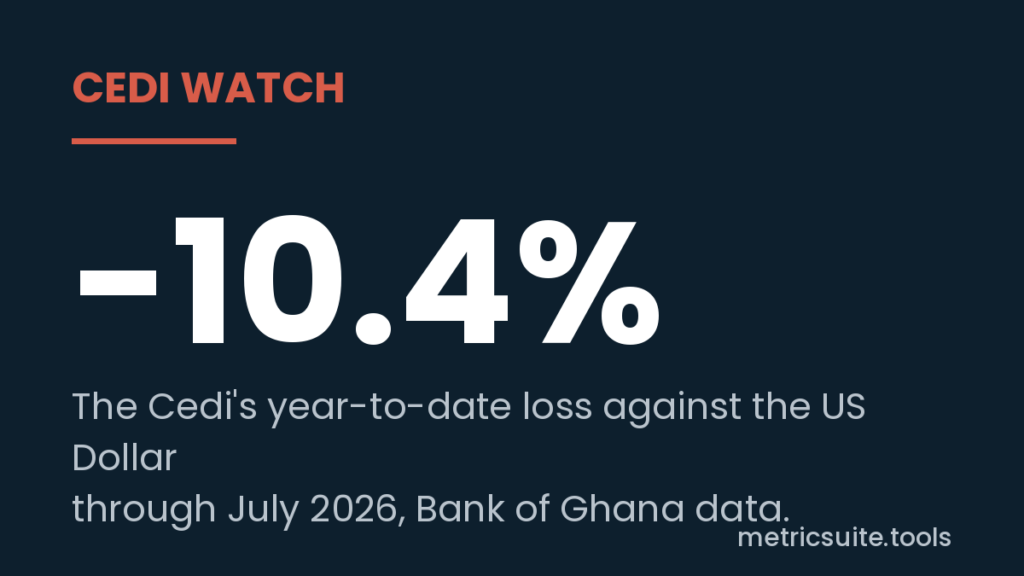
And yet the cedi lost 10.4% of its value against the US Dollar in the year to July 2026, including a 3.1% drop in July alone. The Bank of Ghana sold more than $8.2 billion through its FX intervention programmes between January and July trying to hold the line. The mid-rate stood at GH₵11.74 to the dollar on August 11.
That gap, strong fundamentals on paper, a weaker currency in your pocket, is the real story for anyone running a business, freelancing for foreign clients, or sending money home in Ghana right now. At the same time, the Bank of Ghana is publicly pushing commercial banks to turn diaspora remittances into investment, not just consumption. Regulators want more capital flowing in. Currency risk means every cedi flowing in and out needs to be priced with that risk built in, not assumed away.
Need a Freelancer for This?
Hire verified talent on Fiverr — starting from $5. No contracts, no hassle.
Browse Fiverr Freelancers →This piece walks through what’s actually driving the pressure, what the diaspora investment push means in practice, and which free MetricSuite tools help you price, plan, and file around all of it.
Cedi Depreciation 2026: What It Costs You at the Till
A 10.4% year-to-date loss doesn’t feel like much until you’re the one restocking. If you priced a product in January using January’s exchange rate, the same US Dollar order now costs roughly a tenth more in cedis to replace, even though your customer paid the old price. That gap comes straight out of your working capital.
The Bank of Ghana’s own weekly data shows why guessing is risky. The rate moved between roughly GH₵10.97 and GH₵11.76 in just the first two weeks of August, a swing of more than 1% in a single day at points. Import bureau rates have run higher still, closer to GH₵12.30 at points earlier in the year. Whichever rate you use to price, it will likely be wrong by the time you restock.
If you’ve already worked out your basic landed cost using our Ghana import guide, the exchange rate is the layer that sits on top of it and moves the most. Use the free Cedi Depreciation Buffer Calculator at MetricSuite.tools to calculate this instantly, no signup required. It takes your landed cost in USD, applies a buffer you choose on top of today’s rate, and shows you the GHS price that still lets you restock even if the cedi weakens further before your next shipment. A built-in stress test shows exactly where your buffer runs out.
Here’s what that looks like with real numbers. A $10 landed cost at today’s roughly GH₵11.70 rate converts to about GH₵117. Price it there with a 30% markup and you’re charging around GH₵152. Depreciate the rate by 10% before you restock, which is close to what’s already happened this year, and the real cost of replacing that unit becomes about GH₵129. Your GH₵152 sale still covers it, but with a thinner margin than you planned. Build the 10% buffer into the price from the start instead, and the sale price becomes about GH₵167, protecting the same margin even if the cedi moves against you exactly as much as it has all year.
Pair it with the China Sourcing Landed Cost Calculator at MetricSuite.tools when you’re pricing a new shipment from scratch, since freight and sourcing costs sit underneath currency risk, not on top of it.
Ghana Wants Its Diaspora to Invest, Not Just Send Money Home
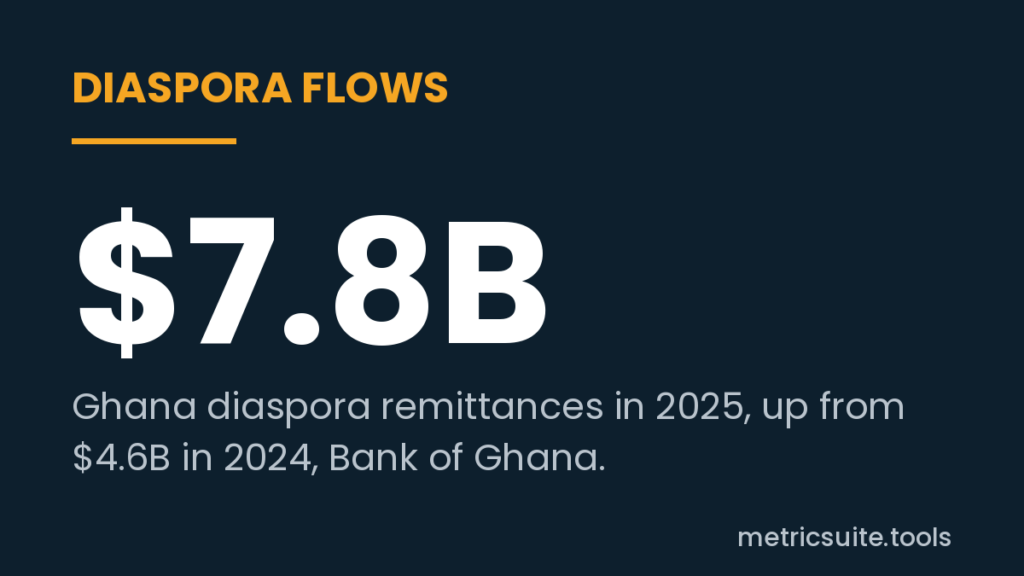
Ghana’s diaspora sent home nearly $7.8 billion in 2025, up from $4.6 billion in 2024. Bank of Ghana Governor Johnson Pandit Asiama wants that number to keep growing, but he wants less of it spent and more of it invested. Speaking at a diaspora forum this year, he described Ghanaians abroad as “domestic investors abroad” rather than a source of transfers.
The problem, according to the BoG’s own survey of the banking sector, is that most banks still only offer basic transfer services. Structured savings products, bonds, and other investment vehicles built specifically for the diaspora are rare. The central bank’s Remit2Invest push is an attempt to close that gap, formalising remittance flows into government securities, SMEs, fintech, real estate, and infrastructure.
If you’re part of that diaspora and earning in USD or EUR while living in or planning a move to Ghana, the first number you need isn’t an investment return, it’s your actual take-home pay after Ghana’s mandatory income tax. Use the free Freelance Take-Home Calculator at MetricSuite.tools to calculate this instantly, no signup required. It’s built specifically to correct a common assumption: SSNIT is not mandatory for a freelancer billing a foreign client, since there’s no Ghanaian employer to trigger it. It’s a voluntary choice you can toggle on or off and see the trade-off in real numbers, which matters a great deal if part of your investment plan involves building a pension record through it.
If your version of “investing” is repatriating savings, equipment, or capital to start something in Ghana rather than just transferring cash, the Repatriation Cost Calculator at MetricSuite.tools covers the logistics side of that move. And whatever you’re moving, price it with the cedi’s current volatility in mind using the Cedi Depreciation Buffer Calculator above, the same currency risk that hits an importer’s restock hits a diaspora investor’s capital just as directly.
Formalising Is Still the Hard Part for Ghana’s Small Businesses
While the currency and diaspora stories play out at the macro level, a quieter number tells you what’s happening on the ground. A 2026 study by the Institute for Liberty and Policy Innovation surveyed 600 Ghanaian MSMEs and found that only 28.2% of micro enterprises fully transition to medium scale. Another 44.6% make it as far as small enterprise status. The full journey from micro to medium can take nine to twelve years.
The study, covering businesses in manufacturing, ICT, and tourism, points to a familiar culprit: registration, licensing, and compliance costs that can eat up 30% to 40% of a small business’s annual revenue. Overlapping requirements across agencies like the Food and Drugs Authority, the local Metropolitan or Municipal Assembly, and the Ghana Standards Authority were named as specific barriers, alongside informal payments to unofficial middlemen that businesses sometimes turn to just to move an application forward. None of that shows up in a headline growth number, but it’s the real cost of staying formal, or the real reason many businesses don’t.
This is exactly the gap Ghana’s 2026 VAT reform was meant to narrow. Under the Value Added Tax Act, 2025, the registration threshold for goods businesses rose from GHS 200,000 to GHS 750,000, and NHIL and GETFund became creditable as input tax again instead of stacking on top of your costs. Use the free Ghana VAT & Input Tax Calculator at MetricSuite.tools to calculate this instantly, no signup required, to check where you actually stand under the new rules before assuming the old threshold still applies to you.
VAT is only one line item in the formalisation cost the ILAPI study describes. The Business Registration Cost Estimator and PAYE Calculator at MetricSuite.tools cover two more, what it actually costs to register in the first place, and what a formal payroll adds on top once you start hiring. Running the real numbers before you commit is cheaper than discovering them halfway through registration.
Remote Work and Delivery Are Quietly Becoming Real Income
The same digital shift the Bank of Ghana wants for diaspora remittances, moving beyond basic transfers into structured, platform-based financial activity, is already showing up in how ordinary Ghanaians earn. Remote freelance work for foreign clients and platform-based delivery work through services like Bolt and Yango have both grown from side hustles into primary income for a real number of people, particularly younger workers entering a job market where formal employment isn’t guaranteed. National service graduates registering for their next steps this year are exactly the group weighing a formal job search against building income on a platform instead, and increasingly choosing both at once rather than one or the other.
Both income types share the same problem: the headline number isn’t the real number. A freelancer’s USD day rate needs converting, taxing, and adjusting for real costs before it means anything, which is exactly what the Freelance Take-Home Calculator above handles. A dispatch rider’s per-kilometre rate needs to reflect today’s fuel price, not last month’s, or the job quietly stops being profitable. Use the free Delivery Rate Calculator at MetricSuite.tools to calculate this instantly, no signup required, whether you’re pricing direct WhatsApp clients or working out the fare you need on a platform meter after their commission.
Both groups also move money through mobile platforms constantly, and the fees are easy to lose track of. The Mobile Money Fees Comparison tool at MetricSuite.tools shows what each major service actually charges side by side, and our MTN MoMo Fees Ghana 2026 guide breaks down what changed on one of the country’s most-used platforms this year. Kenya’s mobile money market runs on a similar tariff-band logic, see our M-Pesa Fees 2026 guide for the comparison.
The Real Action Item
None of these four pressures, currency risk, diaspora investment, formalisation cost, and gig income, are separate stories. They’re the same underlying shift in Ghana’s economy showing up in different places: more capital and more income moving through formal, trackable channels, with a weaker cedi as the tax on getting the pricing wrong.
You don’t need to fix all of it this week. Pick the one that applies to your situation right now, an import you need to restock, a rate you need to quote, a registration you’ve been putting off, and run the actual numbers using the tool that matches it. All of them are free, and none of them need an account.
Key Takeaways
- The cedi lost 10.4% of its value against the US Dollar in the year to July 2026, even as GDP growth, inflation, and credit conditions all improved.
- The Bank of Ghana’s Remit2Invest push wants diaspora capital moving into structured investment products, not just transfer services, and banks are still catching up.
- Only 28.2% of Ghana’s micro businesses fully transition to medium scale, with regulatory compliance eating 30% to 40% of revenue for many.
- SSNIT is voluntary, not mandatory, for freelancers billing foreign clients, a common and costly misunderstanding.
- Currency risk, tax compliance, and gig or remote income all move together. Pricing and planning around one without the others leaves a gap.
FAQ
Why is the cedi depreciating in 2026 if Ghana’s economy is growing?
Strong GDP growth, falling inflation, and rising credit don’t automatically stabilise a currency on their own. The cedi lost 10.4% against the Dollar through July 2026 despite these improvements, and the Bank of Ghana has spent over $8.2 billion on FX intervention this year trying to manage the pressure.
What is Ghana’s Remit2Invest initiative?
It’s a Bank of Ghana push encouraging commercial banks to build investment products, not just transfer services, for Ghanaians abroad. The goal is channelling more of the country’s remittance inflows, which reached $7.8 billion in 2025, into government securities, SMEs, real estate, and other productive investment.
How much does regulatory compliance actually cost a small business in Ghana?
A 2026 ILAPI study of 600 MSMEs found that registration, licensing, and compliance can consume 30% to 40% of annual revenue for some businesses, and that the full transition from micro to medium enterprise status can take nine to twelve years.
Is SSNIT mandatory for Ghanaians freelancing for clients abroad?
No. SSNIT is only compulsory where a formal Ghanaian employer is remitting on someone’s behalf. A freelancer billing a foreign client has no such employer, so SSNIT is a voluntary choice through the self-employed SEED route, not an automatic deduction.
How can I protect my prices from further cedi depreciation?
Build a currency risk buffer into your price before you set it, rather than adjusting after a bad month. The Cedi Depreciation Buffer Calculator applies your chosen buffer to today’s exchange rate before converting your USD cost, so your price already accounts for a weaker cedi by the time you restock.
REFERENCES
- Pulse Ghana, “Ghana Cedi to Dollar Rate Today: Latest Bank of Ghana Rates” (GH₵11.7400 mid-rate, August 11, 2026): https://www.pulse.com.gh/story/ghana-cedi-dollar-rate-today-bank-of-ghana-2026081210131189837
- MyJoyOnline, “BoG Governor urges banks to develop innovative diaspora investment products” (3.1% July depreciation, 10.4% year-to-date loss): https://www.myjoyonline.com/bog-governor-urges-banks-to-develop-innovative-diaspora-investment-products/
- Business Day Ghana, “BoG Governor urges banks to deepen diaspora investment” (6.4% Q1 GDP growth, 4.6% July inflation): https://businessdayghana.com/bog-governor-urges-banks-to-deepen-diaspora-investment/
- Citinewsroom, “BoG unveils ‘Remit2Invest’ push to channel diaspora remittances into investment” (remittances $4.6B to $7.8B, “domestic investors abroad” framing): https://www.citinewsroom.com/2026/04/bog-unveils-remit2invest-push-to-channel-diaspora-remittances-into-investment/
- The Business & Financial Times, “Editorial: Diaspora inflows to be channelled into real sector” (current account surplus $3.1B, reserves $14.4B): https://thebftonline.com/2026/06/19/editorial-diaspora-inflows-to-be-channelled-into-real-sector/
- Ghana Business News, “Only three in 10 micro businesses reach medium scale, ILAPI research” (28.2% and 44.6% transition rates, 600 businesses surveyed): https://www.ghanabusinessnews.com/2026/08/13/only-three-in-10-micro-businesses-reach-medium-scale-ilapi-research/
- MyJoyOnline, “Regulatory burden threatens SME growth, job creation, ILAPI study” (30% to 40% of revenue on compliance): https://www.myjoyonline.com/regulatory-burden-threatens-sme-growth-job-creation-ilapi-study/
- Ghana Revenue Authority, “VAT” (Act 1151 reform details, already the primary source for the Ghana VAT Calculator): https://gra.gov.gh/domestic-tax/tax-types/vat/
- Wise, USD to GHS exchange rate history (weekly rate volatility, GH₵10.97 to GH₵11.76 range in early August): https://wise.com/gb/currency-converter/usd-to-ghs-rate/history
Sourcing your next shipment? Browse wholesale listings on Alibaba before you run your buffered price.