
A maize farmer outside Nakuru priced her season in January using last year’s fertilizer numbers. By the time she was ready to buy in April, DAP had moved so far past her budget that she cut her planted acreage rather than borrow to cover the gap. She isn’t alone, and she isn’t wrong to be confused. For most of 2025, fertilizer costs in Africa had actually been easing off their 2022 peak. Then, in late February 2026, a near-closure of the Strait of Hormuz reversed that trend almost overnight, and the farmers who budgeted off last year’s prices are now finding out the hard way.
This is not a repeat of the 2022 crisis playing out again. It’s a new shock, with a different cause, and it is hitting African countries very unevenly depending on where their fertilizer actually comes from. Some markets are genuinely exposed. Others, for reasons that have more to do with domestic industrial policy than luck, are starting to insulate themselves.
Why Fertilizer Costs in Africa Are Climbing Again in 2026
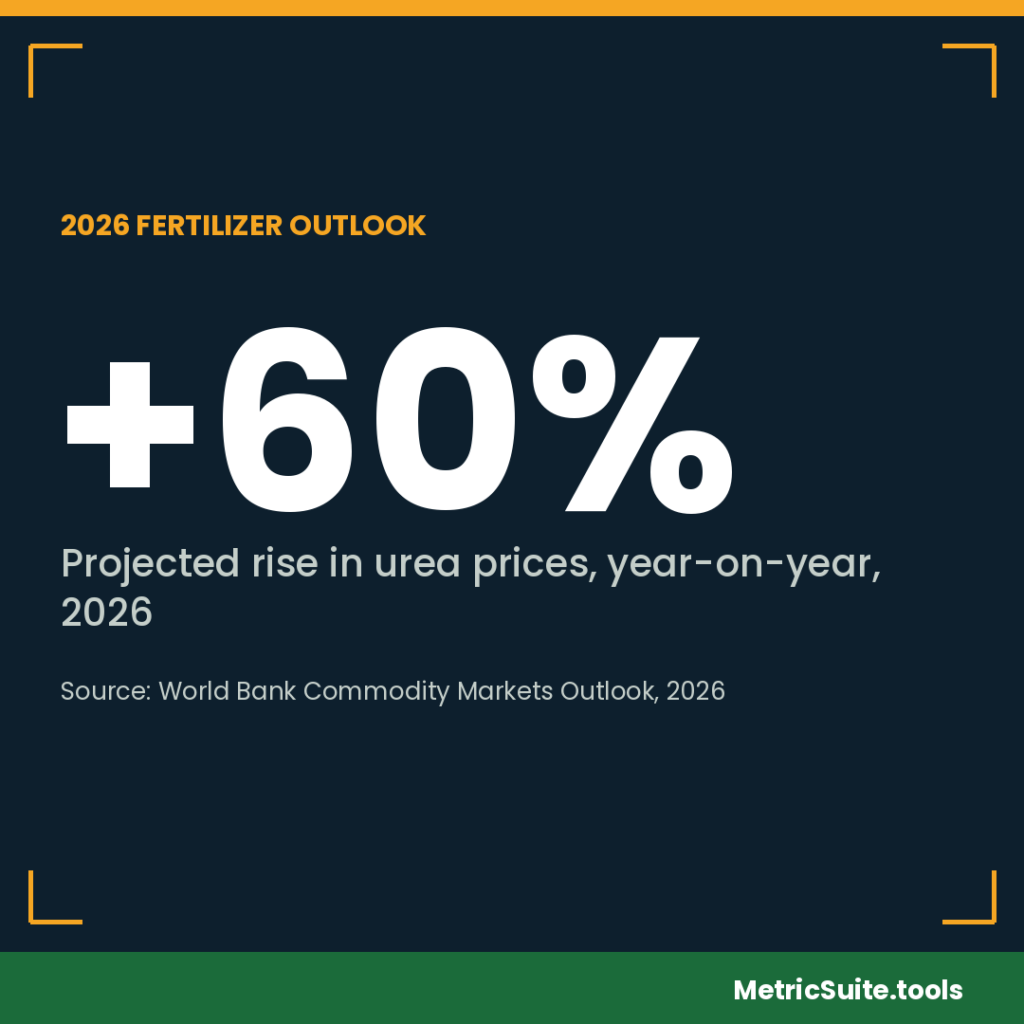
The proximate cause is geography, not economics. Roughly a third of the world’s seaborne fertilizer trade, about 16 million tonnes a year, moves through the Strait of Hormuz. Escalating US-Iran military tension since late February 2026 has choked that route, and the price response has been sharp. The World Bank’s Commodity Markets Outlook now projects urea prices could rise as much as 60% year-on-year in 2026, with the broader global fertilizer price index up around 31% for the year, having already climbed more than 12% in the first quarter alone. In its own words, fertilizers have not been this unaffordable since 2022.
Need a Freelancer for This?
Hire verified talent on Fiverr — starting from $5. No contracts, no hassle.
Browse Fiverr Freelancers →The FAO has issued a parallel warning that prices could climb a further 15 to 20% in the first half of 2026 if the disruption continues, and the early data backs that up: granular urea in the Middle East jumped 19% in a matter of weeks, and Egypt’s urea costs rose 28% in March 2026 alone. For African countries that import the bulk of their fertilizer rather than produce it domestically, that’s not a rounding error on a farm budget, it’s the difference between a season that pencils out and one that doesn’t.
Who’s Exposed and Who Isn’t: A Country Breakdown
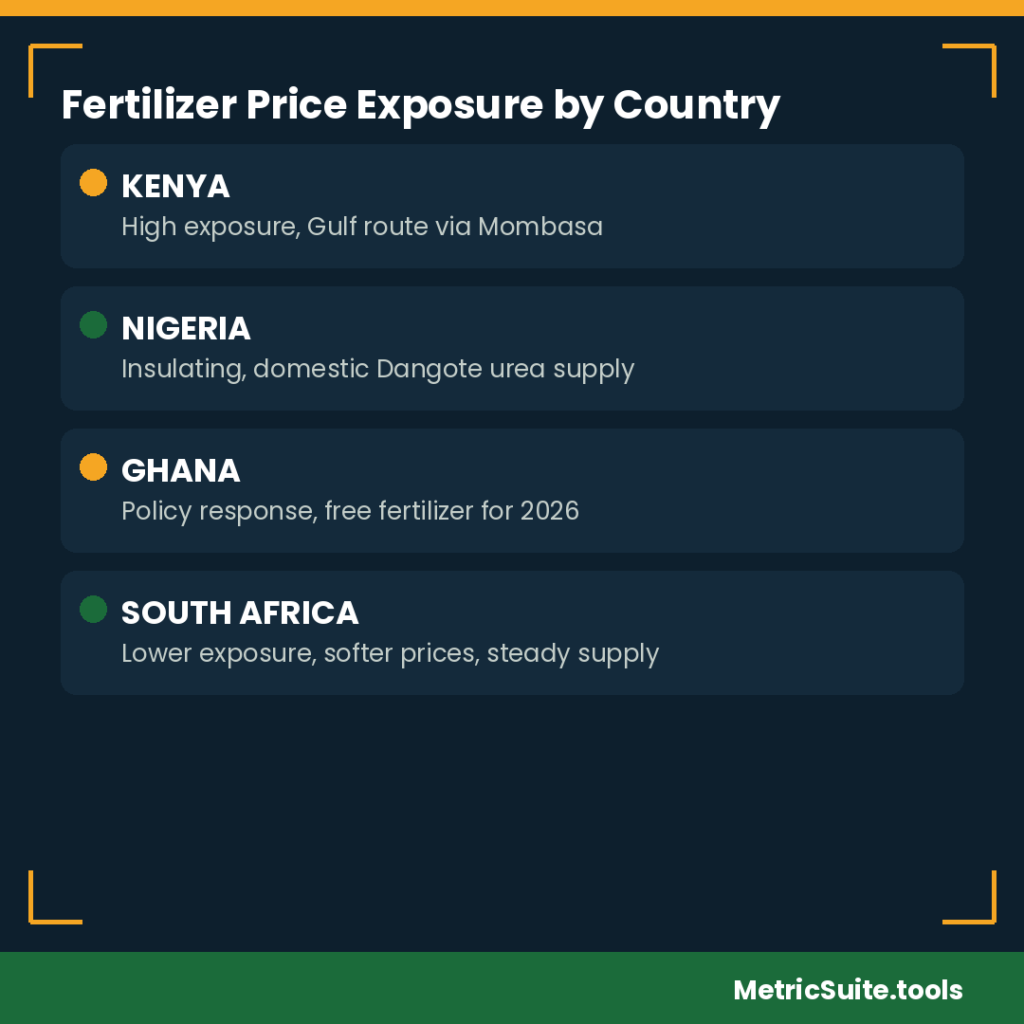
Exposure to this spike depends almost entirely on how much of a country’s fertilizer moves through the Gulf, and how much domestic production capacity exists to fall back on.
Kenya sits on the exposed end. A meaningful share of Kenya’s fertilizer imports route through the Strait of Hormuz into Mombasa, and DAP and CAN prices have been climbing through the first half of 2026 as a result. The government’s KSh 2 billion subsidy announced in March, targeting 2.5 million smallholders ahead of the long rains, cushions the blow but doesn’t offset it entirely, it was sized for a calmer price environment than the one that followed.
Nigeria is a genuinely different story. Dangote Fertiliser’s Lagos complex, the largest granulated urea plant in Africa at roughly 3 million tonnes of annual capacity, has turned Nigeria into a net urea exporter rather than a pure importer. Industry analysts now describe Nigerian urea as gaining “cost tailwinds” from domestic supply even as global benchmark prices climb, a genuinely different position from most of the continent. It’s not full insulation, Nigerian farmers still feel global price pressure through other inputs, but it’s a meaningful buffer that didn’t exist a few years ago.
Ghana took the most direct policy swing. On March 21, 2026, President Mahama announced that Ghana would move from its long-running subsidized fertilizer scheme under Planting for Food and Jobs to full free distribution for the 2026 season, citing the global price spike directly. It’s a strong signal, but worth reading carefully: Ghana still imports the large majority of what it consumes, so the government is absorbing the global price shock on its own balance sheet rather than removing the underlying exposure. Supply secured for free distribution is also finite relative to national demand, so allocation and timing through your local agriculture office matters more than usual this season.
South Africa is, for now, the most comfortable of the four. IFDC’s most recent market bulletin describes weaker demand and slightly softer prices there, with improved supply expected from incoming shipments, a notably calmer picture than its East and West African counterparts.
Three practical steps regardless of which country you’re farming in:
- Re-price your input budget against current-week costs, not the numbers you priced in January or last season
- Check whether your country has an active subsidy or free-distribution scheme before paying full market price, and confirm the application window with your local agriculture office
- Run the actual numbers before you commit capital, not after you’ve already bought inputs
→ Use the free Crop Profit Calculator at MetricSuite.tools to calculate this instantly, no signup required. It’s pre-loaded with 2026 cost baselines for Nigeria, Ghana, Kenya, South Africa, Zimbabwe and Botswana, so you can swap in this season’s real fertilizer price and see exactly what it does to your margin before you spend anything.
Protecting Your Margin Before You Buy
None of this means sitting out the season. It means buying differently. Splitting fertilizer into a basal application at planting and a top-dress at four to six weeks consistently outperforms a single large application in trial data from Nigeria’s Middle Belt, and it spreads your cash outlay across a period when prices may still be moving. Buying in bulk ahead of peak planting season, before every other farmer in your area is also trying to buy, is worth more this year than most. Where irrigation is optional, running the numbers on rain-fed versus irrigated at this season’s fertilizer price, rather than last season’s, will change the answer for some farms.
Need help modelling your farm budget or building a spreadsheet to track input costs?
Hire verified talent on Fiverr for business tools and dashboards, starting from $5.
Browse Fiverr Business Tools →If you’re buying imported fertilizer priced in USD but paying and budgeting in naira, cedi, shilling or rand, the currency conversion adds another layer of uncertainty on top of the price spike itself.
→ Use the free Multi-Currency Pricing Calculator at MetricSuite.tools to calculate this instantly, no signup required, so you’re working from a real landed cost in your own currency rather than an FOB dollar price that doesn’t reflect what you’ll actually pay.
The Bottom Line
Fertilizer costs in Africa are not moving uniformly this season, and treating them as if they are is the mistake worth avoiding. A Kenyan smallholder and a Nigerian commercial farmer are facing genuinely different input environments right now, shaped by shipping routes and domestic industrial capacity more than by anything happening on their own farms. The World Bank expects some relief by 2027 as new export capacity, including Africa’s own Dangote and OCP plants, comes online, but that’s next year’s story. This week’s task is simpler: re-run your actual budget with this season’s real numbers before you commit money to inputs.
Key Takeaways
- The World Bank projects fertilizer prices could rise 31%, and urea specifically up to 60%, year-on-year in 2026, reversing the easing trend from 2025
- The main driver is a near-closure of the Strait of Hormuz since late February 2026, a route that carries roughly a third of the world’s traded fertilizer
- Exposure varies sharply by country: Kenya imports heavily through the Gulf route, Nigeria is increasingly self-sufficient through domestic urea production, Ghana moved to free fertilizer distribution for 2026, and South Africa is seeing comparatively softer prices
- Re-price your input budget against current costs, not earlier-2026 or 2025 figures, before you commit to planting
- Use MetricSuite’s free Crop Profit Calculator to model your real numbers by country and crop before you spend
FAQ
Why are fertilizer costs in Africa rising in 2026?
A near-closure of the Strait of Hormuz since late February 2026, tied to escalating US-Iran tension, has disrupted a shipping route that carries roughly a third of the world’s traded fertilizer. The World Bank now projects fertilizer prices could rise 31%, and urea specifically up to 60%, year-on-year in 2026.
Which African countries are most exposed to the 2026 fertilizer price spike?
Countries that depend heavily on Gulf-route imports feel it hardest, Kenya is a clear example, with a meaningful share of its fertilizer imports moving through the Strait of Hormuz into Mombasa. Countries with growing domestic production, like Nigeria, or an active government response, like Ghana’s free distribution program, are comparatively more insulated.
Is Ghana’s free fertilizer program available to every farmer?
The 2026 program distributes government-secured stock through the Ministry of Food and Agriculture’s existing Planting for Food and Jobs channels. Supply is finite relative to national demand, so check allocation and timing with your local district agriculture office rather than assuming automatic access.
Will fertilizer prices come back down?
The World Bank’s own outlook expects prices to ease by around 25% in 2027 as new export capacity, including Africa’s own Dangote and OCP plants, comes online. That’s next year’s relief, not this season’s.
How much extra should I budget for fertilizer this season?
That depends heavily on your country and crop, which is exactly why a blanket percentage isn’t reliable. Run your specific crop, country and cost combination through a calculator rather than applying a rule of thumb sourced from a different market.
Data Sources & Verification
| Data Point | Source | Date |
|---|---|---|
| Urea prices projected to rise up to 60% YoY in 2026 | World Bank Commodity Markets Outlook, via Nairametrics | May 3, 2026 |
| Global fertilizer price index projected +31% in 2026; Strait of Hormuz carries ~1/3 of global seaborne fertilizer trade | World Bank Commodity Markets Outlook, via The Lead Africa | May 9, 2026 |
| FAO warning of 15-20% further price rise in H1 2026; Egypt urea +28% March 2026 | African Mining Week | April 7, 2026 |
| Fertilizer price index +6.5% (Feb data); urea +46% month-on-month Feb-March 2026 | World Bank Food and Nutrition Security Update #121 (PDF) | March 27, 2026 |
| South Africa: weaker demand, softer prices, improved incoming supply | IFDC Global Fertilizer Markets Bulletin #14 | June 2, 2026 |
| Dangote Fertiliser: ~3 million tonnes/year urea capacity, Africa’s largest; Nigeria gaining domestic cost tailwinds | Mordor Intelligence Africa Fertilizers Market report | June 15, 2026 |
| Ghana: free fertilizer distribution announced for 2026 season, replacing subsidy program | GBC Ghana Online / Milling Middle East & Africa Magazine | March-May 2026 |
| Kenya: KSh 2 billion input subsidy, March 2026, targeting 2.5 million smallholders | MetricSuite Crop Profit Calculator (existing, live) | March 2026 |
Figures are as reported by the sources above at time of writing. Fertilizer prices remain volatile and tied to an active geopolitical situation, confirm current local prices with agro-dealers before committing capital.