
At Balogun Market in Lagos, a trader restocks her stall every Friday. She buys a carton of soap, sells every bar by Sunday, and hands her supplier roughly the same amount of cash the following week. On paper she is busy. In her pocket, she often cannot say whether she made money or simply moved it in a circle.
That is the reality for most small business owners across Nigeria, Kenya, Ghana, South Africa, and the CFA franc zone. Revenue is visible. Profit margin is not. Informal trade and small enterprise account for the overwhelming majority of jobs in the region, with informal employment estimated at 86.3% of all jobs in Sub-Saharan Africa as of 2024, and most of that activity runs on instinct rather than a number on a page.
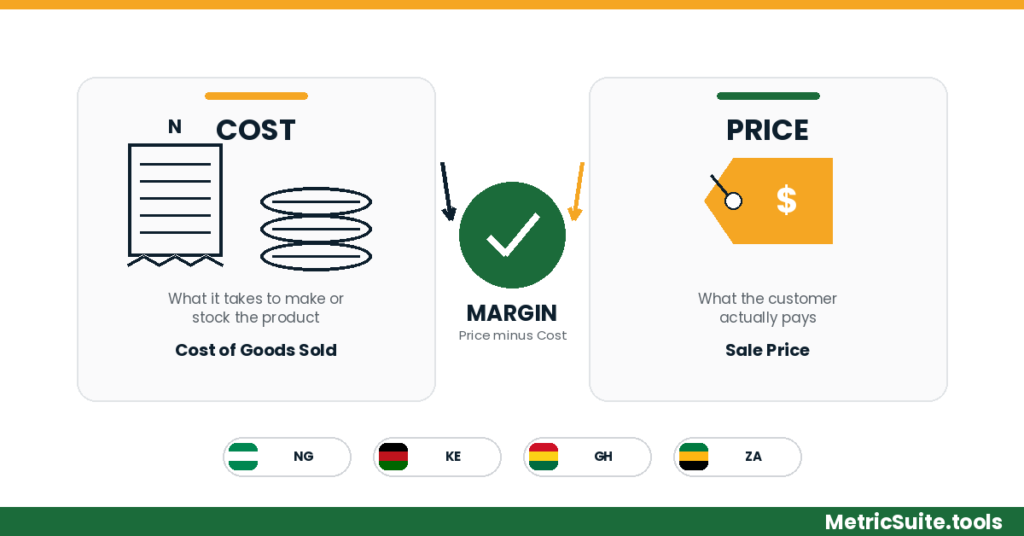
Knowing how to calculate profit margin for small business survival, not accounting theory, comes down to two figures. Gross margin is revenue minus the cost of goods sold. Net margin is gross profit minus everything else it costs to keep the business running: rent, transport, mobile money fees, spoilage, and the currency loss that eats into cross-border stock between order day and sale day. Mixing the two up is the single most common reason a “profitable” business quietly runs out of cash.
Need a Freelancer for This?
Hire verified talent on Fiverr — starting from $5. No contracts, no hassle.
Browse Fiverr Freelancers →→ Use the free Margin & Markup Calculator at MetricSuite.tools to calculate this instantly. No signup required.
Below are six real African small business types, each with a worked margin calculation in local currency, so the formula stops being abstract and starts being something you can run against your own numbers this week.
How to Calculate Profit Margin for a Retail Stall in Lagos, Nigeria
Wholesale and retail trade is Nigeria’s single largest source of informal employment, and margin literacy is thinnest here precisely because stock turns over fast and cash gets spent before it gets counted. A trader who cannot separate cost of goods from take-home pay will restock forever without building capital.
Cost breakdown (household goods, e.g. bar soap):
- Wholesale carton of 24 bars: NGN 14,000 (about $10.10 at NGN 1,380/USD)
- Retail sale at NGN 700/bar × 24 = NGN 16,800
- Gross profit per carton: NGN 2,800 (gross margin: 16.7%)
90-day scenario: Selling 10 cartons a week generates about NGN 722,000 in monthly revenue against NGN 602,000 in cost of goods, for a gross profit near NGN 120,000. After stall rent (NGN 15,000), transport (NGN 8,000), and a spoilage and shrinkage allowance (NGN 5,000), monthly net profit lands around NGN 92,000, a net margin of 12.8%. Over 90 days that is roughly NGN 277,000, or about $201.
First steps:
- Keep a separate cash box or mobile money till for stock money versus take-home money.
- Record cost price and sale price per item, not just total daily sales.
- Recalculate margin monthly using the free Margin & Markup Calculator, since supplier prices shift often.
How to Calculate Profit Margin for a Mobile Money Agency in Nairobi, Kenya
Mobile money is the backbone of retail cash flow across East Africa, and 2025 was the busiest year on record for the sector globally, with more than $2 trillion moving through mobile wallets and merchant payments alone growing 42% to $155 billion. An agency outlet does not sell a product, so its margin calculation looks different from a shop that stocks goods.
Commission structure: Safaricom’s published M-PESA agent tariffs run in bands, with deposit commission from roughly KES 4 to KES 190 and withdrawal commission from roughly KES 5 to KES 200, depending on the transaction size.
90-day scenario: An agent handling 40 withdrawals a day (averaging KES 30 commission) and 25 deposits a day (averaging KES 20 commission) earns about KES 1,700 in daily gross commission, or KES 44,200 across a 26-day working month. After shop-in-shop rent (KES 8,000), the cost of financing float (KES 4,000), and data or utilities (KES 1,500), net monthly profit is about KES 30,700, a striking 69.5% net margin against commission revenue since there is no cost of goods to subtract. Over 90 days that is close to KES 92,000, about $712.
First steps:
- Track commission earned by band, not just total float turned over.
- Separate float capital from personal funds so a slow week does not read as a loss.
- Compare your effective commission rate across providers using the free Mobile Money Fees Comparison tool before choosing which network to prioritize.
How to Calculate Profit Margin for Import and Wholesale Trading in Tema, Ghana
Small importers bringing electronics accessories from China into Ghana routinely misprice because they calculate margin against the supplier invoice instead of the full landed cost. Duty, VAT, and clearing fees at Tema port typically add 30 to 50% on top of the factory price, and skipping that step is the fastest way to sell at a loss while believing you turned a profit.
Cost breakdown (500 units of earphones):
- Supplier price: $1.20/unit × 500 = $600
- Duty, VAT, and clearing (about 35% of value): $210
- Total landed cost: $810, or GHS 9,396 at GHS 11.6/USD (GHS 18.79 per unit)
90-day scenario: Selling the batch wholesale at GHS 28/unit brings in GHS 14,000, a gross profit of GHS 4,604 (32.9% gross margin). After local transport and storage (GHS 500), net profit is GHS 4,104, a 29.3% net margin. Running two import cycles in a 90-day window brings cumulative net profit to roughly GHS 8,200, about $708.
First steps:
- Calculate landed cost, not invoice cost, before setting a wholesale price.
- Build a currency buffer of 3 to 5% into your sell price to absorb GHS movement between order and sale.
- → Use the free African Import Duty Calculator at MetricSuite.tools to calculate this instantly. No signup required.
If you are sourcing the stock itself, browsing verified suppliers directly on Alibaba before you commit to a landed cost estimate can help you lock in the input side of this calculation early.
How to Calculate Profit Margin for a Social Commerce Seller in Johannesburg, South Africa
Roughly 78% of small businesses across Sub-Saharan Africa now use WhatsApp as a primary sales channel, and Africa’s chat-led social commerce market is projected at $33.7 billion in 2026. The upside is reach without a storefront. The trap is confusing sales volume on the app with actual profit, since delivery, packaging, and payment fees quietly compress margin on every order.
Cost breakdown (imported handbags resold via WhatsApp and Instagram):
- Cost per bag (import plus delivery to seller): ZAR 180
- Sale price: ZAR 320
- Gross profit per bag: ZAR 140 (43.75% gross margin)
90-day scenario: At 15 bags a week, monthly revenue runs about ZAR 20,640 against ZAR 11,610 in cost of goods, for a gross profit near ZAR 9,030. After WhatsApp Business data, packaging, and card or EFT payment fees (about ZAR 763 combined), net profit lands around ZAR 8,267, a 40% net margin. Over 90 days that is close to ZAR 24,800, about $1,476.
First steps:
- Price in delivery and packaging per order, not as an afterthought at month-end.
- Log every sale with cost and sale price side by side, even for one-off WhatsApp orders.
- Use the free Social Commerce Profit Tracker to see which product line is actually carrying the business.
How to Calculate Profit Margin for Small-Scale Farming in Côte d’Ivoire (XOF Zone)
Agriculture still employs the majority of the workforce across the CFA franc zone, and margin swings hardest here because a single harvest carries the season’s entire input cost against a market price that can move sharply between planting and sale.
Cost breakdown (0.5 hectare of tomatoes):
- Seed, fertilizer, and labour for the season: XOF 180,000 (about $313 at XOF 575/USD)
- Expected yield: 3,000 kg at a farm-gate price of XOF 250/kg = XOF 750,000 revenue
- Gross profit: XOF 570,000 (76% gross margin)
90-day scenario (a single growing cycle): After transport to market (XOF 40,000) and a typical middleman commission of about 10% of revenue (XOF 75,000), net profit comes to XOF 455,000, a 60.7% net margin, about $791. That margin looks generous on paper, but a 20% yield shortfall from pests, drought, or late rain can cut it by more than half, which is why farmers should model a low-yield scenario alongside the expected one.
First steps:
- Record input cost per hectare separately from labour, so you know which line item to cut first in a bad season.
- Get a market price quote before harvest, not at the farm gate on sale day.
- → Use the free Crop Profit Calculator at MetricSuite.tools to calculate this instantly. No signup required.
How to Calculate Profit Margin for a Tailoring Business in Kano, Nigeria
Fashion and garment production is one of the more forgiving small businesses for margin control, because every input, fabric, thread, and labour, is known before the item is cut. The mistake most tailoring shops make is pricing off memory instead of a per-item cost sheet, which lets fixed overhead quietly eat the margin.
Cost breakdown (ready-made ankara dress, one employee):
- Fabric: NGN 3,500
- Thread and notions: NGN 300
- Labour (piece rate): NGN 1,200
- Total cost per dress: NGN 5,000
90-day scenario: Selling at NGN 9,000 gives a gross profit of NGN 4,000 per dress (44.4% gross margin). At 20 dresses a month, that is NGN 180,000 in revenue against NGN 100,000 in cost of goods, an NGN 80,000 gross profit. After shop rent and electricity or generator fuel (NGN 33,000 combined), net profit is about NGN 47,000 a month, a 26.1% net margin, close to NGN 141,000 over 90 days.
First steps:
- Build a cost sheet per garment style before quoting a customer, not after.
- Calculate the true cost of your employee’s time, including downtime between orders, using the free Employee True Cost Calculator.
- Review pricing every quarter as fabric costs move with the naira.
Conclusion
Every business above sells something different, a product, a commission, a harvest, a garment, but the discipline is identical: know your true cost, subtract it from what actually lands in your account, and track the percentage, not just the cash. That is how to calculate profit margin for small business decisions that hold up under pressure, whether the pressure is a currency swing, a slow week, or a supplier price hike.
The action to take this week is small. Pick your best-selling item, run its real numbers, cost of goods, overhead share, and sale price, through a calculator instead of your head. → Use the free Break-Even Calculator at MetricSuite.tools to calculate this instantly. No signup required. Once you know the number your business needs to hit before you’re even at zero, every pricing decision after that gets easier.
Key Takeaways
- Gross margin only accounts for cost of goods sold. Net margin subtracts every other operating cost, including rent, transport, and mobile money fees, and it is the number that decides whether the business survives.
- Import businesses must fold customs duty, VAT, and clearing fees into cost of goods sold before calculating margin, or the “profit” being celebrated is fictional.
- Commission-based businesses, like mobile money agencies, calculate margin against commission revenue rather than against sales, since there is no product being resold.
- Currency movement between the day stock is ordered and the day it is sold can erode margin by several percentage points on cross-border purchases, so build a buffer into the sell price.
- Track margin per cycle, weekly for traders, per harvest for farmers, rather than waiting for month-end, so a slipping margin gets caught while it is still fixable.
FAQ
What is the difference between gross profit margin and net profit margin?
Gross profit margin is revenue minus the direct cost of the goods or materials sold, shown as a percentage of revenue. Net profit margin goes further and subtracts every other cost of running the business, including rent, transport, wages, and fees, so it reflects what the owner actually keeps.
How do I calculate profit margin as a percentage?
Subtract total cost from revenue to get profit, then divide that profit by revenue and multiply by 100. For example, a product that costs NGN 5,000 and sells for NGN 9,000 has a profit of NGN 4,000, which is a 44.4% margin on the sale price.
What is a good profit margin for a small business in Africa?
It varies widely by business type. Retail and wholesale trading often run net margins between 10% and 20% because of thin unit pricing and high volume, while service and commission-based businesses, like mobile money agencies or tailoring, can see net margins above 25% once overhead is fixed and low.
How does currency volatility affect profit margin for cross-border traders?
If you buy stock in US dollars and sell in local currency, a weakening local currency between the order date and the sale date raises your effective cost of goods after the fact, even if the sale price never changed. Building a 3 to 5% currency buffer into pricing protects margin against normal monthly swings.
Can I calculate margin for a service business that has no cost of goods sold?
Yes. For commission or fee-based businesses, calculate margin against gross commission or service revenue instead of against product sales, then subtract operating costs like rent, data, and staff time the same way you would for a product business.
Need help building a pricing spreadsheet or business dashboard? Find vetted freelancers on Fiverr, starting from $5.
Browse Fiverr Business Tools & Dashboards →REFERENCES
- GSMA, The State of the Industry Report on Mobile Money 2026: https://www.gsma.com/sotir/
- Safaricom, M-PESA Charges (official consumer and agent tariffs): https://www.safaricom.co.ke/personal/m-pesa/mpesa-charges
- Brookings, Rethinking informality in Africa (citing ILO 2024 informal employment data): https://www.brookings.edu/articles/rethinking-informality-in-africa/
- World Bank, Policy Research Working Paper 10703: Urban Informality in Sub-Saharan Africa: https://documents1.worldbank.org/curated/en/099417402142413528/pdf/IDU1e9d2d68a110ad14aaa1af9a110e90bd603f1.pdf
- AVODA Group, WhatsApp’s 2026 AI Rules: African Commerce Playbook (WhatsApp Business adoption and social commerce market size): https://avodagroup.org/whatsapp-ai-rules-2026-african-commerce/
- Exchange rate data (USD/NGN, USD/KES, USD/GHS, USD/ZAR, USD/XOF), spot rates as of July 2026, compiled from Xe.com and Wise.com