
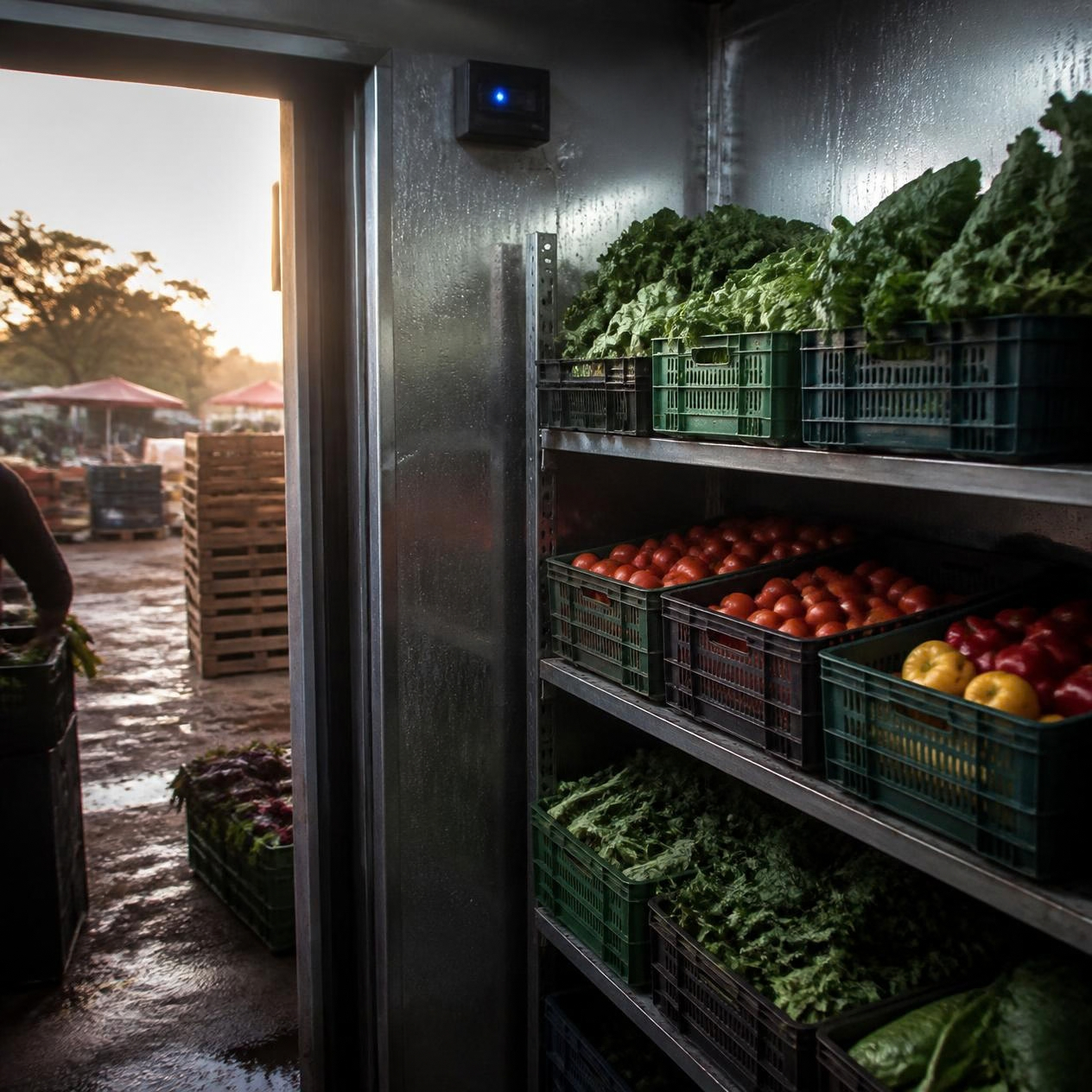
A trader can have steady buyers, a fair supplier price and a full stall, and still lose the week. Tomatoes soften, fish warms up, chicken sits in a shared freezer that dies during a power cut. Demand was never the problem. She had nowhere reliable to keep the stock cold.
That gap is the opening for a cold storage business in Africa. You do not buy food and resell it. You own the refrigeration and rent space inside it. Customers pay for storage, but what they buy is inventory that stays saleable.
It is also easy to get wrong. SEforALL’s September 2026 AgCAP methodology release says many cold-chain projects in low and middle income countries were placed in the wrong location, at the wrong scale, or without the market and energy infrastructure to sustain them. This article is about testing the idea before you buy a compressor. Nothing here promises a profit, and every illustrative number must be replaced with local quotations.
Need a Freelancer for This?
Hire verified talent on Fiverr — starting from $5. No contracts, no hassle.
Browse Fiverr Freelancers →What Is a Cold Storage Business?
A cold storage business rents temperature-controlled space (cold rooms, chillers or freezers) to farmers, traders and food companies. Customers pay a fee per crate, box, pallet or kilogram, per day, week or month. The owner sells storage capacity, not food.
How Does a Cold Storage Business Make Money?
- Storage fees. A price per unit per day or week, charged on what customers actually store.
- Reserved space. A monthly fee for guaranteed capacity, useful for restaurants, hotels and processors.
- Add-ons. Ice, crates, handling, sorting or short-distance refrigerated delivery.
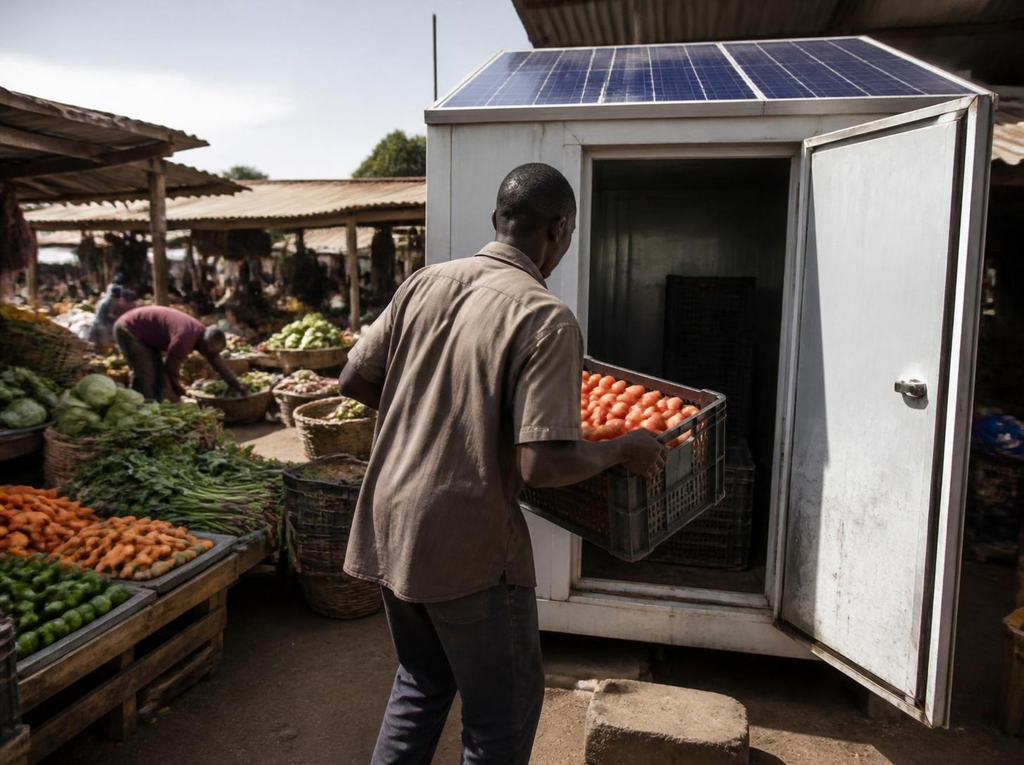
The model already exists. In Kenya, the company Soko Fresh charges farmers by the kilogram stored in solar-powered cold rooms, according to an Associated Press report from June 2026.
How Much Does It Cost to Start?
There is no honest universal number. Cost depends on country, city, land or rent, room size, temperature, equipment and power. A room sized to proven demand costs far less than a warehouse sized to hope, as the US$35,000 section below shows.
Why Boring Infrastructure Can Be a Business
Most first-time entrepreneurs look at restaurants, clothing, online shops, phones or a food brand. Infrastructure is less exciting, but it solves a problem that returns every day.
Customers do not want refrigeration equipment. They want their inventory to remain usable and saleable. Provide that reliably and you are selling protection against loss, not speculating on the price of tomatoes.
The risks simply move. Instead of price risk, you carry utilization risk, power risk and equipment risk. Cold storage is not passive income. It needs electricity, maintenance, cleaning, monitoring, security and working capital.
What the 2026 Evidence Says
SEforALL’s same release puts losses of perishable harvested products before market at up to about 40 percent in Sub-Saharan Africa. Its framing is the useful part: the question is not whether cold storage matters, but where, for whom, and alongside which other interventions.
A March 2026 SEforALL analysis finds cooling has repeatedly proven viable where producers are organised and buyers are reliable, and names dairy, fish and certain horticultural products as the most promising off-grid value chains. It also warns of “white elephants”, meaning stranded or underused cold rooms.
The Biggest Cold Storage Mistake: Buying the Equipment First
The wrong sequence is: buy a cold room, then hope customers arrive. The right sequence is:
Customers, then location, then product, then required temperature, then utilization, then electricity, then equipment, then financing.
Every step before the equipment costs almost nothing. Every step after it costs real money. If you cannot name ten customers who would use the space in week one, you do not have a business yet. You have a purchase.
Location Matters More Than the Building
Look for proximity to wholesale markets, fish landing sites, farming clusters, livestock and poultry producers, restaurants, hotels, supermarkets, transport corridors and processing zones.
There are two different plays:
- Production-side storage sits near farms, landing sites or livestock. Customers are farmers, cooperatives and fish traders who need to cool product quickly after harvest or catch.
- Market-side storage sits near wholesalers, retailers and restaurants. Customers are traders and food businesses holding stock for days before sale.
SEforALL notes that large downstream facilities, such as urban aggregation centres, tend to be built by big private players who already know where to put them, and describes community-level upstream cooling as the more underserved space. Read that as a hint to stay small and specific, not to compete with a logistics company.
Product Type Decides the Room
Do not treat “cold” as one setting. Requirements depend on the product, whether it is processed, how it is packaged and your country’s food-safety rules.
| Product | Temperature requirement | Potential customer |
|---|---|---|
| Fresh vegetables | Varies by crop and ripeness | Farmers, traders |
| Fruit | Varies by fruit and stage of ripeness | Traders, exporters |
| Fish | Chilled or frozen, depending on the product | Fish traders, processors |
| Poultry | Chilled or frozen | Poultry businesses, wholesalers |
| Meat | Chilled or frozen | Butchers, wholesalers |
| Dairy | Chilled | Processors, retailers |
Confirm exact set points with your national standards body and equipment supplier before you design anything. Mixed rooms often fail because products need different conditions.
Electricity Is the Real Business Problem
A cold room without reliable power is not an asset. It is a liability.
A 2024 study of Ugandan cities logged storage temperatures in bulk facilities and found readings above the maximum allowable temperature for between a third and three quarters of the logged period. Equipment existed. Temperature control did not hold.
Your options are grid power, generator backup, solar with batteries, or a mix. Solar can improve resilience, but it is not automatically cheaper. The economics depend on your load, refrigeration efficiency, battery size, local sunshine, tariffs, generator fuel prices and maintenance. Insulation, door discipline and temperature alarms often save more than another solar panel.
Price your real power situation first. MetricSuite’s Generator vs Grid Power Cost Calculator is a good starting point.
Show the Money: A Simple Illustrative Model
Illustrative example. Replace with local quotations before investing. These are not market prices.
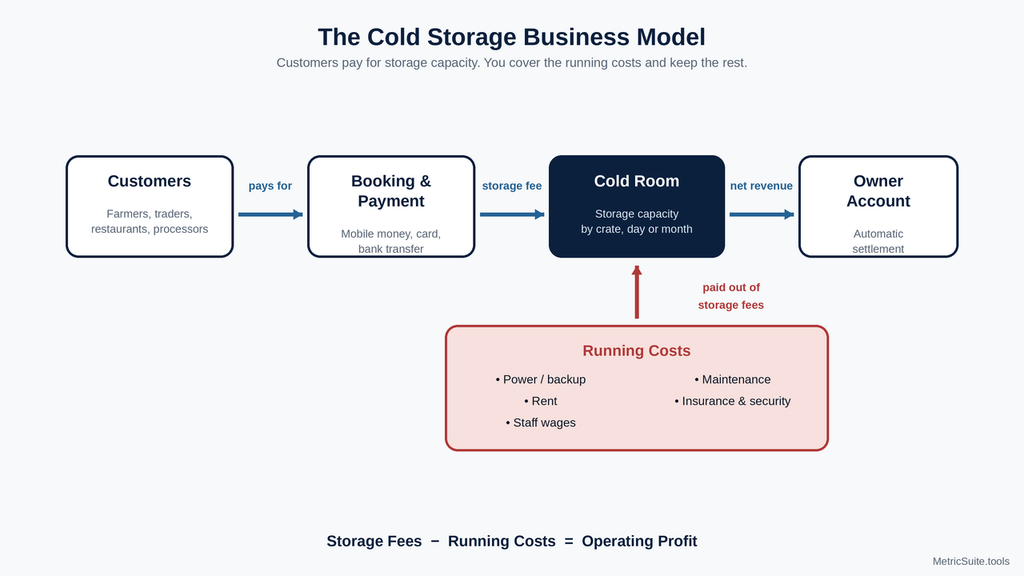
Assume a small facility with 500 crate spaces, a price of US$0.15 per crate per day, and monthly costs of:
| Monthly cost | US$ |
|---|---|
| Electricity or fuel backup | 250 |
| Rent | 150 |
| Attendant wages | 180 |
| Maintenance | 80 |
| Security and monitoring | 50 |
| Insurance | 40 |
| Other operating costs | 50 |
| Total | 800 |
Now see what utilization does to the result:
| Average utilization | Monthly revenue (US$) | Operating profit before tax and financing (US$) |
|---|---|---|
| 30% | 675 | -125 |
| 40% | 900 | 100 |
| 60% | 1,350 | 550 |
| 80% | 1,800 | 1,000 |
Each 10 points of utilization moves profit by US$225 here. Break-even sits near 36 percent utilization, or roughly 178 crates stored daily.
The point is not the profit figure. It is that utilization decides everything, and you cannot know yours until customers commit. This example also leaves out tax, loan repayments, equipment replacement and spoilage claims.
→ Use the free Break-Even Calculator at MetricSuite.tools to calculate this instantly, no signup required. Enter your monthly fixed costs, your price per crate-day and your handling cost per crate.
Can You Start With US$35,000?
Maybe, maybe not. It depends on the country, city, land or rent, room size, equipment type, temperature requirement, new or used equipment, solar or generator needs, construction, permits and working capital.
Here is a conceptual framework, not a quotation:
| Category | Approximate share of startup budget |
|---|---|
| Refrigeration and cold-room equipment | Largest component |
| Building or site preparation | Significant |
| Power and backup | Significant |
| CCTV, sensors and access control | Relatively small |
| Licences and registration | Varies by country |
| Working capital | Essential, never skip it |
A small, well-utilized room is more realistic at this budget than a large warehouse. Keep money aside for the first months, when utilization is low and costs are not.
Start Small: A Staged Test
Stage 1. Interview 30 to 50 potential customers. Ask what they store now, how much, for how long, at what temperature and what they pay, plus what happens when they cannot find space, how much they lose, and whether they would pay for reliable third-party storage.
Stage 2. Secure anchor customers. Do not build first. Collect letters of interest, preliminary commitments, cooperative relationships and recurring customers.
Stage 3. Lease before you buy land. Flexibility is worth more than ownership at this point.
Stage 4. Install a deliberately small facility.
Stage 5. Track utilization weekly.
Stage 6. Expand only when demand proves itself.
Before committing to a site, check whether the producers you plan to serve earn enough to pay for storage. The Crop Profit Calculator and Livestock Profitability Calculator help you test that. Then use the Margin and Markup Calculator to check that your storage price leaves you a margin.
Could You Run a Cold Storage Business From Another Country?
Partly, if you design it that way. The aim is to depend less on employee reports.
- Digital payments. Bank transfer, mobile money, card, QR or payment links. Avoid cash wherever possible.
- Digital booking. Customers reserve space, dates, duration and product type.
- CCTV. Entrance, loading area, cold-room doors, receiving desk, equipment room and perimeter.
- Sensors. Temperature, humidity where relevant, power status, door openings and equipment alarms.
- Digital records. Customer, storage location, arrival, departure, payment, temperature and balance.
Stop Staff From Controlling the Money
Design the business so staff cannot touch the cash: customer, then digital payment, then business merchant account, then automatic settlement, then owner-controlled bank account.
Staff should not hold banking credentials or mobile-money PINs, unrestricted transfer authority, the ability to change payment destinations, the ability to refund themselves, or control over cash collections.
Add inventory controls too: numbered storage locations, customer records, access logs, CCTV, weighing records where relevant, digital invoices and collection records.
Technology reduces fraud risk. It does not remove it. You still need someone local you trust, and a qualified technician on call.
Where Could This Work?
This is not a ranking. Conditions differ by country, city and product, so local research is essential.
| Country | Possible customers | What the 2026 record shows |
|---|---|---|
| Ghana | Poultry, fish, produce, urban food distributors | A large poultry cold store was commissioned at Kpone in February 2026, reported as 2,400 tonnes by one outlet and 3,000 tonnes by another. Ghana spends US$300 to US$400 million a year on poultry imports. |
| Uganda | Fish, produce, meat, dairy, Kampala and secondary cities | Only 9 of 16 city districts had bulk cold storage, at 4.5 cubic metres per 1,000 inhabitants, with private owners holding 90.3 percent of volume. Fieldwork ran late 2022 to early 2023. |
| Kenya | Horticulture, fish, produce traders, supermarket and export supply chains | Solar cold rooms were commissioned at Kitengela Market in February 2026 to cut spoilage among traders and farmers. |
| Nigeria | Large urban food markets, poultry, fish, fruit and vegetable traders | Not untouched. ColdHubs already runs solar cold rooms in markets and farm clusters. The Climate and Clean Air Coalition cites average post-harvest losses of 45 percent for vegetables and 35 percent for fruit. |
| Tanzania | Fisheries, produce, meat, urban markets, export agriculture | FAO lists limited cold chain infrastructure among the challenges facing Lake Tanganyika fisheries, with a target to cut dagaa losses by 60 percent by 2030. |
In Ghana and Nigeria, larger players are already active. A small operator’s realistic fit is a niche a big facility ignores: one market, one landing site or one cluster of restaurants. In Uganda and Tanzania, the gap looks less like missing equipment and more like reliability outside the biggest city. Verify each of these against your own site.
Who Should Not Start This Business?
Skip it if you cannot monitor refrigeration or arrange maintenance, have no plan for reliable electricity, have no identified customer base, expect passive income from day one, cannot tolerate downtime, do not understand food-safety requirements, will not track utilization, or cannot keep working capital in reserve.
FAO makes a related point for fish: a reliable cold chain is not economically sustainable unless volume and quality reach a threshold, and cold chains depend on maintenance by qualified staff.
The Five Numbers You Need to Know
- Storage capacity. How many crates, boxes or pallets fit.
- Average utilization. The share of capacity actually filled and paid for.
- Revenue per storage unit. Price times days stored.
- Electricity cost per month. Grid, fuel and battery costs combined.
- Customer acquisition and retention. How many customers you win, and how many stay.
From these you get break-even utilization: the share of capacity you must fill to cover monthly costs. If that number is above what your customer interviews support, do not build.
Researching storage for your own farm instead? MetricSuite’s guide to post-harvest storage and ROI covers the farmer side. This article covers the operator side.
Frequently Asked Questions
Is cold storage a profitable business in Africa?
Only at the right utilization. In the illustrative model above, a small facility breaks even near 36 percent utilization and earns a modest profit above that. Location, power reliability, pricing, maintenance and demand decide the outcome.
How much does it cost to start a cold storage business?
It depends on country, city, room size, temperature, equipment and power set-up. No single figure applies. Get local quotations and keep working capital in reserve.
What products need cold storage?
Fresh vegetables, fruit, fish, poultry, meat and dairy all benefit, each at different conditions. SEforALL names dairy, fish and certain horticultural products among the most promising for off-grid cooling.
How does a cold storage business make money?
It charges for storage space, usually per crate, box, pallet or kilogram for each day, week or month. Reserved-space contracts and add-ons such as ice and handling add revenue.
Can a cold storage business be managed remotely?
Partly. Digital payments, online booking, CCTV, temperature sensors and digital records reduce your dependence on employee reports. You still need trusted local staff and a technician for repairs.
How can farmers reduce post-harvest losses?
Cool produce quickly after harvest, handle it gently, use clean crates and sell or store it promptly. Shared cold rooms let farmers pay only for the crates and days they use.
Is solar power suitable for cold storage?
It can be, especially where the grid is unreliable and fuel is costly. It is not automatically cheaper. Compare load, battery needs, sunshine, tariffs and generator costs before deciding.
Your Next Step: Calculate Before You Spend
Find the customers first. Measure the demand. Calculate the utilization you need to break even. Then price the equipment.
This week, list ten businesses that might rent cold space from you and ask each the Stage 1 questions. Then run your numbers through the free Break-Even Calculator. If the demand is real, you have something worth pricing. If not, you saved yourself a cold room.
Sources and References
- SEforALL, AgCAP methodology news release, 10 September 2026 and methodology PDF.
- SEforALL, Sustainable Cooling Access for Agriculture and Fisheries in Sub-Saharan Africa, 19 March 2026.
- Mukama and Abaasa (2024), Assessment of the cold storage capacity used in bulk handling of perishable agricultural produce in Ugandan cities, International Journal of Refrigeration.
- Ghanaian Times, 3,000 tonnes cold storage facility commissioned in Kpone, February 2026, and Graphic Online, 2,400-tonne cold storage facility for poultry inaugurated at Kpone, 16 February 2026.
- GhanaWeb, Agric minister unveils cold storage facility and cuts sod for poultry processing complex at Kpone, February 2026.
- The Metropolitan Shopper, Kajiado commissions solar-powered cold rooms at Kitengela Market, 16 February 2026.
- Associated Press, Solar cold storage helps African farmers cut losses and reach global markets, June 2026.
- Climate and Clean Air Coalition, ColdHubs Ltd. (undated), and ColdHubs.
- FAO, UDSM hands over TANFISH Digital Market System to FAO, 18 February 2026.
- FAO, Multidimensional solutions strategy for dagaa fisheries in Tanzania, and Services and infrastructure for freezing.