

An overseas holiday property can create income, build wealth and give a diaspora family a connection to home. But before you buy a Caribbean vacation rental, you need to understand the economics of running a hospitality business from another country.
A beautiful property overlooking the Caribbean Sea can look like an easy decision. The photographs are impressive, the nightly rates seem generous, and someone locally may already be telling you how much money it could make.
For an African or Caribbean diaspora investor living in Canada, the United States, Britain or Europe, the idea is especially appealing. You could own an income-producing asset in the region, earn in a US-dollar-linked currency, host visiting family and eventually have a place for retirement or relocation.
But there is a problem.
A property that looks like a good real-estate purchase is not necessarily a profitable vacation-rental business.
The purchase price is only the beginning. You have to account for occupancy, seasonal pricing, booking commissions, property management, maintenance, insurance, licensing, tax, financing, exchange control and the cost of overseeing everything from abroad. A property can generate substantial booking revenue and still leave its owner putting money in every month.
This guide shows you how to test a Caribbean vacation rental investment before you commit your savings, using Barbados as the worked case study.
What is a Caribbean vacation rental investment?
A Caribbean vacation rental investment is the purchase of a house, apartment or villa in the Caribbean that is let to visitors for short stays, usually through platforms such as Airbnb, Vrbo or Booking.com. It is two investments in one: a real-estate asset and a hospitality business. Both must work for the investment to pay off.
The Caribbean vacation rental opportunity is real, but so is the competition
Tourism matters across the region. The World Bank’s 2025 report Rethinking Caribbean Tourism found that tourism accounted for about 22% of the combined GDP of the 12 countries it studied in 2023.
The accommodation market is also changing. The same report cites AirDNA data showing short-term rental listings across the Caribbean grew by 35% after 2019, and notes that in most Caribbean countries these alternatives to hotels now account for more than 30% of tourist accommodation stays.
Potential guests include:
- Canadian, American and British visitors returning to see relatives.
- Caribbean nationals living overseas who travel home regularly.
- International holidaymakers who want an apartment or private villa.
- Digital nomads and remote workers.
- Retirees taking extended winter stays.
- Families who need more space than a hotel room offers.
A well-run property can also work with local drivers, tour operators, restaurants, farmers, fishers and cleaning companies, so the investment supports the local economy beyond the building itself.
But growing demand does not mean every property will succeed.
Tourism growth does not guarantee property profitability
The World Bank report makes a point every investor should read twice. Short-term rental supply in several destinations now rivals or exceeds the hotel sector. In St Lucia, for example, short-term rentals offered 5,584 rooms in 2024 against 4,449 hotel rooms, and fewer than 10% of those rentals were registered with the tourism authority.
More supply means more competition for the same guests.
The difference between hotel occupancy and rental occupancy
The report also notes that Airbnb listings in the data it cites average roughly 25 to 120 occupied nights a year, while a hotel room running at 70% occupancy is occupied for about 255 nights.
That is a large gap. A listing can be open to guests 365 days a year and still receive relatively few bookings. So do not buy on the strength of listing counts, glossy photographs or the nightly rates advertised by neighbouring properties. You need evidence of actual demand for your specific location and type of accommodation.
Why diaspora investors frequently miscalculate rental returns
Consider a Jamaican Canadian in Toronto looking at a two-bedroom property in Barbados. The agent shows comparable listings charging BBD 500 to 800 a night and suggests the property could be busy most of the year.
The investor does a quick calculation:
BBD 600 × 20 nights × 12 months = BBD 144,000 a year
It looks attractive. But it assumes 20 booked nights every month (about 66% occupancy, year-round), the same rate in July as in February, and no costs. Set that 240-night assumption against the 25 to 120 nights the World Bank cites and the problem is obvious.
There are two mistakes here.
Gross bookings are not investment income
Booking revenue is the starting point, not the result. From it, an owner may pay platform fees, management, cleaning, laundry, electricity, water, internet, insurance, land tax, repairs, replacement furniture, licensing, accounting and statutory levies. If the property is financed, loan payments come out next.
Separate three numbers:
- Gross revenue: what guests pay for accommodation.
- Net operating income: what remains after ordinary operating expenses.
- Investor cash flow: what remains after loan payments, taxes and other cash needs.
A property can show an operating profit and still require the owner to send money every month.
The passive-income illusion
Vacation rentals are hospitality businesses. Guests expect clean rooms, reliable internet, working air conditioning, fresh linen, a safe property and a quick response when something breaks. Someone has to deliver all of that, and when you live overseas that someone is usually a local property manager.
Good managers are valuable. The problem arises when the arrangement is informal rather than a contracted service. Who controls the booking account? Who approves repairs? Who verifies cleaning invoices? Who receives the guest payments? Who checks that every booking was recorded?
An overseas owner needs an operating system, not just a trusted person with the keys.
Five numbers every vacation rental investor must understand

1. Average daily rate (ADR)
ADR is the average accommodation revenue earned per occupied night.
ADR = Accommodation revenue ÷ Occupied nights
If a property earns BBD 60,000 from 120 occupied nights, its ADR is BBD 500. Do not confuse ADR with the advertised nightly price. Discounts, low-season pricing, weekly-stay reductions and promotions all pull the real figure down.
2. Occupancy rate
Occupancy measures how much of the available inventory was actually sold.
Occupancy = Occupied nights ÷ Available nights × 100
If the property is available for 300 nights after owner use and maintenance closures, and guests book 120 of them, occupancy is 40%. Be consistent. Blocking dates for personal use should not inflate the occupancy figure.
3. Revenue per available night (RevPAR)
RevPAR combines price and occupancy in one number.
RevPAR = Accommodation revenue ÷ Available nights
A property charging BBD 600 at 30% occupancy earns BBD 180 per available night. One charging BBD 450 at 70% occupancy earns BBD 315. The cheaper listing is the stronger business. RevPAR is more useful than nightly rates alone, but it still ignores costs.
4. Net operating income (NOI)
NOI is the income the property produces after operating expenses, before loan payments and income tax.
NOI = Operating revenue − Operating expenses
Operating expenses include management, platform fees, cleaning, utilities, insurance, routine repairs, property taxes and other recurring costs. Keep mortgage payments and major capital projects out of this figure, so you can see whether the property itself is productive before considering how it was financed.
5. Cash-on-cash return and break-even occupancy
Cash-on-cash return measures annual cash flow against the cash you actually put in.
Cash-on-cash return = Annual pre-tax cash flow ÷ Initial cash invested × 100
An investor who puts in BBD 180,000 and receives BBD 18,000 a year in pre-tax cash flow has a 10% cash-on-cash return.
Break-even occupancy answers the most important question of all: how many nights must be booked before the property stops losing money? For a financed property, calculate it twice:
- The occupancy needed to cover operating costs and loan interest.
- The occupancy needed to cover the full loan payment, including principal.
The second number is the one that matters if rental income has to meet your monthly mortgage.
The real costs of operating a Caribbean vacation rental
Acquisition and setup costs
Allow for:
- Legal representation and conveyancing.
- Title searches and due diligence.
- Survey and valuation.
- Stamp duty, transfer taxes and registration fees where they fall on the buyer.
- Exchange control filings if you are a non-resident.
- Renovation and repairs.
- Furniture, appliances and furnishings.
- Security systems and keyless entry.
- Professional photography and listing setup.
- Working capital.
Working capital is the item most often skipped. A new listing can take months to build reviews and a reliable booking pattern. Do not spend every dollar buying and furnishing the property.
Monthly operating expenses
| Expense | What to include |
|---|---|
| Property management | Booking administration, guest communication and oversight |
| Platform fees | Airbnb, Vrbo, Booking.com or other channels |
| Housekeeping | Cleaning, laundry and linen changes |
| Utilities | Electricity, water, internet and cable |
| Maintenance | Plumbing, electrical, air conditioning and general repairs |
| Security | Monitoring, guards and access systems |
| Staff | Gardening, pool service and other workers |
| Insurance | Building, contents, liability and windstorm cover |
| Property taxes | Land tax and other statutory charges |
| Accounting | Bookkeeping, tax returns and compliance |
| Supplies | Toiletries, kitchen items, cleaning products and replacements |
If you employ a gardener, pool attendant or housekeeper directly, use the Caribbean employee cost calculator to estimate the employer contributions on top of wages.
Booking platform fees have gone up
Platform fees deserve special attention. Airbnb has retired its old split-fee model, under which hosts paid about 3% and guests paid a separate service fee. Most hosts now pay a single host-only fee of about 15.5% of the booking subtotal, including the cleaning fee, deducted from the payout. If you are working from an older spreadsheet or an agent’s projection that assumes a 3% host fee, your margins are overstated by more than 12 percentage points.
Other platforms charge differently. Confirm the current fee on each channel you plan to use.
Maintenance and capital expenditure
Replacing a dripping tap is routine maintenance. Replacing a roof, several air-conditioning units or a bathroom is capital expenditure. Many “profitable” rentals only look that way because these future costs were left out.
In the tropics, heat, humidity, salt air, storms and heavy air-conditioning use wear out equipment quickly. Set a monthly maintenance reserve and keep a separate capital replacement fund.
Worked example: does a Caribbean vacation rental actually make money?
Here is an illustrative two-bedroom vacation rental in Barbados. These figures are hypothetical. They are not market rates or verified results for any property.
Investment assumptions
| Item | Assumption |
|---|---|
| Purchase price | BBD 560,000 |
| Closing, furnishing and setup | BBD 40,000 |
| Total project cost | BBD 600,000 |
| Owner’s cash invested | BBD 180,000 |
| Loan | BBD 420,000 at 7% over 25 years |
| Annual loan payments | BBD 35,622 |
| Available nights | 300 |
| Occupancy | 45% (135 nights) |
| Average daily rate (after guest-paid levies) | BBD 500 |
| Annual accommodation revenue | BBD 67,500 |
Note that 135 nights is already above the top of the 25 to 120 night range the World Bank cites for Airbnb listings. This is not a pessimistic case.
Annual operating budget
| Expense | Annual amount |
|---|---|
| Booking platform fees (15.5%) | BBD 10,463 |
| Property management (20% of revenue) | BBD 13,500 |
| Cleaning and guest supplies | BBD 6,000 |
| Utilities and internet | BBD 12,000 |
| Maintenance reserve (8% of revenue) | BBD 5,400 |
| Insurance, land tax, licensing and accounting | BBD 7,000 |
| Total operating expenses | BBD 54,363 |
Operating result
| Calculation | Amount |
|---|---|
| Accommodation revenue | BBD 67,500 |
| Operating expenses | (BBD 54,363) |
| Net operating income | BBD 13,137 |
| Annual loan payments | (BBD 35,622) |
| Pre-tax cash flow | (BBD 22,485) |
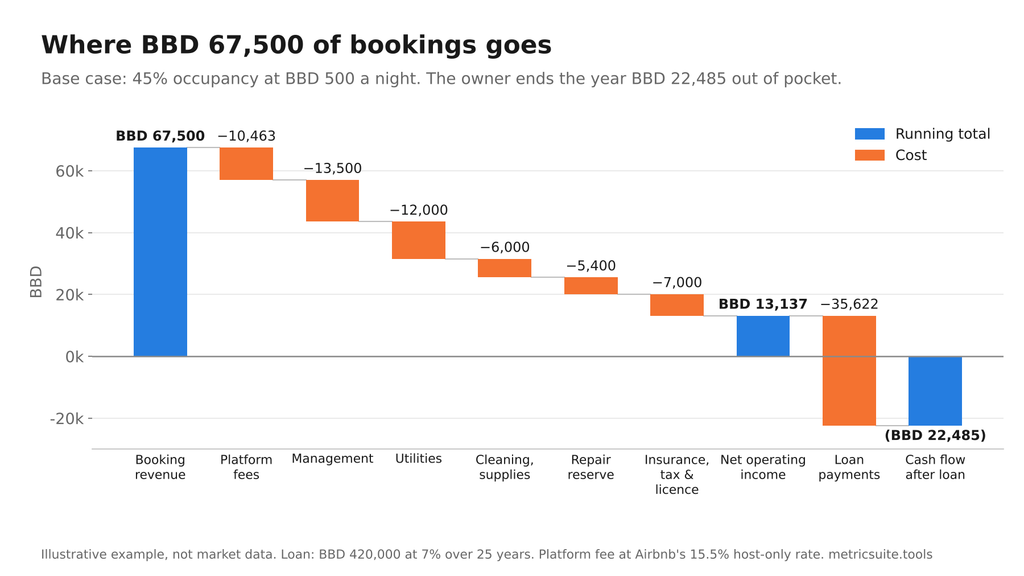
The property makes an operating profit, but the owner must contribute about BBD 22,500 a year, nearly BBD 1,900 a month, to keep it running. The cash-on-cash return is negative 12.5%.
Even without a loan, the picture is weak. An NOI of BBD 13,137 on a BBD 600,000 investment is a yield of about 2.2% before income tax.
What occupancy would this property need?
In this example, each booked night contributes about BBD 238 after platform fees, management, the maintenance reserve and cleaning. Fixed costs (utilities, insurance, tax, licensing and accounting) are BBD 19,000 a year. That gives three break-even points:
| Break-even target | Nights needed | Occupancy needed |
|---|---|---|
| Cover operating costs | 80 | 27% |
| Cover operating costs and year-one interest | 202 | 67% |
| Cover operating costs and the full loan payment | 229 | 76% |
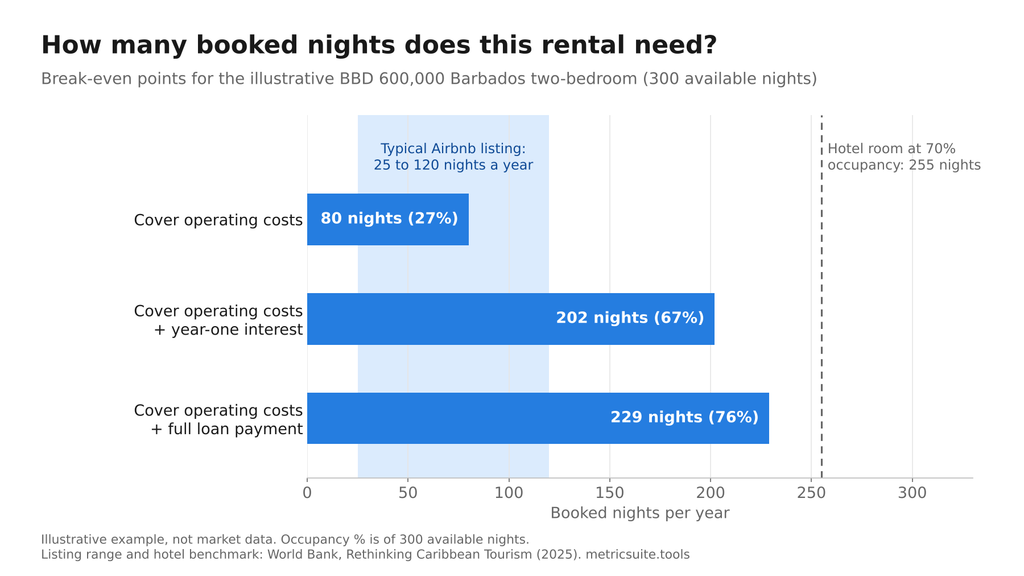
A 76% break-even is higher than the 70% a typical hotel room achieves, and nearly double the top of the range the World Bank cites for Airbnb listings. That is the number the agent’s projection never showed.
Stress-testing the example
| Scenario | Occupancy | ADR | NOI | Cash flow after loan |
|---|---|---|---|---|
| Weak year | 30% | BBD 500 | BBD 2,425 | (BBD 33,197) |
| Base case | 45% | BBD 500 | BBD 13,137 | (BBD 22,485) |
| Strong year | 60% | BBD 500 | BBD 23,850 | (BBD 11,772) |
| Strong year, higher rate | 60% | BBD 550 | BBD 28,935 | (BBD 6,687) |
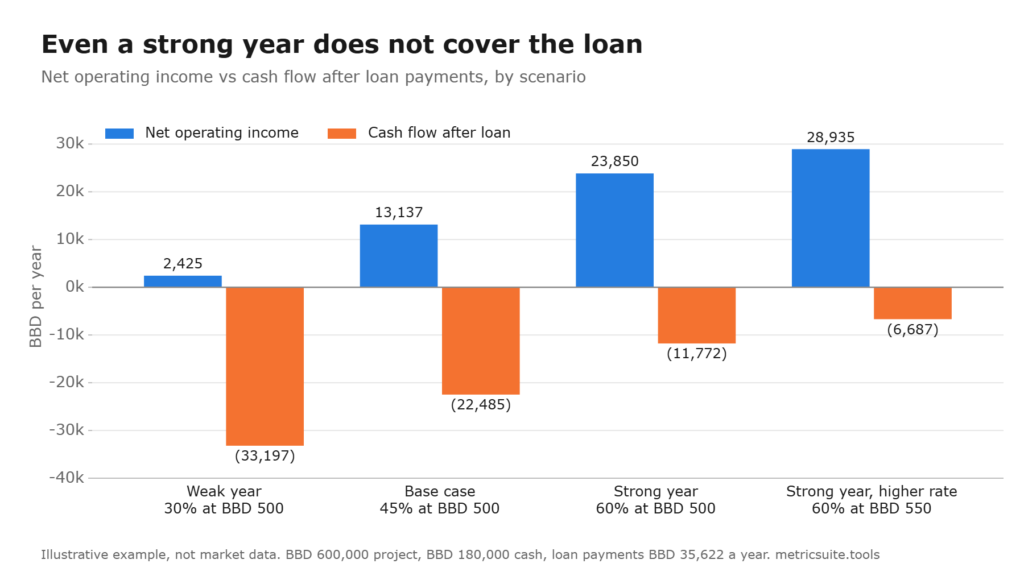
Even a strong year does not cover the loan. To make this property work, the investor would need to negotiate a lower price, put in more cash, cut the management fee, add revenue through higher rates or longer stays, or walk away.
A good investment should survive a disappointing year. It should not depend on every assumption going right.
To run your own numbers month by month, including high and low seasons, the Shared Economy Levy and VAT treatment, use the Barbados vacation rental profit calculator. Its seasonal cash-flow view is especially useful for exposing the weak months.
Tax, licensing and legal requirements
Owning a property does not automatically mean you may run it as tourist accommodation. Requirements vary by country, and sometimes by property type within a country. Before you make an offer, investigate:
- Whether short-term letting is permitted at the property.
- Tourism registration and operating licences.
- Zoning and planning restrictions.
- Condominium or homeowners’ association rules.
- Tax registration, tourism levies and VAT.
- Income tax on rental income and any withholding on non-residents.
- Insurance requirements.
- Foreign ownership and exchange control rules.
Barbados as a practical case study
Barbados shows why you should verify requirements with official sources rather than rely on an agent.
Licensing. The Barbados Ministry of Tourism states that the Barbados Tourism Product Authority enforces the Accommodation Services Act, and that accommodation businesses must register by obtaining a licence before doing business in the sector.
Rules in transition. In September 2025 the House of Assembly passed the Tourist Accommodation Bill, 2025, which would require all tourist accommodation, including short-term rentals, to be licensed, registered and inspected, and would make it an offence to operate or advertise without approval. In December 2025 the Senate sent the bill, together with a bill to repeal the Barbados Tourism Product Authority Act, to a joint select committee for wider consultation. Check the current status before you buy, because the licensing body and standards may change.
Tourism levies. Barbados charges a 10% Shared Economy Levy on tourist accommodation supplied by operators who are not registered for VAT. The Tourism Levy (Amendment) Act, 2026, passed by Parliament in January 2026, requires suppliers of tourist accommodation and online marketplaces to register with the tourism authority and the Barbados Revenue Authority, and moves collection of the levy onto booking platforms such as Airbnb and Booking.com. Do not assume the platform has handled everything: confirm what it collects, keep your own booking records and check whether direct bookings leave you responsible for the levy.
VAT. The VAT registration threshold has been BBD 200,000 a year, and the 2026 Budget raised it to BBD 350,000 from 1 October 2026. Most single-villa operators will fall below the threshold and pay the Shared Economy Levy instead, unless they register voluntarily. VAT-registered operators charge the concessionary accommodation rate plus the Room Rate Levy. PwC and the Central Bank of Barbados report that this rate rose from 7.5% to 10% from January 2020, but some Barbados Revenue Authority pages still show 7.5%. Confirm the rate directly with the Authority.
Exchange control. Non-residents need Central Bank of Barbados permission to buy property. Buyers bring the full purchase money in from abroad and register it with the Central Bank, which is what later allows rental income and sale proceeds to be sent home. Borrowing locally as a non-resident also requires permission, so many diaspora buyers finance from their home country instead. Your attorney normally handles these filings, but make sure they are done.
Tax treatment for owners living abroad
Rental income can create tax obligations in the Caribbean even if you live in Toronto, London or New York. In Barbados, income from renting residential property is taxed at 15%, and rental income earned by non-residents has been reported as subject to 25% withholding that is credited against the final tax bill. Whether those rules apply to your property depends on how it is owned and whether the income is treated as rental or business income.
Confirm with a qualified tax adviser:
- Whether the income is classified as rental income or business income.
- Whether owning through a company changes the treatment.
- Whether gross rents are subject to withholding.
- Whether withholding is a final tax or a prepayment.
- Which expenses are deductible.
- Whether you must file a local tax return.
- Whether your home country gives a foreign tax credit.
- Whether a double-taxation agreement applies.
If you plan to hold the property through a local company, the Caribbean business registration estimator gives a first view of government registration fees. The Barbados Revenue Authority should be one of your first calls.
Currency risk
The Barbados dollar is pegged to the US dollar at BBD 2 to USD 1. For a Canadian or British investor, the real currency exposure is therefore to the US dollar. A stronger Canadian dollar or pound reduces the value of your rental income when you bring it home, and a weaker one raises the cost of supporting a property that runs a deficit. Other Caribbean currencies, such as the Jamaican dollar, float and carry more risk.
How to manage your vacation rental from Canada, the UK or the United States
Remote ownership is not remote management. A successful overseas investment needs local execution and remote accountability.
Choosing a property manager
Do not choose a manager simply because they are a relative, a friend or a familiar contact. Choose someone who can show operational competence. Ask:
- How many properties do you manage now?
- What is your fee, and is it charged on gross or net revenue?
- Do you have established cleaning and maintenance teams?
- How do you handle guest complaints?
- How quickly can you respond to an emergency?
- How are bookings reconciled?
- Can you provide monthly financial statements?
- Who approves repairs above an agreed amount?
- Are you licensed, registered and insured?
Ask for references from current owners and speak to at least two of them independently. A good manager can explain how the property will be maintained, marketed and monitored all year, not just in high season.
Controlling payments and accounts
Booking revenue should flow through an account or arrangement you can see. Avoid any setup where a third party collects all the income informally and sends you whatever is left.
Put the payment process in writing. The agreement should state:
- Who owns and controls the booking platform accounts.
- Where guest payments are received.
- Who pays utilities and contractors.
- Which expenses need your approval.
- How the manager’s fee is calculated.
- When you receive distributions.
- How cash payments to contractors are documented.
- How refunds and chargebacks are handled.
You should have direct access to booking calendars, platform statements and invoices. To track operating cash month by month, the business profit and cash flow calculator can help you set a baseline.
Building a monthly reporting system
Require a monthly report covering:
| Measure | What it tells you |
|---|---|
| Available nights | How many nights were offered for sale |
| Occupied nights | How many nights were sold |
| Occupancy | How well the property was booked |
| ADR | Average income per occupied night |
| Booking revenue | Accommodation income earned |
| Platform charges | What the booking channels deducted |
| Management costs | What the manager charged |
| Operating expenses | What the property cost to run |
| Maintenance | What was repaired or replaced |
| Net cash flow | What was left after the month’s expenses |
Compare every report with your original forecast. If costs are rising faster than revenue, act immediately. Do not wait until year end to discover the property has been losing money.
Choosing the right rental investment model
Not every diaspora investor needs to run a full vacation-rental business. The right model depends on your goals, your time, your appetite for operational responsibility and how you plan to use the property.
| Investment model | Advantages | Main risks | Best suited to |
|---|---|---|---|
| Short-term vacation rental | Higher nightly rates and flexible owner use | Seasonality, high costs and heavy management | Active investors with reliable local support |
| Long-term residential rental | Steadier income and fewer guest turnovers | Tenant risk, maintenance and lower rent | Investors who want simpler recurring income |
| Professionally managed rental pool | Outsourced operations and shared services | Fees, contract restrictions and limited control | Investors comfortable with formal management |
| Personal holiday home | Personal use and long-term appreciation | Ongoing costs with no guaranteed income | Buyers who put lifestyle before returns |
A vacation rental is not always the best option for someone approaching retirement. A long-term tenant may provide steadier income with far less involvement. The investment model must fit your life, not just the property’s view.
An eight-step process for evaluating a Caribbean rental property
Step 1: Choose the destination and micro-location
Do not treat a whole country as one market. Compare parishes, towns, neighbourhoods and tourism corridors. A property near a popular beach, cruise port, business district or airport will have a different demand pattern from one further inland. Check transport, restaurants, attractions, safety, utilities and access to healthcare.
Step 2: Establish actual accommodation demand
Find comparable properties with similar bedrooms, amenities, location, guest capacity, finish quality and seasonal pricing. Ask for real booking histories where possible. Use market data tools to check occupancy rather than advertised rates. Use a conservative occupancy assumption and separate high season from low season.
Step 3: Verify ownership and permission to operate
Use an independent local attorney, not the seller’s. Confirm title, boundaries, registered interests, planning permission, permitted use, building condition and outstanding charges. Check whether a short-term rental licence is needed and whether any condominium or association rules prohibit holiday letting.
Step 4: Calculate the complete acquisition cost
List every cost needed to make the property operational: purchase, legal fees, taxes, exchange control filings, repairs, furniture, appliances, photography, registration, insurance and working capital. Get independent quotes where you can.
Step 5: Build a month-by-month forecast
Do not use one annual rate and one annual occupancy figure. Forecast each month with its own nightly rate, occupancy, available nights, platform fees, cleaning, management, utilities, repairs, insurance, levies, taxes and loan payments. This shows whether high-season income can carry the property through the slow months.
Step 6: Audit the management arrangement
Get a written proposal from the manager covering service standards, payment controls, approval limits, reporting and termination terms. Do not buy on the assumption that you will find a good manager later.
Step 7: Stress-test the investment
Model at least three scenarios: conservative, expected and optimistic. Then test a major repair, a hurricane closure of several weeks and a currency move that cuts the value of your income in your home currency. If the property only works in the optimistic case, it does not work.
Step 8: Make the decision
Compare the expected cash-on-cash return with other uses of your capital. Consider the time the property will demand and the risk of concentrating your savings in one building in one country. If the return does not compensate for the financial, operational and currency risks, negotiate, change the model or walk away. Turning down a property that does not make financial sense is a good decision.
Diaspora investor due diligence checklist
Property and legal
- Have I independently verified ownership and title?
- Have I checked boundaries and outstanding charges?
- Is short-term rental use permitted?
- Have I confirmed every licence and registration, including any pending changes in the law?
- Have I reviewed condominium or neighbourhood restrictions?
- Has my attorney handled exchange control permission and registered my funds?
Financial
- Have I included every acquisition cost?
- Have I forecast revenue month by month?
- Have I used current platform fees, not old ones?
- Have I included management, insurance, utilities and maintenance?
- Have I calculated all three break-even points?
- Have I modelled the full loan payment, including principal?
- Have I kept a working-capital reserve?
Remote management
- Have I independently checked the property manager’s references?
- Do I control the booking accounts?
- Will every booking and expense be recorded?
- Are repair approval limits in writing?
- Will I receive a monthly report?
Tax and wealth protection
- Have I confirmed local income tax treatment?
- Do I know my obligations as a non-resident owner?
- Do I know whether withholding is a final tax or a prepayment?
- Have I checked my home-country tax position?
- Have I planned for currency conversion costs and getting money home?
If you cannot answer these questions, the investment is not ready for your money.
Key takeaways
- Tourism growth is not proof that your property will profit. What matters is your location, your guest segment and your seasonality.
- Gross bookings are not investor income. Platform fees, management, maintenance, levies and financing can absorb most of the revenue.
- Break-even occupancy is the key number. In our example, the property needed 76% occupancy to cover its loan, well above what most listings achieve.
- Remote management needs controls. A good local manager is essential, but you still need transparency and financial oversight.
- Check licensing, levies, tax and exchange control before you buy. Never assume a property can legally operate as a vacation rental because others nearby do.
Conclusion: buy the business case for your Caribbean vacation rental investment, not the holiday dream
For the African and Caribbean diaspora, buying property back home is about more than money. It can mean a connection to family, a source of income, a future retirement home or something to pass to the next generation. Those are legitimate reasons to invest.
But good intentions do not replace financial discipline. A Caribbean vacation rental investment must attract guests, operate efficiently, meet its legal obligations and produce enough cash after every expense. Distance makes it easier for costs, management problems and poor decisions to go unnoticed, so an investor in Toronto, London, New York or Amsterdam has to be more disciplined, not less.
Before you buy, build the financial model. Check the legal position. Interview managers. Study the local market. Stress-test the numbers.
Start with MetricSuite’s Barbados vacation rental profit calculator and see what happens when you change the nightly rate, occupancy, management fee, utilities and financing. Then compare the result with your other options. For more tools built for overseas families, see the MetricSuite diaspora tools.
The goal is not to own a Caribbean property that looks successful. It is to own an investment that performs, protects your capital and builds your long-term financial independence.
Frequently asked questions
Is buying a vacation rental in the Caribbean a good investment?
It can be, but profitability depends on the purchase price, location, occupancy, seasonal rates, operating costs, taxes, financing and management. Calculate cash flow after loan payments and break-even occupancy before you commit capital.
How much can an Airbnb in the Caribbean make?
Income varies by property, destination and season. Estimate revenue using realistic monthly occupancy and nightly rates, then deduct platform fees of about 15.5%, management, operating costs and loan payments. Data cited by the World Bank suggests many listings are booked only 25 to 120 nights a year.
What is a good occupancy rate for a Caribbean vacation rental?
There is no universal target. Compare the property with genuine local competitors, then calculate the occupancy it needs to cover operating costs and the full loan payment. If that break-even figure is higher than comparable properties achieve, the price or financing does not work.
Can I manage a Caribbean vacation rental while living abroad?
Yes. You need a reliable local manager, a written management agreement, direct access to booking accounts, monthly financial reports and clear approval limits for repairs and payments.
What expenses should I include when buying a vacation rental?
Include purchase and legal costs, exchange control filings, repairs, furnishing, insurance, licensing, management, platform fees, cleaning, utilities, maintenance, levies, property taxes and working capital.
Do non-residents pay tax on Caribbean rental income?
Usually, yes. Non-residents can have local tax and filing obligations on rental income, and some countries withhold tax from rents paid to non-residents. The rules depend on the country, the ownership structure and how the income is classified, so get local tax advice.
Do I need a licence to operate an Airbnb in Barbados?
Yes. Barbados requires accommodation businesses to register and obtain a licence before operating, and a Tourist Accommodation Bill that would require licensing, registration and inspection of all short-term rentals is before Parliament. Check current requirements before buying.
What is the difference between rental profit and rental cash flow?
Operating profit measures income against operating expenses. Cash flow also accounts for loan payments, including principal, and other cash movements. A property can make an operating profit and still have negative cash flow.
How do I calculate the return on a vacation rental?
Take the annual pre-tax cash flow after all expenses and loan payments, divide it by the cash you invested, and multiply by 100. This is the cash-on-cash return.
Should I buy a vacation rental or a long-term rental property?
A vacation rental can earn higher nightly rates but needs more intensive management and carries more seasonal risk. A long-term rental usually gives steadier income with fewer turnovers. Choose according to your goals, time and risk tolerance.
Sources: