
Your client in London or Texas pays US$500. By the time it reaches your bank account or mobile money wallet in Kampala, Nairobi, Accra, Lagos or Kingston, some of it has gone to receiving fees, conversion fees and an exchange rate you never agreed to. On a bad route you lose 8% or more. On a good one you keep about 97%.
This calculator shows what actually lands from every option available where you live: Payoneer, Grey, PayPal, Wise and a plain bank wire. Enter the amount, the currency and your country, and it ranks them by what you keep.
Disclosure: MetricSuite may earn a commission if you open an account through some links on this page, at no cost to you. It does not change the numbers. The calculator ranks every option by what you receive, including the ones that pay us nothing.
Get Paid From Abroad: What You Actually Receive
Compare Payoneer, Grey, PayPal, Wise and a bank wire for a client payment landing in Uganda, Kenya, Ghana, Nigeria or Jamaica.
Every option, ranked by what lands in your account
How this works: each option is costed from the client's payment to money in your local bank account or mobile money wallet, at today's mid-market exchange rate, minus every fee and exchange rate margin along the way. The client's own sending fees are not included.
Fees used: Payoneer 1% to receive into a USD, EUR or GBP receiving account (minimum US$1), your withdrawal rate above, and a US$29.95 annual fee if you receive under US$6,000 in 12 months. Grey 0.8% deposit (minimum 2, maximum 10 in the payment currency), 1% conversion capped at US$6, your margin above, and Grey's published withdrawal fee for your country. PayPal 4.40% plus a fixed fee on commercial payments from abroad, plus your conversion rate above. Wise is shown as unavailable because it does not let residents of these countries hold money or get USD account details.
This is an estimate, not a quote. Fees vary by account, and every provider shows the final amount before you confirm. Fees last checked November 2026.
Which option pays the most?
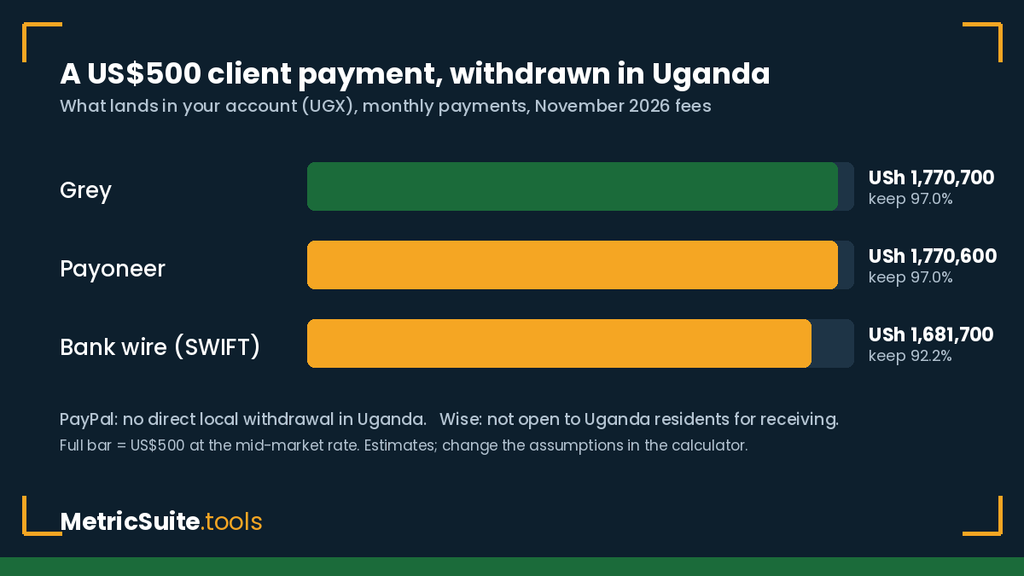
For a straightforward bank transfer from a client, Grey and Payoneer come out close to level, and both beat a bank wire by a wide margin. On a US$500 monthly payment withdrawn in Uganda, both leave you about 97% of the payment, while a SWIFT wire to a local bank leaves about 92%.
[IMAGE: get-paid-from-abroad-uganda-chart-1200×675.png]
What changes the ranking is not the fee table. It is where you live, who is paying you, and how much you receive in a year.
| You live in | Payoneer | Grey | PayPal | Wise | Bank wire |
|---|---|---|---|---|---|
| Uganda | Yes | Yes | No direct local withdrawal | Not for residents | Yes |
| Kenya | Yes | Yes | Yes, withdraw to M-Pesa | Not for residents | Yes |
| Ghana | Yes | Yes | Not operating | Not for residents | Yes |
| Nigeria | Yes | Yes | Yes, through Paga (new in 2026) | Not for residents | Yes |
| Jamaica | Yes | No | Receive only, no local withdrawal | Not for residents | Yes |
What each option costs
Payoneer
Payoneer gives you receiving accounts in USD, EUR and GBP that work like a local bank account in those countries. Payments from another Payoneer customer are free. A client paying into your receiving account in a currency that is not your local one costs 1%, and a card payment through a Payoneer payment request costs 3.20% plus US$0.49.
Withdrawing to your local bank in your own currency costs 1 to 4% of the amount, depending on your region and volume. Payoneer shows your exact rate in your account. The calculator uses 2% by default and lets you change it.
There is also a US$29.95 annual account fee if you receive less than US$6,000 in any 12 months. Above that, it does not apply. This is the fee that makes Payoneer expensive for occasional, small payments and cheap for regular income.
Grey
Grey is an Africa-focused account with USD, EUR and GBP details. It charges 0.8% to receive a US bank transfer, with a minimum of US$2 and a maximum of US$10. Converting to your local currency costs 1%, capped at US$6, plus an exchange rate margin that Grey shows before you confirm.
Withdrawals are flat and small: US$1 to MTN or Airtel mobile money in Uganda, US$0.50 to M-Pesa in Kenya, US$0.20 to mobile money in Ghana and ₦35 to a Nigerian bank. Because the big fees are capped, Grey gets relatively cheaper as payments get larger. Grey does not cover Jamaica.
PayPal
PayPal charges 4.40% plus a fixed fee to receive a commercial payment from abroad in Kenya, then a currency conversion margin of around 4% when you convert. Kenyan users can withdraw to M-Pesa through PayPal’s mobile money service.
Nigeria regained the ability to receive PayPal payments in January 2026 through a link with Paga, which lets users withdraw in naira. PayPal does not currently operate in Ghana, Ugandan accounts cannot withdraw directly to a local bank or mobile money, and Jamaican accounts can receive money but not withdraw to a Jamaican bank. Use PayPal only when a client will pay no other way.
Wise
Wise is one of the cheapest ways to send money to Africa and the Caribbean, which is why it shows up in every comparison. But to receive client payments you need a Wise balance and account details, and Wise only offers balances to residents of a list of countries that does not include Uganda, Kenya, Ghana, Nigeria or Jamaica. Nigeria is also specifically excluded from USD account details. If someone tells you to “just use Wise”, check where you are registered first.
Bank wire (SWIFT)
A wire straight to your local bank works everywhere, but you pay twice. Intermediary banks and your own bank take fees out of the payment, and your bank converts at its own buying rate. The calculator assumes US$25 in deducted fees and a 3% exchange margin. Check your bank’s tariff guide and change both if yours are different. A wire makes sense for large one-off payments, or when you want to keep dollars in a domiciliary account.
When Payoneer is the better choice
Pick Payoneer over a cheaper-looking option when:
- A platform pays you. Upwork, Fiverr, Amazon and more than 2,000 other marketplaces pay into Payoneer directly, so the money goes straight from the platform to your account.
- You live in Jamaica. Of the accounts compared here, Payoneer is the only one that both receives client payments and withdraws to a Jamaican bank.
- You receive US$6,000 or more a year. The annual fee disappears, and Payoneer’s costs come close to Grey’s.
- Clients want to pay by card. Payoneer payment requests let a client pay by card. You pay more in fees, but you get paid.
- You want one account for several currencies and platforms. Payoneer also offers a Mastercard for eligible accounts. Check what is available for your country in your account before you rely on it.
If you are paid a few hundred dollars a year by one client through a bank transfer, Grey will usually leave you more.
Getting the money onto mobile money

Most freelancers in East and West Africa spend from mobile money, not a bank account. Grey withdraws directly to MTN and Airtel in Uganda, M-Pesa in Kenya and mobile money in Ghana. With Payoneer, the usual route is to withdraw to your local bank and move it to mobile money from your banking app. In Kenya, PayPal withdraws to M-Pesa.
Each extra hop can carry its own fee. Before you settle on a route, check what your bank charges to send to mobile money with the Mobile Money Fees Calculator.
How to keep more of every payment
- Invoice in USD, GBP or EUR, not your local currency. You control when and where it gets converted.
- Ask clients to pay by bank transfer, not card. On Payoneer, a card payment costs more than three times as much as a bank transfer.
- Batch small payments. Grey’s minimum deposit fee is US$2, so ten US$20 payments cost more than one US$200 payment.
- Check the rate before you convert. Compare the rate you are offered with the mid-market rate on the Currency Converter. The gap is the fee you do not see.
- Price your work to cover it. The Freelance Day Rate Calculator helps you set a rate that leaves room for payment costs, and the Free Invoice Generator makes the invoice.
More tools
- Send Money to Ghana and Uganda: What Your Family Actually Receives for money going the other way
- Africa Remittance Comparison
- Caribbean Remittance Comparator
- Uganda Business Tools
- Kenya Business Tools
- Caribbean Business Tools
Fees last checked November 2026. Providers change fees and the countries they serve, and your own account may show a different rate. Every provider shows the final amount before you confirm, so treat these numbers as a planning estimate.
FAQ
What is the cheapest way to receive money from abroad in Uganda?
For a client paying by bank transfer, Grey and Payoneer both leave you about 97% of a US$500 monthly payment, well ahead of a bank wire at about 92%. Grey withdraws directly to MTN and Airtel mobile money. Payoneer is the better choice if a platform like Upwork or Fiverr is paying you.
Can I use Wise to receive payments in Uganda, Kenya, Ghana or Nigeria?
Not as a resident. Wise only lets residents of certain countries hold money or get USD account details, and Uganda, Kenya, Ghana and Nigeria are not on that list. Wise is useful for people abroad sending money to these countries.
Does PayPal work in Nigeria in 2026?
Yes. Since January 2026, Nigerian users can link PayPal to a Paga wallet to receive international payments and withdraw in naira. Expect PayPal’s commercial receiving fee and a currency conversion margin on top.
How much does Payoneer charge to receive money?
Payments from other Payoneer customers are free. A client paying into your USD, EUR or GBP receiving account costs 1% if it is not your local currency, and a card payment costs 3.20% plus US$0.49. Withdrawing to a local bank in your own currency costs 1 to 4%, and there is a US$29.95 annual fee if you receive less than US$6,000 in 12 months.
How do I receive international payments in Jamaica?
Payoneer receives in USD, EUR and GBP and withdraws to a Jamaican bank. A SWIFT wire also works but usually costs more. PayPal accounts in Jamaica can receive money but cannot withdraw to a local bank, and Wise and Grey do not serve Jamaican residents for receiving.
Why is a bank wire the most expensive option?
Intermediary banks deduct their own fees as the payment passes through, your bank may charge an inward fee, and your bank converts at its own buying rate, often several percent below the mid-market rate.
Sources
- Payoneer fees (receiving, withdrawal, annual account fee): https://www.payoneer.com/in/about/fees/
- Payoneer pricing (receiving accounts, local vs non-local currency): https://www.payoneer.com/pricing/
- Grey fees and charges (deposit, conversion, withdrawal by country, updated October 2026): https://grey.co/blog/fees-and-charges-on-grey
- Wise, where you need to live to hold money: https://wise.com/help/articles/2813542/where-do-i-need-to-live-to-hold-money-with-wise
- Wise, USD account details restrictions: https://wise.com/help/articles/2810318/can-i-get-usd-account-details
- PayPal Kenya merchant fees: https://www.paypal.com/ke/webapps/mpp/merchant-fees
- PayPal Mobile Money Service with M-PESA: https://www.paypal.com/ke/smarthelp/article/FAQ3891
- Wise, can PayPal be used in Kenya (4% currency conversion): https://wise.com/gb/blog/can-paypal-be-used-in-kenya
- TechCabal, PayPal returns to Nigeria through Paga (January 2026): https://techcabal.com/2026/01/27/paypal-returns-to-nigeria-after-two-decades-this-time-through-paga/
- WorldFirst, PayPal Business in Nigeria, Morocco, Kenya and Ghana (fees checked June 2026): https://www.worldfirst.com/af/blog/business-banking-insights/paypal-business-nigeria-morocco-kenya/
- PayPal Community, Jamaican bank accounts cannot be linked for withdrawal: https://www.paypal-community.com/t5/Wallet/Unable-to-link-my-Jamaican-bank-account-to-the-bank-account/m-p/2809824
- GTBank Uganda tariff guide (inward and outward telegraphic transfer charges): https://gtbank-uganda.files.svdcdn.com/production/general/A2-Tariff-guide2.pdf
- ProGigFinder, receiving Upwork payments in Uganda, Kenya, Nigeria and Ghana (bank wire costs): https://www.progigfinder.com/blog/how-to-receive-upwork-payments-in-uganda-kenya-nigeria-and-ghana-in-2026
- Zawya / Reuters, East and West African exchange rates (fallback FX): https://www.zawya.com/en/economy/africa/ugandan-and-kenyan-currencies-could-climb-zambias-may-slide-rjm72yef