
A man spent seven years in Dubai sending money home for a house. Every few weeks he got photos of freshly tiled floors, so he never doubted the build was nearly done. When he flew back, he found the money gone and a structure that was barely standing. (YEN.com.gh)
Stories like his are common enough to be a genre on Ghanaian social media. A man in Germany trusted an uncle with a four-bedroom house and came home to something far smaller. A worker in the UK sent his brother £10,000 and got almost nothing for it. The transfer itself rarely goes wrong. What goes wrong is everything after it: who holds the money, who checks the work, and what has to be true before the next payment goes out.
This guide covers how to build a house in Ghana when you live abroad, in the order things need to happen. It is built around one rule: no money leaves your account until you have proof that the last stage was done properly.
The 8 steps at a glance
- Set the full budget before you buy anything
- Verify and register the land
- Put your paperwork in order in Ghana
- Hire licensed professionals, and someone independent to watch the site
- Get the building permit before anyone digs
- Choose the builder and sign a written contract
- Release money stage by stage, against proof
- Fund it steadily and finish it properly
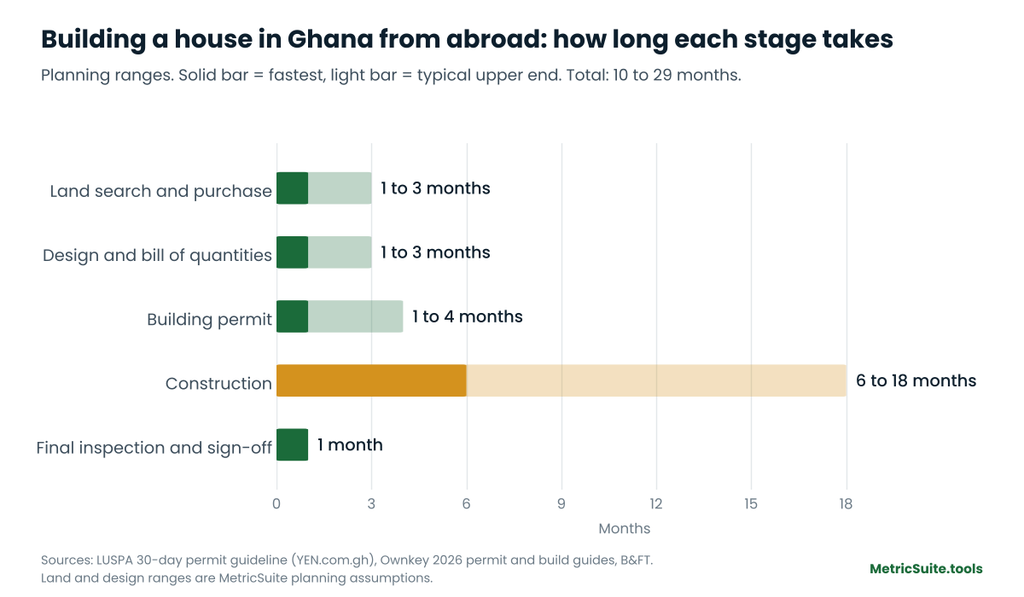
Plan on 10 to 29 months from first land search to moving in. Most of the variation comes from the land checks, the permit queue and how steadily you can fund construction.
Step 1: Set the full budget before you buy anything
Most people budget for the house and forget everything around it. Construction in Greater Accra runs about GH₵2,600 to GH₵7,200 per square metre in 2026, depending on finish. That covers the structure and finishes only.
On top of it come professional fees (usually 8 to 14% of construction), the permit, utility connections, a compound wall, independent supervision and a contingency. If you are managing the build from abroad, use a 20% contingency, not 10%.
For a typical 3-bedroom house of about 135 sqm at a standard finish in Greater Accra, that adds up to roughly GH₵835,000, or about US$71,700, before land. Kumasi, Takoradi, Tamale and Cape Coast usually come in 15 to 25% lower.
Run your own numbers in the Ghana House Build Cost Calculator. It gives you a stage-by-stage budget in cedis and your own currency, and tells you how much to send each month. Then cost the land separately with the Ghana Land Purchase Cost Calculator.
If you cannot fund the whole build, decide now which stage you can fully fund and stop there. A roof on a finished shell protects your money. A half-built wall left through two rainy seasons does not.
Step 2: Verify and register the land
Do not build on land you have not checked yourself through a lawyer. Ghana’s land disputes come from double sales, family land sold without authority and boundaries that do not match the documents.
Before you pay the balance on a plot:
- Hire your own lawyer, not the seller’s. Ask for a lawyer who regularly handles diaspora land purchases.
- Get an official search at the Lands Commission. It shows who is registered as owner and whether there are competing claims or encumbrances on the plot. The Commission’s GELIS online portal now covers several regions. (Lands Commission GELIS)
- Have a licensed surveyor check the plot on the ground against the site plan used for the search. A clean search on the wrong plot is worthless.
- Ask the neighbours who owns the land and whether anyone else has claimed it.
- Register the land in your name as soon as the purchase is done. You will need a TIN to register land documents at the Lands Commission. (Graphic Online)
If the plot has never been registered, the Lands Commission publishes a notice of the first registration so that anyone with a competing claim can object. That takes time, but it is the point at which hidden claims surface. It is far better to find them before the foundation goes in.
Step 3: Put your paperwork in order in Ghana
Three things save months later if you set them up early:
- Ghana Card and TIN. Your TIN is needed for land registration and much of the formal paperwork around a build. If you hold a Ghana Card, the TIN is linked to it.
- A power of attorney with limits. If someone in Ghana needs to sign for you at the Lands Commission or the assembly, give them a written power of attorney. A power of attorney made abroad has to be notarised where you live and then authenticated for use in Ghana, usually at the Ghana embassy or high commission. Ask your lawyer exactly what the Lands Commission will accept before you sign. (MyJoyOnline)
- A bank account the build runs through. Pay suppliers and the builder from an account you control and can see online, not through a relative’s personal account.
Keep the power of attorney narrow. Name the property and the tasks (signing land documents, filing the permit), and set an end date. A broad power of attorney to “manage my affairs” is how people lose land, not just money.
Step 4: Hire licensed professionals, and someone independent to watch the site
From abroad, your professionals are your eyes. You need four of them, and the builder is not one of them.
| Role | What they do for you | How to check them |
|---|---|---|
| Architect | Drawings for the permit and the builder | Must be registered with the Architects Registration Council. Search the Ghana Institute of Architects online portal by name. |
| Structural engineer | Foundation, columns, beams and slabs | Ask for their professional registration number and check it with their institution. |
| Quantity surveyor | Bill of quantities: every material and labour item, priced | Use a GhIS-licensed QS. Fees are typically 1 to 3% of construction. |
| Independent site supervisor | Checks each stage before you pay for the next | Someone who is not paid by, related to or chosen by the builder. |
Checking the architect matters more than it sounds. In 2026 the Ghana Institute of Architects reported an arrest for drawings stamped with a real architect’s stolen registration number, and urged the public to verify architects through its online portal before engaging them. (Graphic Online)
The bill of quantities is your most important document. It turns “about GH₵600,000” into a list of bags of cement, blocks, rods and roofing sheets you can check prices against. Every builder you ask for a price should be pricing the same list. (Ownkey)
Step 5: Get the building permit before anyone digs
You need a development and building permit from the Metropolitan, Municipal or District Assembly where the land sits. Building without one risks fines, a stop-work order and demolition, and an unpermitted house is hard to sell or mortgage later.
A typical application includes:
- The assembly’s application forms
- Proof of land ownership (title certificate, registered lease or a Lands Commission letter)
- Architectural and structural drawings signed by registered professionals
- A site plan showing boundaries and setbacks
- EPA clearance, where the assembly requires it
- Proof that property rates are paid
The Land Use and Spatial Planning Authority’s guideline is 30 days for a complete application, but some assemblies list longer timelines and many applicants wait two to four months. (YEN.com.gh, Ownkey) Fees are set by each assembly. As one example, Ga West Municipal Assembly’s draft 2026 schedule lists GH¢200 for the application form and a permit rate of 0.63% of the cost of development. A permit is generally valid for five years.
Two things to tell whoever is handling this for you:
- A receipt for the processing fee is not a permit. Do not let work start until the permit itself is in hand, and ask for a clear photo of it.
- The assembly inspects at key stages and does a final inspection before it signs the building off for occupation. Your builder must call for these inspections, not skip them.
Step 6: Choose the builder and sign a written contract
Get at least three prices against the same bill of quantities. A price far below the others usually means something is missing that will be added later.
There are two common ways to engage a builder in Ghana:
- Full contract: the builder supplies labour and materials for an agreed price. Simpler to manage, but you need tight stage payments and proof of what was bought.
- Labour only: you buy materials directly from suppliers and pay the builder for labour. Cheaper and more transparent, but someone you trust has to check deliveries against the bill of quantities.
Whichever you choose, the contract should state:
- The drawings and bill of quantities the price is based on
- What is and is not included (roofing, electrical, plumbing, finishes, compound wall)
- The payment schedule, tied to stages, not dates
- A retention of about 10% held until a defects period after handover
- Who buys materials, and that every purchase needs a receipt
- The timeline, and what happens if the builder stops work
Step 7: Release money stage by stage, against proof
This is the step that separates a finished house from a viral video. Overruns of 40 to 60% are typical on Ghana self-builds paid as a lump sum instead of milestone by milestone with an independent supervisor, according to Ownkey’s 2026 build guide. (Ownkey)
Split the build into six payment gates. Before each payment, ask for specific proof and get your independent supervisor to confirm it.
| Payment gate | Proof to ask for before you pay |
|---|---|
| 1. Mobilisation | Signed contract, permit in hand, site cleared and set out to the drawings |
| 2. Foundation | Trench depth with a tape measure in shot, rebar before concrete is poured, receipts for cement and rods |
| 3. Walls and ring beam | Walls at full height, ring beam reinforcement before the pour, block and cement receipts |
| 4. Roof | Roof structure and sheets on, receipts for timber or steel and roofing sheets |
| 5. Services and finishes | Conduit and pipes before plaster covers them, then tiling, fittings and painting |
| 6. Handover | Final walk-through on a live video call, snag list cleared, keys and all receipts handed over |
A milestone split many quantity surveyors use is 10 to 20% to mobilise, 30% at foundation, 25% at ring beam, 25% when the roof is on, and the last 10% at handover, held for about 30 days for defects.
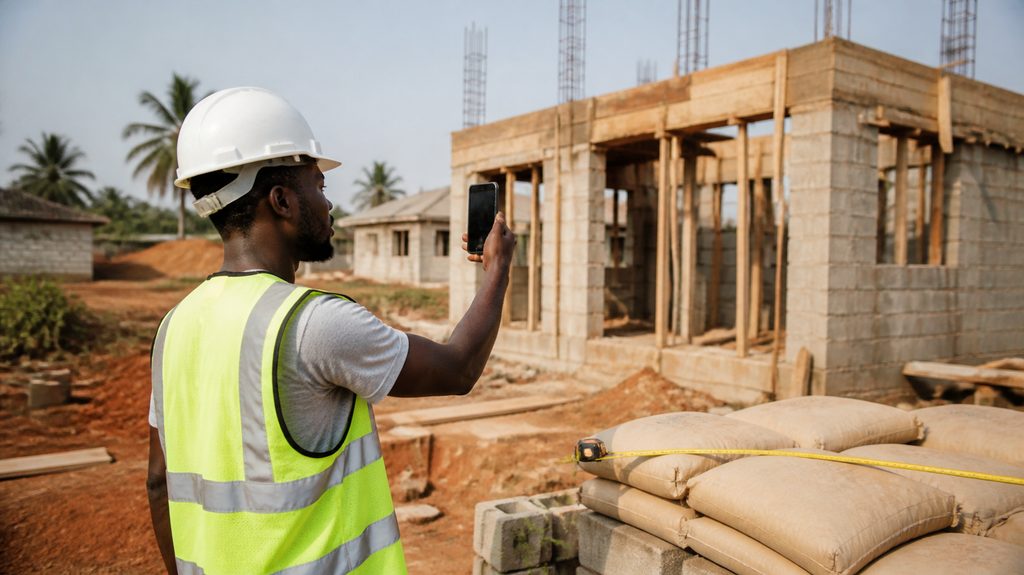
How to make the proof hard to fake:
- Use live video calls, not just photos. Photos can be old or from another site. Ask the supervisor to walk the site on video, starting from the gate.
- Ask for something specific each time. A tape measure in the trench, a reading of the date on a newspaper, the plot number painted on the wall.
- Match money to receipts. Every transfer should map to a stage, and every purchase to a receipt. Spending without a receipt is a flag, not a detail.
- Visit at the moments that matter. If you can only travel once or twice, go before the foundation is poured and before the roof goes on.
Track every cedi you send
The Build From Abroad Control Workbook gives you a stage-by-stage budget scaled to your house, the six payment gates with the proof needed before each payment, and logs that match every transfer to what was actually spent. Excel, no macros. CA$49, one-time.
Get the workbook | See what is inside
Step 8: Fund it steadily and finish it properly
Stop-start funding is the main reason Ghana builds drag on for years. Materials go up, exposed work weathers and builders move to other jobs. Divide your full budget by the number of months you plan to build and send that amount on a schedule. For a GH₵835,000 build over 12 months, that is about US$6,000 a month before fees.
Three things protect the money on the way:
- Compare transfer providers on the full cost, fee and exchange rate together. The Africa Remittance Comparison shows both, and our guide to sending money to Ghana shows what actually lands.
- Price the build in cedis, not dollars. The cedi lost about 9.5% against the dollar on the interbank market in the first nine months of 2026, and local material prices move with it. (MyJoyOnline) The Cedi Depreciation Buffer Calculator helps you size a buffer.
- Send for the next stage only. Never fund two stages ahead because the rate looks good this week.
When the house is done, get the assembly’s final inspection and its sign-off for occupation, connect ECG and water in your own name, and keep every drawing, permit, receipt and contract together. You will need them if you ever sell, rent out or mortgage the house.
If a relative is managing the build
Many people build through family, and it can work. It works best when the relative is your eyes on the ground, not your wallet.
- Pay suppliers and the builder directly where you can, rather than sending lump sums to a relative to pass on.
- Agree in writing what the relative is responsible for, and what you are paying them for their time. Unpaid help is where resentment and “borrowed” money start.
- Keep the independent supervisor even when family is involved. It protects the relationship as much as the money.
If family is also relying on you for monthly support while you build, the Black Tax Calculator shows what both commitments add up to in a year, and our guide on family financial support covers how people structure it.
Your checklist before the first payment
- Full budget worked out, with a 20% contingency
- Lands Commission search done, plot surveyed and land registered in your name
- Ghana Card, TIN and a limited power of attorney in place
- Architect verified, bill of quantities from a GhIS-licensed QS
- Independent site supervisor hired
- Building permit in hand, not just the fee receipt
- Written contract with stage payments and a retention
- Proof required for each of the six payment gates agreed with the builder
More tools for building in Ghana
- Ghana House Build Cost Calculator
- Ghana Land Purchase Cost Calculator
- Generator vs Grid Power Cost Calculator
- Ghana Import Duty Calculator for fittings you ship from abroad
- All Ghana tools and all diaspora tools
This guide is general information, not legal advice. Rules and fees differ by assembly and change over time. Confirm requirements with your lawyer and the assembly where you are building. Last checked October 2026.
FAQ
Can I build a house in Ghana while living abroad?
Yes, many people in the diaspora do. The safe way is to verify and register the land through your own lawyer, hire registered professionals and an independent site supervisor, get the building permit first, and release money only stage by stage, against proof that the previous stage was done.
Do I need a building permit to build a house in Ghana?
es. You need a development and building permit from the assembly where the land is located before construction starts. Building without one risks fines, a stop-work order and demolition, and makes the house hard to sell or mortgage.
How long does it take to get a building permit in Ghana?
The planning authority’s guideline is 30 days for a complete application, but many applicants wait two to four months, depending on the assembly and whether drawings need revising. A permit is generally valid for five years.
How long does it take to build a house in Ghana?
Construction of a typical 3-bedroom house takes about 6 to 18 months with steady funding. Add one to three months each for land checks and design, one to four months for the permit and about a month for the final sign-off.
Should I let a family member manage my house project in Ghana?
A relative can be useful as your eyes on site, but should not be the only check on the money. Pay suppliers and the builder directly where possible, keep an independent supervisor, and agree in writing what the relative is responsible for and paid for.
Do I need a power of attorney to build in Ghana from abroad?
Usually, if someone in Ghana has to sign land or permit documents for you. A power of attorney made abroad must be notarised and then authenticated for use in Ghana, usually at the Ghana embassy or high commission. Keep it limited to the property and specific tasks, with an end date.
How do I check that an architect in Ghana is genuine?
Search the architect by name on the Ghana Institute of Architects online portal, which shows registration status, photo, firm and registration number. The Architects Registration Council also publishes lists of architects and firms in good standing.
Sources
- YEN.com.gh, man in Dubai sends money for house, relative squanders it: https://yen.com.gh/people/301723-ghanaian-man-sends-money-build-house-cries-visit-site-return/
- YEN.com.gh, man in Germany sends money to uncle for four-bedroom house: https://yen.com.gh/people/299329-ghanaian-man-sends-money-uncle-build-a-hose-cries-return/
- YEN.com.gh, Ghanaian in UK sends brother £10,000 (GH¢144,000): https://yen.com.gh/people/239370-ghanaian-uk-recounts-how-brother-built-house-sending-ghc144k-i-mad/
- Lands Commission GELIS online services: https://onlineservices.lc.gov.gh
- Ownkey, How to Register Land in Ghana 2026 (first registration, publication, TIN): https://ownkey.com/blog/how-to-register-land-ghana
- Graphic Online, things you cannot do without a TIN (land registration): https://www.graphic.com.gh/business/business-news/thirteen-basic-things-you-cannot-do-without-a-tin-in-ghana.html
- B&FT, Land registration in Ghana part II (search timelines): https://thebftonline.com/2021/11/25/real-estate-development-101-land-registration-in-ghana-part-ii/
- MyJoyOnline, How Ghanaians abroad can buy property in Accra in 2026 (power of attorney): https://www.myjoyonline.com/how-ghanaians-abroad-can-buy-property-in-accra-in-2026-a-practical-guide/
- Graphic Online, GIA cracks down on fake architects (2026): https://www.graphic.com.gh/news/general-news/ghana-news-architects-institute-cracks-down-on-fake-architects-illegal-practice.html
- Architects Registration Council, architects and firms in good standing: https://www.arc.gov.gh/2025-good-standing-achitects/
- Ownkey, Quantity Surveyors in Ghana 2026 (BoQ, 1 to 3% fees): https://ownkey.com/gh/blog/quantity-surveyor-ghana-guide
- YEN.com.gh, Building permit costs in Ghana in 2026 (LUSPA 30 days, Ga West fees, five-year validity): https://yen.com.gh/real-estate/314630-building-permit-costs-ghana-2026-fees-requirements-how-apply/
- Ownkey, How to Apply for a Building Permit in Ghana 2026 (documents, stage inspections, occupation sign-off): https://ownkey.com/gh/blog/how-to-apply-for-building-permit-ghana
- Accra Metropolitan Assembly, permitting guidelines (completion certificate before occupation): https://ama.gov.gh/doc/permitting-guidelines.pdf
- Ownkey, Building a House in Ghana 2026: Step-by-Step Cost Guide (overruns): https://ownkey.com/gh/blog/building-house-ghana-cost-guide
- Ownkey, Ghana Build Cost Index 2026 (per sqm rates): https://ownkey.com/gh/blog/ghana-build-cost-index-per-square-metre-rates
- MyJoyOnline, Cedi depreciates by 9.5% in nine months of 2026: https://www.myjoyonline.com/cedi-depreciates-by-9-5-in-nine-months-of-2026-bog/