
Picture two letters. The first comes from a seller in Accra with a plot, a site plan and a deadline. The second arrives a year later from a tax authority in the country you left, asking why it was never told you had gone. Most returnees plan for the first letter and forget the second.
This guide covers the two parts of a return that cost the most when they go wrong and that the rest of the internet explains badly: leaving the US, UK or Canadian tax system cleanly, and buying land when the registry may not treat you as a citizen. For your budget, savings runway, pensions and 90-day plan, start with our Repatriation Checklist and come back here for the detail.
Part 1: Which Tax System Are You Leaving?
The three big departure countries work differently. The US keeps asking its citizens and resident aliens to file from abroad, and offers an exclusion for those who qualify. The UK and Canada decide whether you are still a tax resident, and the answer depends on facts you control: days, homes and family.
United States: You Keep Filing
The Foreign Earned Income Exclusion (FEIE) lets you exclude foreign earned income from regular income tax, but only if you meet all three conditions: you have foreign earned income, your tax home is in a foreign country, and you pass one of two tests.
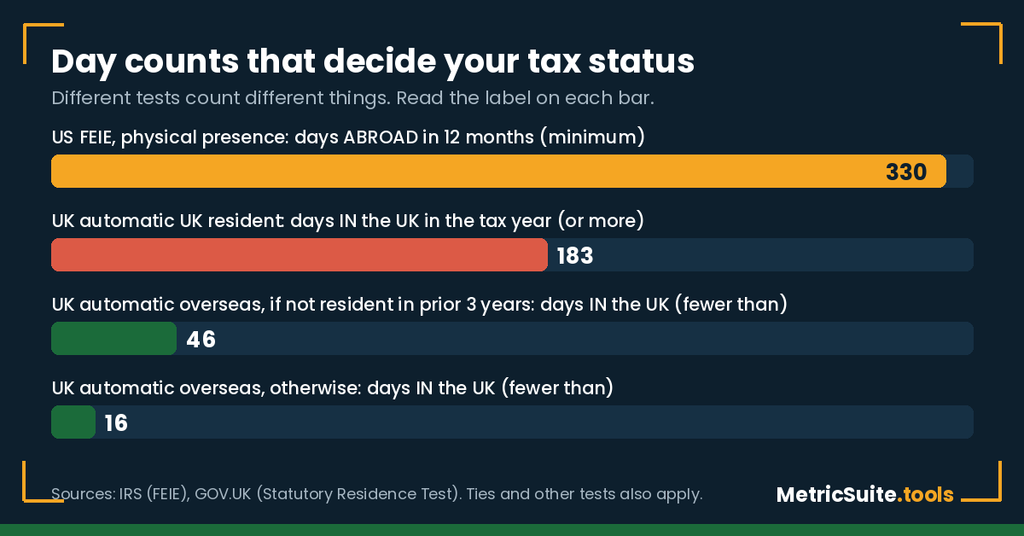
- Physical presence test: you are physically present in a foreign country or countries for at least 330 full days in any period of 12 consecutive months.
- Bona fide residence test: you are a bona fide resident of a foreign country for an uninterrupted period that includes an entire tax year.
The trap for green card holders: the bona fide residence test is open to US citizens, but resident aliens can use it only if they are citizens or nationals of a country with a US income tax treaty. If yours has no treaty, the physical presence test is your route.
Three limits to plan around:
- The cap. For 2026 the exclusion is $132,900.
- Earned income only. Wages and self-employment income count. Pensions and annuities do not.
- Self-employment tax still applies. The IRS states the excluded amount reduces regular income tax but not self-employment tax. If you run a consultancy from home, that matters.
You claim the exclusion on Form 2555, attached to your return. You still file the return.
If you open local bank accounts, the FBAR rule applies once your foreign accounts together pass $10,000 at any time in the year. The Repatriation Checklist covers it.
United Kingdom: Day Counts Decide
UK residence is worked out for each tax year (6 April to 5 April) using the Statutory Residence Test. You are UK resident only if you meet an automatic UK test or the sufficient ties test, and you meet no automatic overseas test.
The automatic overseas tests are the ones returnees aim for:
- Fewer than 16 days in the UK in the tax year (or fewer than 46 days if you were not UK resident in the previous three tax years).
- Full-time work abroad, averaging at least 35 hours a week, with fewer than 91 days in the UK, no more than 30 of them working days.
The automatic UK tests are 183 or more days in the UK, having your only home in the UK for 91 days or more in a row (with at least 30 days spent there in the year), or working full-time in the UK for any 365-day period. If neither side applies, the sufficient ties test looks at your family, work and accommodation ties against your day count.
Split-year treatment is not an application. In the year you leave, HMRC can treat your tax year as two parts, so UK tax on foreign income reflects only the time you lived in the UK. You do not apply for it. You identify the relevant case on your Self Assessment return, and it comes with conditions. Becoming non-resident also does not automatically end UK tax on income that arises in the UK, so ask an adviser about any UK rental income or UK-based work before you rely on it.
HMRC publishes a residence status checker and full guidance in RDR3. Run your own numbers through the checker for the year you plan to leave, not the year you hope you will.
A word on UK pensions. Moving a UK pension into an overseas scheme can trigger the overseas transfer charge, which is 25% of the transferred value. The charge does not apply if, for example, you are resident in the same country as the receiving scheme. Our Repatriation Calculator notes that none of its five destination countries currently hosts an HMRC-recognised scheme, so check HMRC’s list before you plan a transfer. State Pension uprating depends on where you live, and we cover it in the Repatriation Checklist.
Canada: Ties and Departure Tax
The CRA decides your status from your residential ties to Canada. Primary ties are a home in Canada, a spouse or common-law partner, and dependants. Secondary ties include a driver’s licence, passport, bank accounts and health insurance. Keeping the house, the spouse and the bank accounts while telling the CRA you have left is the classic mistake. If your situation is genuinely unclear, you can ask the CRA for a residency determination using Form NR73.
The departure tax itself (the deemed sale of your property when you leave) is explained in our Repatriation Checklist, along with RRSP withholding and TFSA rules. Two details are worth adding here. It does not reach Canadian real estate, Canadian business property, or registered plans such as RRSPs, RRIFs and TFSAs. And beyond Form T1161, you file Form T1243 with your departure-year return, and you can use Form T1244 to defer paying the tax until you sell the asset. Deferral can require security, so ask your adviser before you elect.
Tax Exit at a Glance
| Country | What decides your status | Core filings | Common trap |
|---|---|---|---|
| United States | Citizenship; FEIE needs 330 days abroad or bona fide residence | Return plus Form 2555; FBAR if foreign accounts pass $10,000 | Assuming green card holders can always use bona fide residence |
| United Kingdom | Statutory Residence Test day counts and ties | Self Assessment, with the split-year case identified | Treating split year as something you apply for |
| Canada | Residential ties | T1161, T1243, optional T1244 | Keeping the home, spouse and bank accounts and expecting non-resident status |
→ Use the free Repatriation Cost Calculator at MetricSuite.tools to calculate this instantly, no signup required.
Part 2: Buying Land When You Might Not Be a Citizen
Before the survey and the lawyer, one question decides what you can legally buy: how will the registry classify you? In several African countries the answer changes the type of interest you can hold, and a company you set up to get around it can be classified against you.

What Non-Citizens Can Hold
| Country | Non-citizens | Companies and structures |
|---|---|---|
| Ghana | Leasehold only, up to 50 years at any one time. No freehold. (Constitution, Article 266) | A company with more than 40% non-Ghanaian ownership counts as non-Ghanaian (Land Act 2020) |
| Kenya | Leasehold only, up to 99 years. Any longer grant is treated as 99 years. (Constitution, Article 65) | A company counts as a citizen only if wholly owned by citizens. Trusts: only if all beneficial interests belong to citizens |
| Nigeria | Land is held through rights of occupancy rather than absolute ownership. Transferring a statutory right of occupancy needs the Governor’s consent (Land Use Act, section 22) | Foreign buyers commonly buy in their own name, through a Nigerian company, a joint venture or a lease |
| Caribbean | Rules differ island by island | See our Caribbean Diaspora Investing guide |
If you hold the destination country’s citizenship, citizen rules should apply. Have your lawyer confirm in writing how the registry will record you before you pay a deposit, because dual citizens and non-citizens are treated differently.
The 5 Checks Before You Pay
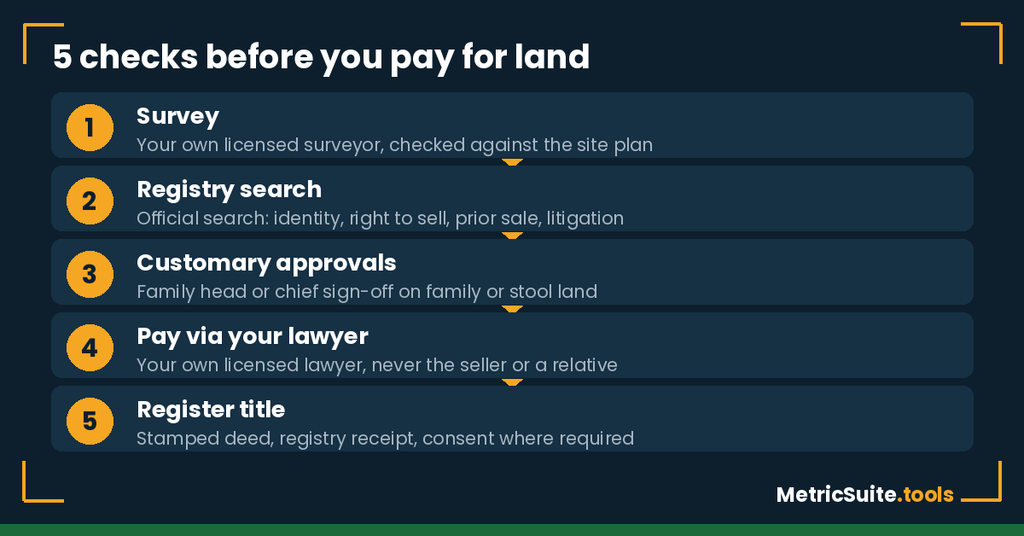
For Ghana, our Ghana Land Purchase Cost Calculator page has a full 10-item due diligence checklist, so this guide does not repeat it. Here is the short version, plus what changes in Kenya and Nigeria.
- Survey. Commission your own licensed surveyor. In Nigeria, charting also shows whether the land falls within government acquisition, committed land, excised land or free land, and a survey plan alone does not make land safe to buy.
- Registry search. Run it yourself. In Kenya, searches go through the Ministry of Lands, on Ardhisasa for digitised registries and eCitizen for others, so ask the Ministry which applies to your parcel. In Nigeria, search at the state Lands Registry, such as Lagos. In Ghana, use the Lands Commission.
- Customary approvals. On family or stool land, get the family head or chief’s approval. Ghana’s Land Act 2020 requires each Customary Land Secretariat to send its transaction records to the Lands Commission every six months, so a genuine grant should leave a paper trail.
- Your own lawyer. Pay through them, never to the seller or a relative.
- Register the title. In Nigeria, get the Governor’s consent. In Ghana, the grantor must hand you the title document at conveyance.
→ Use the free Ghana Land Purchase Cost Calculator at MetricSuite.tools to calculate this instantly, no signup required. It also carries the full Ghana checklist. It estimates stamp duty, Lands Commission fees and legal costs, and survey costs and VAT on developer sales are excluded, so budget those separately.
Currency Risk on the Purchase
You do not need a theory of exchange rates to protect a land purchase. You need three habits:
- Fix the currency in writing. Confirm whether the price is in cedi, naira, shilling or dollars, and what happens if the rate moves before completion.
- Agree the payment schedule first. Staged payments through your lawyer can spread exchange-rate risk, but only if the contract allows them.
- Price the transfer. Spreads and fees differ between providers. Compare them with the Africa Remittance Comparison tool before you move a large sum.
For the full savings and runway plan, see the Repatriation Checklist. For customs concessions on shipping your belongings, see Returning Resident Customs Rules. For investment options once you land, see Diaspora Investing in Africa and the Caribbean.
Key Takeaways
- Know your tax country first. The US taxes on citizenship and offers the FEIE. The UK and Canada tax on residence, so your days and ties decide.
- Green card holders: check your treaty. Bona fide residence is open to resident aliens only from treaty countries. Otherwise count 330 days abroad.
- Split year is claimed, not requested. You identify the case on your UK Self Assessment return.
- Canada’s departure tax skips real estate and registered plans. It hits non-registered assets, and you still file T1161 and T1243.
- Land rules depend on who you are. Non-citizens can hold Ghanaian leasehold up to 50 years and Kenyan leasehold up to 99 years, and a company with foreign owners can be classed as foreign.
Conclusion: Start This Week
Do one thing this week: write down which tax system you are leaving and which test decides your exit (330 days, an automatic overseas test, or your ties). Then ask your land lawyer one question in writing: “How will the registry classify me, and what interest can I hold?” The answers decide your filings, your budget and your structure.
→ Use the free Repatriation Cost Calculator at MetricSuite.tools to calculate this instantly, no signup required.
Disclaimer: MetricSuite.tools is not a tax adviser, law firm or financial adviser. This guide is general information, not tax, legal, immigration or financial advice, and reading it or using our tools does not create an adviser relationship. Figures, thresholds and rules were checked on 12 October 2026 and may change, so confirm your situation with the relevant tax authority, land registry or a qualified adviser before you act. See our full Disclaimer.
FAQ
What is the biggest tax mistake returnees make?
Leaving without checking which test decides their status. A US citizen needs to keep filing and claim the FEIE correctly. A UK leaver needs the day counts to work. A Canadian leaver who keeps a home, spouse or bank accounts can stay resident and keep paying tax there.
Can a US green card holder use the Foreign Earned Income Exclusion?
Yes, but not always through both tests. The physical presence test (330 full days abroad in any 12 consecutive months) is open to resident aliens. The bona fide residence test is open to them only if they are citizens or nationals of a country with a US income tax treaty.
How do I get split-year treatment in the UK?
You do not apply. When you move, you identify the relevant split-year case on your Self Assessment return, and you must meet its conditions. You will not qualify if you live abroad for less than a full tax year before returning to the UK.
Does Canada charge tax when I leave?
It can, on certain non-registered property such as shares. Canadian real estate, Canadian business property and registered plans such as RRSPs, RRIFs and TFSAs are excluded. Beyond Form T1161, you file Form T1243 with your departure-year return, and Form T1244 lets you defer paying the tax until you sell.
Can non-citizens buy land in Ghana?
Yes, as a leasehold of up to 99 years. A company is treated as a citizen only if it is wholly owned by citizens, so a company with foreign shareholders does not get around the limit.
How do I avoid land fraud when buying from abroad?
Commission your own survey, run the official registry search yourself, confirm customary approvals, pay through your own licensed lawyer rather than to the seller or a relative, and register the title. For Ghana, the full 10-item checklist is on our Ghana Land Purchase Cost Calculator page.
SOURCES
United States
- IRS, Foreign earned income exclusion: https://www.irs.gov/individuals/international-taxpayers/foreign-earned-income-exclusion
- KPMG, Rev. Proc. 2025-32, 2026 inflation adjustments (FEIE $132,900): https://kpmg.com/us/en/taxnewsflash/news/2025/10/tnf-rev-proc-2025-32-inflation-adjustments-for-2026-individual-taxpayers.html
- IRS, Report of Foreign Bank and Financial Accounts (FBAR): https://www.irs.gov/businesses/small-businesses-self-employed/report-of-foreign-bank-and-financial-accounts-fbar
United Kingdom
- GOV.UK, Tax on foreign income: residence (SRT and split year): https://www.gov.uk/tax-foreign-income/residence
- GOV.UK, RDR3 Statutory Residence Test: https://www.gov.uk/government/publications/rdr3-statutory-residence-test-srt
- GOV.UK, Overseas transfer charge guidance: https://www.gov.uk/government/publications/qualifying-recognised-overseas-pension-schemes-charge-on-transfers/the-overseas-transfer-charge-guidance
- GOV.UK, Check your UK residence status: https://www.tax.service.gov.uk/guidance/check-your-uk-residence-status (linked from the GOV.UK page above, not opened separately)
Canada
- CRA, Determining your residency status: https://www.canada.ca/en/revenue-agency/services/tax/international-non-residents/information-been-moved/determining-your-residency-status.html
- CRA, Leaving Canada (emigrants): https://www.canada.ca/en/revenue-agency/services/tax/international-non-residents/individuals-leaving-entering-canada-non-residents/leaving-canada-emigrants.html
- BDO, Canada departure tax and reporting (exclusions, T1161, T1243, T1244): https://www.bdo.global/en-gb/insights/tax/expatriate-tax/canada-departure-tax-and-reporting-requirements-when-you-leave-canada
Land
- Kenya Constitution 2010, Article 65: https://www.constituteproject.org/constitution/Kenya_2010
- Global Law Experts, Land for foreign investors in Ghana (non-citizen freehold ban, 50-year leasehold, Article 266): https://globallawexperts.com/land-for-foreign-investors-ghana/
- Afriwise, Key highlights of Ghana’s Land Act 2020 (40% test, customary land secretariats, registration): https://www.afriwise.com/blog/key-highlights-of-ghanas-land-act-2020
- Resolution Law Firm via Mondaq, Buying property in Nigeria as a foreigner (29 May 2026): https://www.mondaq.com/nigeria/real-estate/1794016/buying-property-in-nigeria-as-a-foreigner-legal-requirements-procedure-and-practical-guide
- AMCO Properties, Land search on eCitizen Kenya (plot seller blog, used only for which platforms exist; confirm with the Ministry of Lands): https://amccopropertiesltd.co.ke/how-to-do-land-search-ecitizen-kenya-2026-guide
MetricSuite (internal)
- https://metricsuite.tools/repatriation-readiness-checklist/
- https://metricsuite.tools/repatriation-calculator/
- https://metricsuite.tools/ghana-land-purchase-cost-calculator/
- https://metricsuite.tools/africa-remittance-comparison-send-money-for-less-metricsuite/
- https://metricsuite.tools/returning-resident-customs-rules/
- https://metricsuite.tools/caribbean-diaspora-investing/
- https://metricsuite.tools/diaspora-investing-africa-caribbean/