

Introduction
On 2 September 2024, Benin became the first African country to pass a nationality law written specifically for descendants of the enslaved. Benin Afro-descendant citizenship, created by Law No. 2024-31, is now one of the most closely watched experiments in reparative justice and memory justice on the continent.
The law offers Beninese nationality by recognition to people whose genealogy includes a sub-Saharan African ancestor deported during the transatlantic slave trade. It was amended by Law 2025-11 of 1 July 2025, and applications run through the official portal, myafroorigins.bj. Benin even took the message to the UN General Assembly on 28 September 2026, according to Rio Times.
Our thesis is simple. This policy is a double-edged sword. It gives applicants a real legal home in West Africa and gives Benin a lever for investment and soft power. It also carries hard limits on political rights, a demanding burden of proof, tax exposure and open questions about how the state will cope at scale.
This guide covers both sides: what Afro-descendant repatriation means for you and your family, and what it means for the Republic.
Not legal or tax advice. This is general information, checked on 13 October 2026. Nationality and tax rules change, and your facts matter. Confirm everything with the Beninese authorities or a qualified adviser before you apply or move.
Section I: The Individual’s Perspective (Benefits and Pitfalls)
The Benefits for the Individual

Legal status and identity. You apply online at myafroorigins.bj. The fee is US$100, and the decision window is three months from the date Benin confirms it has your complete file.
To qualify for Benin Afro-descendant citizenship you must:
- Be at least 18 years old.
- Show that you have a sub-Saharan African ancestor deported during the slave trade, or a direct line of descent from someone already recognised under the law.
- Not be a national of a sub-Saharan African state.
Your outcome depends on where you file from. The three statuses look like this:
| Status | How you get it | What it gives you | Catch |
|---|---|---|---|
| Certificate of eligibility | Applied from abroad, valid 3 years | Freedom to enter, stay in and leave Benin | Void unless you travel to Benin, appear at the Ministry of Justice nationality department and complete identification. No passport |
| Nationality by recognition | Decree of the Council of Ministers | Entry, stay and exit, a nationality certificate, a Beninese passport, and the right to pass nationality to minor descendants | No political rights, no civil service access, can be revoked |
| Full nationality | Separate naturalisation under the Nationality Code | All rights of a citizen | Separate application and conditions |
If you apply while physically in Benin and can attend the identification appointment, you can move straight to the decree. That is the faster route to a passport.
The right to reside. Nationality by recognition gives you the freedom to enter, stay in and leave Benin, and that right has no expiry attached. Official sources do not spell out work authorisation separately for certificate holders, so confirm your position with the Ministry of Justice before you resign from a job abroad. Do not assume the right to work without checking.
Economic and investment opportunities. Benin sits inside the UEMOA (WAEMU) zone and trades in the CFA franc (XOF), which makes it a plausible base for regional trade and diaspora investment. The government has also approved a new agency with a “Guichet Unique” (one-stop shop) to receive and guide eligible applicants, announced in the Council of Ministers. Its job is orientation and support, not deciding nationality.
Before you commit capital, model your own runway. Our Repatriation Checklist covers savings, pensions and a 90-day plan.
→ Use the free Repatriation Cost Calculator at MetricSuite.tools to calculate this instantly, no signup required. It does not list Benin as a destination yet, so use a neighbouring corridor such as Ghana or Nigeria as a rough proxy, then replace the numbers with real Beninese quotes.
Cultural and historical reconnection. For many applicants this is the real prize. Isaline Attelly, a Martinican content creator, told reporters that genealogical records traced her great-grandmother to Benin, and she describes the nationality as a source of pride. An American applicant, Lilith Dorsey, told AFP she plans to spend the rest of her life there. Ouidah, a major departure point of the slave trade, is the centre of this memory economy.
The Pitfalls for the Individual
Restricted political rights. This is the critical limit. Nationality by recognition does not carry the right to vote, to stand for political office or to enter the Beninese civil service. The restriction comes from Article 36 of the 2022 Nationality Code. Beninese academics writing for GLOBALCIT call the result a nationality without citizenship. In practice it is a second-tier status.
Proof of descent. The burden of proof sits entirely with you. Admissible evidence includes:
- Civil status records of you and your ancestors, such as birth, marriage and death certificates.
- Slavery-era records such as plantation registers, manumission records, property deeds and censuses.
- Authenticated deeds or documented family trees.
- Proof of birth before 1944 in a territory of deportation.
DNA is not enough alone. Benin accepts genetic tests only from approved laboratories and only to support documents. You also need a valid ID, proof of address, proof of occupation and a criminal record certificate issued within the last three months. Foreign documents must be translated into French by an accredited translator and legalised or apostilled.
Expect this to be slow, costly and emotionally heavy, especially if your records stop at an archive gap. We could not find published cost estimates, so budget for archive research, translations, apostilles and testing before you pay the fee. Ancestors who migrated into slave-trade territories after 1944 do not qualify.
Tax implications. Read this section twice. Under Beninese rules, an individual whose tax domicile is in Benin is generally taxed on worldwide income. Domicile turns on habitual residence: a permanent home, your main place of residence or your centre of economic interests. People not domiciled in Benin are taxed only on Benin-source income. Foreign income already taxed elsewhere may be relieved under a tax treaty.
Two practical warnings follow. First, the nationality itself does not set your tax status. Your actual life does. Second, leaving your current country can be as complicated as arriving in Benin. US citizens keep filing from abroad, and UK and Canadian leavers must pass residence tests. Our tax exit and land guide walks through each system. Get tax planning before you move, not after.
Access to full citizenship. Recognition is a pathway, not the finish line. Official materials say recipients may acquire full citizenship at any time, and the government has said this runs through naturalisation under the Nationality Code. Those are separate applications with their own conditions.
Recognition is also revocable. The grounds are fraud with no evidence of integration, conviction for a serious crime or a security offence, and acts on behalf of a foreign state. GLOBALCIT notes the law offers no recourse against a revocation decree. Keep certified copies of every document you submit, in case your file is ever reviewed.
Section II: The Republic’s Perspective (Benefits and Pitfalls)
The Benefits for the Republic
Economic boost. Benin’s remittance base is thin. World Bank-based data put personal remittances at 1.7% of GDP in 2023, about $339 million, against 10.6% for Senegal. Later estimates for 2024 point lower still, around 0.9% to 1.1%.
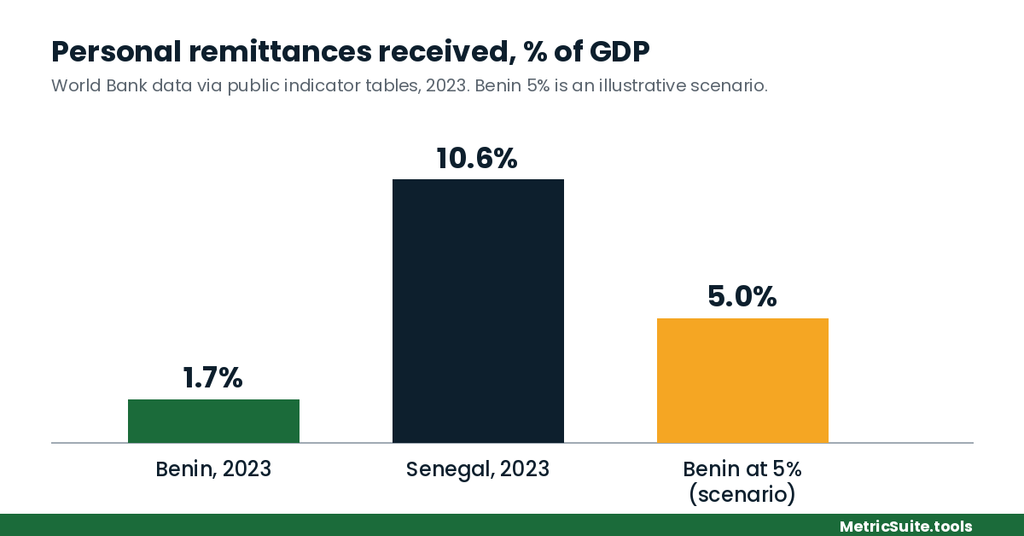
Close part of that gap and the numbers get large. On 2023 figures (GDP of roughly $19.7 billion), reaching 5% of GDP means about $985 million a year, roughly $645 million above today. Treat that as arithmetic, not a forecast. Remittances flow to households that already exist in the country, and most new nationals have no Beninese household to support. Investment, tourism and property spending are the more realistic channels.
The government is already building the tourism side. Ouidah is getting a Door of No Return and a replica slave ship, and a housing estate for Afro-descendants is being built there.
Human capital. The application asks for proof of occupation, which signals who Benin hopes to attract: working professionals and entrepreneurs, not only pilgrims. GLOBALCIT’s authors argue the law also invites investment, since eligibility reaches anyone with sub-Saharan origins living outside Africa. Whether that reverses brain drain depends on whether returnees can actually work and build here.
Soft power and diplomacy. The policy aligns with the African Union’s view of the diaspora as Africa’s sixth region and with the UN’s International Decade for People of African Descent. It strengthens Benin’s ties with countries such as Haiti and Brazil, and the government named filmmakers Spike Lee and Tonya Lewis Lee as thematic ambassadors to the US diaspora. An OHCHR story notes the law has been welcomed because it sets few conditions.
The Pitfalls for the Republic
Social and economic tension. Some Beninese people interviewed by Le Monde, as reported by GLOBALCIT, worry that returnees could compete for jobs. A large influx could also raise rents and strain services in Cotonou and Ouidah. We found no published data yet on arrivals or housing effects, so this stays a risk to monitor, not a measured outcome.
Security and integration. The state screens applicants through criminal record checks and can revoke nationality for fraud, serious crime or acting for a foreign state. Those are real safeguards against bad-faith applicants, but they depend on verification quality, especially for documents issued abroad.
Administrative burden. Running a global application process takes capacity. The three-month decision window and the Guichet Unique are the government’s answer, but neither is proven at scale. Full naturalisation applications still go directly to the administration rather than through the portal, so the step many applicants want most is still manual.
Political and legal complexity. Creating nationals without voting rights or civil service access builds a two-tier system. We found no reported constitutional challenge in the sources reviewed, but the question is open, and national cohesion depends on how both groups experience it.
Conclusion: Is Benin Afro-Descendant Citizenship Worth It?
Benin Afro-descendant citizenship is two things at once. It is a genuine act of historical reparation, and it is a pragmatic development tool aimed at investment, tourism and talent.
For the individual, it is a unique but limited opportunity. You gain a legal home, a passport and a place to reconnect. You must plan carefully around proof of descent, tax domicile, work rights, whether your current country lets you hold a second nationality, and the lack of political voice.
For Benin, it is a bold, high-stakes experiment in nation-building and diaspora engagement. The upside is large. The execution risk sits in administration, integration and the legitimacy of a two-tier status.
Do one thing this week: list the documents you already hold that prove descent, and note the gaps. Then decide whether you will file from abroad or in person, and book a tax adviser before you move anything. Start your budget with the Repatriation Checklist, and see how to move money for less with the Africa Remittance Comparison tool.
→ Use the free Repatriation Cost Calculator at MetricSuite.tools to calculate this instantly, no signup required, then swap in Benin-specific quotes. For investing once you are there, read Diaspora Investing in Africa and the Caribbean.
Disclaimer: MetricSuite.tools is not a law firm, immigration adviser or tax adviser. This guide is general information, not legal, tax or financial advice, and reading it does not create an adviser relationship. Rules and figures were checked on 13 October 2026 and may change. Confirm your situation with the Beninese Ministry of Justice or a qualified adviser. See our full Disclaimer.
Key Takeaways
- Benin Afro-descendant citizenship costs US$100 to apply at myafroorigins.bj, with a decision due within three months of a complete file.
- Where you apply matters. From abroad you get a three-year certificate of eligibility and must visit Benin. In person you can go straight to the decree and a passport.
- No vote, no office, no civil service. Recognition is a second-tier nationality, and it is revocable on defined grounds.
- DNA alone will not work. Approved-lab tests only support documents, and you also need French translations and legalised papers.
- Tax follows domicile, not the passport. If Benin becomes your home, expect tax on worldwide income and plan with an adviser first.
FAQ
What is Benin Afro-descendant citizenship?
It is Beninese nationality by recognition under Law No. 2024-31, available to adults who can prove a sub-Saharan African ancestor deported during the transatlantic slave trade. It was amended by Law 2025-11 of 1 July 2025.
How much does it cost to apply?
The government fee is US$100, paid through myafroorigins.bj. You should budget separately for archive research, translations, legalisation and any approved-lab DNA test.
Can I live and work in Benin with Beninese nationality by recognition?
You get the freedom to enter, stay in and leave Benin, and you can obtain a Beninese passport. Official pages do not spell out work authorisation for certificate holders, so confirm with the Ministry of Justice before you rely on it.
Can Afro-descendant nationals vote or work in the civil service?
No. Nationality by recognition does not carry political rights or access to the civil service. Full citizenship needs a separate naturalisation application.
Will I pay tax in Benin on my worldwide income?
If your tax domicile is in Benin, you are generally taxed on worldwide income, subject to treaty relief. If you are not domiciled there, only Benin-source income is taxed. Get professional advice, and remember you may still owe tax in your current country.
Can I apply with a DNA test only?
No. Genetic tests from Benin-approved laboratories are accepted only in support of documentary evidence such as civil records or slave-era archives.
Can Benin revoke my nationality?
Grounds include fraud with no later evidence of integration, conviction for a serious crime or security offence, and acts incompatible with Beninese nationality on behalf of a foreign state.
SOURCES (opened 13 Oct 2026 unless noted)
Official
- Benin government, Afro-descendants page (law number, Law 2025-11, eligibility, documents): https://benin.bj/en/afro-descendants
- MyAfroOrigins portal, service page and FAQ (US$100 fee, 3-month window, certificate of eligibility, rights, revocation, document rules): https://myafroorigins.bj/services/1/recognition-of-beninese-nationality-for-afro-descendants
Law and analysis
- GLOBALCIT, Benin: A New Law on the Recognition of Nationality for People of African Descent (key provisions, proof, effects, revocation, administration): https://globalcit.eu/benin-a-new-law-on-the-recognition-of-nationality-for-people-of-african-descent/
- Citizenship Rights in Africa Initiative, citing Law Library of Congress (Article 36 limit on political rights and civil service): https://citizenshiprightsafrica.org/en/benin-government-proposes-bill-to-recognize-afro-descendants-as-nationals/
- Citizenship Rights in Africa Initiative, mirror of OHCHR story on people of African descent: https://citizenshiprightsafrica.org/returning-to-africa-people-of-african-descent-seek-unique-status/
- Rio Times, Benin at the UN, 28 Sept 2026 (secondary source): https://www.riotimesonline.com/benin-un-speech-afro-descendant-citizenship-diaspora/
- Benin Web TV, new agency and guichet unique: https://beninwebtv.bj/benin-creation-dune-agence-pour-lassistance-au-retour-des-afro-descendants/
- Graphic Online, Benin offers citizenship to African diaspora (Attelly story, Door of No Return): https://www.graphic.com.gh/international/international-news/benin-offers-citizenship-to-african-diaspora.html
Tax and economy
- Bank of Scotland Trade, Benin taxes (domicile and worldwide income): https://www.bankofscotlandtrade.co.uk/en/market-potential/benin/taxes
- TheGlobalEconomy, Benin remittances % of GDP (World Bank data, 1.72% in 2023, $338.54 million): https://www.theglobaleconomy.com/Benin/remittances_percent_GDP/
- Statistics of the World, Benin (2024 remittances 1.1% of GDP, secondary): https://statisticsoftheworld.com/country/benin
- Wikipedia list of remittances received (World Bank data: Senegal 10.6%, Benin 1.7%): https://en.wikipedia.org/wiki/List_of_countries_by_remittances_received
- UNCTADstat Benin profile (GDP 2024, remittances 0.94% of GDP in 2024, XOF rate): https://unctadstat.unctad.org/CountryProfile/GeneralProfile/en-GB/204/GeneralProfile204.pdf
MetricSuite (internal)
- https://metricsuite.tools/repatriation-readiness-checklist/
- https://metricsuite.tools/repatriation-calculator/
- https://metricsuite.tools/diaspora-repatriation-tax-and-land-guide/
- https://metricsuite.tools/africa-remittance-comparison-send-money-for-less-metricsuite/
- https://metricsuite.tools/diaspora-investing-africa-caribbean/