
At Wakulima Market in Nairobi, a tomato trader watches roughly a third of her crates lose value before she can sell them, not because buyers aren’t there, but because the tomatoes were never cooled after harvest. This is not a personal failure. It is the default outcome of farming without storage infrastructure across most of the continent.
Post-harvest losses cost Sub-Saharan Africa an estimated USD 4 billion a year in grains alone, enough lost food to meet the minimum annual calorie needs of 48 million people. Country-level data across Nigeria, Ghana, South Africa, Kenya, Tanzania, Ethiopia and Uganda puts average grain losses at around 15.1 percent, with Kenya recording the highest rate at 16 percent. For perishables like tomatoes and leafy vegetables, losses in some Kenyan value chains run as high as 50 percent before the produce ever leaves the farm gate.
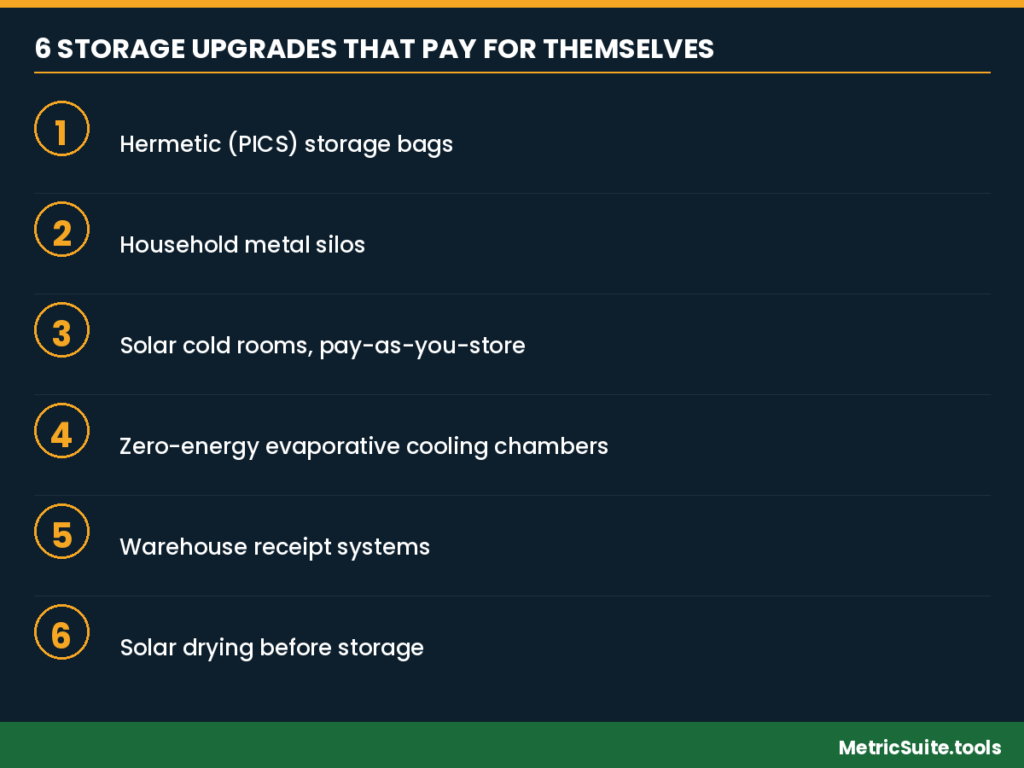
None of this is inevitable. It is a storage problem, and storage is one of the few post-harvest fixes with a genuinely fast payback. This piece breaks down six storage upgrades African traders and farmers are already using, what each one costs in local currency, and what it changes in the first 60 to 90 days. → Use the free Break-Even Calculator at MetricSuite.tools to calculate this instantly, no signup required, and work out exactly how many kilograms saved from spoilage you need before a given storage upgrade pays for itself. If you’re weighing storage costs against next season’s planting budget, the free Crop Profit Calculator shows the full picture.
Need a Freelancer for This?
Hire verified talent on Fiverr — starting from $5. No contracts, no hassle.
Browse Fiverr Freelancers →Hermetic (PICS) Storage Bags: The Cheapest First Step
Kenya loses an estimated 35 to 40 percent of stored maize to insect pests alone, a number that has held steady for years despite widespread awareness of the problem. Hermetic bags, commercialized globally as PICS bags (Purdue Improved Crop Storage), solve this without chemicals: a triple-layer design starves insects of oxygen and locks out moisture, letting farmers store grain for up to two years without fumigants.
Why it matters: This is the lowest-cost entry point on this list, and it is proven at scale across Nigeria, Kenya, Ethiopia and Tanzania.
Cost breakdown: A 100kg PICS bag costs roughly USD 2 to USD 3 globally, or KES 250 to KES 300 in Kenya (about USD 1.93 to USD 2.32), which converts to roughly NGN 2,700 to NGN 4,100, GHS 21.94 to GHS 32.91, ZAR 32.36 to ZAR 48.54, or XOF 1,134 to XOF 1,701 per bag.
60 to 90 day scenario: PICS Global’s own field data estimates an extra USD 36 in net benefit per bag over three seasons of reuse (about USD 12 per season, roughly KES 1,550, NGN 16,300, GHS 131.64, ZAR 194.16, or XOF 6,805), combining saved grain with the higher price farmers get by selling after the immediate post-harvest price dip. An independent eastern Kenya study found return on investment ranging from 13 to 80 percent across crops, with maize stored in hermetic bags showing the highest returns.
Do this first:
- Buy only from certified manufacturers. Kenya has five authorized hermetic bag makers, including PICS, ZeroFly, and locally made Mavuno Bora.
- Store only fully dried grain. Hermetic bags manage insects and moisture retention, not a wet harvest.
- Reuse each bag for two to three seasons rather than buying new bags every harvest, since durability is part of the return on investment.
Metal Silos: The Household-Level Bulk Upgrade
Traditional sack and granary storage exposes maize to insects, rodents and pathogens for months at a time, with losses commonly running 20 to 30 percent under CIMMYT’s Effective Grain Storage research across Eastern and Southern Africa. A metal silo, a galvanized-iron cylinder sealed to kill any pests already present, solves this at a scale beyond what a single hermetic bag can hold.
Why it matters: For a household or small aggregator storing multiple tonnes, silos beat bags on cost per kilogram protected and let you hold a full harvest, not just part of it.
Cost breakdown: In Kenya, a half-tonne household metal silo costs about KES 15,000 (roughly USD 116), while a 2.7-tonne silo runs closer to KES 35,000 (about USD 271), converting to approximately NGN 157,700 to NGN 368,000, GHS 1,273 to GHS 2,971, ZAR 1,878 to ZAR 4,381, or XOF 65,808 to XOF 153,557 depending on size. Globally, artisan-fabricated silos across the 100kg to 3,000kg range run USD 35 to USD 375.
60 to 90 day scenario: Grain prices in Sub-Saharan Africa typically show a near-doubling effect between harvest season, when farmers are forced to sell immediately, and the lean season a few months later. A silo that keeps grain insect-free through that window lets a farmer capture that price gap instead of a trader downstream.
Do this first:
- Size the silo to your actual harvest volume rather than buying the cheapest option and running out of capacity mid-season.
- Use a trained local artisan fabricator. Silo quality depends heavily on welding and sealing, not just the sheet metal itself.
- Confirm the grain is fully dry (below 13 percent moisture) before sealing, since a silo traps humidity in as effectively as it locks pests out.
Solar Cold Rooms: Pay-As-You-Store for Perishables
Fruits, vegetables and fish do not tolerate the multi-season storage window that grains do, which is why up to 40 percent of Africa’s perishable food is lost between harvest and market, largely from a lack of cold storage rather than a lack of buyers. Nigeria’s ColdHubs and Kenya’s SolarFreeze have both built a rental model around this: solar-powered walk-in cold rooms placed directly in farm clusters and markets, where farmers pay only for the crates and days they actually use.
Why it matters: This removes the single biggest barrier to cold storage adoption, the upfront capital cost, by turning refrigeration into a per-day operating expense instead of a purchase.
Cost breakdown: ColdHubs charges around NGN 250 per crate per day at its newer sites (about USD 0.18), while SolarFreeze in Kenya charges as little as USD 0.10 per crate per day, payable through M-Pesa. Neither requires the farmer to buy equipment.
60 to 90 day scenario: ColdHubs’ model extends produce shelf life from roughly 2 days to 21 days and has cut post-harvest losses by up to 80 percent for its users. In one deployment tracked by researchers, average monthly household income for 612 users rose from about USD 60 to about USD 120, alongside a reported 50 percent reduction in spoilage losses.
Do this first:
- Locate the nearest solar cold room or pay-as-you-store service in your market or farm cluster before assuming none exists. Coverage has expanded fast since 2023.
- Use the reusable crate system the operator provides rather than loose produce, since crate design affects airflow and cooling efficiency.
- Track your daily storage spend against the price gap between distress-selling at harvest and holding for a better buyer, so you know the service is paying for itself.
Zero-Energy Evaporative Cooling Chambers: Build Your Own
Where no cold room or solar cooling service is within reach, a zero-energy cooling chamber (ZECC) offers a middle ground: a double brick wall packed with wet sand cools produce through evaporation alone, with no electricity, solar panels, or ongoing energy cost. Kenyan smallholders working with the University of Nairobi and MIT D-Lab have used the design specifically because vapor-compression refrigeration is out of reach for farmers living on less than USD 3 a day.
Why it matters: This is the option for farmers and cooperatives who need cooling but cannot access, or cannot yet afford, a pay-as-you-store cold room in their area.
Cost breakdown: A standard 2-cubic-meter ZECC costs approximately USD 400 to construct from local materials, which converts to roughly KES 51,700, NGN 543,580, GHS 4,388, ZAR 6,472, or XOF 226,828, using bricks, sand, wood, and burlap sacking rather than imported components.
60 to 90 day scenario: The chamber holds temperatures around 10 to 15 degrees Celsius with roughly 95 percent humidity, conditions that meaningfully extend shelf life for vegetables that would otherwise wilt within a day or two of harvest. TAAT’s own assessment is that the investment is typically recovered quickly through reduced losses and higher-quality produce reaching market.
Do this first:
- Site the chamber in shade, ideally under trees or a simple roof, since direct sun defeats the cooling effect.
- Confirm a reliable water source nearby, since the walls need wetting one to three times daily to maintain cooling.
- Separate ethylene-producing fruit like bananas and mangoes from ethylene-sensitive vegetables inside the chamber, since they will spoil each other faster if mixed.
Warehouse Receipt Systems: Turn Stored Grain Into Collateral
In February 2026, Kenya launched its Electronic Warehouse Receipt System Central Registry (eWRS-CR), a government-backed digital platform built with TradeMark Africa and the British High Commission to formalize a problem that has quietly drained farmer income for years: smallholders contribute over 75 percent of Kenya’s agricultural output, yet less than 5 percent of bank lending reaches the sector, and post-harvest losses run 30 to 40 percent for some commodities. Nigeria has moved in parallel, with the Central Bank of Nigeria now formally permitting warehouse receipt financing and the Nigeria Commodity Exchange being repositioned under new leadership, alongside the existing private AFEX Commodities Exchange network.
Why it matters: A warehouse receipt does two things a hermetic bag or silo cannot: it certifies grain quality to a buyer, and it converts stored grain into loan collateral a bank will actually accept.
Cost breakdown: This is a service, not a purchase. Kenya’s National Cereals and Produce Board charges around KES 15 per 50kg bag for bagging (about USD 0.12) and KES 100 to KES 200 per tonne for handling (about USD 0.77 to USD 1.55), on top of a storage rent set by the individual certified warehouse.
60 to 90 day scenario: So far, Kenya’s registry has recorded 114 warehouse receipts covering nearly 600,000kg of deposited commodities in its first months. Farmers using the system avoid distress-selling at harvest-time lows and can instead borrow short-term against the receipt, for example to cover school fees, while waiting to sell into the lean-season price recovery described in Section 2.
Do this first:
- Find your nearest certified warehouse. In Kenya that means an NCPB depot or a certified cooperative store; in Nigeria, AFEX collection centers.
- Get your produce graded and tested before depositing, since the receipt’s value depends entirely on verified quality.
- Approach a partner financial institution, such as Cooperative Bank, Equity Bank, or Family Bank in Kenya, once you hold the receipt, rather than waiting until you need the cash urgently.
Solar Drying: Fixing the Problem Before It Starts
Every storage option above depends on one precondition: grain has to be dried below 13 percent moisture before it goes in the bag, silo, or warehouse. Most Kenyan smallholders harvest maize at 18 to 25 percent moisture, and open-air sun drying, still used by an estimated 80 percent of smallholders, is slow, weather-dependent, and leaves grain exposed to rain, dust, and animals throughout the process. Maize that stays wet too long is exactly the maize that develops aflatoxin, a carcinogenic toxin that can shut a farmer out of premium markets entirely.
Why it matters: Kenyan maize that meets EU aflatoxin standards commands 30 to 50 percent higher prices in regional markets than contaminated grain. Drying is the cheapest lever on this entire list for protecting that premium.
Cost breakdown: A basic DIY solar dryer can be built from local materials for under USD 200 for a pair of units (roughly USD 100 each, about KES 12,925, NGN 135,895, GHS 1,097, ZAR 1,618, or XOF 56,707), while commercial cabinet dryers in Kenya start around KES 100,000 (about USD 774) for cooperatives processing larger volumes. → Use the free Margin and Markup Calculator at MetricSuite.tools to price in that upfront cost against the premium your dried, aflatoxin-safe grain will fetch, no signup required.
60 to 90 day scenario: One Kenyan cooperative example found that cutting drying losses on 10 tonnes of maize from 30 percent down to under 5 percent saved roughly KES 111,000 (about USD 859) in a single season, at a maize price of KES 4,000 per 90kg bag.
Do this first:
- Use a moisture meter rather than guesswork. The difference between 14 percent and 18 percent moisture is invisible to the eye but decisive for aflatoxin risk.
- Keep grain off bare ground and covered against sudden rain, since re-wetting partially dried grain is one of the most common causes of contamination.
- Match the dryer to your volume. A small DIY unit suits household quantities; a cooperative processing multiple tonnes per season should budget for a commercial cabinet or tunnel dryer instead.
The One Investment to Make This Season
You do not need all six of these at once. Start with whichever gap is costing you the most right now: hermetic bags if you are losing grain to weevils, a cold room or ZECC if your tomatoes rot before market day, or a warehouse receipt if you are always forced to sell at the worst possible price. Beating post-harvest losses is rarely about one big purchase. It is about matching the cheapest fix to your actual point of failure. → Use the free Break-Even Calculator at MetricSuite.tools this week to test that fix against your own harvest volume and local price before you spend a single shilling, naira, cedi, rand or franc on it.
Key Takeaways
- Post-harvest losses cost Sub-Saharan Africa roughly USD 4 billion a year in grains alone, with Kenya’s grain loss rate the highest among major producers at 16 percent.
- Hermetic PICS bags are the cheapest entry point, at USD 2 to USD 3 per 100kg bag, with documented ROI of 13 to 80 percent depending on crop.
- Pay-as-you-store solar cold rooms remove the upfront capital barrier to cold chain access entirely, charging as little as USD 0.10 to USD 0.18 per crate per day.
- Kenya’s new Electronic Warehouse Receipt System Central Registry, launched in February 2026, turns stored grain into bank-recognized loan collateral for the first time at national scale.
- Drying grain below 13 percent moisture before storage is the cheapest lever on this list, and directly protects the 30 to 50 percent price premium clean, aflatoxin-safe maize earns in export-linked markets.
FAQ
What causes the highest post-harvest losses in Africa: grains or perishables
Perishables typically show far higher loss rates. Grain losses across major Sub-Saharan African producers average around 15 percent, while fresh produce like tomatoes and leafy vegetables can see losses of up to 50 percent before reaching market, mainly due to the lack of affordable cold storage.
Is a hermetic storage bag enough, or do I need a metal silo too
For a single season’s harvest on a smallholder plot, hermetic bags alone are often sufficient and far cheaper. Metal silos make more sense once you are storing multiple tonnes, aggregating for a cooperative, or want a single structure that survives many seasons rather than replacing bags each cycle.
How do I access a warehouse receipt system if I’m not near a big city?
Kenya’s NCPB network spans certified warehouses across the country, and the Warehouse Receipt System Council has been actively mapping and certifying cooperative-owned stores in cereal and pulse producing counties. In Nigeria, AFEX operates collection centers designed for exactly this purpose. Ask your local cooperative or extension officer which certified warehouse is nearest to you.
Does drying really matter that much if I’m already using a hermetic bag?
Yes. Hermetic bags manage insects and moisture retention after storage begins, but they cannot fix grain that was already too wet when it went in. Aflatoxin risk is set by moisture content at the point of storage, not by the storage method itself.
How quickly does better storage infrastructure actually pay for itself?
It varies by option, but most of the technologies in this guide show payback within a single season to three seasons. Hermetic bags and solar drying tend to pay back fastest since the upfront cost is lowest, while a metal silo or evaporative cooling chamber typically pays back over two to three seasons of reduced losses.
Resources and Further Reading
- FAO/World Bank: Missing Food, The Case of Postharvest Grain Losses in Sub-Saharan Africa. https://www.worldbank.org/en/news/press-release/2011/05/31/stemming-post-harvest-waste-crucial-african-food-security
- CIMMYT / ScienceDirect: The Metal Silo, An Effective Grain Storage Technology for Reducing Post-Harvest Losses. https://www.sciencedirect.com/science/article/abs/pii/S0261219410003376
- TradeMark Africa: Kenya Launches Electronic Warehouse Receipt System to Cut Post-Harvest Losses. https://trademarkafrica.com/kenya-launches-electronic-warehouse-receipt-system-to-cut-post-harvest-losses-and-unlock-finance-for-smallholder-farmers/
- energypedia: ColdHubs, Solar Cold Rooms in Nigeria. https://energypedia.info/wiki/ColdHubs_-_Solar_Cold_Rooms_in_Nigeria
- TAAT e-Catalogs: PICS Hermetic Bags for Safe Storage of Grain. https://e-catalogs.taat-africa.org/gov/technologies/pics-hermetic-bags-for-safe-storage-of-grain
- TAAT e-Catalogs: ZECC, Zero Energy Cooling Chamber for Vegetables. https://e-catalogs.taat-africa.org/com/technologies/zecc-zero-energy-cooling-chamber-for-vegetables