In Kitui County, in Kenya’s semi-arid east, farmers used to plant maize in the second week of March, once the long rains reliably arrived. This year, forecasters are cautioning southeastern lowland farmers like these that the rains may start on time but cut off abruptly, a pattern that is becoming the rule rather than the exception. A planting calendar for unpredictable rainfall is no longer a nice-to-have for African farmers. It is the difference between a harvest and a replanting bill.
Across the continent, roughly 75 percent of Sub-Saharan Africa’s population lives in rural areas dependent on rain-fed farming, and this single sector still contributes between 50 and 60 percent of African GDP. A recent study of Kenyan rainfall records found that both the frequency and magnitude of extreme wet and dry events have risen since 2013, and that the reliable link between El Nino patterns and local rainfall has weakened, meaning old rules of thumb are becoming less trustworthy. In parts of West Africa’s Sahel, an estimated 52.8 million people are currently facing hunger risk tied in part to erratic harvests.
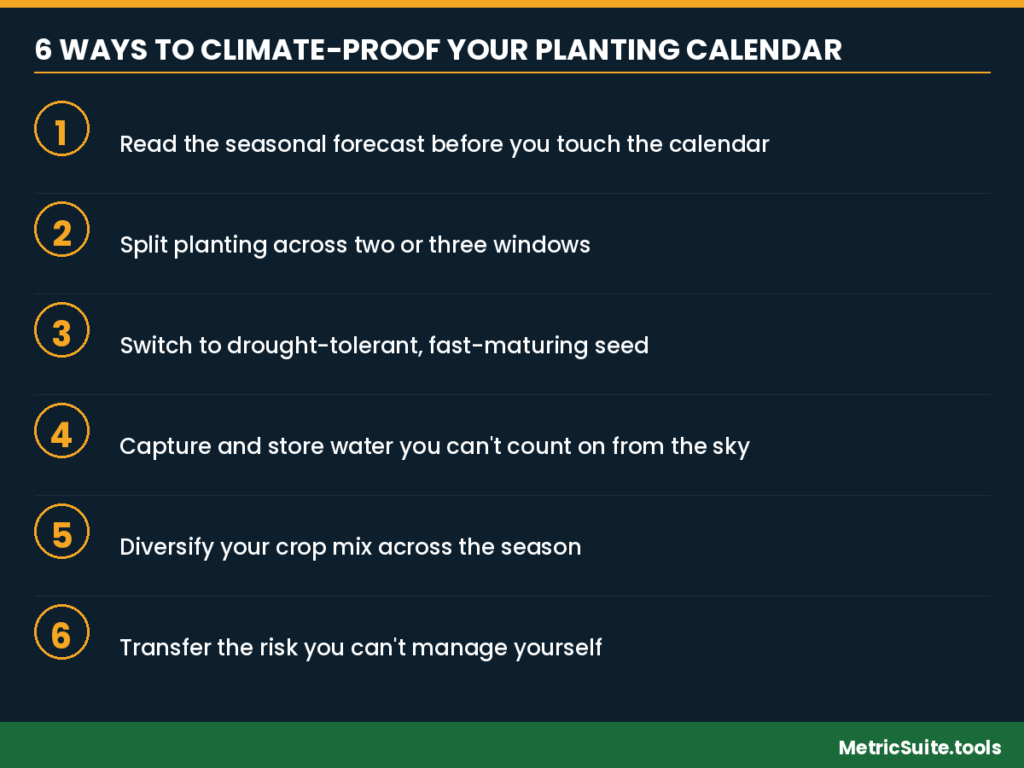
None of this means farming decisions have to be guesswork. It means the decisions have to change. This guide walks through six practical ways to adjust your planting calendar for unpredictable rainfall, what each one costs in your local currency, and what it changes in your first 60 to 90 days. → Use the free Crop Profit Calculator at MetricSuite.tools to calculate this instantly, no signup required, testing different planting windows and yield assumptions before you commit seed to soil.
Need a Freelancer for This?
Hire verified talent on Fiverr — starting from $5. No contracts, no hassle.
Browse Fiverr Freelancers →Read the Seasonal Forecast Before You Touch Your Planting Calendar for Unpredictable Rainfall
Kenya’s national weather service operates only 33 meteorological stations to cover more than 580,000 square kilometers, which is one reason forecasts have historically been treated with suspicion by farmers who never see a station near their plot. That gap is closing. Nigeria’s meteorological agency, NiMet, launched a pilot in February 2026 with MTN and Tomorrow.io to deliver digital climate advisories combining weather forecasts with agronomic guidance to roughly 100,000 farmers across six states. In northern Nigeria, the fintech platform Crop2Cash has already reached more than 500,000 smallholder farmers with climate-linked advisory and financing, and farmers using it report a 70 percent increase in income.
Why it matters: A forecast you can act on is worth more than a forecast you cannot access. The advisory services above are built to reach ordinary phones, not just smartphones, but a basic Android device still opens up USSD apps, WhatsApp advisories and SMS bundles that a keypad phone cannot. A basic Android smartphone in Kenya now retails from about KES 6,000 to KES 10,000 (roughly USD 46 to USD 77), which converts to approximately NGN 62,500 to NGN 104,200, GHS 505 to GHS 843, ZAR 745 to ZAR 1,242, or XOF 26,100 to XOF 43,500 at August 2026 rates. That is the real entry cost of climate-smart planning for most smallholders, not the advisory service itself, which is typically free or bundled into normal airtime.
60 to 90 day scenario: A farmer who checks two forecast sources before planting and holds off two weeks avoids the cost of a failed germination entirely, which, as the next section shows, can run USD 10 to USD 20 in wasted seed and labor on a small plot. That is the price of one skipped forecast check.
Do this first:
- Find and subscribe to your national meteorological agency’s SMS, USSD or app-based advisory (Kenya’s KMD, Nigeria’s NiMet, Ghana’s GMet, or South Africa’s SAWS).
- Cross-check the national forecast against a second source, such as your local extension officer, agrodealer, or a mobile advisory partner where available.
- Log actual rainfall against the forecast each week in a notebook or spreadsheet, so next season’s planting decision is backed by your own field data, not just someone else’s model.
Split Your Planting Across Two or Three Windows Instead of One
Agronomists across the continent are already reporting a shift in behavior for the 2026 season: in East and Southern Africa, delayed rains have pushed back land preparation, while parts of West Africa are seeing unusually intense rainfall events in the same season. Betting an entire plot on a single planting date assumes the rains behave the way they did ten years ago. Increasingly, they do not.
Why it matters: Splitting your planting into two or three windows, 10 to 15 days apart, means a false start in window one does not cost you the whole season.
Cost breakdown: A 10kg bag of subsidized hybrid maize seed from Kenya Seed Company costs KES 2,625 in 2026 (about USD 20.31), which converts to roughly NGN 27,600, GHS 222.79, ZAR 328.61, or XOF 11,517. Splitting that into two 5kg batches for two planting windows costs the same total, just paid in two installments of about USD 10.15 each, roughly half the figures above.
60 to 90 day scenario: If the first window’s germination fails, a scenario that Kenyan rainfall data shows has become more common since 2013, only half the seed and labor investment is lost, and the second window becomes your main crop. That roughly halves your total-loss risk compared with committing everything to one planting date.
Do this first:
- Divide your plot, or your seed budget, into two or three planting blocks instead of committing everything on day one.
- Stagger planting by 10 to 15 days per block based on observed soil moisture, not a fixed calendar date.
- Keep a reserve seed batch specifically for a delayed or repeat planting, rather than only buying more after a failure.
Switch to Drought-Tolerant, Fast-Maturing Seed Varieties
CIMMYT’s Drought Tolerant Maize for Africa project, tested across 13 countries including Kenya, Nigeria, Ghana and Zimbabwe, found that drought-tolerant varieties yield at least one additional tonne per hectare under moderate drought conditions, a 20 to 30 percent gain over the standard varieties most smallholders were already planting. Kenya’s KALRO has responded with the Katumani (KDV) open-pollinated series, bred to complete its full cycle in under three months for semi-arid counties like Machakos and Makueni. In Nigeria, hybrids such as DK777 and the Sammaz series are bred specifically for drought tolerance and Striga resistance.
Why it matters: Standard seed is not built for a shortened or interrupted rainy season. Drought-tolerant and fast-maturing varieties are.
Cost breakdown: A 2kg pack of DK777 drought-tolerant hybrid maize seed retails for around NGN 12,000 in Nigeria (about USD 8.83), which converts to roughly KES 1,141, GHS 96.87, ZAR 142.88, or XOF 5,007. On a full hectare planted at a typical rate of 20 to 25kg of seed, that price difference over recycled or uncertified seed adds up. → Use the free Break-Even Calculator at MetricSuite.tools to work out exactly how many extra kilograms per hectare you need from the higher-cost seed before it pays for itself, no signup required.
60 to 90 day scenario: CIMMYT’s field trials found the extra tonne of grain that drought-tolerant varieties produce under moderate drought is worth substantially more than the seed price premium, at almost any recent Nigerian wholesale maize price.
Do this first:
- Ask your local agrodealer or extension office which drought-tolerant or fast-maturing variety is bred for your specific agro-ecological zone, not just what is popular nearby.
- Buy certified seed from a registered seed company. Drought tolerance is bred into F1 hybrids and does not reliably carry over into farmer-saved seed from a previous harvest.
- Test the new variety on a portion of your land in the first season, so you can compare it against your usual crop under your own field conditions before converting fully.
Capture and Store Water You Can’t Count On From the Sky
A 2026 World Bank assessment of East and Southern Africa found that up to 65 percent of productive land across the region is already degraded, worsening water storage at the landscape level, while rainfall irregularity and limited storage capacity leave farmers exposed at exactly the moments they need water most. Investment in irrigation remains far behind what the region needs, even as the technology to close the gap has become dramatically cheaper.
Why it matters: You cannot control when the rain falls, but you can control whether you have a way to bridge the gaps between rainfall events.
Cost breakdown: In Kenya, a basic drip irrigation bucket kit covering around 100 seedlings costs about KES 2,100 (roughly USD 16.25), while a quarter-acre kit runs closer to KES 40,000 (about USD 309), converting to roughly NGN 22,100 to NGN 420,600, GHS 178 to GHS 3,395, ZAR 263 to ZAR 5,007, or XOF 9,214 to XOF 175,500 depending on the size of kit.
60 to 90 day scenario: Aqua Hub Kenya, a Nairobi-based irrigation supplier, cites an example in which an acre of tomatoes under drip irrigation yields 6 to 8 tonnes worth roughly KES 800,000 to KES 1,000,000, against a kit cost of KES 130,000 to KES 180,000 for that acreage, recovering the investment within one to two harvest cycles. Even a small kitchen-garden kit can protect a household’s highest-value crop through a dry spell that would otherwise wipe it out.
Do this first:
- Start small. A bucket kit or an eighth-acre kit costs a fraction of a full-acre system and proves the concept on your highest-value crop first.
- Pair the kit with a water storage tank or harvested rainwater rather than relying only on a borehole or river, since availability itself varies by season.
- Choose drip over flood or sprinkler irrigation in water-scarce zones. Kenyan suppliers report it cuts water use by 50 to 70 percent compared with traditional methods.
Diversify Your Crop Mix Across the Season
Agronomists tracking the 2026 planting season report a clear shift toward drought-resistant crops such as sorghum, millet, cowpea and cassava, particularly among smallholders trying to reduce their exposure to a single crop’s rainfall requirements. That instinct is backed by climate modeling: peer-reviewed projections for West Africa show sharply divergent regional outcomes, with areas like Guinea-Bissau facing severe drying while central Nigeria trends wetter, often within the same country’s borders. Betting an entire farm on one crop’s rainfall assumptions is a narrower bet than it used to be.
Why it matters: A second, shorter-cycle crop with different moisture needs than your main crop is insurance your main crop cannot provide on its own.
Cost breakdown: In Kenya, drought-tolerant bean varieties like Mwitemania (GLP 92) cost roughly KES 350 to KES 400 per kg from Kenya Seed Company. Five kilograms for intercropping runs about KES 1,875 (roughly USD 14.51), converting to approximately NGN 19,700, GHS 159.14, ZAR 234.72, or XOF 8,226.
60 to 90 day scenario: Mwitemania matures in just 70 to 80 days and yields 6 to 8 bags per acre even when seasonal rains fail early, according to Kenya Seed Company’s own variety notes. If your main maize crop is delayed or fails in its first window, a fast-cycle legume intercrop planted alongside it can still deliver income or food within the same 60 to 90 day period your main crop would have needed just to establish.
Do this first:
- Pair your main cereal with at least one shorter-cycle, drought-tolerant legume or root crop suited to your zone.
- Choose crops with genuinely different rainfall and moisture requirements, so one bad rain window cannot wipe out your entire plot at once.
- Check current input and market prices for the secondary crop before you commit, so diversification adds real income rather than just extra labor.
Transfer the Risk You Can’t Manage Yourself
Globally, fewer than 20 percent of smallholder farmers carry any form of crop insurance, largely because traditional indemnity insurance requires expensive farm-by-farm loss assessments that are impractical at smallholder scale. Weather index insurance solves this differently: payouts are triggered automatically by rainfall data from satellites and local weather stations, not by an inspector’s visit. ACRE Africa, the continent’s largest such program, has insured more than 1.7 million farmers across Kenya, Tanzania and Rwanda for a combined value exceeding USD 180 million.
Why it matters: No amount of forecasting, staggered planting or drought-tolerant seed eliminates risk entirely. Insurance is how you transfer what is left.
Cost breakdown: In Kenya, ACRE Africa’s Bima Pima product sells for as little as KES 50 per policy (about USD 0.39), covering up to KES 500 (about USD 3.87), payable and payable out entirely through M-Pesa. In Mali and Cote d’Ivoire, the OKO Pay platform charges farmers an average annual premium of roughly EUR 13 to EUR 24 per hectare (about USD 15 to USD 27), paid through Orange mobile money, directly relevant for farmers working in XOF.
60 to 90 day scenario: In an independent pilot evaluation, 97 percent of surveyed Kenyan farmers said the premium cost was not burdensome, and 40 percent of claims were processed within 24 hours thanks to automated smart-contract payouts. That speed matters most in the germination window covered in Section 3: a payout that lands within days, rather than weeks, is fast enough to fund a replanting inside the same season instead of writing it off.
Do this first:
- Ask your agrodealer, seed supplier, or mobile money provider whether a bundled weather index product is available in your area. Many are sold alongside seed or fertilizer rather than as standalone policies.
- Start with a small policy tied to your highest-risk plot or crop stage, typically germination, rather than trying to insure everything at once.
- Keep your phone number and mobile money account active and linked to the policy, since payouts are automated and sent electronically.
The One Thing to Do This Week
You do not need to adopt all six strategies before your next planting window opens. Pick the one that addresses your biggest single point of failure this season, whether that is a forecast you have never checked, a seed variety that is not built for your rainfall pattern, or a plot with no water storage at all. Building a genuinely resilient planting calendar for unpredictable rainfall is a multi-season process, not a single decision. → Use the free Crop Profit Calculator at MetricSuite.tools this week to model your chosen strategy against your actual plot size, crop, and country before you spend a single shilling, naira, cedi, rand or franc on it.
Key Takeaways
- Rainfall variability, not just total rainfall, is now the bigger risk. Kenyan data shows both extreme wet and dry events, and intraseasonal swings, have increased sharply since 2013.
- Splitting planting into two or three windows costs nothing extra in seed. It roughly halves the risk of losing your entire investment to one failed start.
- Certified drought-tolerant seed carries a real price premium, but CIMMYT trial data shows the yield gain under moderate drought typically outweighs it.
- Small drip irrigation kits start under USD 20 in Kenya and can pay for themselves within one to two harvests on a high-value crop.
- Weather index insurance is inexpensive relative to the risk it covers. Kenya’s smallest policies cost under USD 0.40, and payouts can arrive within days.
FAQ
What is climate-smart agriculture, and how is it different from ordinary farming advice?
Climate-smart agriculture is farming decision-making that explicitly accounts for rainfall and temperature variability rather than assuming past patterns will repeat. In practice, that means forecast-checking, staggered planting, drought-tolerant seed, small-scale irrigation, crop diversification and risk transfer through insurance, rather than a single fixed calendar used every season regardless of conditions.
How do I know when to shift my planting date this season?
Start with your national meteorological agency’s seasonal forecast, cross-checked against a second source such as a local extension officer or agrodealer. Watch soil moisture at planting depth rather than the calendar date alone, and be prepared to delay by 10 to 15 days if the forecast and ground conditions disagree with the traditional start date for your area.
Is drought-tolerant seed worth the extra cost every season?
In a season with moderate drought stress, CIMMYT field trials found drought-tolerant varieties yielded at least one additional tonne per hectare, a 20 to 30 percent gain over standard varieties. In a season with normal or above-average rainfall, the yield gap narrows. Testing the variety on a portion of your land before converting fully is the safest way to judge it under your own conditions.
How much does weather index insurance actually cost in Africa?
It varies by country and provider, but it is designed to be affordable at smallholder scale. In Kenya, ACRE Africa’s Bima Pima policies start at KES 50 (about USD 0.39). In Mali and Cote d’Ivoire, OKO Pay’s annual premiums average roughly EUR 13 to EUR 24 per hectare (about USD 15 to USD 27), paid through mobile money.
Can I combine several of these strategies at once, or should I start with one?
Most farmers who use these approaches successfully layer them gradually rather than adopting all six in one season. Start with whichever addresses your single biggest point of failure this season, most commonly forecast access or staggered planting, since both cost little to nothing to implement immediately.
Resources and Further Reading
- World Bank: It’s Time to Transform Africa Through Climate-Smart Agriculture. https://blogs.worldbank.org/en/africacan/its-time-to-transform-africa-through-climate-smart-agriculture
- CIMMYT: Drought Tolerant Maize for Africa (DTMA). https://www.cimmyt.org/projects/drought-tolerant-maize-for-africa-dtma/
- GSMA: Data-Driven Advisory Services for Climate-Smart Smallholder Agriculture. https://www.gsma.com/solutions-and-impact/connectivity-for-good/mobile-for-development/gsma_resources/data-driven-advisory-services-for-climate-smart-smallholder-agriculture/
- ACRE Africa: Weather Index Insurance. https://acreafrica.com/crop-insurance/weather-index-insurance/
- AllAfrica / NiMet: Nigeria Partners Move to Pilot Digital Climate Advisory Service for Farmers (Feb 2026). https://allafrica.com/stories/202602130112.html
- Nature Scientific Reports: Observations of Enhanced Rainfall Variability in Kenya, East Africa. https://www.ncbi.nlm.nih.gov/pmc/articles/PMC11153539/