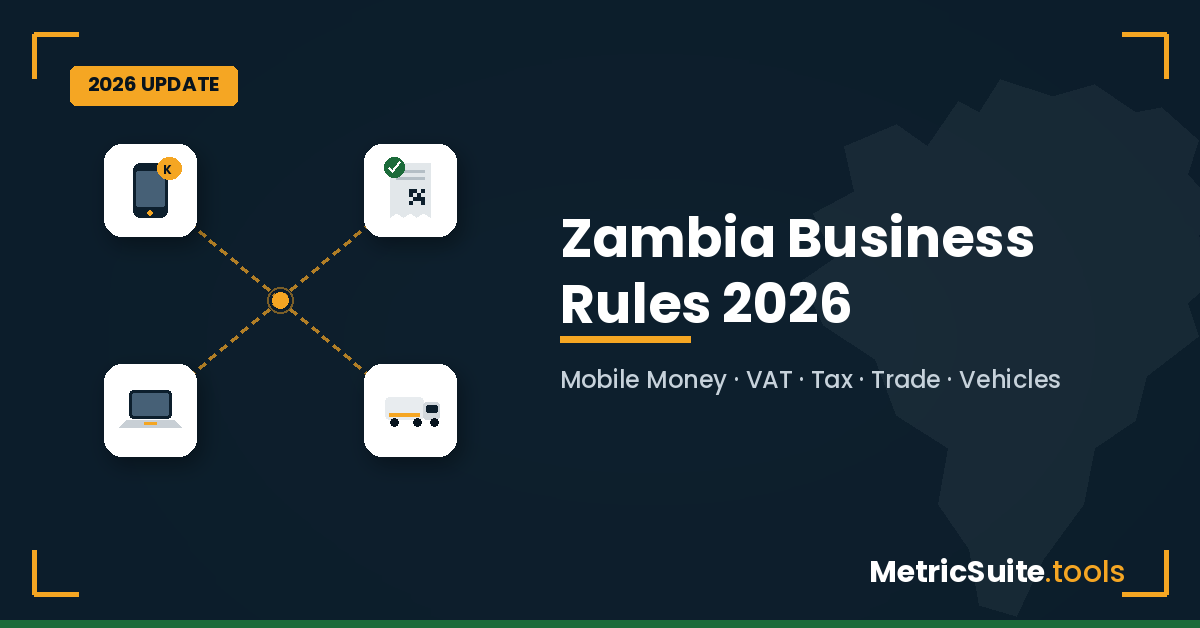
A trader in Kitwe pays her mobile money withdrawal fee without a second thought, files VAT the way she has for years, and quotes freelance clients the same rate she’s always quoted. None of that math is current anymore. Between January and mid-2026, Zambia quietly rewrote the rules on four fronts at once: mobile money levies, VAT compliance, gig economy tax, and how regional trade actually works. Most business owners caught one of these changes. Few caught all four.
Mobile Money: A New Levy, But Not Where You’d Expect
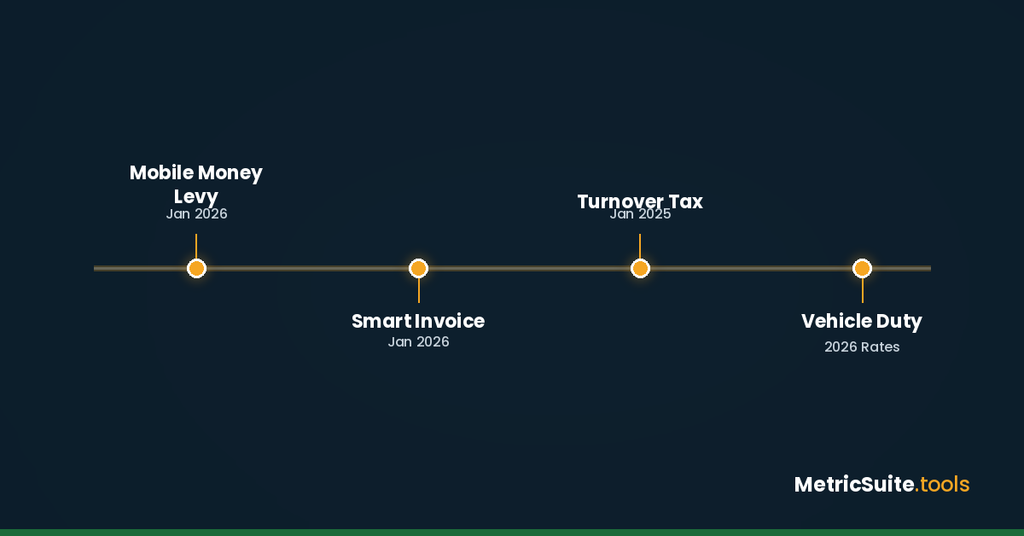
Effective 1 January 2026, the amended Mobile Money Transaction Levy Act introduced new tiered fees on person-to-person mobile money transfers, from K0.32 on transfers under K150 up to K8.00 on transfers between K5,000 and K10,000. The detail that trips people up: the levy is charged to whoever sends the money, not the person receiving it, and it doesn’t apply to cash withdrawals at all. If a client pays you K1,000 via MTN MoMo, you get the full K1,000. What actually costs you money is the agent withdrawal fee when you cash out, a completely separate charge with no government levy attached.
Use the free Zambia Mobile Money Fee Calculator at MetricSuite.tools to calculate this instantly, no signup required. It also works backwards: tell it what you want to walk away with in cash, and it calculates what to invoice to cover the withdrawal fee.
Need a Freelancer for This?
Hire verified talent on Fiverr — starting from $5. No contracts, no hassle.
Browse Fiverr Freelancers →VAT: The Smart Invoice Mandate Changes What Counts as Proof
The 16% standard VAT rate hasn’t moved. What changed is enforcement. Since 1 January 2026, ZRA only accepts input VAT claims backed by a Smart Invoice-generated receipt carrying a Mark ID and QR code. A supplier’s ordinary invoice, even one that genuinely charged VAT, no longer supports a claim if it wasn’t issued through the Smart Invoice system. Layered on top of that is a distinction that trips up small businesses constantly: Zero-Rated supplies charge 0% VAT but remain legally taxable, so input VAT on related purchases can still be claimed, while Exempt supplies sit outside the VAT system entirely and input VAT on them is simply lost.
Use the free Zambia VAT & Smart Invoice Calculator at MetricSuite.tools to calculate this instantly, no signup required, including a check for whether your turnover has crossed the K800,000 mandatory registration threshold.
Gig Economy Tax: Freelancers Are Now Inside the System
From 1 January 2025, Zambia brought gig economy digital platform workers into the Turnover Tax system at a flat 5% on gross turnover, up to K5,000,000 a year. There are no deductions for equipment, software, or a home office, the tax applies to whatever lands in your account before any of that. A developer quoting a client in USD needs to gross up their day rate to cover the 5%, not deduct it afterward, or they’re quietly working for less than planned. Worth checking too: consultancy and professional services are normally excluded from Turnover Tax entirely, taxed under standard income tax instead, so how your contracts are framed matters.
Use the free Zambia Freelancer Turnover Tax & Day-Rate Calculator at MetricSuite.tools to calculate this instantly, no signup required, in USD or ZMW.
Regional Trade: DRC and South Africa Run on Completely Different Rules
Zambian exporters often assume AfCFTA covers regional trade uniformly. It doesn’t, and the DRC is the clearest example why. South Africa has given Zambian goods duty-free access under the SADC Free Trade Area since 2008. The DRC never joined SADC’s free trade area, and never joined COMESA’s either, so the only regional preferential mechanism available is AfCFTA itself, ratified by the DRC in 2022 but still unevenly implemented at the border. Duty aside, Kasumbalesa’s truck queues have averaged around 72 hours through 2026, a real cost in driver subsistence and demurrage that a duty-only estimate misses entirely.
Use the free Zambia Regional Trade Cost Estimator at MetricSuite.tools to calculate this instantly, no signup required, covering both the DRC and South Africa corridors.
Vehicle Import Duty: A Fixed Kwacha Schedule, Not a Percentage
Unlike most Zambian taxes, vehicle import duty for standard used cars over 2 years old isn’t based on what you paid. ZRA applies a Specific Duty, a fixed Kwacha amount set by age, engine size, and body type that bundles Customs Duty, Excise, VAT, and several smaller fees into one charge. Two buyers who paid very different prices for similar used hatchbacks owe ZRA the exact same amount. Vehicles under 2 years old, hybrids, and EVs skip this schedule entirely and get taxed on a percentage of CIF value instead.
Use the free Zambia Vehicle Import Duty Calculator at MetricSuite.tools to calculate this instantly, no signup required, before you commit to shipping.
The Common Thread
Every one of these changes shares the same shape: a fixed schedule or flat rate replacing what used to be more negotiable, paired with a compliance requirement (Smart Invoice, Certificates of Origin, ZRA classification) that decides whether the number even applies to you. Test one real transaction against your own numbers this week using whichever tool above matches your situation, before the assumption costs you.
Key Takeaways
- The mobile money levy is paid by the sender, not the receiver, and doesn’t apply to cash withdrawals at all.
- Input VAT claims are only valid from 1 January 2026 if backed by a Smart Invoice-generated receipt with a Mark ID.
- Gig economy Turnover Tax is 5% flat on gross turnover, with no expense deductions, up to K5,000,000 a year.
- The DRC has no COMESA or SADC preferential trade coverage with Zambia. South Africa has had SADC duty-free access since 2008.
- Vehicle import duty for most used cars is a fixed Kwacha amount based on age and engine size, not a percentage of purchase price.
FAQ
Do all these changes apply to every business, or just specific sectors?
They apply differently depending on how you operate. Anyone using mobile money is affected by the levy rules. Any VAT-registered business needs Smart Invoice compliance. Freelancers and digital gig workers fall under the new Turnover Tax provisions. Exporters to DRC or South Africa need the trade corridor guidance. Vehicle importers need the duty schedule. Most businesses touch at least two of these.
Is there one single ZRA change that affects the most businesses?
Smart Invoice has the broadest reach, since it affects every VAT-registered business trying to claim input VAT, not just a specific sector. The mobile money levy affects the most individual transactions, given how widely mobile money is used across Zambia.
Where can I check these numbers for my own business?
Each section above links to a free calculator built for that specific rule. All run in the browser with no signup, and the mobile money and VAT tools include a written breakdown of exactly how the government’s own math works.
Sources
- Mobile Money Transaction Levy (Amendment) Act No. 22 of 2025, National Assembly of Zambia
- Zambia Revenue Authority — Tax Information
- PwC Tax Summaries, Zambia — Corporate: Significant Developments (2026)
- Zambia Development Agency — Trade Agreements
Need Help Staying Compliant?
Find verified Zambian bookkeepers, tax consultants, and clearing agents on Fiverr.