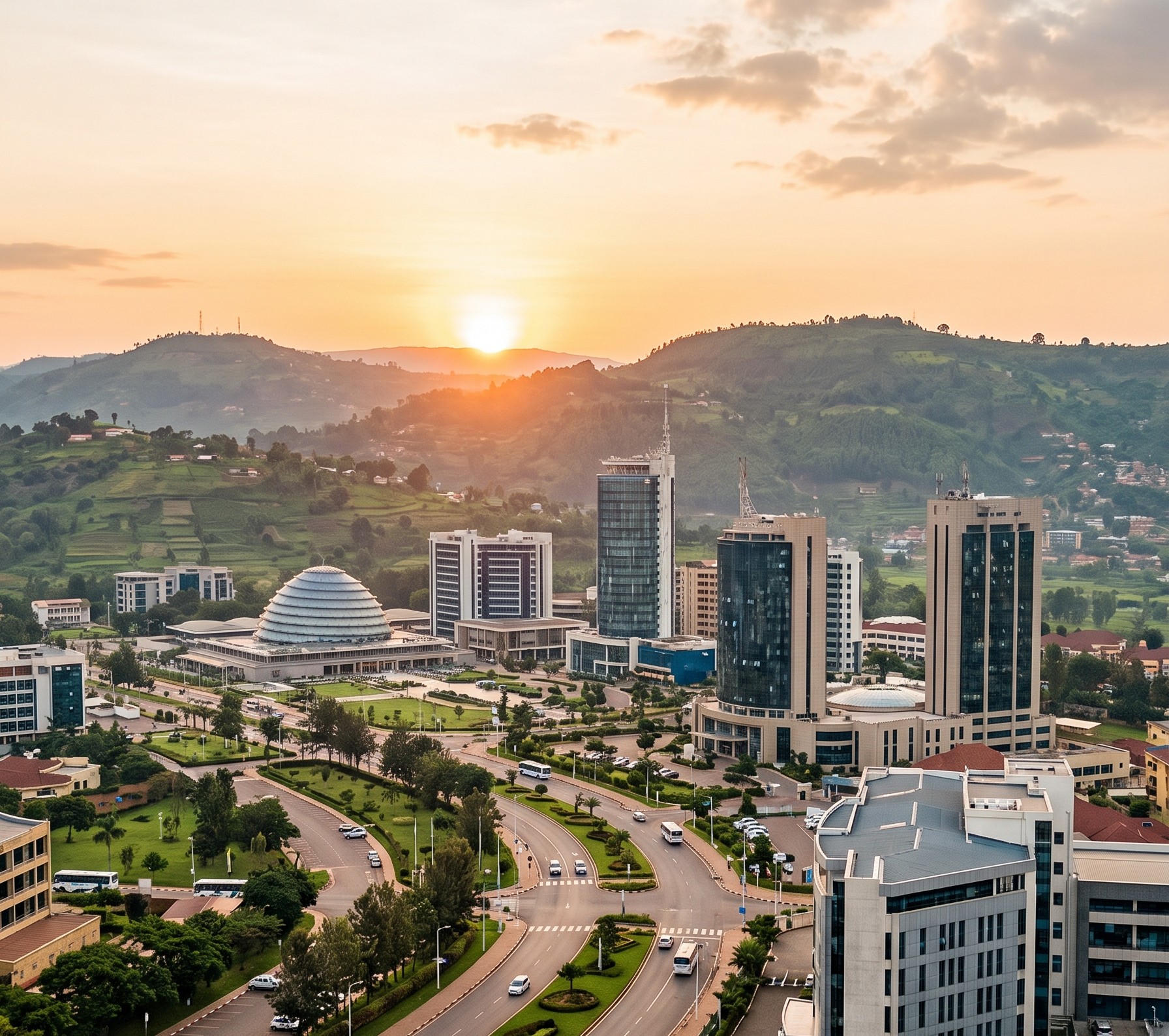
Land at Kigali International Airport on any given morning and the first thing you notice isn’t the hills, though there are a thousand of them rolling toward every horizon. It’s the quiet. No horns. No litter blowing across the tarmac road into the city center. A traffic officer waves a line of motorcycle taxis through an intersection with the unhurried precision of someone who has done this the same way, correctly, ten thousand times. For a visitor arriving from almost anywhere else on the continent, or frankly from most cities in the world, the effect is disorienting in the best possible way. Kigali does not perform order for visitors. It simply runs that way, every day, whether anyone is watching or not.
That quiet efficiency is not an accident of geography or a trick of urban planning. It is the visible surface of a three-decade project to rebuild a state from the ground up, and it is why Rwanda has become one of the most closely watched economies in Africa, not for its size (it is not large; GDP sits around $16 billion at official exchange rates) but for what it represents: a working demonstration that governance, discipline, and long-term planning can move a country from catastrophe to credibility inside a single generation.
A Nation Rebuilt, Not Just Recovered
In 1994, Rwanda experienced one of the worst atrocities of the twentieth century, a genocide against the Tutsi that killed an estimated 800,000 to one million people in roughly one hundred days, while the world largely watched from a distance. Any honest account of Rwanda’s transformation has to start there, not as a footnote but as the baseline against which everything since has to be measured. There was, by 1994’s end, functionally no state left to speak of: no institutions, no civil service, no functioning courts, a shattered economy, and a population carrying trauma that does not resolve on any development timeline.
Need a Freelancer for This?
Hire verified talent on Fiverr — starting from $5. No contracts, no hassle.
Browse Fiverr Freelancers →What happened over the following three decades is the part of the story that gets told, and it deserves to be, but it is worth telling through numbers rather than adjectives. Rwanda’s GDP grew 9.4% in 2025, capping an average annual growth rate of 8.5% between 2022 and 2024, among the fastest sustained growth rates on the continent, according to World Bank data. Poverty rates have fallen substantially since the early 2000s. Life expectancy has more than doubled from its post-genocide low. The country built a nationwide network of community-based health insurance that covers the large majority of its population, a policy choice few countries at Rwanda’s income level have managed to sustain. Kigali’s convention center, its cable-car-quiet BRT-style bus corridors, its fiber-optic backbone reaching into rural districts, none of this existed in any form a generation ago.
Institutional rebuilding, not charisma, is what actually explains the trajectory. Rwanda restructured its civil service around performance contracts (known locally as imihigo) that hold local and national officials accountable to specific, publicly tracked targets. It digitized tax collection and business registration years before most peer economies attempted the same. It built a genuinely technocratic Rwanda Development Board that functions as a single front door for investors instead of the multi-agency maze common elsewhere on the continent. None of this erases what came before 1994. It is, instead, the most concrete argument that a state can choose reconstruction over relapse, and that the choice, sustained over decades, compounds.
Transparency as Infrastructure
Ask an investor who has worked across multiple African markets what Rwanda does differently, and the answer rarely starts with tax incentives. It starts with predictability. Rwanda consistently ranks among the least corrupt nations in Africa on Transparency International’s Corruption Perceptions Index, typically placing in the low-to-mid 40s globally out of roughly 180 countries assessed, a startling position for a country at its income level and a marked outlier in its region. The Rwanda Revenue Authority’s e-tax platform lets a business file and pay online without ever meeting an official in person, which is not a convenience feature so much as a corruption-resistance mechanism: fewer human touchpoints means fewer opportunities for the small, grinding bribery that taxes businesses everywhere else on the continent far more than any official levy does.
“In most markets I work in, the real cost of doing business isn’t the tax rate, it’s the number of people you have to pay to get to the tax rate,” one regional investment analyst put it in a conversation about comparative African market entry. [Illustrative quote, composite of investor sentiment commonly expressed about the region, not attributed to a specific named individual.] Rwanda’s answer to that problem has been to remove the people wherever possible and replace them with systems: online land title searches, digital company registries, a single electronic window for customs declarations.
Credibility, though, requires the fuller picture, and a serious investor briefing owes readers that picture rather than a highlight reel. Rwanda’s governance model is highly centralized, and international observers, including Freedom House and Reporters Without Borders, have consistently raised concerns about political space, press freedom, and the treatment of government critics, some of whom have faced prosecution or, in a small number of internationally documented cases, violence abroad. Public debt is also rising quickly, projected by the World Bank to exceed 77% of GDP by the end of 2026, a trajectory that will require careful management as concessional financing tightens. And Rwanda’s regional standing has been complicated by the ongoing conflict in eastern Democratic Republic of Congo, where the United States, the United Nations, and the Congolese government have accused Kigali of backing the M23 rebel movement, an allegation Rwanda disputes but which has drawn U.S. sanctions on senior Rwandan military figures as recently as early 2026. None of this negates the economic and institutional achievements described above. It does mean that “efficient” and “transparent” describe Rwanda’s business administration more precisely than they describe its politics, and any investor doing real diligence should hold both facts at once.

The Mechanics of Ease
Strip away the macro narrative and the operational reality is what actually moves capital: how long does it take to start a business, and how much does uncertainty cost along the way? Rwanda Development Board registration is free and largely completed online, with many company registrations processed within six to twelve working hours, among the fastest turnarounds anywhere in the world, not just in Africa. The registration number issued at incorporation doubles as the Tax Identification Number, eliminating a separate bureaucratic step that trips up first-time founders in most markets.
The World Bank’s now-discontinued Doing Business index, before it was retired in 2021 following a data-integrity scandal unrelated to Rwanda’s own numbers, last ranked Rwanda 38th globally out of 190 economies and 2nd in Africa, a position it had held near consistently since the mid-2010s. No global successor index has fully replaced it, but the underlying regulatory architecture that earned that ranking, single-window registration, digitized land administration, streamlined construction permitting, remains largely intact and continues to be cited by the Mo Ibrahim Foundation’s governance rankings and by sub-Saharan regulatory-quality assessments as among the strongest on the continent.
Rwanda has also built one of Africa’s more coherent frameworks for foreign investors specifically: full repatriation of profits, no minimum capital requirement for most private company types, and, for people of the diaspora or foreign nationals working under the Kigali International Financial Centre, a five-year exemption on foreign-sourced personal income for qualifying new residents. A Digital Nomad Visa, introduced to capture the growing population of location-independent professionals, lets remote workers live in Rwanda for roughly a year at a time while working for employers or clients anywhere else in the world, backed by some of the fastest fiber connectivity in East Africa.
Africa’s Investment Gateway, Sector by Sector
Rwanda’s pitch to global capital has never been scale. With roughly 14 million people and a GDP under $20 billion, it will not out-market Nigeria or out-produce South Africa. Its pitch is that it is the easiest place on the continent to actually execute a plan, and that reliability draws capital into sectors where execution risk, not opportunity, has historically been the binding constraint.
Technology and fintech have become the most visible face of that pitch. Kigali Innovation City, an ambitious mixed-use tech and education campus anchored by Carnegie Mellon University Africa, was built explicitly to give the country a physical and reputational center of gravity for its digital ambitions. Mobile money penetration is near-universal, and MTN Rwanda’s fintech revenue has grown at double-digit rates in recent reporting periods, a signal of how quickly financial services are digitizing even among small merchants.
Agribusiness remains the backbone of employment, engaging roughly two-thirds of the workforce, and coffee and tea continue to anchor export earnings. Rwanda has leaned into specialty coffee positioning rather than competing purely on commodity volume, and the country’s 2026 farmgate price reset (a 25% increase set by the National Agricultural Export Development Board) signals a government willing to let producer prices rise even when it compresses exporter margins, a genuine bet on quality over volume that specialty buyers in Europe and North America have rewarded with premium pricing.
Tourism built its brand on mountain gorilla trekking in Volcanoes National Park, but the country has deliberately positioned itself at the premium end of the market rather than chasing volume, a strategy that protects both conservation outcomes and per-visitor revenue. Convention and conference tourism, anchored by the Kigali Convention Center, has become a second pillar, with the country actively courting international summits and corporate retreats.
Manufacturing is earlier-stage but deliberately targeted: textiles, agro-processing, and construction materials benefit from investment incentives and Rwanda’s access to regional markets through the East African Community and, longer-term, the African Continental Free Trade Area. Renewable energy, particularly solar and methane extraction from Lake Kivu, has drawn blended-finance interest from development finance institutions looking for bankable projects with genuine grid impact. Real estate in Kigali has grown fast enough to raise its own affordability questions, but institutional-grade office and residential product remains scarce relative to demand from the growing expatriate and diaspora-return population. Logistics is structurally disadvantaged by Rwanda’s landlocked geography, coffee and other exports travel roughly 1,500 kilometers overland to reach the ports at Mombasa or Dar es Salaam, and that overland leg often costs more than the ocean freight onward to Europe or the US, a real constraint any serious trade-focused investor needs to underwrite rather than wish away. And education, from Carnegie Mellon Africa to a growing cluster of international schools, has become both a service export in its own right and an input that makes every other sector’s talent pipeline more credible.
Kigali as Proof of Concept
Every emerging-market pitch eventually needs a physical symbol, a place an investor can walk through and feel the thesis rather than read it in a deck. For Rwanda, that place is Kigali. The city has been repeatedly described, by residents and first-time visitors alike, as the cleanest capital in Africa, a reputation built on a decades-old tradition of umuganda, mandatory monthly community service that still draws citizens, cabinet ministers included, into the streets on the last Saturday of most months to clean, build, and maintain shared infrastructure. Plastic bags have been banned since 2008, years ahead of most of the world. Motorcycle taxi drivers wear numbered helmets and reflective vests, not because a foreign consultant recommended it, but because the city’s traffic police enforce it as a baseline, every day, without exception.
None of this is cosmetic. A city that can sustain basic order at street level, over decades, without backsliding, is making a credible claim about its capacity to sustain more complex commitments: contract enforcement, permit timelines, currency stability. Visitors read cleanliness as a proxy for competence, and in Kigali’s case, the proxy holds up.
The Wode Maya Effect
For years, the single biggest constraint on African investment wasn’t policy, it was perception, a global audience whose mental image of the continent was shaped almost entirely by crisis coverage and safari documentaries, with almost nothing in between. That has started to change, and not primarily because of government tourism campaigns. It has changed because of creators like Berthold Kobby Winkler Ackon, the Ghanaian YouTuber known to over two million subscribers as Wode Maya.

Wode Maya’s channel, active since 2013 and now past 300 million cumulative views, has built its identity around a simple, disarming premise: point a camera at ordinary, functioning African life and let the footage do the arguing. His repeated visits to Kigali, walking its streets, riding its motorcycle taxis, marveling on camera at how clean and orderly the city is, have introduced millions of viewers, many of whom had never previously considered the continent as an investment or travel destination, to a version of Rwanda that official communications, however polished, rarely manage to convey with the same credibility. A government press release about ease of doing business is expected to say the country is doing well. A vlogger with no obvious incentive to flatter anyone, filming unscripted street scenes, saying it, carries a different kind of weight.
“Until the history of Africa is told by Africans, the story will glorify the imperialists,” is a sentiment Wode Maya has voiced repeatedly across his catalog of work, part of an explicit, stated mission to reshape global narratives about the continent one country at a time. That mission has made him and a small cohort of peer creators into something close to unofficial trade ambassadors, reaching Gen Z and millennial audiences that traditional investment promotion agencies structurally cannot access through a press conference or a glossy brochure. For a country like Rwanda, whose entire value proposition rests on a perception gap between how safe, clean, and functional it actually is and how most of the world still imagines the continent, that kind of organic, high-trust content is not a nice-to-have. It is arguably as valuable as any single trade mission the country has ever run.
Rwanda and the Future of Africa
Rwanda’s own long-term planning document, Vision 2050, targets upper-middle-income status by 2035 and high-income status by 2050, an explicitly numbers-driven roadmap rather than a slogan. Whether it lands on schedule is genuinely uncertain; the World Bank’s own analysis flags rising public debt, a comparatively low ranking on its Human Capital Index (160th of 174 countries assessed), and continued vulnerability to climate shocks as real headwinds. Ambition and delivery are not the same thing, and Rwanda’s own institutions are candid about the gap that remains.
What is not in dispute is Rwanda’s symbolic role in Africa’s economic integration story. In March 2018, Kigali hosted the Extraordinary Summit of the African Union at which 44 member states signed the founding Agreement establishing the African Continental Free Trade Area, alongside the Kigali Declaration committing signatories to ratification. The AfCFTA Secretariat itself is headquartered in Accra, Ghana, but the agreement that created the world’s largest free trade area by member count carries Kigali’s name in its founding declaration, a detail Rwandan officials reference often and with evident pride. As AfCFTA implementation continues to unfold across the 2020s, Rwanda has positioned itself as an early, committed adopter, consistent with a broader pattern of getting to new regional and digital infrastructure ahead of most peers, from mobile money interoperability to early moves on continental digital trade frameworks.
The MetricSuite Connection

None of the preceding sections, the growth statistics, the registration timelines, the sector opportunities, are much use to an entrepreneur or investor without a way to turn them into an actual decision. That is the gap a new generation of Africa-focused digital business intelligence platforms has emerged to close, and MetricSuite.tools is a useful example of what that looks like in practice.
Rather than a generic global calculator retrofitted with an African country selector, tools built specifically for markets like Rwanda start from the actual regulatory source material: Rwanda Development Board registration fees, the National Agricultural Export Development Board’s published coffee farmgate pricing, Rwanda Revenue Authority’s turnover-based tax bands for freelancers and small businesses, the country’s full import duty and customs charge stack. An entrepreneur weighing whether to register a coffee export business, a diaspora investor comparing remittance costs before wiring capital home, a freelancer trying to work out whether Rwanda’s tax rules treat foreign clients differently from local ones, all of these are decisions that used to require either expensive local counsel or risky guesswork. Platforms like MetricSuite.tools exist to close that gap for free, turning published government rates into an actual number a founder can act on before they’ve spent a dollar.
That is, in miniature, exactly what Rwanda itself has been trying to do at a national level for three decades: replace opacity with a number you can check, replace a relationship-dependent system with one anyone can navigate on their own. Data-driven decision-making and a business-friendly state are not separate trends happening to coincide in Rwanda’s case. They are the same instinct, applied at different scales.
Why Rwanda Matters
Rwanda matters because it is proof, not promise, that African markets can compete on the same terms serious global capital already expects: predictable rules, digitized administration, low everyday corruption, and a state willing to measure itself against its own targets in public. It matters because that proof arrived not by accident or by resource windfall, the way it has in some other rapidly growing African economies, but through three decades of deliberate institution-building following a catastrophe most nations would never have recovered from at all.
It matters, too, because Rwanda is not a finished story. Debt is rising. Human capital gaps remain wide. Regional tensions with the DRC are unresolved and carry real reputational and security weight. Political space remains tightly managed by international standards. A credible investor briefing holds all of that alongside the genuine achievements, because the achievements are more impressive, not less, once the full picture is on the table.
For the entrepreneur, investor, or diaspora professional actually deciding where to place capital or build a business on the continent, the lesson Rwanda offers isn’t “invest here uncritically.” It’s that specificity beats generality, that a country’s actual registration timeline matters more than its reputation, that a real duty rate matters more than a headline growth number, and that the tools now exist, MetricSuite.tools among them, to check every one of those specifics before a single dollar moves. Rwanda built a state that rewards exactly that kind of due diligence. The opportunity, for anyone willing to do the homework, is still very much open.
Sources
- World Bank, Rwanda country overview (GDP growth, debt trajectory, Human Capital Index): worldbank.org
- United Nations, historical background on the 1994 genocide against the Tutsi: un.org
- Rwanda ease of doing business, historical World Bank ranking: tradingeconomics.com
- Rwanda Revenue Authority, Personal Income Tax and KIFC exemption: rra.gov.rw
- African Union, AfCFTA Agreement signed in Kigali, March 2018: au.int
- AfCFTA Secretariat location, Accra, Ghana: au-afcfta.org
- The New Times, 2026 NAEB coffee farmgate price increase: newtimes.co.rw
- Rwanda Digital Nomad Visa requirements: playroll.com
- TechCabal, MTN Rwanda fintech revenue growth: techcabal.com
- Council on Foreign Relations, Global Conflict Tracker, DRC/M23 conflict and US sanctions: cfr.org
- Al Jazeera, DRC-M23 peace talks roadmap, August 2026: aljazeera.com
- Wikipedia, Wode Maya (subscriber count, channel history): en.wikipedia.org
- Meridian Brief, profile of Wode Maya’s African storytelling mission: meridianbrief.com
- Sucafina, Rwanda’s landlocked coffee logistics: sucafina.com
Editorial note on sourcing: Economic figures (GDP growth, debt trajectory, Human Capital Index ranking) are drawn from World Bank Rwanda country data as of 2026. Ease of Doing Business figures reference the World Bank’s final published ranking before the index was discontinued in 2021. Corruption Perceptions Index figures are approximate and should be verified against Transparency International’s current release before publication. The DRC/M23 conflict summary reflects reporting current as of mid-2026 and is a live, evolving situation, verify the latest status before publishing. Quotes attributed to unnamed composite figures (investment analyst) are illustrative and not real statements from a real, identifiable person; the Wode Maya line is a paraphrase of a sentiment he has expressed across multiple videos, not a verbatim quote from one verified source, confirm exact wording against a specific video before using it as a direct quotation.