
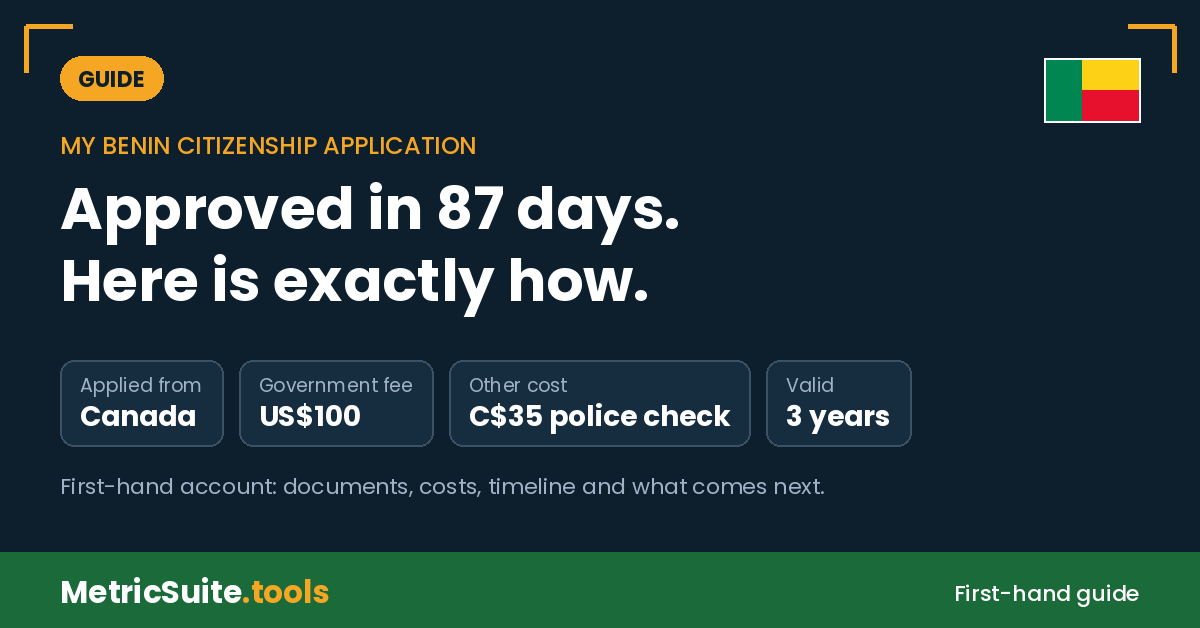
On 20 October 2026, I received a one-page certificate from Cotonou. It is signed by Benin’s Minister of Justice, and it says I am eligible for Beninese nationality.
My Benin citizenship application took 87 days from the moment I pressed submit in Canada. It cost US$100 in government fees and C$35 for a police certificate. Nothing was translated, and no document came back for corrections.
I built MetricSuite.tools to put real numbers in front of diaspora decisions, so here are mine: every date, every document and every dollar, plus what I would do differently. For the rules, rights and tax side, read our full guide to Benin Afro-descendant citizenship. This page is the lived version.
What is a Benin certificate of eligibility? It is the document Benin issues when you apply for Afro-descendant nationality from outside the country. It is valid for three years and lets you enter and stay in Benin. It is not a passport. You become a national only after you travel to Benin, complete identification at the Ministry of Justice and receive a decree from the Council of Ministers.
Why I Chose Benin
I was born in Kingston, Jamaica, and I live in Canada. I was looking for a home in Africa, and Benin invited me home.
After Kenya, I am going to go where I am treated best.
That invitation is written into law. Benin’s Law No. 2024-31 of 2 September 2024 offers nationality to people whose ancestors were deported from sub-Saharan Africa in the slave trade. It did not ask me to buy property, invest a minimum sum or move first. It asked me to prove where I came from.
Most coverage of this law has focused on African Americans and celebrities. Singer Ciara received hers at a ceremony in Cotonou in July 2025. But the law reaches the Caribbean just as clearly, and Caribbean applicants may have the easiest paper trail of anyone.
My Benin Citizenship Application at a Glance
| Item | My application |
|---|---|
| Applied from | Canada, online at myafroorigins.bj |
| Submitted | 24 July 2026 |
| Certificate dated | 19 October 2026, Cotonou |
| Received | 20 October 2026 |
| Time to certificate | 87 days |
| Government fee | US$100 |
| Other costs | C$35 police certificate |
| Proof of descent | Five birth certificates: mine, both parents’, both grandmothers’ |
| DNA | MyHeritage results attached as support |
| Translations | None. Every document was in English |
| Status now | Certificate of eligibility, valid three years. Waiting for my decree and ceremony date |
The Documents That Carried My File
The official portal asks for five things: a valid ID, proof of address, proof of occupation, proof of Afro-descent and a criminal record certificate. The proof of descent is the one that decides your file.
Proof of Descent: Three Generations of Birth Certificates
I built my case on paper. I submitted my own birth certificate, both of my parents’ and both of my grandmothers’. Together they trace my line back two generations, through records issued by a civil registry.
That matches what Benin asks for. The official FAQ on myafroorigins.bj lists civil status records of you and your ancestors as admissible proof. It also accepts documents showing birth before 1944 in a state or territory of deportation, and it excludes people whose ancestors migrated to those territories after 1944.
That 1944 line is why grandparents matter. A grandparent’s birth certificate is often the document that crosses it, and I would not apply without one.
Here is the Caribbean advantage, and it is why I applied with confidence. Jamaica’s Registrar General’s Department has run compulsory civil registration since 1878, and church registers go back to 1664. Many Jamaican families can document a line of births that starts well before 1944. If you are Trinidadian, Barbadian or Guyanese, check how far back your own registry goes. The principle is the same.
The DNA Test I Attached Anyway
I uploaded my MyHeritage DNA results. Honestly, I do not know whether they counted.
Benin’s FAQ says genetic tests are accepted only from laboratories approved by the Republic of Benin, and only to support documents. MyHeritage is a consumer test, not a Benin-approved lab. My read is that the birth certificates carried my file.
If you already have consumer DNA results, attaching them costs nothing. Do not buy a kit expecting it to do the work.
The Other Four Documents
- Valid ID. I used my Canadian passport. The certificate cites it by number.
- Proof of address. The FAQ accepts documents such as a utility bill, tax receipt or residence certificate showing your name and full address.
- Proof of occupation. The FAQ accepts an employer letter, recent payslips or business registration, among others.
- Criminal record certificate. Mine cost C$35. It must be issued within the last three months, so order it last.
What I Did Not Do: Translations
Every document I submitted was in English. I did not pay a translator.
The FAQ says documents need a French translation “where applicable,” by a translator accredited in Benin or by the issuing country’s courts. It also says foreign public documents must be legalised unless an apostille or another exemption applies, and that originals or certified copies may be requested.
In my case, English originals were enough to get the certificate. I treat that as one data point, not a rule. Before I fly, I am asking the nationality authority in writing whether I need translations or legalised copies at my identification appointment.
What My Benin Citizenship Application Cost
| Item | What I paid | Note |
|---|---|---|
| Government fee | US$100 | Paid online at myafroorigins.bj |
| Police certificate | C$35 | Must be dated within three months |
| Five birth certificates | Already on hand | Order full copies if you need new ones |
| DNA test | Already had results | Consumer test, supporting only |
| Translations | $0 | English documents accepted at this stage |
| Apostille or legalisation | $0 so far | May be needed later. I am confirming |
| Total so far | US$100 + C$35 | Travel to Benin not yet included |
Our own guide told you to budget for archive research, translators and apostilles, because nobody had published real costs. Those costs are real for some applicants, especially if your records are in Spanish, Portuguese or Dutch, or stop at an archive gap.
For an English-speaking Caribbean applicant with civil records in hand, the paperwork cost was close to the fee itself. The real budget line is the trip.
The Timeline: 87 Days From Submit to Certificate
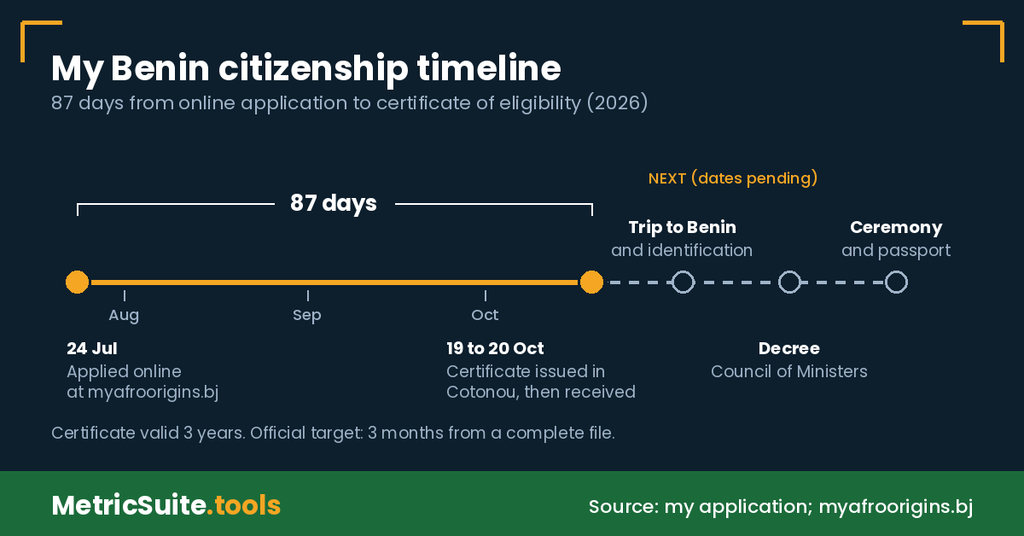
Benin’s official target is three months from receipt of a complete file. Mine came in under three months even counting from the day I submitted.
How the Process Works From Abroad
- Start at myafroorigins.bj. Choose the Afro-descendant recognition service and enter your name, country of residence and email.
- Open the confirmation email. It links you back into your application.
- Upload your documents. ID, proof of address, proof of occupation, proof of descent and a criminal record certificate under three months old.
- Pay the US$100 fee and submit.
- Wait. The target is three months from a complete file. Mine took 87 days from submission.
- Receive your certificate of eligibility. It is valid for three years.
- Travel to Benin. Appear before the Ministry of Justice department in charge of nationality and complete identification in the National Register of Natural Persons.
- Receive the decree. Nationality is granted by decree of the Council of Ministers, which opens the way to a nationality certificate and a Beninese passport.
What the Certificate Actually Says
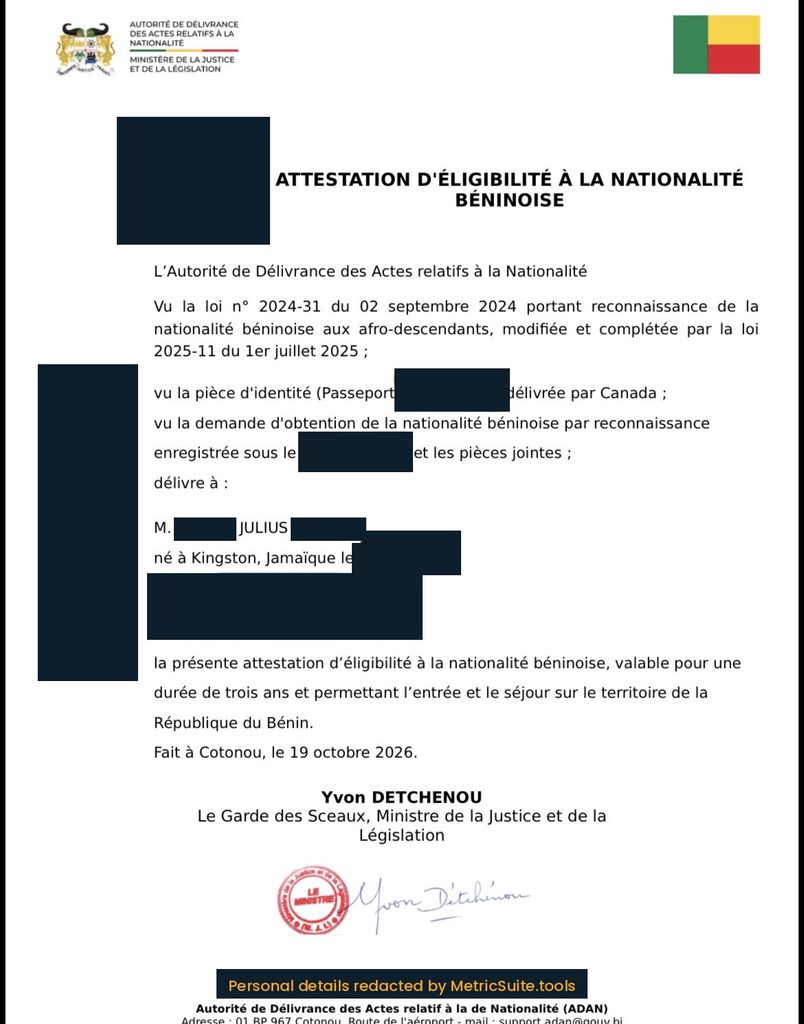
The document is titled Attestation d’éligibilité à la nationalité béninoise, a certificate of eligibility for Beninese nationality. Here is what it contains, in plain English:
- Issuer: the Autorité de Délivrance des Actes relatifs à la Nationalité (ADAN), part of the Ministry of Justice and Legislation. It is signed by the Minister, Yvon Detchenou.
- Legal basis: Law No. 2024-31 of 2 September 2024, as amended and completed by Law 2025-11 of 1 July 2025.
- What it relies on: my Canadian passport, my registered application and the documents I attached.
- What it grants: entry to and stay in the Republic of Benin for three years.
It is not a passport, and it is not nationality yet. Under the official rules, the certificate becomes void if, within its three years, I have not stayed in Benin, appeared before the nationality department and completed identification. My deadline is 19 October 2029, and it is already in my calendar.
What I Would Tell You Before You Apply
- Build the paper chain first, DNA second. Birth certificates for you, your parents and your grandparents.
- Get at least one ancestor’s record dated before 1944 in the Caribbean or the Americas.
- Use full copies of civil records. The FAQ asks for complete copies, not short-form extracts.
- Order your police certificate last. It must be under three months old when you submit.
- Keep originals and certified copies together. You may be asked for them later.
- Ask about translation and legalisation in writing before you book flights.
- Diary your three-year deadline the day your certificate arrives.
- Check your home country’s dual nationality rules. Canada allows dual citizenship. Yours may not.
What Happens Next: My Trip to Benin
Next, I travel to Cotonou to appear before the nationality department and complete identification. The decree and the ceremony follow. I am waiting for my date.
The certificate gives me the right to enter and stay in Benin. I am still asking ADAN whether I also need a visa for the trip, and I will publish the answer. Use the contact details printed on your own certificate.
The trip is where the real money goes: flights from Canada, a hotel in Cotonou, local transport and time off work. Benin uses the West African CFA franc (XOF), so I am pricing everything in XOF before I book.
→ Use the free Currency Converter at MetricSuite.tools to calculate this instantly, no signup required.
If you want to track a trip budget day by day, our Travel Money Command Center workbook is built for exactly this. I will document the whole trip in Part 2: what it cost, how the identification appointment ran and what Cotonou and Ouidah are like for a returnee.
Is a Benin Citizenship Application Worth It for Caribbean Applicants?
For me, the answer was easy. I was looking for a home in Africa, and this was an invitation, not a transaction.
Go in with clear eyes, though. Nationality by recognition gives you entry, residence, a passport and the right to pass nationality to your minor children. It does not give you the right to vote, run for office or join the civil service, and it can be revoked on defined grounds. Our full guide covers those limits and the tax rules in detail.
If you plan to move, think about tax before you think about shipping. Benin generally taxes people domiciled there on worldwide income, and leaving Canada, the UK or the US has its own rules. Our tax exit and land guide walks through each system. When you are ready to ship belongings, Benin applies the WAEMU common external tariff, and our WAEMU Import Duty Calculator estimates it.
Conclusion: Start Your Benin Citizenship Application With Your Paper Trail
Do one thing this week: collect the birth certificates that link you to your oldest ancestor born before 1944 in the Caribbean or the Americas. If you have that chain, the Benin citizenship application itself is the easy part.
Then budget the trip, because that is the real cost. Start with our Repatriation Checklist, and browse every returnee tool on our Diaspora Tools page.
→ Use the free Repatriation Cost Calculator at MetricSuite.tools to calculate this instantly, no signup required. Benin is not listed yet, so use a nearby West African corridor as a rough guide and swap in real Beninese quotes.
Key Takeaways
- My Benin citizenship application took 87 days from online submission in Canada to a certificate of eligibility.
- It cost US$100 plus a C$35 police certificate. No translations, no apostilles, no paid research.
- Birth certificates carried the file. Five of them, across three generations. Consumer DNA was supporting only.
- The certificate is not a passport. It is valid three years and goes void unless you travel to Benin and complete identification.
- The trip is the real cost. Budget flights, a stay in Cotonou and time off work before you apply.
Disclaimer: This is a personal account and general information, not legal, immigration or tax advice. One application is not a rule, and Benin’s requirements may change or be applied differently to your file. Facts were checked on 21 October 2026. Confirm your situation with Benin’s nationality authority (ADAN) or a qualified adviser. See our full Disclaimer.
FQA
How long does a Benin citizenship application take?
Benin’s official target is three months from receipt of a complete file. My application, submitted online from Canada on 24 July 2026, produced a certificate of eligibility dated 19 October 2026: 87 days.
How much does it cost to apply for Benin citizenship?
The government fee is US$100, paid online at myafroorigins.bj. My only other cost was a C$35 police certificate. Budget separately for translations or apostilles if your documents need them, and for the trip to Benin.
Do I need to translate English documents into French?
The official FAQ requires a French translation where applicable. My English documents were accepted without translation for the certificate. Ask the nationality authority in writing before your identification appointment, as requirements may differ at that stage.
Can I use a MyHeritage or AncestryDNA test for Benin citizenship?
Not on its own. Benin accepts genetic tests only from laboratories it has approved, and only to support documents. I attached MyHeritage results, but my birth certificates carried the file.
What documents prove Afro-descent for Benin citizenship?
Civil status records for you and your ancestors are admissible, along with records showing birth before 1944 in a territory of the slave trade. I used five birth certificates: mine, both parents’ and both grandmothers’.
What is a certificate of eligibility for Beninese nationality?
It is issued when you apply from abroad. It is valid for three years and lets you enter and stay in Benin. It is not a passport, and it becomes void if you do not travel to Benin and complete identification in time.
What happens after I receive the certificate of eligibility?
You travel to Benin, appear before the Ministry of Justice nationality department and complete identification in the National Register of Natural Persons. Nationality is then granted by decree of the Council of Ministers, which leads to a nationality certificate and passport.
Can Caribbean people apply for Benin citizenship?
Yes. The law covers anyone aged 18 or over who can show descent from a sub-Saharan African ancestor deported in the slave trade and who is not a national of a sub-Saharan African state. I was born in Jamaica and applied from Canada.
Do I need a visa to travel to Benin with a certificate of eligibility?
The certificate grants the freedom to enter and stay in Benin. Ask the nationality authority whether you also need a visa for your trip, and get the answer in writing before you book.
SOURCES
Opened 21 October 2026 unless noted.
- Source Name: Recognition of Beninese nationality for Afro-descendants (service page and FAQ) URL: https://myafroorigins.bj/services/1/recognition-of-beninese-nationality-for-afro-descendants Publication/Organization: Government of the Republic of Benin, MyAfroOrigins portal Used for: US$100 fee, three-month target, document list, full-copy rule, police certificate within three months, translation and legalisation rules, DNA rule, 1944 rule, certificate of eligibility validity and voiding, identification steps, decree, rights.
- Source Name: Attestation d’éligibilité à la nationalité béninoise (the author’s own certificate, dated 19 October 2026) URL: Primary document, redacted copy published in the article Publication/Organization: ADAN, Ministry of Justice and Legislation, Republic of Benin Used for: issuer, signatory, legal basis, validity and entry/stay wording.
- Source Name: Registrar General’s Department (RGD) URL: https://jis.gov.jm/government/agencies/registrar-generals-department-rgd/ Publication/Organization: Jamaica Information Service, Government of Jamaica Used for: compulsory civil registration since 1878, church registers from 1664.
- Source Name: New law in Benin grants citizenship to slave descendants, Ciara among first URL: https://www.theweek.in/wire-updates/international/2025/07/29/fes44-benin-citizenship.html Publication/Organization: The Week (PTI wire), 29 July 2025 (seen in search results, not opened) Used for: Ciara’s ceremony in Cotonou, July 2025.
MetricSuite (internal)
- https://metricsuite.tools/benin-afro-descendant-citizenship/
- https://metricsuite.tools/diaspora-repatriation-tax-and-land-guide/
- https://metricsuite.tools/repatriation-readiness-checklist/
- https://metricsuite.tools/repatriation-calculator/
- https://metricsuite.tools/currency-converter/
- https://metricsuite.tools/travel-money-command-center/
- https://metricsuite.tools/waemu-tec-import-duty-calculator/
- https://metricsuite.tools/diaspora-tools/
- https://metricsuite.tools/disclaimer/