

This is general information, not legal or tax advice. Confirm specifics with a licensed China immigration or tax professional before acting on anything below.
You’ve got your Z visa. You teach English at a school. The salary lands on time. But you also know that one salary no longer stretches the way it used to, not if you want to live comfortably, save something, and still send money home occasionally.
→ Use the free Caribbean Remittance Comparator at MetricSuite.tools to check what Western Union, Wise, MoneyGram, Remitly, and bank wire actually charge to send money to Jamaica, Trinidad, Guyana, or Barbados, no signup required.
Need a Freelancer for This?
Hire verified talent on Fiverr — starting from $5. No contracts, no hassle.
Browse Fiverr Freelancers →You’ve seen people around you tutor privately, sell things online, or run side businesses. You’ve thought about “getting something on the side.” But there’s a voice in your head asking: Is this legal? Will it affect my work visa? What happens if I get caught?
This article isn’t going to tell you “everyone’s doing it, so you can too.” It covers one thing: what you can actually do within your existing Z visa framework, what you absolutely must not touch, and how to earn more without gambling with your job.
Let’s Be Clear First: Your Z Visa Doesn’t Let You Just “Work on the Side”
Your legal basis for working in China is your work-type residence permit, and it’s tied to one employer, your school.
It’s worth naming something most generic “expat in China” guides skip: getting that Z visa was harder for you than it was for a British, American, Canadian, or Australian teacher. China’s standard “native English speaker” list for teaching visas runs to six countries (the US, UK, Canada, Australia, New Zealand, and Ireland), and Caribbean nations aren’t on it, even though English is the official language across the Anglophone Caribbean. Jamaican and other Caribbean teachers who do get hired legally usually do so because a specific school convinced the local Public Security Bureau to accept their passport as native-English-speaking, a discretionary call that varies by province and by school, not an automatic right. If that’s how you got here, you already know the process was more precarious than it looks on paper. That’s exactly why what you do with the visa once you have it matters more, not less.
Any employment activity that isn’t registered and attached to your work permit is illegal employment under Chinese law. This isn’t just a “grey area”: the consequences can include fines, visa revocation, and even being banned from re-entering China.
So these are off the table:
- Private English tutoring, offline or online, where the other party is an “employer” your work permit doesn’t cover. It’s common, but common doesn’t mean safe.
- Part-time teaching at another school or training center, unless your school formally “dispatches” you and the paperwork is completed.
- Monetizing “life in China” content on TikTok, Douyin, or any platform without registering as a sole proprietor and paying tax. If you’re in China over 183 days, you may be a Chinese tax resident, and your worldwide income is theoretically taxable.
What About “Teaching Adults Online”? This Is the Biggest Grey Area, and the Most Misunderstood
After the 2021 “Double Reduction” policy, online academic tutoring for compulsory-education-age children in China, delivered from outside the country, was essentially shut down.
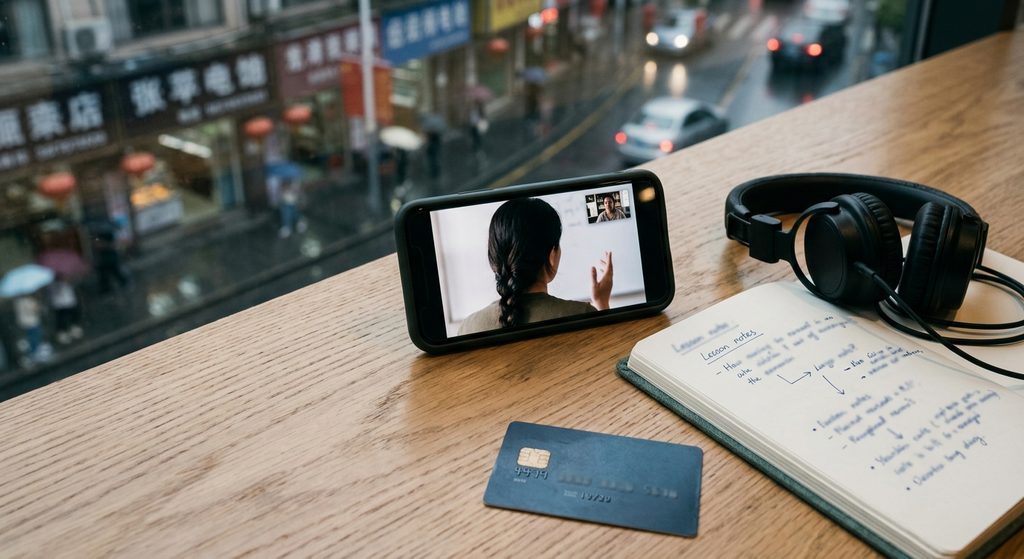
But you might think: “I teach adults, so it’s fine. I pick up Chinese business English students on italki, so that doesn’t count, right?”
The key issue isn’t who you teach. It’s where you physically do the work.
The legal analysis is fairly clear: any work physically performed inside China can trigger tax and work-authorization issues, even if your client is abroad and payment comes from abroad.
You’re sitting in your apartment in China, teaching a Shanghai adult conversational English over Preply or italki, and the money lands in your overseas account. That doesn’t change the fact that you performed labor inside China and got paid for it. Strictly from a compliance standpoint, this can still be treated as activity requiring additional work authorization, and it carries personal income tax filing obligations.
So the reality is: many teachers do this, and platforms won’t proactively report you to Chinese tax or police authorities. But “nobody’s catching it” and “it’s legal” are two different things. What you’re gambling with is your visa record.
The Genuinely “Legal and No-Risk-to-Your-Job” Paths Are Only These
Path One: Treat Skill-Building as Your Side Hustle: No Income, But Real Value
Your Z visa gives you a platform: stable residency, a base income, and a lot of personal time.
The safest “side hustle” strategy is: use your time in China to build assets that don’t generate income now but can later.
- Start a blog or YouTube channel documenting Caribbean teachers’ lives in China, teaching tips, or cultural observations. For now: no ads, no product sales, no fees. Pure content building. When you leave China, this can become the foundation for digital nomad income. One caveat specific to this option: YouTube and most Western social platforms are blocked in mainland China, so running a YouTube channel from inside the country means using a VPN. China’s amended Cybersecurity Law, in force since January 1, 2026, carries real fines (up to roughly RMB 5,000, about $750 USD, for individuals) for unauthorized VPN use, and enforcement has tightened. Casual personal use is rarely the trigger, but keep it low-profile, don’t discuss it on Chinese social platforms, and know it’s not risk-free the way, say, keeping a private Word document of lesson plans is.
- Build a teaching portfolio. Organize the curricula, lesson plans, and classroom videos you’ve designed (with permission) into a professional teaching record. That has direct value for any future job or freelance work, anywhere.
- Learn a hard skill you can monetize remotely. Coding, video editing, UX design, certified translation. Learning these isn’t illegal, and they give you the ability to earn immediately after leaving China.
This path doesn’t sound fast. But it carries the lowest compliance risk of any option here, since no income and no registered employer means nothing for immigration or tax authorities to act on, short of the VPN caveat above.
Path Two: Use the Tax Exemption Window to Legally Optimize Income You Already Have
This is the section where a wrong assumption costs real money. Everything below is general information, not a substitute for a professional reviewing your actual entry dates, trip history, and income sources. Read it fully, then get it checked before you act, not after.
China’s “six-year rule” is the one piece of tax planning every long-stay teacher should actually understand, and most don’t.
Here’s how it works: as a non-domiciled foreign individual, your worldwide income only becomes taxable in China once you’ve been a tax resident (183+ days in China in a calendar year) for six consecutive years without a qualifying break. Two things count as a break, and either one resets the clock: staying under 183 days in China in any one of those years, or taking a single trip of more than 30 consecutive days outside China in any one of those years. Multiple short trips that add up to 30 days do not count. It has to be one continuous trip.
Until the clock resets, your foreign-sourced income, meaning money paid by a Caribbean or other overseas employer or client, not a Chinese entity, is exempt from Chinese individual income tax.
Here’s why this matters specifically in 2026: the six-year count started on January 1, 2019, for everyone, regardless of how long you’d already been in China before that date. If you arrived around then and have stayed in China 183+ days every year since, without ever taking a single trip of 30-plus consecutive days home, 2025 was your seventh year, and your worldwide income may already be taxable in China. If that’s your situation, it’s worth resolving now rather than letting another year pass.
“Exempt” doesn’t mean “invisible.” The exemption on foreign-sourced income isn’t automatic just because you technically qualify. It requires a put-on-record filing with the Chinese tax authority to claim, and you may still need to file an annual return even in a year where the exemption means little or no additional tax ends up owed. Meeting the conditions quietly and never filing anything is not the same as being compliant, it just means nobody’s checked yet.
If you already have some legal passive income in the Caribbean or elsewhere (rental income from property, bank interest, or an online business you were running before you came to China), whether it’s still exempt depends entirely on your specific years in China and travel history.
One thing worth knowing that’s specific to this readership: Jamaica and Trinidad and Tobago each have their own bilateral double taxation treaties with China, separate from the six-year rule. If you’re a Jamaican or Trinidadian national, ask your advisor specifically how your home country’s treaty interacts with the six-year rule for your situation, it may give you options (like credits for tax already paid at home) that a teacher from a country without a China treaty doesn’t have. Guyana and Barbados don’t currently have their own bilateral China treaties, so that extra layer isn’t available the same way.
This isn’t a “tax dodge.” It’s a legally defined compliance window, and claiming it requires proactive filing with tax authorities, not just meeting the conditions quietly.
For Caribbean teachers, if your home country has a low- or zero-tax income structure, this window is worth serious study. But don’t guess: get an advisor who understands Chinese tax law and international tax treaties. If you’ve been in China continuously since around 2019, make that call this year rather than next.
Path Three: If You Really Want to Do Business, Register an Entity and Do It Properly
You teach at a school, but you also have a business mind. You see trade opportunities between the Caribbean and China, or you want to run a legitimate consulting practice.
Before you get anywhere near registering a company, run the actual numbers on the trade idea itself. → Use the free China Sourcing Profit Calculator at MetricSuite.tools to work out landed cost, margin, and breakeven units before you commit to an order, no signup required. If the math doesn’t work as a side project, it won’t work as a WFOE either.
The only compliant route is: register a legitimate business entity and bring it into your work permit framework.
The most common form for foreigners opening a business in China is a WFOE (Wholly Foreign-Owned Enterprise). As of 2026, the process looks roughly like this:
- Preparation (1 to 2 weeks): Choose company form, city, Chinese name, registered capital. There’s no statutory minimum, but the new Company Law requires paid-in capital within 5 years, so don’t inflate the number.
- SAMR registration (3 to 8 weeks): File with the Market Supervision Administration to get your Unified Social Credit Code (your “tax ID”).
- Tax, banking, seals (9 to 12 weeks): Tax registration, bank account, company seals, foreign exchange registration. Bank account opening is the slowest step, possibly 4 to 8 weeks on its own in 2026.
Costs: Full setup for a service or trading WFOE runs roughly $6,000 to $12,000. The $18,000 to $30,000 annual maintenance figure you’ll see in most guides is specifically for a 10-person entity, most of that scales with headcount (payroll processing, social insurance administration per employee), not with the entity’s existence. A solo WFOE with no local hires still needs the mandatory annual audit, bookkeeping, and tax filings (a single-shareholder WFOE is legally required to get an annual statutory audit regardless of size), but skips the payroll layer entirely, so real-world annual costs run meaningfully lower. Get a quote scoped to zero employees specifically before you assume the $18,000 to $30,000 figure applies to you, most firms quote by headcount and transaction volume, not a flat entity fee.
But here’s the critical point: registering a WFOE does not automatically give you work rights. Your work permit is still tied to your school. To legally work for your own company, you’d need to change or add your work permit to include the new company in your employment relationship. This isn’t a “register and you’re done” process. It requires coordination with your school, the foreign experts bureau, and immigration.
If you’re just “testing the waters,” don’t rush into a WFOE. First ask: does your business model actually need a China entity? Or could you run the same business after leaving China, in a more friendly jurisdiction?
A More Honest Suggestion: First Work Out What Your Time Is Worth
How many hours do you teach per week? How long is your commute? How long do you prep?
Say you have 10 hours of “disposable time” per week. Your options are:

- Option A: Risk 3 private online tutoring sessions, earn $60 to $100, carry visa risk.
- Option B: Spend those 10 hours learning a remote-income hard skill over 3 months: lowest compliance risk of the four, but zero income for the first 3 months.
- Option C: Spend those 10 hours seriously running a content account: lowest compliance risk of the four (with the VPN caveat above if it’s video content), possible passive income in 6 to 12 months.
- Option D: Do nothing, and let those 10 hours turn into scrolling and complaining time.
→ Use the free Freelance Day Rate Calculator at MetricSuite.tools to see what your time is actually worth once tax and real costs are factored in, before you decide which option makes sense, no signup required.
Option A pays fastest, but the stake is your visa. Options B and C pay slowest, but the only stake is your patience.
The real question isn’t “what side hustle can I do.” It’s “am I willing to accept slow.”
Final Bottom-Line Checklist
If you only remember a few things:
- Your Z visa is tied to your school. Unregistered employment is illegal.
- Providing any labor inside China, even to a foreign client, can trigger tax and work-authorization issues. Online adult tutoring is not a “safe zone.”
- The safest path to more income is “building assets,” not “selling hours.”
- If you’ve been in China since around 2019 without ever taking a single trip of 30-plus consecutive days home, your six-year tax clock may already be up. Study the foreign-income exemption window, but use a professional. Don’t guess.
- If you truly want to do business, registering an entity is the only proper route, but the cost and complexity are real. Confirm your model is worth it first.
You came to China for a better life, not to walk a tightrope with your visa. A side hustle should make you freer, not leave you one morning realizing you can’t go back.
Calculate first. Then act.
FAQs
Can I legally tutor privately while on a Z visa in China?
No, not unless the arrangement is registered and covered by your work permit. Private tutoring for an employer your permit doesn’t name is illegal employment under Chinese law, regardless of how common it is.
Is teaching adults online through italki or Preply legal while I’m working in China on a Z visa?
It’s a genuine grey area, not a safe zone. What matters legally is where you physically perform the work, not where your client or your payment is based. Teaching from inside China can trigger work-authorization and tax obligations even when the client and payment are both overseas.
What is China’s six-year tax rule, and how do I know if it affects me?
It’s the rule that determines when a foreign resident’s worldwide income becomes taxable in China. If you’ve been a tax resident (183+ days a year) for six consecutive years without ever taking a single trip of more than 30 consecutive days outside China, your foreign-sourced income becomes taxable starting the seventh year. The count started January 1, 2019, so anyone continuously resident since then hit year seven in 2025.
How much does it cost to register a WFOE in China in 2026?
A service or trading WFOE typically runs $6,000 to $12,000 to set up, plus $18,000 to $30,000 a year to maintain for a 10-person entity. The process takes roughly 8 to 12 weeks end to end, with bank account opening usually the slowest single step.
What’s the safest way to earn extra income without risking my Z visa?
Building skills or content assets that generate no income while you’re still in China, then monetizing them after you leave. It’s slower than tutoring on the side, but it carries zero compliance risk.
Sources
- Australian Government Department of Education, “Double Reduction Plan” summary, on the ban on foreign instructors located overseas teaching compulsory-education students: https://www.education.gov.au/download/13152/double-reduction-plan-reduces-homework-and-campus-tutoring-chinese-school-students/40023/double-reduction-plan-reduces-homework-and-campus-tutoring-chinese-school-students/pdf
- China Briefing, “The 6-Year Rule in China for Foreign Individuals: A Comprehensive Guide”: https://china-briefing.com/doing-business-guide/china/taxation-and-accounting/the-6-year-rule-in-china-for-foreign-individuals-a-comprehensive-guide
- Forvis Mazars, “Individual Income Tax Reform: The Six-Year Rule”: https://www.forvismazars.com/cn/en/insights/our-publications/tax-publications/china-tax-newsletter/new-iit-laws-for-the-six-year-rule
- Migaku, “Expat Taxes in China: IIT and the Six-Year Rule Explained,” on the 2025/2026 trigger point: https://migaku.com/blog/language-fun/expat-taxes-in-china-iit-and-the-six-year-rule-explained
- MSA Asia, “How to Start a Business in China in 2026,” 2026 WFOE fee schedule and timeline: https://msadvisory.com/start-business-in-china/
- China Briefing, “Wholly Foreign-Owned Enterprises in China: The Complete 2026 Setup Guide”: https://www.china-briefing.com/news/setting-up-a-wfoe-in-china-complete-guide/