
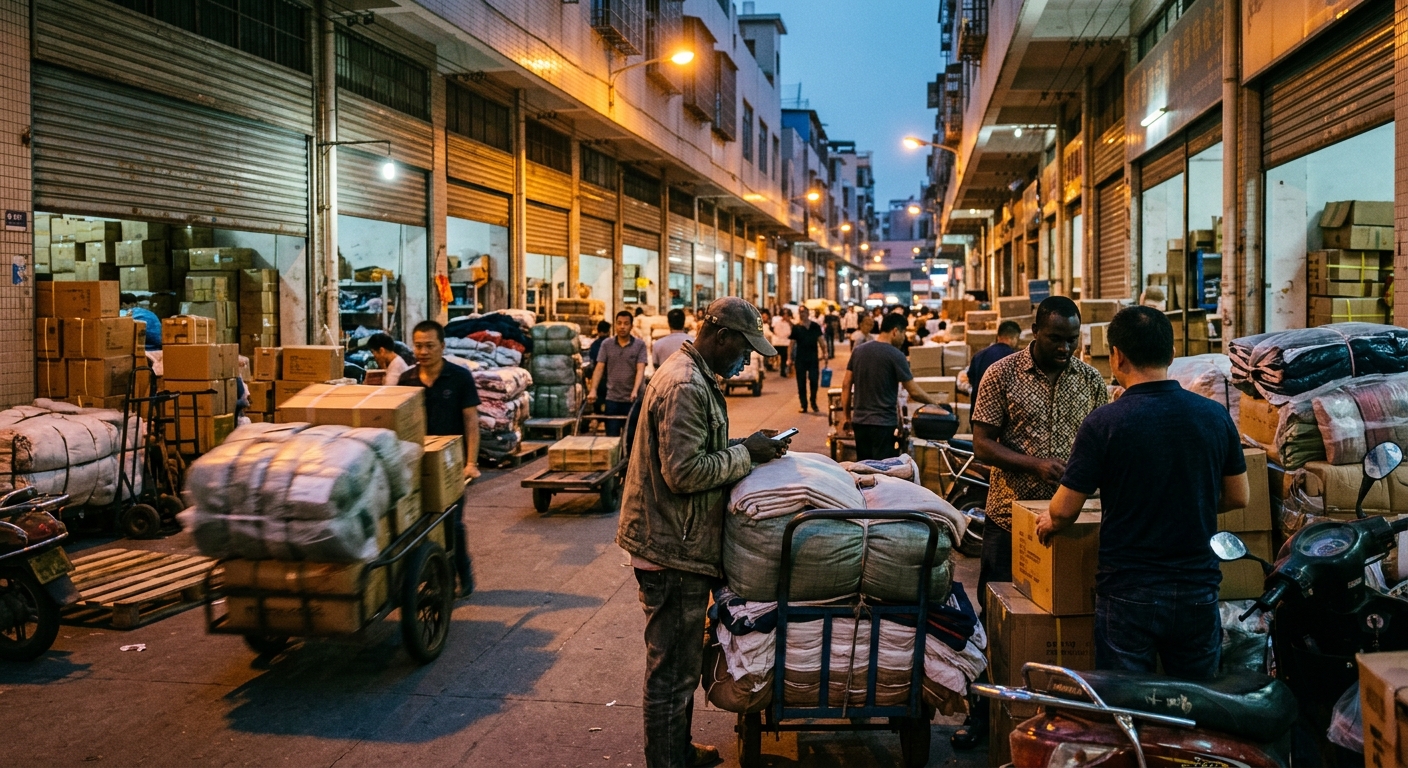
If you’ve spent time around Xiaobei Road, Sanyuanli, or the warehouse districts of Foshan, you know the rhythm of business here has its own pulse.
During the day, the markets are quiet. Many shopkeepers sit behind counters scrolling through their phones. The real energy starts in the late afternoon: phone screens lighting up with messages from clients in Lagos, Accra, or Nairobi. WhatsApp video calls come one after another. By late night, freight trucks pull into narrow streets. Goods get weighed, bagged, labeled, then head to the airport or the port. By 2 or 3 a.m., some people are just sitting down to dinner. Others are already getting ready for sleep.
This is a community of African traders in China living on a trans-continental time difference. Their business connects Chinese factories to African markets. But the way many of them calculate costs still runs on “roughly,” “about,” and “same as last time.”
Need a Freelancer for This?
Hire verified talent on Fiverr — starting from $5. No contracts, no hassle.
Browse Fiverr Freelancers →The problem is that profit margins today no longer have room for “roughly.”
African Traders in China Face a Fading Era of Low-End Globalization
“Little Africa,” the informal cluster of trading communities around Guangzhou’s Xiaobei and Sanyuanli districts, grew on what anthropologist Gordon Mathews calls “low-end globalization”: traders moving relatively small batches of goods through informal or semi-formal channels, from Guangzhou’s factories and wholesale markets back to stalls and shops in Africa. Mathews documents the model in The World in Guangzhou, describing a trade built on informality, reputation, and trust rather than contracts. Traders who arrived in the mid-to-late 2000s describe the flow of trade between the city and Africa as being at its peak around that time.
That era is fading.
Guangzhou’s enforcement against undocumented entry, residence, and employment has tightened. In May 2025, widely circulated reports described a large-scale police operation in Sanyuanli, the district at the heart of Little Africa’s trading community, a sign of how closely the area is now watched even where the exact scale of any single operation is disputed. Meanwhile, Nigeria Customs’ digital systems are fully rolled out. Form M, SONCAP, PAAR: none can be skipped. A wrong HS code or a mismatched invoice amount can mean delays at best, seized goods at worst.
Costs that used to be absorbed through “flexibility” and “connections” now need to be managed through precision.
And precision is exactly what many cross-border traders lack.
The True Cost of a Shipment Was Never Just the Goods
Take an example. You spot a batch of goods in Guangzhou. The supplier quotes you $100,000. You mentally add sea freight and customs clearance, maybe another $20,000. You sell it in Lagos for $150,000. There’s profit in there.
But that ‘roughly’ hides too many variables, and one of them changed in a way plenty of traders still haven’t priced in
Nigeria’s import duty is calculated on CIF value: goods, insurance, and freight added together. The base duty itself runs from 0% to 35% depending on the product’s tariff band under the ECOWAS Common External Tariff. On top of that, Nigeria Customs began collecting a flat 4% levy on FOB value in August 2025, replacing the old 1% CISS fee and 7% duty surcharge. Add a 0.5% ECOWAS Trade Liberalisation Scheme levy on CIF, then 7.5% VAT calculated on the cumulative total once duty and the other levies are added. For electronics and textiles sitting in the 20% duty band, the combined charges can approach 40% of the goods’ value.
That’s before clearance fees. Clearing a 40-foot container in Lagos typically runs $1,200 to $2,500 locally, and demurrage adds up fast if documents have issues and the container sits at port. Get a current quote from your clearing agent before you commit to a shipment, since port charges move with little notice.
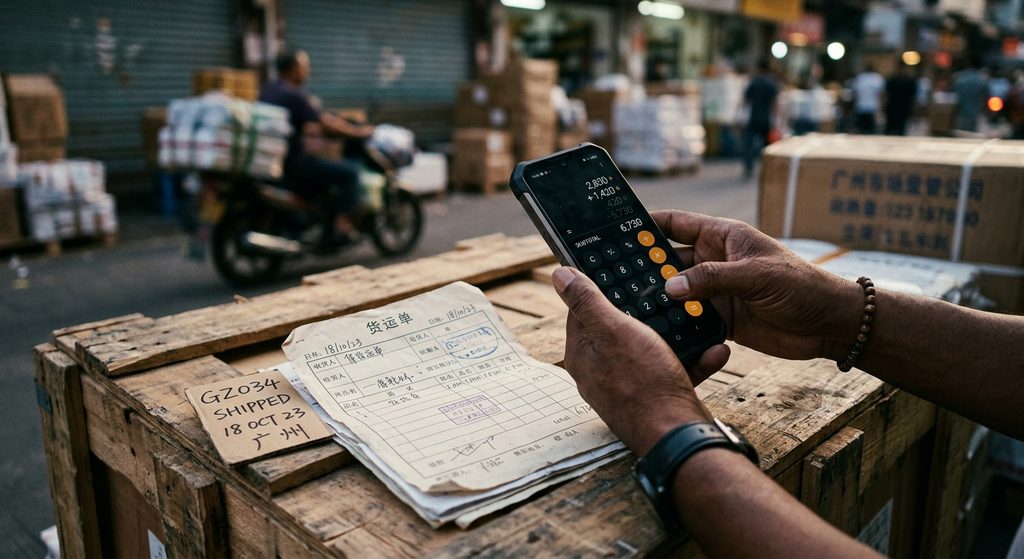
Add it up, and a true landed cost can run 15% to 25% higher than a “roughly” estimate.
That 15% to 25% is often the entire profit.
→ Use the free Nigerian Import Duty Calculaor at MetricSuite.tools to calculate this instantly, no signup required.
The Money Path Needs Optimizing More Than the Goods Path
Goods move from Guangzhou to Lagos in as little as seven days by air freight (DDP), or a month or more by sea. Money moving from Lagos to Guangzhou, or back, often takes longer and costs more.
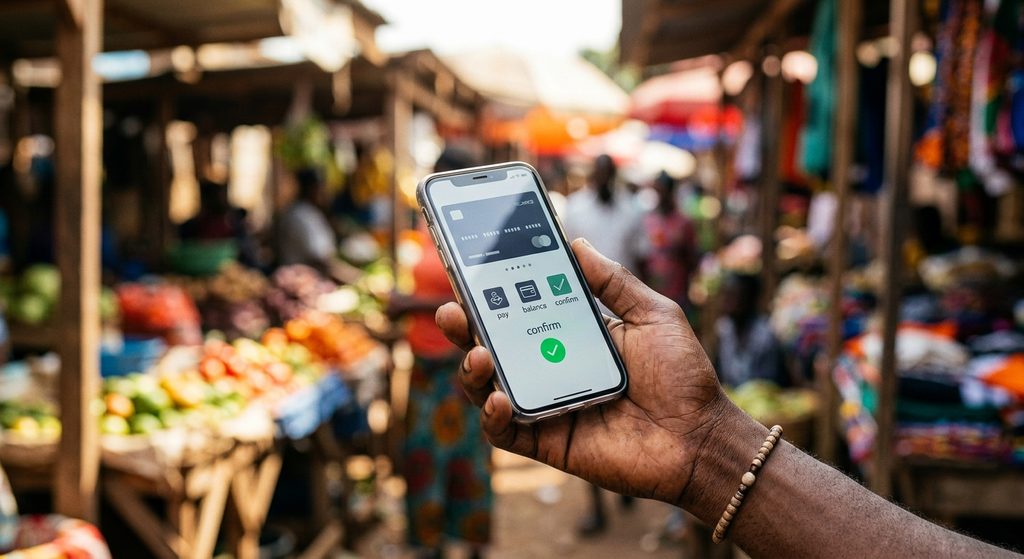
With traditional bank wires, Nigerian retail banks commonly charge FX spreads of roughly 1% to 3% on major currency pairs. Every transfer starts with a loss of at least one point. For traders paying multiple suppliers frequently, those points compound fast.
This is why more African importers are using multi-currency accounts to hold offshore Chinese yuan (CNH) or Hong Kong dollars directly, bypassing repeated currency conversions. Choosing a payment method is a profit center. Most people just never treat it as one.
If you’re doing small, high-frequency transactions, mobile money fees deserve the same scrutiny. The rate differences between M-Pesa, MTN MoMo, and Airtel Money look trivial per transaction. Over dozens of transactions a month, they add up to a box of goods’ worth of profit.
→ Compare M-Pesa, MTN MoMo, and Airtel Money side by side with MetricSuite’s mobile money fee tools, free and no signup required.
If you’re sourcing directly from suppliers rather than going through Guangzhou middlemen, it’s also worth comparing supplier options on Alibaba before committing to a shipment (affiliate link, this supports MetricSuite at no cost to you).
Investing in Chinese Stocks Needs a Cold Look, Not a Quick Yes
Can African traders invest in Chinese or Hong Kong stock markets? Yes, but the barriers aren’t what you might imagine.
For Hong Kong, foreigners can open brokerage accounts directly to trade HK stocks, or get exposure indirectly through US-listed ADRs and ETFs. The Stock Connect mechanism lets overseas investors buy certain A-shares through Hong Kong exchanges. But for most traders in Little Africa, the practical hurdle is more basic: a bank account in Hong Kong or overseas, account-opening paperwork that isn’t quick, and a market logic completely different from Lagos or Nairobi.
Opening a direct A-share account is harder still. Foreigners mostly participate through Qualified Foreign Investor mechanisms or mutual access programs, and individual direct account opening is heavily restricted. Chinese markets are also volatile and policy-sensitive, real risks for anyone unfamiliar with how they work.
This isn’t to say it can’t be done. It’s to say that if you can’t calculate the landed cost of your next shipment precisely, putting money into a stock market you understand even less isn’t efficiency. It’s risk stacked on risk.
The Essence of Efficiency Is Knowing What You Don’t Know
Little Africa is going through a quiet but real shift.
The space for making money through insider tips and flexible operations is narrowing. Customs data systems are networked. Visa management is digital. Tax and customs authorities across Africa are tightening. Winning increasingly depends on who can calculate the numbers more accurately before spending money.
This isn’t about becoming an accountant. It’s about recognizing that the cost of “roughly” is rising fast, and the barrier to precision is falling just as fast for African traders in China who are willing to use the tools available to them.
From Guangzhou to Lagos, from Foshan to Accra, the distance goods travel won’t shrink. The time difference won’t disappear. The warehouse lights will still be on at 2 a.m. But the trader who calculates the true numbers behind every cost, on the same phone he’s negotiating on, runs a more solid business than the one who’s still guessing.
Start Calculating, Not Guessing
MetricSuite is built for how business actually works across Africa: African currencies, mobile money, customs duties, AfCFTA tariffs, and the real cost of moving goods from Guangzhou to Lagos.
Free. No account required.
- Calculate your landed cost now: import duty, freight, and clearance in one place.
- Compare mobile money fees and see what you’re really paying per transaction.
- Explore MetricSuite’s full library of Africa-focused business tools, from import duty to crop profitability.
Know your numbers before you spend your money.
Key Takeaways
- Nigeria’s landed cost stack changed in August 2025: a flat 4% FOB levy replaced the old 1% CISS fee and 7% surcharge, on top of duty, the 0.5% ECOWAS levy, and 7.5% VAT.
- A “roughly” landed cost estimate is commonly off by 15% to 25%, which is often the entire margin on a shipment.
- Payment routing (bank wire vs. multi-currency account vs. mobile money) is a profit center on its own, not a formality.
- Enforcement around Guangzhou’s African trading districts has tightened noticeably since 2025, raising the cost of operating informally.
- Precision, not connections, is now the main edge available to small cross-border traders.
FAQs
What changed in Nigeria’s import duty structure in 2025?
In August 2025, Nigeria Customs replaced the old 1% CISS fee and 7% duty surcharge with a flat 4% levy on FOB value. The base duty (0% to 35% by product band), the 0.5% ECOWAS levy, and 7.5% VAT stayed in place.
How much higher is landed cost than the supplier’s quoted price?
For a typical shipment into Nigeria, total landed cost commonly runs 15% to 25% above the supplier’s quoted price once duty, levies, VAT, freight, and clearing fees are included. The exact figure depends on the product’s tariff band.
Is it cheaper to pay Chinese suppliers by bank wire or mobile money?
It depends on transaction size and frequency. Bank wires carry an FX spread that applies regardless of amount, while mobile money and multi-currency accounts can cost less on smaller, more frequent transfers. Compare actual quoted rates before choosing, since pricing varies by provider and corridor.
Can African traders in Guangzhou legally invest in Chinese stocks?
Yes, mainly through Hong Kong brokerage accounts, US-listed ADRs and ETFs, or the Stock Connect mechanism for certain A-shares. Direct mainland A-share accounts are heavily restricted for foreigners. It requires an overseas or Hong Kong bank account and carries real market risk.
Sources
- DHL Discover Nigeria, “How to Calculate Import Duties in Nigeria”: https://www.dhl.com/discover/en-ng/logistics-advice/import-export-advice/how-to-calculate-import-duties-in-nigeria
- BusinessDay Nigeria, on the August 2025 4% FOB levy: https://businessday.ng/?p=1014138
- AllAfrica, “Nigeria: Cargo Clearance Cost to Rise As Customs Begins 4 Percent Levy Collection”: https://allafrica.com/stories/202508070485.html
- Gordon Mathews interview, Hong Kong Free Press, on “low-end globalization” and The World in Guangzhou: https://www.hongkongfp.com/2017/12/25/hkfp-interview-author-gordon-mathews-multiculturalism-ethnic-stereotypes-guangzhou/
- Africans in China, trader account describing the mid-2000s peak in Guangzhou-Africa trade: https://africansinchina.net/2014/02/04/living-without-a-visa-in-guangzhou-via-thinkafricafeed/
- Wikipedia, “Illegal immigration to China,” on the May 2025 Sanyuanli reports: https://en.wikipedia.org/wiki/Illegal_immigration_to_China