
A software developer in East Legon closes out August with three new client contracts and a waitlist. A guesthouse owner in Elmina closes out the same month wondering whether to lay off two of her four staff. Both are running real businesses in the same country, in the same quarter. The Ghana Statistical Service’s latest numbers explain why their experiences have almost nothing in common right now, and they point fairly precisely at where a business should be positioning itself for the next year.
The Number Behind the Headline
Ghana’s economy grew 6.0 percent year-on-year in the second quarter of 2026, a touch softer than the 6.6 percent recorded in the same quarter last year, according to data the Ghana Statistical Service (GSS) presented on 9 September. First-half growth for 2026 came in at 6.2 percent. On its own, that headline number reads as solid, unremarkable continuity.
It is not telling the real story. Government Statistician Dr Alhassan Iddrisu was direct about what actually drove the quarter: information and communication technology alone. ICT grew 30.9 percent year-on-year, up from 21.3 percent the year before, and single-handedly contributed 41.5 percent of Ghana’s total GDP growth in the quarter. Iddrisu called it the single largest driver in the entire economy, and noted the sector has posted double-digit growth every quarter for three straight years. As he put it, Ghana’s growth story right now is substantially a digital one.
Need a Freelancer for This?
Hire verified talent on Fiverr — starting from $5. No contracts, no hassle.
Browse Fiverr Freelancers →Services overall grew 8.0 percent and accounted for 57.6 percent of total GDP growth, making it the biggest broad-sector contributor by far. But within services, ICT is doing most of the heavy lifting. That distinction, ICT specifically rather than services generally, is the difference between a vague “tech is growing” takeaway and an actionable one.
The Boom Side: Where the Growth Actually Is
Four sectors are carrying this economy right now, and each one implies a different kind of business opportunity.
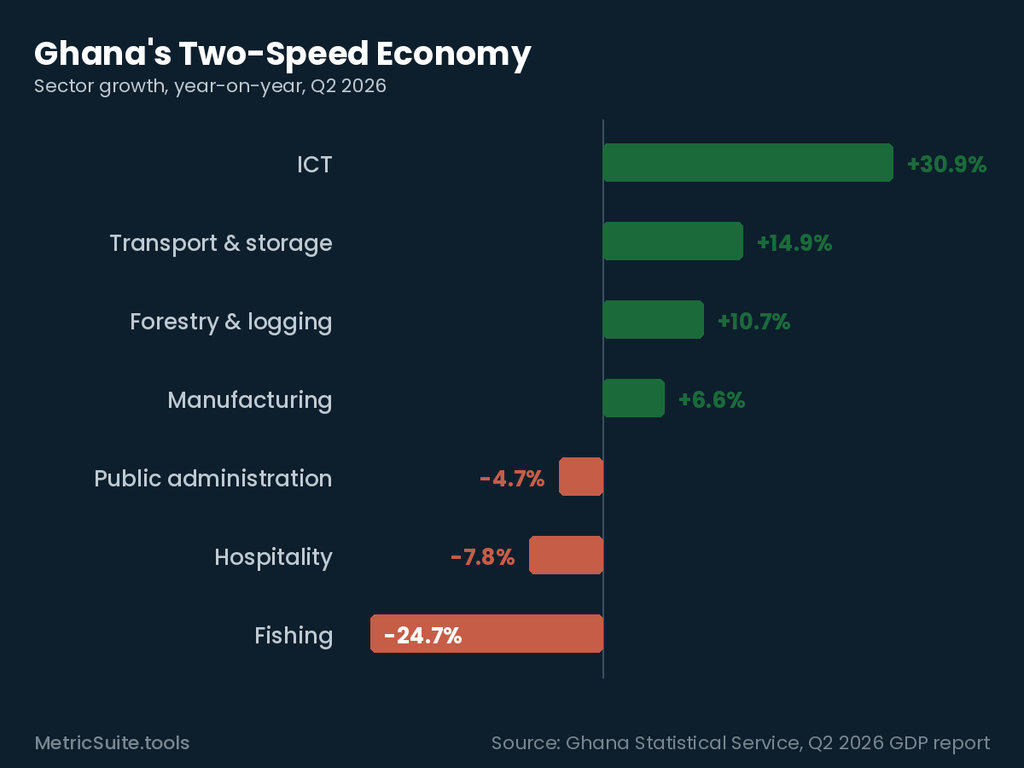
ICT (+30.9%). Three consecutive years of double-digit growth is not a spike, it is a structural shift. This is where new digital infrastructure, digital services, and the businesses that serve both are getting built.
Transport and storage (+14.9%). This sector alone contributed 13.5 percent of total GDP growth. Growth in transport and storage this strong, alongside a well-publicised port congestion crisis (more on that below), points to genuine strain and genuine opportunity in how goods move around and through Ghana right now.
Forestry and logging (+10.7%). Up sharply from 2.7 percent a year earlier. A smaller sector, but a real one, particularly for anyone already in timber, wood products, or export-adjacent supply chains.
Manufacturing (+6.6%). Up from 5.4 percent, and helped materially by January’s VAT reform, which lowered the effective VAT rate and cut roughly 5 percent off the cost of doing business for manufacturers who can now claim GETFund and NHIL as input tax rather than absorbing them as a cascading cost.
Oil and gas is worth naming too, even though it is not a small-business entry point: the sector swung from a 29 percent contraction a year earlier to 22.4 percent growth, contributing 12.8 percent of total GDP growth on its own. That single swing explains a meaningful share of industry’s overall improvement, from 2.4 percent to 4.3 percent growth.
The Other Side: Where It’s Actually Contracting
This is not a rising tide lifting all boats. Three areas are moving in the opposite direction, and ignoring that is exactly how a business gets caught off guard.
Fishing (-24.7%). The sharpest contraction in the data, and the one GSS flagged as a direct concern for coastal livelihoods and food security.
Hospitality (-7.8%). Iddrisu named this sector explicitly as a “critical vulnerability” requiring policy attention, alongside fishing and education.
Public administration (-4.7%). A contraction in government-linked economic activity, which matters directly for any business whose revenue depends on public contracts or procurement.
This is what makes it a genuinely two-speed economy rather than an uneven-but-broadly-positive one. A business tied to fishing, hospitality, or government contracting is not experiencing the same “6 percent growth” headline that a software company or a logistics operator is.
For Each Booming Sector: Where the Actual Openings Are
ICT’s boom is creating demand nobody’s fully served yet: digitising the MSMEs left behind.
Ghana’s Registrar General’s Department puts MSMEs at over 90 percent of all registered businesses in the country, and the overwhelming majority still run on paper records or a notebook. A sector growing 30.9 percent a year does not just mean more software companies. It means more small businesses adjacent to that boom who now expect, or are being pushed toward, digital bookkeeping, digital invoicing, and digital payment reconciliation, and who cannot afford or don’t want a full accountant. That gap, MSME-facing digital bookkeeping and back-office services, is a direct, immediately actionable opening created by this exact data. If you’re building or running that kind of service, the MetricSuite Bookkeeping Workbook is a ready-made template you can put in front of clients without building your own from scratch.
There’s a second, more specific ICT-adjacent opening forming right now. The Bank of Ghana is actively developing a licensing framework for cedi-backed stablecoins, built on the Virtual Asset Service Providers Act, 2025. Tahiru Alhassan, who heads oversight and compliance in the BoG’s Virtual Assets Department, has described a cedi-backed stablecoin as an enabler of monetary policy in its own right. A consultation paper for industry was expected imminently as of early September. This is not yet a live product Ghanaians are using, but it is a clear signal: businesses that position themselves early around compliant digital-payments advisory, virtual asset onboarding, or stablecoin-adjacent bookkeeping will have a real head start once the framework goes live, rather than scrambling to catch up after it does.
Transport and storage’s growth is tangled up with a real, current crisis, and that crisis is the opportunity.
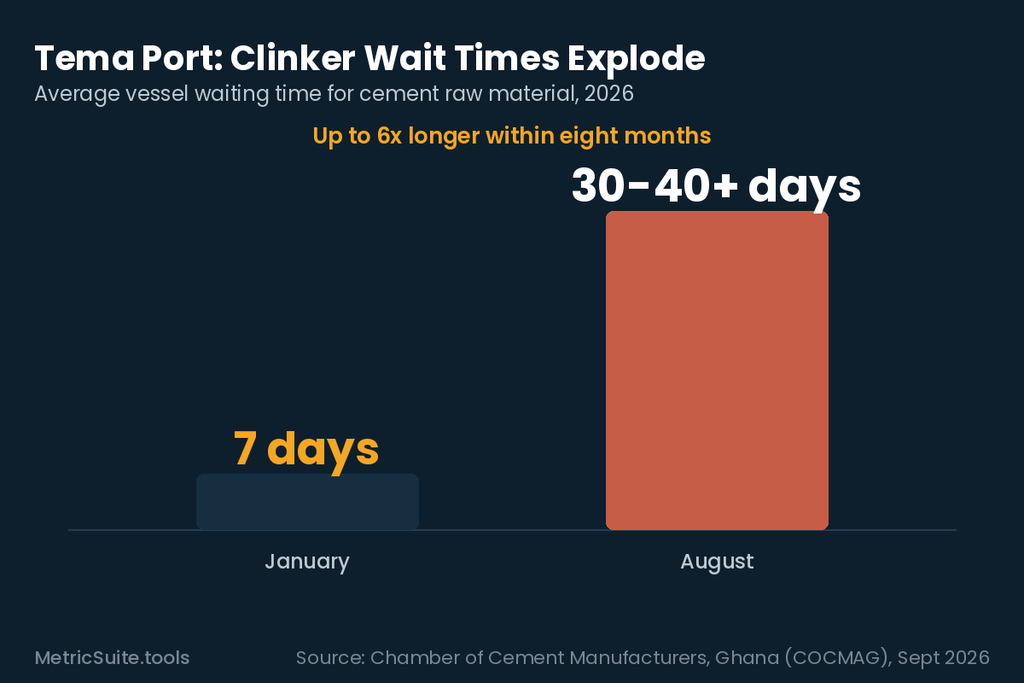
Vessel waiting times for clinker (the raw material cement manufacturers depend on) at Tema Port rose from an average of seven days in January 2026 to between 30 and more than 40 days by August. The Chamber of Cement Manufacturers, Ghana estimates the industry absorbed US$45 to 50 million in demurrage costs in just the first eight months of the year, expensive enough that manufacturers introduced a temporary GH¢12-per-bag surcharge to cover it. On 11 September, the government responded, agreeing to dredge an additional berth at Tema specifically to relieve the clinker backlog, following an urgent meeting between the Transport and Trade ministries, the Ghana Ports and Harbours Authority, and cement manufacturers.
That is a live, acknowledged bottleneck, and bottlenecks are where logistics businesses get built. Freight forwarding, customs brokerage, bonded warehousing near Tema, and even demurrage-cost consulting for importers who don’t have the scale to negotiate their own berth access are all direct responses to a problem the government itself is currently scrambling to fix. If your business touches imports in any way, run your full landed cost, duty, ECOWAS and AU levies, NHIL, GETFund, and VAT, through the Ghana Import Duty Calculator before you commit to an order, and see the full breakdown of every import charge so port delays don’t blindside a budget that was already tight.
Manufacturing’s growth got a direct assist from the VAT reform, and that assist is still underused.
The effective VAT rate dropped from 21.9 percent to a flat 20 percent from 1 January 2026, after the COVID-19 levy was abolished and GETFund and NHIL were pulled back into the VAT base as creditable input tax rather than a cascading add-on cost. The government estimates this alone cuts the cost of doing business by roughly 5 percent for VAT-registered manufacturers. If you manufacture, assemble, or process goods in Ghana and you are still pricing as though the old 21.9 percent cascade applies, you are leaving margin on the table that the tax reform already handed you.
Forestry’s growth is smaller, but real, if you’re already positioned in timber or wood products.
At 10.7 percent growth, up from 2.7 percent, this is a narrower opportunity, but a genuine one for anyone in sustainable timber sourcing, wood product manufacturing, or export certification services that feed regional and international demand.
For Each Declining Sector: Pivot, Don’t Panic
Fishing (-24.7%): move toward value-add and aquaculture, not more of the same.
A contraction this sharp in wild-catch fishing does not necessarily mean less opportunity in seafood generally. Fish processing, smoking, packaging for retail and export, and aquaculture (which sidesteps the pressures driving the wild-catch decline) are all adjacent activities that can grow even while the raw fishing numbers fall.
Hospitality (-7.8%): stop building for leisure tourism, start building for the boom sectors’ business travel.
A tech sector growing 30.9 percent a year, plus growing transport and logistics activity, means more business travellers moving through Accra, Tema, and Kumasi, not fewer. If your hospitality business is still positioned around leisure tourism, the data says pivot toward short-stay corporate accommodation, meeting and co-working space, and catering for the sectors that are actually expanding, rather than waiting for leisure demand to recover on its own.
Public administration (-4.7%): diversify away from government-dependent revenue now, while you have room to.
If a meaningful share of your revenue comes from public contracts, procurement, or government-adjacent services, this contraction is a direct warning. It does not mean government spending disappears, but it means betting the business on it right now is betting against the data. Diversifying toward private-sector clients in the booming sectors above is the more defensible position for the next year.
The Practical Signal for Anyone Watching Ghana Right Now
Put together, the data says something more specific than “Ghana’s economy is growing.” It says growth is real, concentrated, and identifiable by sector, and the businesses that do well over the next twelve months will be the ones that consciously position themselves inside ICT, transport and logistics, manufacturing, or forestry, rather than the ones still operating as if 2023’s economic map still applies.
There is also a genuinely better operating backdrop underneath all of this. Ghana’s GDP deflator, a broad measure of economy-wide price pressure, fell from 18.6 percent in Q2 2025 to 5.5 percent in Q2 2026, a 13.1 percentage-point drop in a single year. Combined with the VAT reform’s roughly 5 percent cut to the cost of doing business, this is a materially calmer, cheaper environment to reposition a business in than the one Ghana had eighteen months ago. The sectors are uneven. The overall conditions for making a move are not bad.
FAQ
How fast is Ghana’s ICT sector growing in 2026?
Ghana’s ICT sector grew 30.9 percent year-on-year in the second quarter of 2026, up from 21.3 percent a year earlier, according to the Ghana Statistical Service. It has posted double-digit growth every quarter for three consecutive years and contributed 41.5 percent of Ghana’s total GDP growth in Q2 2026 alone.
Why is Ghana’s technology sector growing so fast right now?
Ghana’s Government Statistician has described the growth as structural rather than a one-off spike, pointing to three straight years of double-digit ICT expansion. The sector is also benefiting from active regulatory development, including the Bank of Ghana’s work on a licensing framework for cedi-backed stablecoins under the Virtual Asset Service Providers Act, 2025, which signals continued institutional investment in Ghana’s digital finance infrastructure.
What does Ghana’s digital economy look like in 2026?
ICT alone contributed 41.5 percent of Ghana’s total GDP growth in Q2 2026, more than any other single sector. The Bank of Ghana is simultaneously developing a cedi-backed stablecoin framework requiring fiat reserves at regulated institutions, pointing to a digital economy that is expanding in both scale and regulatory sophistication at the same time.
Which sectors are driving and dragging Ghana’s GDP growth?
Driving growth: ICT (+30.9%), transport and storage (+14.9%), forestry and logging (+10.7%), manufacturing (+6.6%), and oil and gas (+22.4%, recovering from a prior-year contraction). Dragging growth: fishing (-24.7%), hospitality (-7.8%), and public administration (-4.7%), according to Ghana Statistical Service Q2 2026 data.
What business opportunities exist in Ghana’s current tech boom?
Concrete openings include digital bookkeeping and back-office services for Ghana’s roughly 1.5 million MSMEs, many of whom still run on paper records; logistics and freight services responding to Tema Port’s clinker congestion crisis; and early positioning around compliant digital-payments and stablecoin-adjacent advisory ahead of the Bank of Ghana’s cedi-backed stablecoin framework going live.
SOURCES
- “Ghana’s economy grows 6.0% in 2026 Q2 – GSS.” MyJoyOnline, 9 September 2026. https://www.myjoyonline.com/ghanas-economy-grows-6-0-in-2026-q2-gss/
- “ICT growth surges to 30.9% in Q2 2026, leading economic expansion.” Adomonline, 9 September 2026. https://www.adomonline.com/ict-growth-surges-to-30-9-in-q2-2026-leading-economic-expansion/
- “Ghana’s economy grows 6% in Q2 2026, ICT becomes biggest driver.” The Sikaman Times, 9 September 2026. https://sikamantimes.com/ghanas-economy-grows-6-in-q2-2026-ict-becomes-biggest-driver/
- “Digital economy powers Ghana’s GDP to 6% – GSS.” Ghana Business News, 10 September 2026. https://www.ghanabusinessnews.com/2026/09/10/digital-economy-powers-ghanas-gdp-to-6-gss/
- “Ghana economy grows 6% despite slower Q2 expansion.” Ghana Netherlands Business & Culture Council, citing Citi Newsroom. https://gnbcc.net/ghana-economy-grows-6-despite-slower-q2-expansion/
- “Govt moves to avert cement price hike.” Graphic Online, 12 September 2026. https://www.graphic.com.gh/news/general-news/govt-moves-to-avert-cement-price-hike.html
- “Ghana cement producers introduce clinker demurrage surcharge.” CemNet, September 2026. https://www.cemnet.com/News/story/182025/ghana-cement-producers-introduce-clinker-demurrage-surcharge.html
- “Tema Port Dredging To Ease Clinker Delays, Cut Pressure On Cement Producers.” The High Street Journal, 11 September 2026. https://thehighstreetjournal.com/tema-port-dredging-to-ease-clinker-delays-cut-pressure-on-cement-producers/
- “African nations move to bring stablecoins into the financial mainstream.” Daily Maverick, 7 September 2026. https://www.dailymaverick.co.za/article/2026-09-07-african-nations-move-to-bring-stablecoins-into-the-financial-mainstream/
- “Mobile money gives Africa head start in tokenised payment adoption.” Financial Fortune Media. https://www.financialfortunemedia.com/mobile-money-gives-africa-head-start-in-tokenised-payment-adoption/
- “Ghana reconsolidates VAT to 20%.” VATCalc, January 2026. https://www.vatcalc.com/ghana/ghana-raises-vat-2-5-to-15-2023/
- “Ghana VAT Reform 2026: Higher Thresholds, Lower Rates.” VATabout, November 2025. https://vatabout.com/ghana-vat-reform-2026-higher-thresholds-lower-rates
- “Ghana Import Duty Calculator 2026.” MetricSuite.tools. https://metricsuite.tools/ghana-import-duty-calculator/