
If you’re reading this from a rented apartment in a city where the rent went up again this year, you already know the arithmetic. The paycheck lands, the bills clear it out, and the gap between “working hard” and “getting ahead” doesn’t close no matter how many extra hours you put in. For a lot of African and Caribbean professionals abroad, that gap is compounded by something harder to put a number on: promotions that stall for reasons nobody states out loud, and a cost of living that keeps climbing faster than wages.
The paradox is that the same systems producing that stagnation are also, in a narrow sense, comfortable. The lights stay on. The roads are paved. Nobody has to know somebody to get a business license processed. That predictability is real, and it’s part of why so many people who talk about leaving never do.
This isn’t a pitch to drop everything and move. It’s a look at what changes when you stop treating the frustration as something to endure and start treating it as information, specifically, information about where the gaps are that a business could fill.
Need a Freelancer for This?
Hire verified talent on Fiverr — starting from $5. No contracts, no hassle.
Browse Fiverr Freelancers →The Western Reality: Predictable, and Predictably Limited
Paycheck-to-paycheck living isn’t a personal failing. It’s the design of an economy where wage growth has trailed cost-of-living increases for most workers for over a decade, and where a single missed pay cycle can undo months of saving. Layer on discrimination that shows up as being passed over rather than being told why, and the ceiling becomes something you feel in your career trajectory more than something you can point to in a memo.

None of this is unique to any one country, and none of it means the system is only bad. Salaries are stable. Healthcare, however expensive, exists. Contracts are enforced. These are real advantages, which is exactly why the decision to build something elsewhere feels like giving up security for uncertainty, rather than trading one set of tradeoffs for another.
Why Leaving Feels Impossible: Two Different Operating Systems
The friction on the other side is real too, and it’s worth describing plainly rather than diplomatically. Power isn’t always reliable. Government processes can move slowly. Getting things done sometimes depends on who you know rather than what’s written in a procedure manual. These aren’t moral failings of the countries in question, they’re the normal operating conditions of markets that are still building out formal institutions, and every entrepreneur who has built something profitable there has built it by planning around those conditions rather than pretending they don’t exist.
That’s a different problem from the one in the West. The West’s friction is embedded in a system that already works, so it’s hard to out-earn. The friction in faster-growing markets is embedded in a system that’s still forming, and unformed systems are exactly where new businesses find room to operate. A gap in reliable power is also a market for backup power. A gap in formal credit is also a market for a company that prices risk differently. The friction isn’t a reason the opportunity doesn’t exist. It’s usually the shape of the opportunity itself.
The Mindset Shift
The reframe is straightforward to state and harder to actually adopt: the same frustration that makes the West feel stagnant is diagnostic information about unmet demand elsewhere. Every fintech, healthtech, and logistics company that’s grown fast in these markets over the past few years did it by identifying one specific, expensive problem an ordinary person deals with, and pricing a solution to it.
That’s a narrower claim than “Africa is full of opportunity,” and a more useful one. It’s not about the continent or the region in the abstract. It’s about a specific gap, in a specific market, that someone with outside capital, outside experience, or an outside network is positioned to close.
Where the Gaps Actually Are
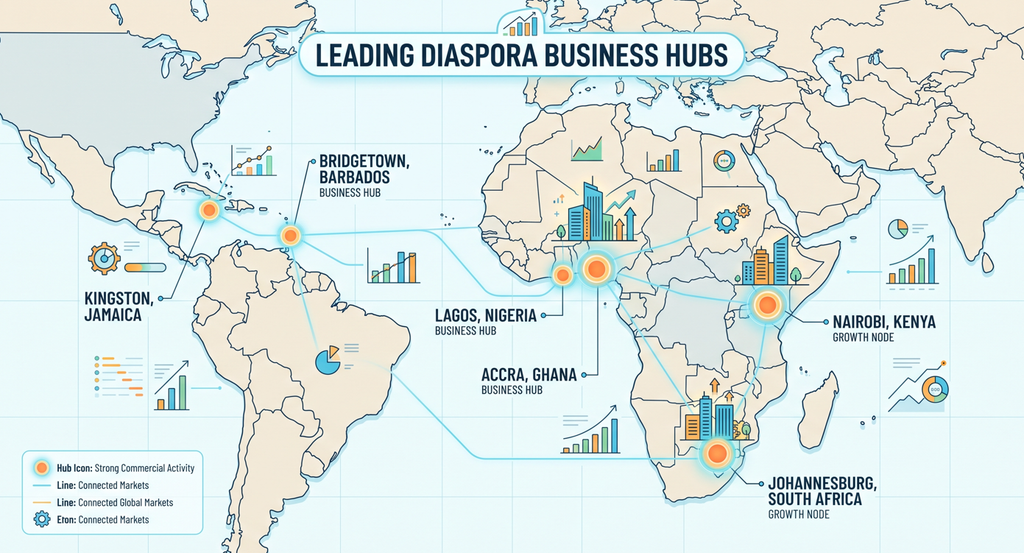
Nigeria: Healthcare in Nigeria is largely cash-up-front, which means patients who can’t pay immediately often can’t get treated immediately. A startup called 10mg Health built a financing layer that lets hospitals and pharmacies treat patients before payment clears, directly targeting that bottleneck. Separately, digital lenders like Sycamore are underwriting credit for informal workers who have no paper trail a traditional bank would accept.
Ghana: Smallholder farmers make up a large share of the workforce, but most still get paid in cash for their produce, with no transaction record and no path to formal credit. Mobile-enabled payment tools that move farmer payments onto digital rails are gaining traction precisely because that gap, formal financial inclusion for agricultural producers, has stayed open despite mobile money’s broader growth in the country.
Kenya: Kenya’s mobile money infrastructure is mature, which makes it a market where distribution is solved and the remaining gap is asset ownership. M-KOPA built a pay-as-you-go financing model for solar kits, smartphones, and e-motorbikes aimed at people the formal credit system doesn’t reach, and has extended over $2 billion in credit on that model.
South Africa: The country has gone over a year without scheduled power cuts as of mid-2026, so the “load shedding” pitch is now outdated. What hasn’t gone away is the cost: Eskom tariffs are still rising close to 9% a year, which keeps commercial solar and battery storage a straightforward payback calculation for businesses, not an emergency purchase.
Jamaica: The diaspora’s contribution to Jamaica’s economy is dominated by remittances in the public imagination, but a 2017 CAPRI study put the diaspora’s total economic contribution, remittances, investment, philanthropy, exports, and tourism combined, at roughly 28% of national output, with investment representing the largest share of what’s still unrealized. The shift diaspora leaders are now pushing for publicly is from sending money home to owning something there.
Barbados: Tourism accounts for roughly 12-13% of Barbados’ GDP and employment, and that concentration is exactly the vulnerability the government’s diversification push is aimed at. It also creates a visible local gap: business owners in Speightstown have publicly flagged that cruise visitors are bussed straight out after disembarking, with little structure in place to route that spending into local shops and services.
Practical Steps to Start
Two tools worth using before you commit capital anywhere:
- Run the numbers in your own currency first. The free tools on MetricSuite.tools include a currency converter that lets you model a business case in Naira, Cedi, Shilling, Rand, or Jamaican and Barbadian dollars without signing up for anything.
- Map the idea before you commit to it. The Business Model Builder on the same tools page helps structure a rough concept into something you can actually pressure-test, revenue lines, cost structure, and the specific problem it solves, before you spend money validating it in market.
Beyond that: talk to someone already operating in the market you’re considering, not just someone who left it. The gap between “how this country is perceived from abroad” and “how business actually gets done there” is usually where new entrants lose the most time and money.
Conclusion
None of this requires resolving whether the West or the diaspora’s country of origin is the “better” place to live. It requires treating the frustration as data rather than as a dead end. The markets profiled above aren’t opportunities because they’re easy. They’re opportunities because specific, expensive problems are still unsolved there, and solving one profitably doesn’t require permission from either system, just a clear read on where the gap is and the discipline to build for the market you’re actually in, not the one you wish existed.
Key Takeaways
- Paycheck-to-paycheck stagnation in Western economies is a structural pattern, not a personal failure, and it’s a poor predictor of what’s possible elsewhere.
- Infrastructure and institutional gaps in faster-growing markets are normal operating conditions, not reasons to avoid them, and they’re often the shape of the business opportunity itself.
- The businesses succeeding in these markets solve one specific, expensive, everyday problem rather than chasing “opportunity” in the abstract.
- Facts change fast: South Africa’s power crisis has eased materially since 2023, while Jamaica’s diaspora conversation has shifted from remittances toward ownership. Don’t plan off outdated narratives.
- Model the numbers before committing capital, and talk to people currently operating in-market, not only people who’ve left it.
FAQ
Do I need to relocate permanently to start a business in these markets?
No. Many of the examples above, from Ghana’s agri-fintech tools to Kenya’s asset-financing models, were built with a mix of remote oversight and local operating partners. Relocation is one path, not the only one.
How much capital does this actually require?
It depends entirely on the sector and the problem you’re solving. A digital services business aimed at an underserved niche can start with a few thousand dollars; a physical infrastructure play (solar, logistics, agro-processing) requires substantially more. Model it before assuming either extreme.
Is the infrastructure risk (power, roads, bureaucracy) actually manageable?
Businesses operate profitably around these constraints every day, they budget for backup power, build in longer timelines for approvals, and price logistics accordingly. It’s a planning problem, not a reason to avoid the market.
How do I stay current on country-specific conditions instead of working off outdated assumptions?
Follow local business press directly, BusinessDay (Nigeria), the Jamaica Gleaner, and similar outlets, rather than general diaspora commentary, since conditions like South Africa’s power situation can shift materially within a single year.
What’s the biggest mistake diaspora entrepreneurs make?
Assuming the market they left years ago is the market that exists today, in either direction, more broken or more solved than it actually is.
Sources
- World Bank remittance data via RemitSCOPE Africa: https://remitscope.org/africa/
- African Development Bank, “Making Remittances Work for Africa”: https://www.afdb.org/sites/default/files/documents/publications/making_remittances_work_for_africa.pdf
- Jamaica Gleaner, “Jamaicans abroad playing important role through business, investment and philanthropy”: https://jamaica-gleaner.com/article/news/20240607/jamaicans-abroad-playing-important-role-through-business-investment-and
- BusinessDay Nigeria, “Four Nigerian startups make Bloomberg’s 2026 ‘Startups to Watch’ list”: https://businessday.ng/technology/article/four-nigerian-startups-make-bloombergs-2026-startups-to-watch-list/
- Modern Ghana, “The State of Business in Ghana in 2026”: https://www.modernghana.com/news/1499156/the-state-of-business-in-ghana-in-2026-opportunit.amp
- UNCTAD, “UNCTAD supports Barbados to bolster economic diversification”: https://unctad.org/news/unctad-supports-barbados-bolster-economic-diversification