
A security firm in Nairobi budgeted May and June payroll at the old rates, waiting to see whether President Ruto’s Labour Day announcement would actually become law before changing anything. It was the right instinct and the wrong bet. The Regulation of Wages (General) (Amendment) Order 2026 was gazetted on 26 June, backdated to 1 May, which means every employer who waited now owes two months of arrears on top of the new rate.
Quick Answer: Kenya’s general minimum wage rose 12 percent and agricultural minimum wage rose 15 percent, both effective 1 May 2026, though the legal notice was only gazetted on 26 June 2026. The new general minimum is KES 16,114 a month in Group A towns like Nairobi and Mombasa, down to KES 13,572 in Group C. Employers who did not backdate the increase owe arrears from May.
What Changed and When
President Ruto announced the increase at Labour Day celebrations on 1 May 2026. The legal framework to enforce it did not exist until nearly two months later: the Regulation of Wages (General) (Amendment) Order 2026 and the Regulation of Wages (Agricultural Industry) (Amendment) Order 2026 were published in Kenya Gazette Supplement No. 128 on 29 May 2026, with Legal Notice No. 108 giving them formal legal force on 26 June.
Need a Freelancer for This?
Hire verified talent on Fiverr — starting from $5. No contracts, no hassle.
Browse Fiverr Freelancers →Both orders are deemed to have come into operation on 1 May 2026, retroactively. That single detail is the part most coverage undersells: it is not just a rate change, it is a mandatory correction for any employer who processed May and June payroll at the old rate.
The New Minimum Wage Rates
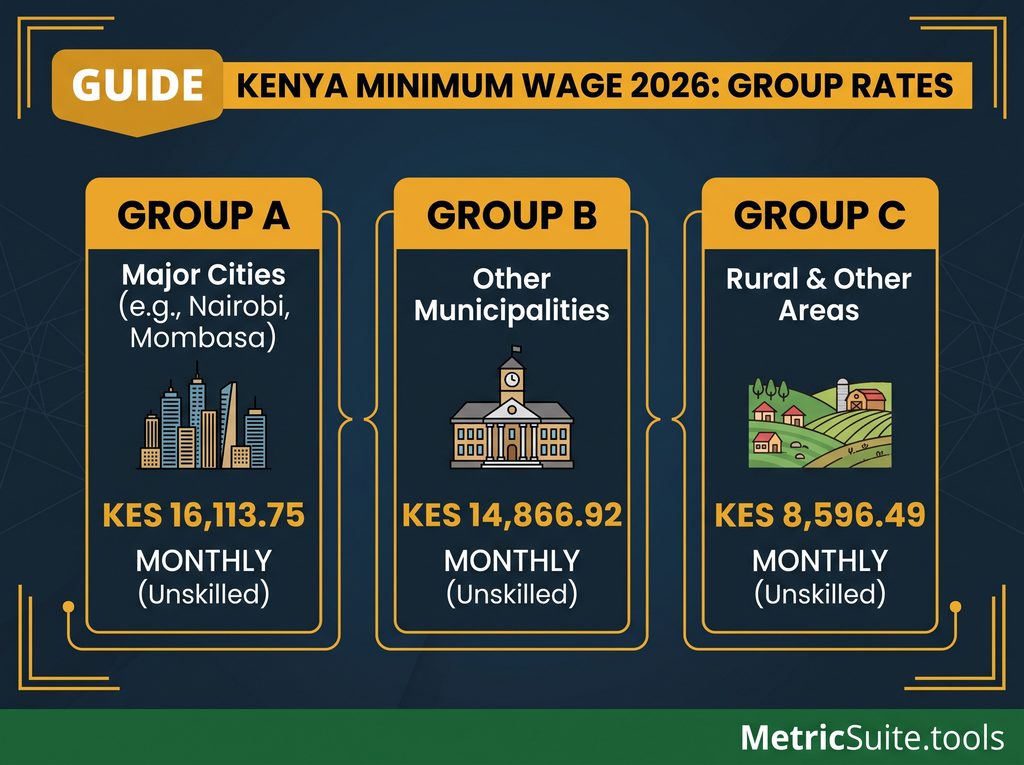
Kenya sets minimum wage by sector and by town classification, not as one national number. Rates below are monthly, general sector unless stated otherwise.
| Category | Old rate | New rate (from 1 May 2026) |
|---|---|---|
| General labourer, Group A (Nairobi, Mombasa) | ~₦14,388 | KES 16,114 |
| General labourer, Group B | ~₦12,912 | KES 14,461 |
| General labourer, Group C | ~₦12,118 | KES 13,572 |
| Agricultural, unskilled | ~₦7,997 | KES 9,196.93 |
| Agricultural, stockmen/herdsmen/watchmen | lower | KES 10,621.15 |
| Domestic workers (Nairobi, Mombasa, Kisumu, Eldoret) | KES 16,113 | KES 18,047 |
| Ungraded artisans | lower | KES 24,358.79 |
| Artisan Grade III | lower | KES 30,634.74 |
| Artisan Grade II | lower | KES 33,087.44 |
Security guards sit outside this specific order. A February 2025 Employment and Labour Relations Court ruling upheld a separate KES 30,000 minimum for security workers, and unions have continued pushing for full enforcement of it in 2026 even as many firms fall short.
The Arrears Trap
Because the order is backdated to 1 May but only became enforceable law on 26 June, any employer running payroll in that window at the old rate is now non-compliant, whether or not they knew the increase was coming. The fix is not optional: calculate the shortfall for every affected employee across May and June, and pay it out as arrears alongside your next payroll cycle. The Federation of Kenya Employers has directly told member companies to do exactly this, and labour inspectors treat unpaid arrears the same as ongoing underpayment.
The Part Most Coverage Misses: NSSF Tier II
Here is where the minimum wage increase quietly collides with a separate 2026 change. Since February 2026, NSSF’s Lower Earnings Limit sits at KES 9,000 a month, the point where Tier I ends and Tier II begins. Below that threshold, only 6 percent of the full amount up to KES 9,000 is deducted. Above it, an additional 6 percent applies to everything up to KES 108,000.
A Group C minimum wage earner on the old rate of roughly KES 12,118 was already just over that Tier I line. At the new KES 13,572 rate, they are further into Tier II than before. A Group A earner on the new KES 16,114 rate pays NSSF on the full KES 9,000 Tier I band plus KES 7,114 of Tier II, for total employee NSSF of about KES 967 a month, more than under the old rate, and structurally different from a simple percentage bump.
Use the free African PAYE Calculator at MetricSuite.tools to calculate this instantly, no signup required. It applies the current NSSF two-tier structure and the full five-band KRA PAYE table, so you can see exactly what a minimum wage adjustment does to net pay rather than estimating it.
What Employers Must Do Now
- Backdate the increase to 1 May 2026 for every affected employee and calculate the shortfall through the date you actually implement it.
- Check which wage order applies to each role. Kenya runs roughly 17 separate wage orders by sector and town classification, general staff, agricultural workers, domestic workers, and security guards are not all on the same schedule.
- Recheck NSSF deductions, not just gross pay. A wage increase that crosses the Tier I to Tier II line changes take-home pay by more than the raw percentage suggests.
- Keep records of the correction. Labour inspectors and any future dispute will ask for evidence you backdated correctly, not just that current pay is compliant.
Beyond minimum wage compliance, a wage floor increase also changes what a new hire actually costs once pension, SHIF, and the Housing Levy are added on top. Use the free African Employee True Cost Calculator at MetricSuite.tools to calculate this instantly, no signup required, before you budget headcount for the rest of the year.
Conclusion
If you have not already backdated May and June payroll to the new rates, do it this week, not at year-end reconciliation. Run your affected employees through the updated PAYE calculator to confirm both the wage correction and the NSSF Tier II shift are reflected correctly, then keep a paper trail of the adjustment.
Key Takeaways
- Kenya’s general minimum wage rose 12 percent and agricultural minimum wage rose 15 percent, both effective 1 May 2026, but only gazetted into law on 26 June 2026.
- The increase is retroactive. Employers who paid the old rate through May and June owe arrears, not just a rate change going forward.
- New general minimum: KES 16,114 in Group A towns (Nairobi, Mombasa), KES 14,461 in Group B, KES 13,572 in Group C.
- Security guards have a separate, court-upheld KES 30,000 minimum, distinct from this general wage order.
- The increase pushes more minimum wage earners further into NSSF Tier II, changing net pay by more than the headline percentage suggests.
FAQ
When did Kenya’s 2026 minimum wage increase take effect?
The increase took legal effect retroactively from 1 May 2026, the date President Ruto announced it. The Regulation of Wages (General) (Amendment) Order 2026 that made it enforceable was gazetted on 29 May and given legal force on 26 June 2026.
Do employers owe back pay for the gap between May and when the law was gazetted?
Yes. Because the order is backdated to 1 May 2026, any payroll run at the old rate during May and June is now underpaid, and employers are expected to calculate and pay the shortfall as arrears.
What is the new minimum wage in Nairobi
KES 16,114 a month for general labourers in Group A towns, which includes Nairobi and Mombasa. Domestic workers in Nairobi have a separate rate of KES 18,047 a month.
Does the minimum wage increase affect NSSF deductions?
Indirectly, yes. Since NSSF’s Tier II threshold starts at KES 9,000 a month, minimum wage earners at the new, higher rates fall further into the Tier II band than before, which changes their NSSF deduction by more than the raw wage increase alone.
Is the minimum wage the same across all of Kenya?
No. Kenya uses roughly 17 separate wage orders that vary by sector (general, agricultural, domestic, security) and by town classification (Group A, B, or C), so the applicable minimum depends on both the role and the location.
REFERENCES
- Grant Thornton Kenya. “Kenya Minimum Wage Guide 2026.” https://www.grantthornton.co.ke/insights/kenya-minimum-wage-guide-2026/
- Kenya Gazette Supplement No. 128, Legal Notices No. 95 and 96, 29 May 2026 (Regulation of Wages General and Agricultural Amendment Orders 2026). https://www.grantthornton.co.ke/globalassets/1.-member-firms/kenya/insights/pdf/wages-guide-2026.pdf
- The Star. “Wage order sparks hope, pressure as Kenya balances workers’ pay and business survival.” https://www.the-star.co.ke/news/2026-07-06-employers-feel-pinch-as-12-pay-rise-takes-effect
- Two Max Group. “Kenya Minimum Wage 2026 | Sector-Specific Rates.” https://www.2maxgroup.com/kenya-minimum-wage-2026/
- Kenyans.co.ke. “Labour Ministry Publishes New Regulations Raising Wages for Domestic Workers by 12%.” https://www.kenyans.co.ke/news/124044-labour-ministry-publishes-new-regulations-raising-wages-domestic-workers-12
- Deel. “Kenya NSSF rates update 2026: new Tier I and Tier II limits.” https://www.payspace.com/blog/kenya-nssf-rates-update-2026