A payroll officer at a mid-sized logistics firm in Lagos ran January 2026 the same way she had run every month for six years: gross salary, minus the Consolidated Relief Allowance, minus pension, then the old bands from 7 to 24 percent. Every payslip that month was wrong. Nigeria’s tax law changed on 1 January 2026, the Consolidated Relief Allowance no longer exists, and the bands it fed into have been replaced entirely.
Quick Answer: The Nigeria Tax Act 2025, effective 1 January 2026, replaced the old 7 to 24 percent PAYE bands with a new progressive structure: 0 percent on the first ₦800,000 of taxable income, then 15, 18, 21, 23, and 25 percent as income rises above ₦50 million. The Consolidated Relief Allowance is abolished. A new rent relief, capped at ₦500,000, partly replaces it.
What Changed: The Nigeria Tax Act 2025 Replaces PITA
The Nigeria Tax Act (NTA) 2025 was signed into law on 26 June 2025 and took effect on 1 January 2026, replacing the decades-old Personal Income Tax Act (PITA). The Federal Inland Revenue Service (FIRS) was renamed the Nigeria Revenue Service (NRS) as part of the same reform package, though state Internal Revenue Services still collect PAYE on behalf of state governments, employers remit to the state where the employee ordinarily resides.
Need a Freelancer for This?
Hire verified talent on Fiverr — starting from $5. No contracts, no hassle.
Browse Fiverr Freelancers →Three changes matter most for payroll:
- A new six-band progressive structure replaces the old 7 to 24 percent bands.
- The Consolidated Relief Allowance, previously the higher of ₦200,000 or 1 percent of gross income, plus 20 percent of gross income, is gone.
- A new rent relief, 20 percent of annual rent paid capped at ₦500,000, takes over part of that role, but only for tenants who can document it.
Any payroll run from January 2026 onward that still uses the old CRA formula is non-compliant, and the NRS has expanded audit powers to catch it.
The New PAYE Bands for 2026
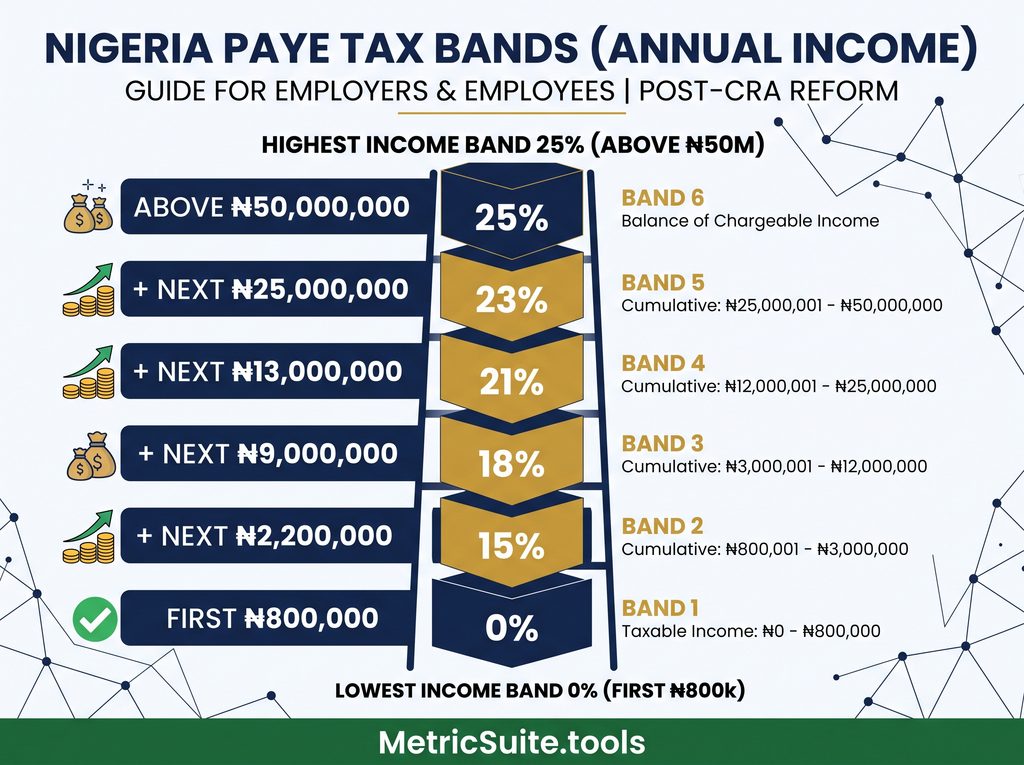
The bands are marginal, not flat. Crossing into a higher band only taxes the income above that threshold, not your entire income.
| Annual taxable income | Rate | Cumulative tax at top of band |
|---|---|---|
| ₦0 to ₦800,000 | 0% | ₦0 |
| ₦800,001 to ₦3,000,000 | 15% | ₦330,000 |
| ₦3,000,001 to ₦12,000,000 | 18% | ₦1,950,000 |
| ₦12,000,001 to ₦25,000,000 | 21% | ₦4,680,000 |
| ₦25,000,001 to ₦50,000,000 | 23% | ₦10,430,000 |
| Above ₦50,000,000 | 25% | Variable |
This replaces a top rate that used to sit at a flat 24 percent for anyone above ₦3.2 million in taxable income. On paper, a 25 percent top rate looks like a small increase. In practice, whether an individual pays more or less depends heavily on what happened to their relief allowance, which is the part most coverage of this reform skips.
What Replaced the Consolidated Relief Allowance
Under the old system, every employee received CRA equal to the higher of ₦200,000 or 1 percent of gross income, plus a flat 20 percent of gross income, before any bands applied. For a mid-level earner, that routinely erased a quarter or more of taxable income before tax was even calculated.
NTA 2025 replaces it with three separate, narrower reliefs:
- The 0 percent band. The first ₦800,000 of taxable income is tax-free, full stop, no formula required.
- Rent relief. 20 percent of annual rent paid, capped at ₦500,000. You need a tenancy agreement or payment receipts to claim it. Homeowners paying a mortgage do not qualify for this one, they have a separate route.
- Pension and NHF. The mandatory 8 percent employee pension contribution and 2.5 percent National Housing Fund contribution remain deductible before tax, same as before. Life assurance premiums up to ₦100,000 are also still deductible.
Use the free African PAYE Calculator at MetricSuite.tools to calculate this instantly, no signup required, it walks through gross salary, pension, and rent relief for Nigeria alongside six other African markets.
Worked Example: Who Actually Pays More or Less
The honest answer is it depends where you sit on the income scale, and the direction sometimes surprises people expecting a straightforward tax cut.
₦200,000 a month (₦2,400,000 a year), no pension, no rent relief claimed:
- New law: taxable income ₦2,400,000, PAYE ₦240,000, effective rate 10.0%
- Old law: CRA of ₦680,000 brought taxable income to ₦1,720,000, PAYE ₦249,200, effective rate 10.4%
- Difference: about ₦9,200 less tax a year under the new law, roughly ₦767 a month. Close to a wash.
₦1,000,000 a month (₦12,000,000 a year), same assumptions:
- New law: PAYE ₦1,950,000, effective rate 16.3%
- Old law: PAYE ₦2,048,000, effective rate 17.1%
- Difference: about ₦98,000 less tax a year under the new law.
₦5,000,000 a month (₦60,000,000 a year), same assumptions:
- New law: PAYE ₦12,930,000, effective rate 21.6%
- Old law: PAYE ₦11,168,000, effective rate 18.6%
- Difference: about ₦1,762,000 more tax a year under the new law.
The generous 20 percent-of-gross CRA scaled up with income and sheltered high earners more than the capped ₦500,000 rent relief does now. Below roughly ₦25 to 30 million a year, most employees break close to even or come out slightly ahead. Above that, the new law can cost noticeably more, the opposite of what a “flat 24% became a tiered 15-25%” headline suggests.
What Employers Must Do Now
- Update your payroll formula immediately if you have not. Remove the CRA calculation entirely and replace it with the six-band table above, applied to taxable income after pension, NHF, and any documented rent relief.
- Collect rent documentation from staff claiming relief. A tenancy agreement or bank transfer evidence, without it the relief cannot be applied through payroll.
- Check your remittance deadline. PAYE is due by the 10th of the month following deduction, January’s PAYE is due 10 February, and the NRS has stiffer penalties for late or incorrect remittance than under the old regime.
- Reclassify contractors carefully. True independent contractors on a contract for services are subject to Withholding Tax, typically 5 to 10 percent, not PAYE. Getting this wrong in either direction creates compliance exposure.
Beyond the employee-side changes, the reform also introduced a 4 percent Development Levy on assessable company profit, replacing the old Education Tax and NASENI levy, and confirmed 0 percent corporate tax for small companies under ₦25 million turnover. Neither directly touches PAYE, but both affect the total cost of running payroll in Nigeria in 2026. Use the free African Employee True Cost Calculator at MetricSuite.tools to calculate this instantly, no signup required, it accounts for employer pension, statutory levies, and the real cost of a hire beyond gross salary.
Conclusion
If your last payroll run still referenced the Consolidated Relief Allowance, it was wrong the moment you filed it. Run your current staff list through the updated bands this week, confirm the numbers with a registered tax practitioner if anyone sits near a band boundary, and fix the formula in your payroll system before your next remittance deadline.
Key Takeaways
- Nigeria Tax Act 2025 took effect 1 January 2026, replacing PITA’s 7 to 24 percent bands with a new 0 to 25 percent progressive structure.
- The Consolidated Relief Allowance is abolished. It is replaced by a 0 percent band on the first ₦800,000 of taxable income, plus a capped rent relief, not a direct substitute.
- Low and mid-income earners generally see a small tax reduction or close to no change. High earners above roughly ₦25 to 30 million a year can pay more than before.
- Pension (8%), NHF (2.5%), and life assurance premiums up to ₦100,000 remain deductible before tax, same as under the old law.
- PAYE remittance is still due by the 10th of the month following deduction, and NRS enforcement is stricter than under FIRS.
FAQ
When did Nigeria’s new PAYE bands take effect?
1 January 2026. The Nigeria Tax Act 2025 was signed into law on 26 June 2025 and applies to all employment income earned from the start of the 2026 tax year.
Did Nigerian tax rates go up or down under the new law?
It depends on income level. Most employees earning up to roughly ₦25 to 30 million a year see a small reduction or little change, since the new 0 percent band and lower entry rates offset the loss of the Consolidated Relief Allowance. High earners above that level often pay more, because the old CRA scaled with income in a way the new capped rent relief does not.
What replaced the Consolidated Relief Allowance?
No single allowance replaced it. Instead, the first ₦800,000 of taxable income is now tax-free, and a separate rent relief of 20 percent of annual rent, capped at ₦500,000, is available to tenants who can document their payments. Pension and NHF contributions remain deductible as before.
Do employers need to update their payroll software?
Yes. Any system still calculating CRA is producing incorrect PAYE figures for every employee, every month, since 1 January 2026. This includes spreadsheet-based payroll, not just commercial software.
Is there still a tax-free threshold for low earners?
Yes. The first ₦800,000 of annual taxable income is exempt, which covers most minimum-wage employees.
REFERENCES
- PwC. “Nigeria: Individual – Significant developments.” Worldwide Tax Summaries. https://taxsummaries.pwc.com/nigeria/individual/significant-developments
- PwC. “Nigeria: Individual – Taxes on personal income.” Worldwide Tax Summaries. https://taxsummaries.pwc.com/nigeria/individual/taxes-on-personal-income
- Africa Check. “Not true: Nigerians earning N800,000 or more annually will pay 20% tax from January 2026, claim misrepresents new tax law.” https://africacheck.org/fact-checks/meta-programme-fact-checks/not-true-nigerians-earning-n800000-or-more-annually-will-pay
- Ogun State Internal Revenue Service. “Personal Income Tax FAQs” (old PITA bands and CRA formula, for historical comparison). https://www.ogunstaterevenue.com/en/pita.aspx
- SmartSMSSolutions. “Nigeria PAYE Calculator (NTA 2025).” https://smartsmssolutions.com/resources/tools/paye-calculator-nigeria