
How to Schedule Meetings Across Time Zones
It is 8am in Toronto, which sounded perfectly reasonable when you sent the invite. Then the replies start. Your operations lead in Nairobi is asking why the call is at 3pm on a Saturday. Your supplier contact in Lagos never opened the invite at all, because in his calendar it landed at midnight. Someone in London is now getting up before sunrise for the third week running, and nobody meant for that to happen.
More than half the global workforce now works remotely or in a hybrid arrangement, and a growing share of that workforce is spread across more than one continent, not just more than one office. Pan-African businesses coordinate with Caribbean and North American partners. Diaspora professionals in Toronto, London, and New York manage teams or family businesses back home. Import and export operations run calls between suppliers, warehouses, and buyers who are never in the same time zone twice.
None of this works if meeting scheduling is left to guesswork. What is 9am in Toronto is genuinely a different question in July than it is in January, because Toronto shifts its clocks twice a year and Lagos never does. Get this wrong often enough, and the cost is not just an awkward email thread. It is missed calls, disengaged partners, and one person on the team who is quietly always the one losing sleep.
Need a Freelancer for This?
Hire verified talent on Fiverr — starting from $5. No contracts, no hassle.
Browse Fiverr Freelancers →Why Time Zone Scheduling Keeps Going Wrong
Nobody sits down and decides to schedule a meeting badly. It happens because time zone math is genuinely hard to do in your head, especially across more than two locations at once.
The problem compounds when some of the cities involved observe daylight saving time and others do not. Toronto, New York, and London all shift their clocks twice a year. Nairobi, Lagos, Accra, and Kingston do not. That means the gap between, say, Lagos and New York is not a fixed number. It is six hours for part of the year and five hours for the rest, and almost nobody remembers which part of the year they are currently in.
Add a third or fourth city to the mix and manual calculation becomes close to impossible to do reliably. That is exactly why so many international meetings default to whatever time is convenient for whoever sent the invite. It is not malice. It is math nobody has time to redo every week.
The Real Cost of Getting the Time Wrong
A missed meeting is the visible symptom. The deeper cost is what happens when the same person is always the one asked to join at an inconvenient hour.
Distributed teams that never rotate who takes the early or late slot tend to lose engagement from whoever is stuck with it, usually without anyone framing it that way out loud. Over months, that shows up as shorter answers on calls, cameras that stay off, and eventually someone who stops speaking up in meetings scheduled at 11pm their time.
For businesses running supplier relationships or client calls across regions, the cost shows up differently. A contact in Nairobi who has to guess at your working hours will eventually stop trying to reach you during theirs. A partner asked to join a 2am call more than once will start sending a deputy instead of showing up themselves.
None of this is really about time zones. It is about whether scheduling reflects that everyone’s time is worth the same amount of consideration, regardless of which side of the map they are on.
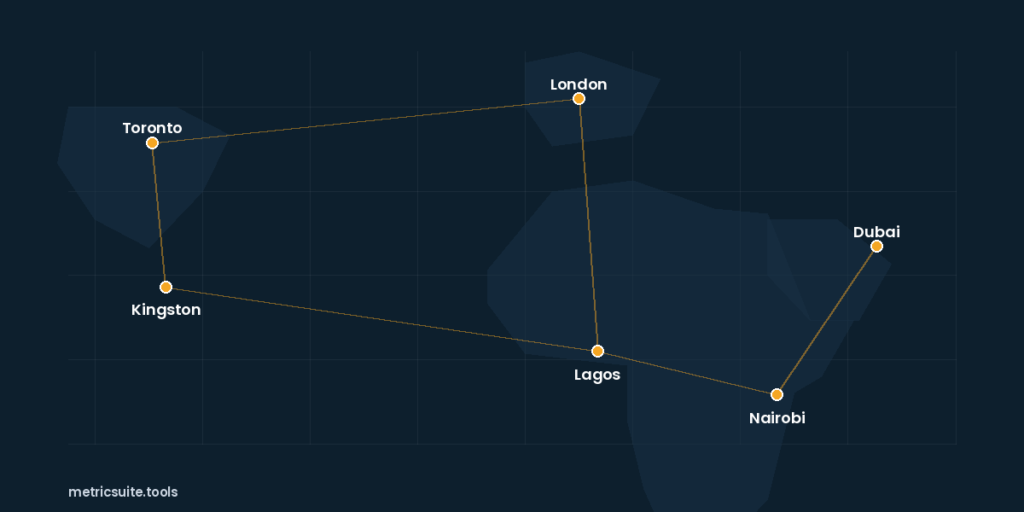
Quick Reference: Common Time Gaps Between Africa, the Caribbean, and North America
These are the pairings that come up constantly for pan-African businesses, diaspora professionals, and cross border teams. The gap is shown for both the Northern Hemisphere winter, when Toronto, New York, and London are on standard time, and summer, when those cities shift forward for daylight saving.
| City Pair | Winter Gap | Summer Gap | Note |
|---|---|---|---|
| Nairobi ↔ Toronto | 8 hours | 7 hours | Nairobi never shifts |
| Lagos ↔ New York | 6 hours | 5 hours | Lagos never shifts |
| Nairobi ↔ London | 3 hours | 2 hours | Nairobi never shifts |
| Kingston ↔ Toronto | 0 hours | 1 hour | Toronto pulls ahead in summer |
| Kingston ↔ London | 5 hours | 6 hours | Only London shifts |
| Nairobi ↔ Dubai | 1 hour | 1 hour | Neither city shifts |
| New York ↔ London | 5 hours | 5 hours | Briefly 4 hours for a few weeks each March and October |
| London ↔ Hong Kong | 8 hours | 7 hours | Hong Kong never shifts, Beijing shares this offset |
The pattern worth remembering: any city that observes daylight saving time, which includes Toronto, New York, London, and most of Europe and North America, will shift its gap with African and Caribbean cities twice a year, usually by one hour. Almost the entire African continent, along with Jamaica and most of the Caribbean, stays on the same offset all year round. Morocco is the one notable African exception, since it observes its own seasonal shift.
Use the free Timezone Meeting Planner at MetricSuite.tools to calculate this instantly for any date, without needing to remember which cities shift and when.
Rules of Thumb for Fairer Scheduling
A few habits go a long way toward making cross time zone meetings sustainable instead of something people quietly resent.
Rotate the inconvenient slot. If a recurring meeting cannot find a time that works for everyone during normal hours, rotate who takes the early morning or late evening slot instead of defaulting to the same person every time.
Look for yellow before you accept red. A slot where everyone is in early morning or evening hours is almost always better than one where even a single person is asked to join in the middle of the night. Two people mildly inconvenienced beats one person badly inconvenienced.
Confirm the date, not just the time. A meeting time that works on one date can shift by an hour on another, purely because a city entered or exited daylight saving time in between. Always check the specific date, not a general rule of thumb you are recalling from memory.
Three things to action this week:
- Audit your recurring meetings for who is always in the inconvenient slot
- Set a rotation if one person has been absorbing it for more than a month
- Re-check meeting times whenever a clock change is coming up in March or November
The Daylight Saving Time Trap Most People Miss
Here is the part that catches even experienced remote teams off guard. Most of Africa and most of the Caribbean do not observe daylight saving time at all. Kenya, Nigeria, Ghana, and Jamaica keep the same clock every single day of the year.
North America and Europe do not. Twice a year, usually in March and again in October or November, cities like Toronto, New York, and London move their clocks by an hour, while Nairobi, Lagos, and Kingston stay exactly where they are.
The result is a gap that quietly changes underneath you. A meeting that worked at 8am Toronto time and 4pm Nairobi time in January can land an hour off by July, not because anyone made a mistake, but because Toronto moved and Nairobi did not. Recurring meetings are especially vulnerable, since a slot booked once in a calendar app rarely gets revisited when the clocks change on the other side of the call.
The safest habit is to stop trusting a fixed time from memory and start checking the actual date every time a meeting involves a city that observes daylight saving time. It takes seconds, and it is the single most common reason a working recurring meeting quietly stops working.
Tools That Actually Solve This
Manual time zone math does not scale past two people, and even two people get it wrong more often than they would like to admit.
The free Timezone Meeting Planner at MetricSuite.tools handles the entire problem in one view. Select up to six cities, pick the date, and it shows every hour of the day, colour coded by whether it falls in business hours, early or evening, or overnight for each person. It ranks the best available windows automatically, accounts for daylight saving time changes on the correct dates, and lets you copy a formatted summary straight into WhatsApp, Slack, or email. Use the free Timezone Meeting Planner at MetricSuite.tools to calculate this instantly, no account or sign-up required.
For related cross border questions, the free World Clock and Currency Converter on the same site cover what tends to come up in the same conversation: what time it is right now in a specific city, and what a quoted price actually converts to today.
The One Thing to Do This Week
Pick your next recurring meeting that spans more than one time zone and actually check whether it is still landing in a fair window for everyone involved, especially anyone in Toronto, New York, London, or elsewhere in North America or Europe, since their clocks may have shifted since the meeting was first scheduled.
Run it through the planner, confirm the date specific gap, and if one person has been quietly absorbing the worst slot for months, rotate it. It costs nothing, takes two minutes, and it is usually the difference between a distributed team that stays engaged and one that slowly stops showing up.
Key Takeaways
- More than half the global workforce now works remotely or in hybrid arrangements, and a growing share of that work spans multiple continents, not just multiple offices
- Most of Africa and the Caribbean never observe daylight saving time, while most of North America and Europe do, which means the time gap between them changes twice a year even when nobody’s local clock feels different
- Kingston and Toronto share the exact same time in winter, then split by an hour every summer, a common surprise for the Caribbean diaspora
- Rotating who takes the inconvenient meeting slot protects engagement better than defaulting to the same person every time
- A free planner that checks the actual date, not a remembered rule of thumb, removes the guesswork entirely
What is the best way to schedule a meeting across more than two time zones?
Use a planner that shows every city’s local hours side by side for the actual date of the meeting, rather than trying to calculate multiple gaps in your head. Once more than two cities are involved, manual math becomes unreliable fast.
Does the time difference between Africa and North America change during the year?
Yes, for any pairing that includes a North American or European city. Almost all of Africa stays on the same offset year round, but cities that observe daylight saving time shift by an hour twice a year, which changes the gap even though the African side never moves.
What is the best time to call someone in Kenya from Canada or the UK?
It depends on the date, since Canada and the UK both observe daylight saving time and Kenya does not. Generally, mid-morning in Nairobi lines up with early morning in Toronto and late morning in London, but the exact overlap shifts by an hour between winter and summer.
How do I make sure I am not always the one asking a colleague to take a call at 2am?
Track who has taken the inconvenient slot for the last several meetings and rotate deliberately. It is easy for the same person to absorb it every time simply because nobody is tracking it.
Is there a free tool that handles this without needing an account?
Yes. The Timezone Meeting Planner at MetricSuite.tools is free, requires no sign-up, and works entirely in the browser.
References
- Pew Research Center, “Most countries don’t observe daylight saving time”: https://www.pewresearch.org/short-reads/2023/10/26/most-countries-dont-observe-daylight-saving-time/
- Yomly, “50+ Important Remote Work Statistics of 2026”: https://www.yomly.com/remote-work-statistics/
- MetricSuite Timezone Meeting Planner: https://metricsuite.tools/timezone-meeting-planner/