

Kwame flew from Accra to Nairobi for a six-day sponsored shoot and came home without knowing whether the trip made money or lost it. He had a flight, a hotel, three currencies, a sponsorship, and two payouts still landing on different days, but no real travel budget for African creators to weigh any of it against. Ask him if the trip was worth it and the honest answer is: I don’t know the number.
This is not a character flaw. Creators traveling across Africa, or from Africa to Europe and North America for shoots and conferences, move through more currencies and payment rails in a single week than most freelancers see in a year. The gap is not effort. It is that revenue and cost never get compared, trip by trip, in the same currency, at the rate that actually applied.
What This Article Covers
This piece breaks down what a trip actually costs an African creator once every currency, every fee, and every dollar of content income is counted honestly. You will see a worked example: a six-day Accra-to-Nairobi shoot, priced in GHS, KES, and USD, with the sponsorship, ad revenue, and affiliate income weighed against what the trip actually cost. You will get a repeatable system for tracking this yourself, on paper or in a spreadsheet, whether or not you ever buy anything. And you will see one specific tool built to do this automatically, if you would rather not build it from scratch.
Need a Freelancer for This?
Hire verified talent on Fiverr — starting from $5. No contracts, no hassle.
Browse Fiverr Freelancers →The Real Travel Budget for African Creators: A Worked Example
Meet Kwame. He is an Accra-based creator with a mid-size YouTube channel covering African fintech and mobile money. A Kenyan fintech app offers him a sponsorship: they will pay him $450 to feature their product in a video shot on location in Nairobi. He books a six-day trip.
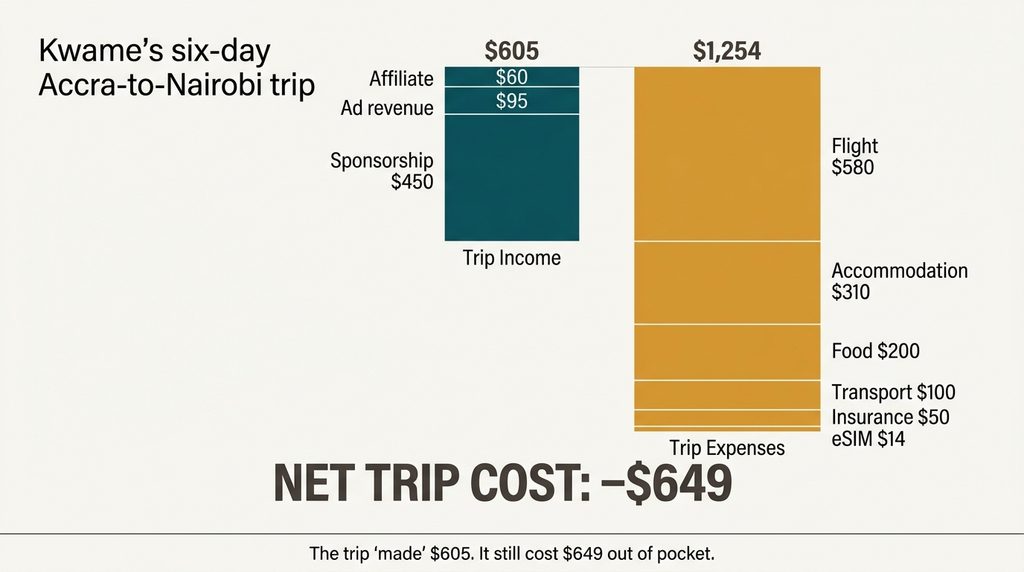
Here is what the trip actually costs him, in the currency he actually paid in:
- Return flight, Accra to Nairobi, paid through a local travel agent in cedis: GHS 8,700 (roughly $580 at the rate he got that day)
- Five nights in a Nairobi Airbnb, charged directly in US dollars: $310
- Local transport over six days, paid in shillings through Uber and Bolt: KES 14,500 (roughly $100)
- A local eSIM, paid in shillings: KES 2,000 (roughly $14)
- Food and incidentals, a mix of shilling cash and card: KES 29,000 (roughly $200)
- Travel insurance, paid in cedis before he left Accra: GHS 750 (roughly $50)
Total trip cost: roughly $1,254.
Here is what came in, attributable to this specific trip:
- The fintech sponsorship, paid by bank transfer in US dollars: $450
- YouTube ad revenue from the two videos this trip produced, tracked over the following 60 days: $95
- One affiliate payout, from a VPN service he mentioned in passing: $60
Total trip income: $605.
Net trip cost: $649 out of pocket.
On paper, Kwame’s trip “made” $605. That is a real number, and it is not nothing. But it covered less than half of what the trip actually cost. If he only looks at the income side, the trip looks like a modest win. If he only looks at the sponsorship, $450 against a $1,254 trip looks like he undercharged badly, which he did. Either partial view teaches him the wrong lesson. The number that matters, net trip cost, only shows up when income and expenses are logged against the same trip and converted at the rates he actually got on the day, not a same-day average pulled from a currency converter after the fact.
This is the arithmetic most African creators are running without realizing it. Multiply Kwame’s trip by four or five a year, and the gap between what a creator earns and what the lifestyle actually costs becomes the difference between building a business and slowly draining savings while posting proof of a business.
(Note: currency amounts above are illustrative at approximate rates. Exchange rates move; check current ones before pricing your own trip.)
Why Generic Travel Budget Advice Fails African Creators
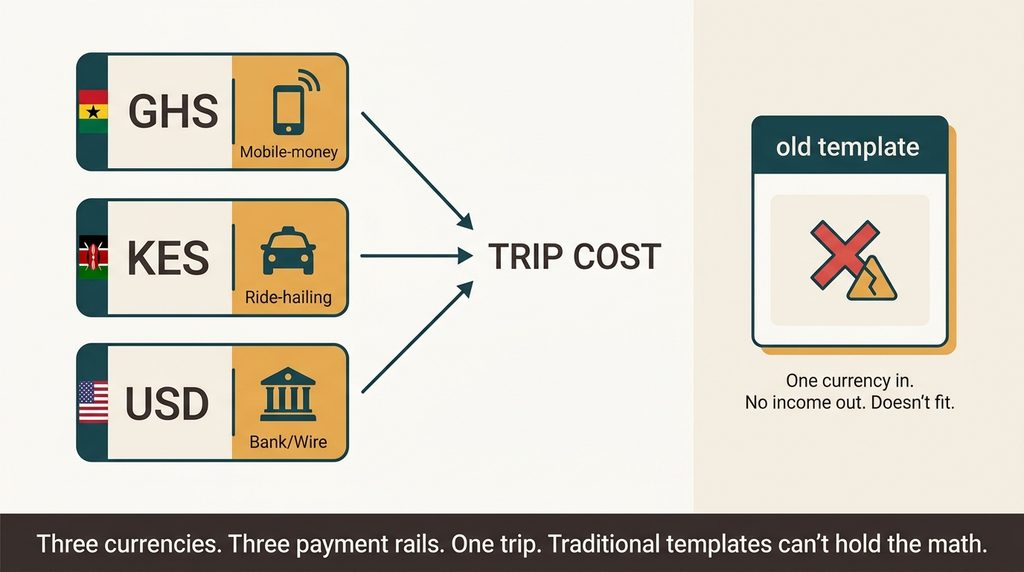
Search “travel budget template” and nearly everything that comes back assumes a single currency, a fixed exchange rate, and no income while traveling. That works for a Canadian couple saving for two weeks in Portugal. It does not work for a creator who gets paid in three currencies through three different rails on the same trip.
This is not a small audience. Wode Maya built Africa To The World into one of the continent’s biggest YouTube channels by traveling to dozens of African countries and showing daily life the way it actually looks, not the way outsiders assume it looks. Ghanaian YouTubers documenting trips to Kenya, Kenyan vloggers covering Rwanda, Nigerian creators filing from Cape Town: all of them are running the same trip-by-trip math Kwame is running, usually without a system built for it.
Three specific ways the generic advice breaks down:
First, it assumes one currency. A template built around “USD in, USD out” has no clean way to log a flight paid in cedis, transport paid in shillings, and a sponsorship that lands in dollars. Creators either skip the conversion step entirely, guess at a rate, or give up on tracking mid-trip.
Second, it assumes no income during the trip. Standard budget templates are built for spending, not for a trip that is meant to pay for itself through content. There is no column for a sponsorship, an affiliate payout, or ad revenue tied to a specific set of videos, so that income either gets ignored or gets logged separately with no link back to what the trip cost.
Third, it ignores how African creators actually get paid. Sub-Saharan Africa moved $1.4 trillion through mobile money in 2025 alone, about two-thirds of the world’s total mobile money transaction value, according to the GSMA’s State of the Industry Report on Mobile Money 2026. Sponsors, fans, and platforms increasingly settle through M-Pesa, MTN MoMo, or a local bank rather than PayPal or a US dollar wire. A template with no row for “paid via MoMo, converted three days later at a different rate than the invoice” is not built for how the money actually moves.
The result is not that African creators are bad with money. It is that they are using tools built for a different kind of trip, spent in a different kind of economy, and then wondering why the numbers never quite add up.
A System You Can Run Yourself, With or Without a Template
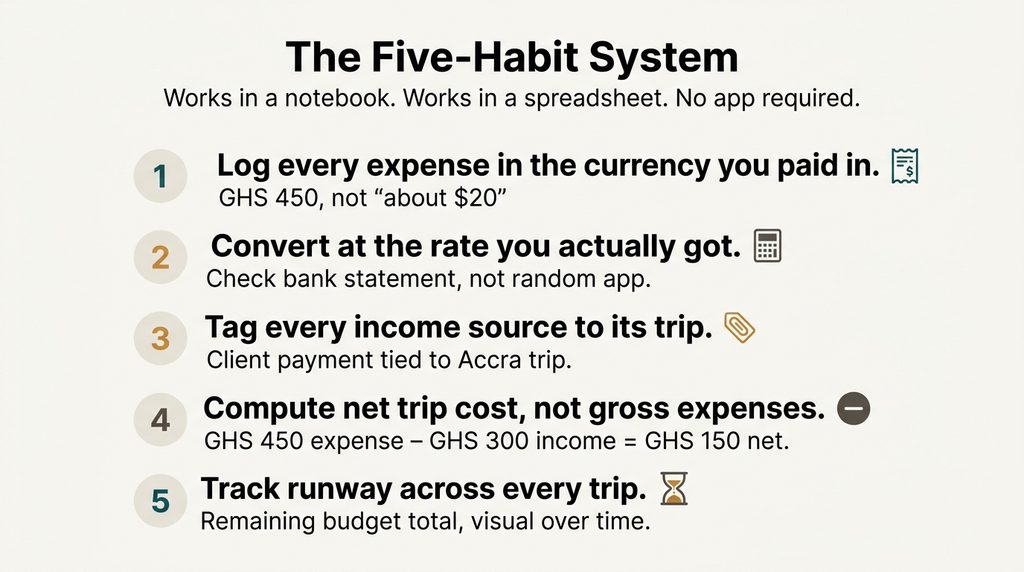
You do not need to buy anything to fix this. You need five habits, applied consistently, whether you track them in a notebook, a basic spreadsheet, or a dedicated tool.
1. Log every expense in the currency you paid in. Not a converted guess, not “about $20.” If you paid GHS 450 for a taxi, write down GHS 450. Converting later, once, at the right rate, is more accurate than converting in your head every time you spend money. Kwame logged his KES 14,500 in Bolt and Uber rides as KES 14,500, not a rounded “about $100,” which is the only reason that $100 figure in his final total is accurate rather than a guess.
2. Convert at the rate you actually got, not a daily average. The rate your bank gave you on a card swipe in Nairobi is not the rate a headline exchange-rate figure shows for that day. It includes a spread. If you want an honest number, use the rate on your statement or receipt, not a general one. A currency converter is useful for a same-day sanity check while planning, but your actual statement is the source of truth once you have spent the money. Kwame’s flight cost him GHS 8,700; at the rate his card actually gave him that day, that is $580, while the headline rate that same morning implied $572, a small gap that still moves the needle on a $1,254 trip.
3. Log every content revenue source against the trip it came from. A sponsorship, an affiliate payout, and ad revenue rarely land on the same day, or even the same month, as the trip that generated them. Tag each one with the trip name when it lands, even if that is 60 days later. Without the tag, that income quietly disappears into your general monthly total, and the trip looks worse than it was, or the month looks better than it was. Kwame’s $95 in ad revenue and $60 affiliate payout landed weeks after he was back in Accra; without tagging both to the Nairobi trip, that $155 would have vanished into his general monthly income and the Nairobi trip would have looked like a straight loss.
4. Compute net trip cost, not gross expenses. Net trip cost equals trip income minus trip expenses. This is the one number that tells you whether the trip paid for itself. A trip can have high expenses and still be profitable if the income tracks with it. A trip can have modest expenses and still be a loss if nothing was monetized. You only find out by subtracting one specific number from another specific number, both tied to the same trip. For Kwame that is $605 in trip income minus $1,254 in trip expenses, a $649 net cost that never shows up if you only look at the $450 sponsorship or the $605 total revenue on their own.
5. Track runway across every trip, not one trip in isolation. If you are funding trips from a dedicated savings pot rather than trip-by-trip income, you need one more number: how many months of travel that pot can still fund at your current burn rate. Take your last 90 days of trip spending, average it monthly, and divide it into your current balance. That is your runway in months, not a guess. One trip like Kwame’s costs $649 out of pocket; run four or five of those a year without tracking runway, and he has no way of knowing how many months his savings can actually absorb that pace before the fund runs dry.
You can run all five of these in a notebook. Two pages per trip, Expenses and Income, each with columns for date, currency paid, amount, category, and the rate that applied. At the end of each trip, subtract one page’s total from the other. It is not difficult. It is just five habits most people do not have, because most templates never asked them to.
The friction is not the math. It is remembering to apply all five habits, every time money moves, across currencies you do not normally think in. That is the real argument for automating it.
One Way to Run This System Without Building It Yourself
If you would rather not build this from scratch, there is a workbook that runs all five habits automatically. I’ll come back to it after we deal with the obvious objections.
The Three Objections You’re Probably Having Right Now
“I can just use a free template.” You can, and if you are only tracking one currency and no content income, you probably should. The free Trip Budget & FX Burn-Rate Planner does exactly that, no cost, no signup. The gap shows up the moment you need to log a sponsorship against a specific trip, or track a fund balance across five trips instead of one. Most free templates were not built for that, because most people building them were not paid to travel.
“I’ll just track it in my head, or in Notes.” You will remember the flight cost. You will not remember the exact rate your card gave you on a Tuesday in Nairobi three weeks ago, or which affiliate payout belonged to which trip, or what your travel fund balance was before four smaller withdrawals. Memory is fine for the obvious numbers. It fails exactly where the real answer lives, in the small transactions and the rate at the moment of payment.
“$29 CAD is a lot of money where I live.” Reframe it per trip, not as a lump sum. Used across ten trips, that is under $3 a trip, once, not monthly. Compare that to the cost of one sponsorship priced too low because nobody ran the real numbers on the last trip, the way Kwame’s was.
Which brings us back to the Travel Money Command Center mentioned earlier.
It is an Excel and Google Sheets workbook, not an app, built around the same five habits. You log expenses in the currency you paid in, with a built-in exchange-rate reference table you can override per line whenever the rate on your receipt differs from the default. A Creator Income tab lets you log sponsorships, ad revenue, and affiliate payouts against a specific trip, even when the payout lands weeks later. The Dashboard then does the subtraction for you: net trip cost, automatically, per trip and across all trips.
It also handles the fifth habit, runway: your 90-day average spend, your monthly burn rate, and how many months your travel fund can still cover, recalculated every time you add a line. Up to ten trips at a time, each with its own category budgets, all rolling into one Dashboard.
It costs $29 CAD, one time, no subscription. It works in Excel for Windows, Excel for Mac, and Google Sheets, with no macros and no add-ins.
Get the Travel Money Command Center here.
Where to Start
If you are not ready to commit to anything, start with the free Trip Budget & FX Burn-Rate Planner. It will show you, on your next trip, whether the five-habit system above is something you will actually keep up manually, or something you would rather have built for you.
If you already know the answer, download the Travel Money Command Center before you fly, not after. Log the trip as it happens, and by the time you land back home, the net cost will already be sitting in the Dashboard instead of a guess you make three weeks later. That’s the difference between finding out on your next trip, and still guessing on your fifth.
Either way, the goal is the same. Stop guessing whether the content is paying for the lifestyle. Know the number, in your currency, at the rate you actually got, trip by trip.
Frequently Asked Questions
How do I track expenses across GHS, KES, NGN, ZAR, and USD without losing my mind on one trip?
Log each expense in the currency you actually paid in, at the moment you paid it, rather than converting in your head. Keep one exchange rate column next to the amount, filled in from your bank statement or card receipt, not a headline rate. Convert to your home currency once, at the end, using the actual rate that applied to that transaction.
Should I use my bank’s rate or a daily average exchange rate when converting?
Use the rate your bank or card actually gave you, visible on your statement. A daily average, like the one a currency converter shows, is useful for planning ahead of a trip, but it will not match what you were actually charged, which usually includes a spread of one to three percent.
Is the $29 CAD workbook worth it if I can use a free Google Sheet?
Depends what you are tracking. If it is one trip, one currency, and no content income, a free sheet is fine, and the free planner covers that case. The paid workbook earns its cost once you are tracking multiple trips, multiple currencies per trip, and content income that needs to be matched back to the trip that generated it, along with runway across your whole travel fund.
My sponsor pays me in Naira through my Nigerian bank while I am shooting in Kenya. How do I know if the rate they gave me is fair?
Check the rate you were actually credited against the rate quoted by your bank or a reputable source on the day of payment, not weeks later. A gap of more than two or three percent is worth a conversation with the sponsor, especially on recurring deals.
What if my income comes through M-Pesa or MTN MoMo instead of a bank transfer or PayPal?
Log it the same way as any other income: the amount in the currency it landed in, the date, and the trip it belongs to. Mobile money is how the majority of transaction value moves across Sub-Saharan Africa, so treat it as a normal income line, not an exception you deal with later. Comparing what different mobile money services actually charge on a transfer is worth checking with the Mobile Money Fees Comparison tool before you assume the fee is the same everywhere.
Sources
- GSMA, State of the Industry Report on Mobile Money 2026: gsma.com/newsroom
- Connecting Africa, on the same GSMA report: connectingafrica.com
- CNN, profile of Wode Maya (Africa To The World): edition.cnn.com
- The African Courier, on Wode Maya and the wave of African travel YouTubers: theafricancourier.de