
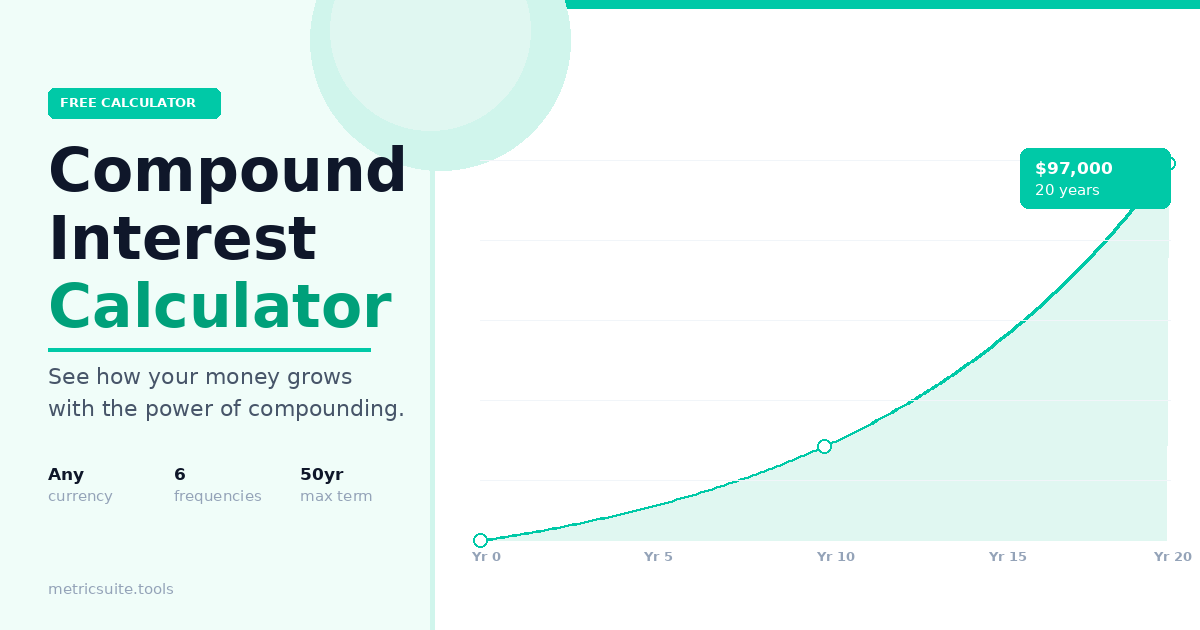
Compound Interest Calculator: See How Your Money Grows Over Time
This free compound interest calculator shows you exactly how an investment grows when interest is earned not just on your original principal — but on every penny of interest already accumulated. Enter your starting amount, annual interest rate, compounding frequency, and time period, and the calculator instantly returns your final balance, total interest earned, your return on investment, and a complete year-by-year breakdown of your growth. Add a monthly contribution to see how regular saving dramatically accelerates the result. No sign-up. No data stored. Works in any currency.
How to Use the Compound Interest Calculator
Step 1 — Select your currency and compounding frequency. Choose the currency your investment or savings account operates in. Then select how often interest is compounded — most savings accounts and investment funds compound monthly or daily. The more frequently interest compounds, the faster your money grows.
Step 2 — Enter your initial principal. This is the lump sum you are starting with — your initial deposit or investment amount. If you are starting from zero and only making regular contributions, enter 0 here and fill in the monthly contribution field instead.
Step 3 — Enter the annual interest rate. Enter the annual interest rate as a percentage. For a savings account, use the stated AER (Annual Equivalent Rate). For investments, use your expected average annual return — a common assumption for diversified stock market index funds is 7–10% per year over long periods, though past performance does not guarantee future returns.
Step 4 — Enter the time period in years. Enter how many years you plan to keep the investment running. Compound interest rewards patience — the longer the time period, the more dramatic the effect. Try comparing 10 years versus 30 years to see the difference.
Step 5 — Add a monthly contribution (optional). If you plan to top up your investment regularly, enter the monthly amount here. Regular contributions combined with compound interest is one of the most powerful wealth-building combinations available to individual investors.
Step 6 — Click Calculate. Your results appear instantly: final balance, total interest earned, total amount invested, and your overall return on investment as a percentage. The stacked bar shows you visually how much of your final balance is original principal, how much came from contributions, and how much is pure interest. The year-by-year table below tracks the growth annually for the full investment period.
Example: You invest $5,000 at 8% annually, compounded monthly, for 20 years, adding $200 per month. Your total invested is $53,000. Your final balance is approximately $128,900 — meaning compound interest generated over $75,900 in additional wealth on top of what you put in.
Once you know your target balance, use the Break-Even Calculator to work out what revenue your business needs to generate to fund that level of monthly contribution.
4. FAQ SECTION
What is compound interest and how is it different from simple interest?
Simple interest is calculated only on your original principal. If you invest $1,000 at 10% simple interest for 3 years, you earn $100 per year — $300 total. Compound interest is calculated on your principal plus all the interest already earned. In year 1 you earn $100, but in year 2 you earn interest on $1,100 — and so on. Over long time periods, this compounding effect creates exponential growth rather than linear growth, which is why Albert Einstein is (perhaps apocryphally) credited with calling compound interest the eighth wonder of the world.
What does compounding frequency mean and does it make a big difference?
Compounding frequency is how often your interest is calculated and added to your balance. Common options are daily, monthly, quarterly, and annually. The more frequently interest compounds, the slightly higher your effective annual return — daily compounding yields marginally more than monthly, which yields more than annual. For most practical purposes the difference between daily and monthly compounding is small, but annual versus monthly compounding can make a meaningful difference over decades. A savings account that compounds daily at 5% AER will slightly outperform one that compounds annually at the same stated rate. Use this calculator’s frequency selector to compare the difference directly.
How much do regular monthly contributions change the final result?
Significantly. Regular contributions have a compounding effect of their own — each contribution earns interest for the remainder of the investment period. A $200 monthly contribution added to a $5,000 initial investment at 8% over 20 years adds more than $60,000 to the final balance compared to investing the lump sum alone. The earlier and the more consistently you contribute, the more powerful the effect. This is the mathematical basis for the advice to start saving early and contribute regularly, even in small amounts.
Can I use this calculator for a savings account or only for investments?
You can use it for any scenario where interest or returns compound over time — savings accounts, cash ISAs, fixed-term deposits, pension funds, index fund investments, or business reinvestment projections. Simply enter the interest or return rate that applies to your specific account or product. For savings accounts, use the AER (Annual Equivalent Rate) stated by your bank. For investment projections, use a realistic long-term average return for your asset class and remember that investment returns fluctuate and are not guaranteed.