Someone in your WhatsApp group mentioned Airtel Uganda shares are up over 100% this year. Someone else says MTN is where the real money is. You half-listen, assume it’s for people with connections at a bank, and go back to your day. That assumption is the only thing standing between most Ugandans and a market that is currently having its best run in years, and getting into it is far less complicated, and far less expensive, than the WhatsApp chatter makes it sound.
What’s Actually Happening on the USE Right Now
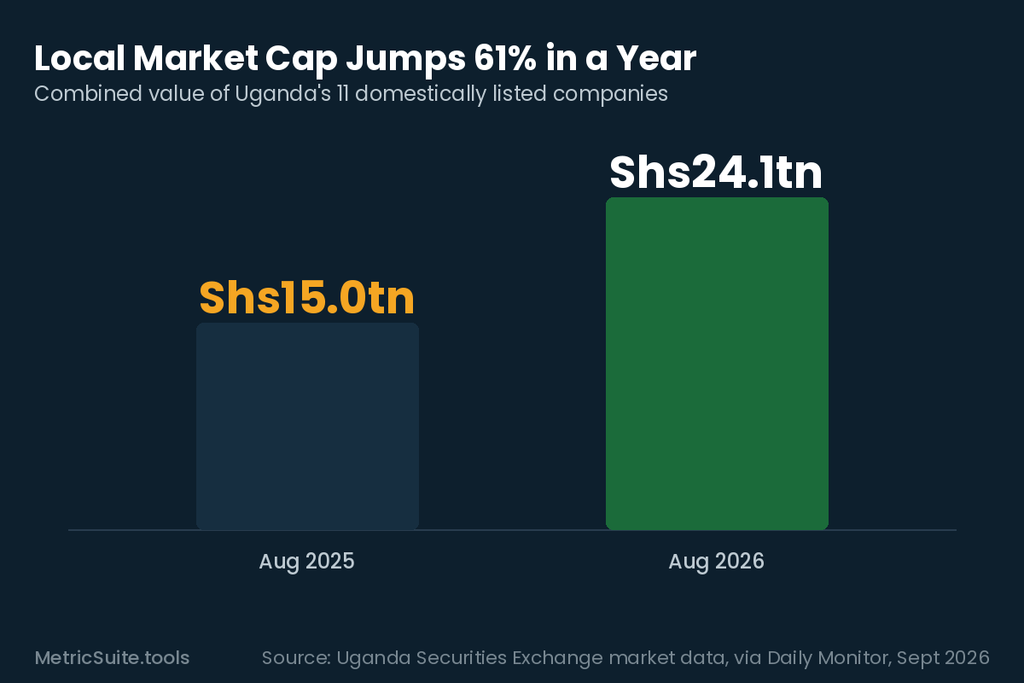
The numbers are not subtle. Equity turnover on the Uganda Securities Exchange (USE) hit Shs101.8 billion in the twelve months to August 2026, nearly double the roughly Shs56 billion recorded over the same period a year earlier. Market capitalisation of the 11 locally listed companies jumped from Shs15 trillion to Shs24.1 trillion in a single year. Including cross-listed regional stocks, total market cap rose from Shs31 trillion to Shs51 trillion.
USE Chief Executive Officer Paul Bwiso has pointed to stronger corporate earnings, higher dividend payouts, and clearer company disclosures as the drivers pulling more investors into the market. The individual stock returns back that up: Airtel Uganda delivered a total return of 105.22 percent over the past year, NIC Holdings 104 percent, Stanbic 67.44 percent, and Uganda Clays, a genuine turnaround story after years of losses, 42 percent. MTN alone accounted for 69.15 percent of turnover, with Stanbic and Umeme making up most of the rest.
Need a Freelancer for This?
Hire verified talent on Fiverr — starting from $5. No contracts, no hassle.
Browse Fiverr Freelancers →This is not a speculative bubble built on rumour. It is a small, thin market where a handful of companies with real earnings and real dividend payouts have re-rated sharply, and where trading volume is finally starting to reflect that.
The Gap Nobody Talks About: 300,000 Accounts, 50,000 Active
Here is the part that should change how you think about this. Bwiso says investor accounts on the USE are expected to approach 300,000 by the end of 2026. Only slightly more than 50,000 of those accounts are actively used in a given year.
Read that again. Roughly 250,000 Ugandans already have what they need to buy shares, an open trading account, and simply are not using it. Many of these accounts were likely opened years ago during a high-profile IPO like MTN’s or Airtel’s, used once, and forgotten. The barrier to Ugandan retail investing was never really access. It is understanding what to do once the account exists, and that gap is precisely what this guide is for.
How to Actually Open a Trading Account
Every share bought or sold on the USE is held electronically, not as a paper certificate, in what is called a Securities Central Depository (SCD) account. You cannot trade without one, and opening one is free, with no minimum balance and no monthly charges.
You have a few practical ways to get one:
- Through a licensed stockbroker in person. Bring a valid national ID and three passport photos. The broker opens your SCD account and later holds the trust account where your trading funds sit before an order is placed.
- Through the USE Easy Portal. Visit the exchange’s digital onboarding platform, create an account, and follow the prompts. This is the fastest self-service route if you have a smartphone and a stable connection.
- Through mobile money. Airtel subscribers can open an SCD account by dialling a USSD code directly from their phone. MTN subscribers can do the same through the MoMo menu. Both routes were built specifically to remove the in-person, paperwork-heavy barrier that kept the account-opening number so far ahead of the active-user number.
- Through Chipper Cash. Chipper Technologies Uganda is now an admitted trading participant on the USE, so existing Chipper users can open an SCD account through the app’s onboarding flow, linked to the same USE Easy Portal system.
Once your account is open, buying is straightforward: tell your broker which company and how many shares you want, deposit the money into the broker’s trust account (payment is required upfront for local orders), and the broker posts your order on the Automated Trading System during trading hours. Settlement takes three working days.
A few practical numbers worth knowing before you place your first order:
- Commission: brokers charge a fixed 2.1 percent of your total transaction value, covering brokerage and related fees. This applies whether you are buying or selling.
- Minimum order size: the common practice on the USE is a minimum of 100 shares per transaction, so your minimum outlay depends entirely on the current share price of the company you want. At a share price of Shs50, that is Shs5,000 before commission. At Shs1,000 a share, that is Shs100,000 before commission. Confirm the current minimum lot size with your broker, since it can be adjusted.
- Trading days: the exchange trades Monday, Tuesday and Thursday mornings.
For the current, definitive list of licensed stockbrokers, check the USE’s own trading participants page or the Capital Markets Authority’s licensed firms list. Names you will encounter include SBG Securities (Stanbic), Crested Capital, Old Mutual Financial Services, African Alliance Uganda, Baroda Capital, Crane Financial Services, Dyer & Blair Uganda, Equity Stock Brokers Uganda, and Chipper Technologies Uganda for the mobile-first route.
The 11 Companies You Can Actually Buy Into
Uganda’s stock market is small by design and by history. There are 11 domestically listed companies, plus 8 cross-listed regional stocks (mostly Nairobi-listed firms like Kenya Airways, Equity Group and KCB Group that also trade on the USE). Here is what each domestic company actually does:
- MTN Uganda (MTNU) — the largest telecom in the country, and the single biggest driver of USE turnover.
- Airtel Uganda (AIRTEL UGANDA) — the second major mobile network, and 2026’s standout performer by total return.
- Stanbic Bank Uganda (SBU) — the country’s largest commercial bank by assets, and a consistent volume leader.
- Bank of Baroda Uganda (BOBU) — a commercial bank and the first financial institution to ever list on the USE.
- DFCU Limited (DFCU) — a commercial bank with a long development-finance history in Uganda.
- NIC Holdings (NIC) — an insurance holding company, and one of 2026’s strongest total-return performers.
- Umeme Limited (UMEME) — the company distributing roughly 97 percent of Uganda’s electricity, currently drawing heavy trading interest as investors assess what comes after its distribution concession ends.
- Uganda Clays Limited (UCL) — a building-materials manufacturer that returned to profitability in 2026 after years of losses, on the back of cost cuts, regional expansion and NSSF debt repayment.
- Quality Chemical Industries Limited (QCIL) — a pharmaceutical manufacturer.
- New Vision Printing and Publishing — a media and publishing group.
- British American Tobacco Uganda (BATU) — a tobacco manufacturer, and one of the exchange’s oldest listings.
Seven of these eleven have already declared dividends this year, a sign that the earnings behind the rally are real, not just sentiment.
Dividends vs Capital Gains: The Two Ways You Actually Make Money
Dividends are a direct cash payout from a company’s profits, paid per share you hold, usually once or twice a year. This is the steadier, more predictable side of stock returns, and it is a large part of why the USE rally has held up: companies are earning more and passing more of it back to shareholders.
Capital gains are the increase in your shares’ price between when you bought and when you sell. This is where Airtel’s 105 percent and NIC’s 104 percent total returns mostly came from. It is also the less predictable side. A stock that has already run up 105 percent in a year is not guaranteed to repeat that, and chasing last year’s best performer is one of the fastest ways new investors lose money in any market, not just Uganda’s.
On tax. Dividends paid by USE-listed companies to individual shareholders are subject to a 10 percent withholding tax, deducted automatically before the payout reaches you, and this is treated as a final tax for individuals, meaning you are not expected to declare it further as personal income. Capital gains are treated differently and less straightforwardly: Uganda does not run a separate, standalone capital gains tax regime the way some countries do, and gains have historically been folded into business income and taxed at the standard 30 percent rate when the seller is trading as a business. How this applies to an ordinary individual who buys and holds shares personally, rather than trades them as a business, is a genuinely case-specific question, and Uganda’s 2026 tax amendments touched capital gains provisions directly. This article is not tax advice. Before you sell a meaningful position, especially one with a large gain, confirm the current treatment with your broker or a tax adviser rather than assuming.
How Uganda’s Rally Stacks Up Regionally
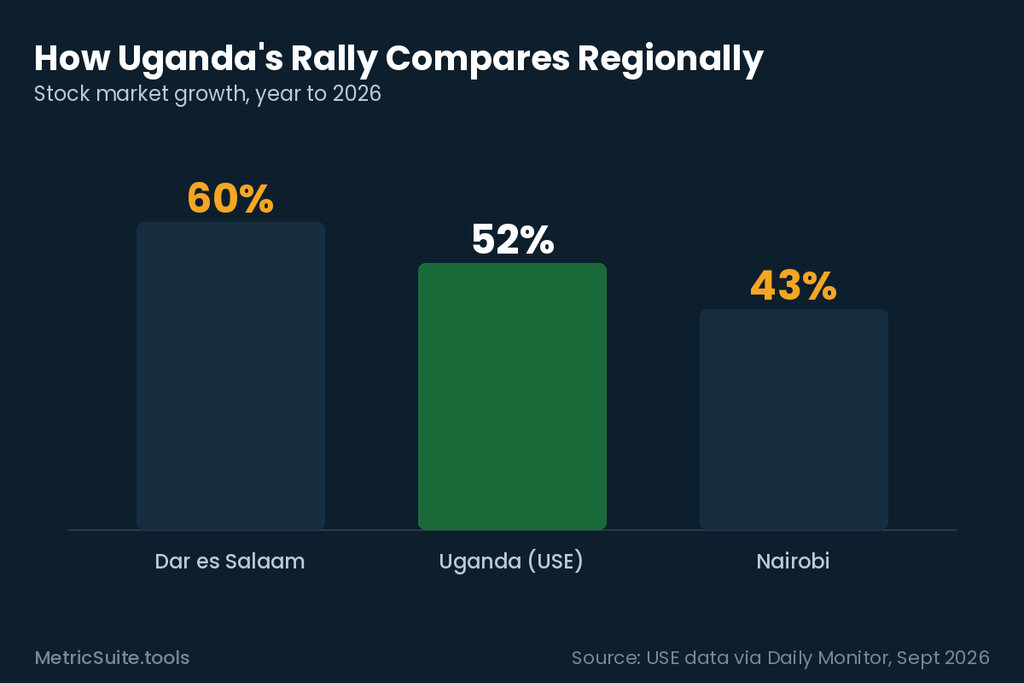
Uganda’s roughly 52 percent market growth this year is genuinely strong, but it is not the region’s best. Dar es Salaam has grown faster, at around 60 percent, while Nairobi has grown more slowly, at about 43 percent. That places Uganda squarely in the middle of a broader East African equities rally, not as an isolated local story, which is itself a reason for cautious confidence: this looks more like a regional re-rating of East African equities than a one-market anomaly that could reverse just as quickly as it appeared.
A First-Time Investor’s Checklist
Before you place your first order, work through this list:
- National ID ready. You need a valid ID to open an SCD account through any route.
- Broker chosen. Pick a licensed stockbroker from the USE or CMA’s current list, or use a mobile route (Airtel, MTN, or Chipper Cash) if you want to skip an in-person visit.
- Account opened. Confirm your SCD account is active before you attempt to fund anything. It costs nothing and carries no ongoing charges.
- Budget the real cost. Factor in the 2.1 percent commission and the roughly 100-share minimum order size before you decide how much to commit.
- Decide your focus. Are you buying for dividend income, for capital growth, or a mix of both? That decision should shape which of the 11 companies you look at first.
- Understand the dividend tax. The 10 percent withholding on dividends is already deducted before you receive payment. Do not budget for it twice.
- Don’t chase 2026’s winners. Airtel’s 105 percent and NIC’s 104 percent already happened. Research a company’s earnings and dividend history, not just its trailing return.
If you want to see what disciplined, reinvested returns could actually look like over five or ten years rather than one strong year, the Compound Interest Calculator at MetricSuite.tools lets you model that with your own numbers before you commit capital.
FAQ
What is the Uganda Securities Exchange and how does a beginner start?
The Uganda Securities Exchange (USE) is Uganda’s stock market, where 11 domestic companies and 8 cross-listed regional companies trade shares. A beginner starts by opening a free Securities Central Depository (SCD) account through a licensed stockbroker, the USE Easy Portal, or a mobile money route via Airtel or MTN, then places an order for shares through a broker.
How do I invest in USE stocks as a beginner?
Open a free SCD account (via a broker, the USE Easy Portal, Airtel, MTN, or Chipper Cash), deposit money with your chosen broker, and instruct them to buy shares in a specific listed company. Brokers charge a fixed 2.1 percent commission on the transaction value, and the common minimum order size is 100 shares, so your minimum spend depends on the share price.
Which USE stocks performed best in 2026?
Airtel Uganda led with a total return of 105.22 percent, followed by NIC Holdings at 104 percent, Stanbic at 67.44 percent, and Uganda Clays at 42 percent, according to USE data cited by Daily Monitor. Past performance does not guarantee future returns.
How much has Airtel Uganda returned to investors?
Airtel Uganda recorded a total return of 105.22 percent over the year to September 2026, combining share price appreciation and dividend payouts, making it the USE’s top-performing domestic stock for the period.
How do I buy MTN Uganda shares?
MTN Uganda shares are bought the same way as any USE-listed stock: through a licensed stockbroker, after opening a free SCD account. MTN accounted for the largest share of USE turnover in 2026, at just over 69 percent, making it one of the most liquid and frequently traded counters on the exchange.
Is retail investing in Uganda worth it right now?
The USE’s turnover nearly doubled and local market capitalisation rose from Shs15 trillion to Shs24.1 trillion in the year to August 2026, driven by real corporate earnings and dividend growth rather than speculation alone. That said, USE CEO Paul Bwiso has noted that of the roughly 300,000 investor accounts expected by year-end, only about 50,000 are actively used, so having an account is not the same as having a strategy. This is not personalised financial advice; consider your own goals and risk tolerance, or speak with a licensed adviser, before investing.
SOURCES
- Nabisubi, Racheal. “USE turnover nearly doubles to Shs102b as equities rally.” Daily Monitor, 10 September 2026. https://www.monitor.co.ug/uganda/business/markets/use-turnover-nearly-doubles-to-shs102b-as-equities-rally-5589288
- “How Uganda’s stock market is making people rich.” Daily Monitor, 3 September 2026. https://www.monitor.co.ug/uganda/business/markets/how-uganda-s-stock-market-is-making-people-rich–5581980
- “Uganda Advances ETF and Commodities Exchange Plans Amid Strong Capital Markets Growth.” NilePost, 15 April 2026. https://nilepost.co.ug/news/334491/uganda-advances-etf-and-commodities-exchange-plans-amid-strong-capital-markets-growth
- “Investor FAQs.” Uganda Securities Exchange. https://use.or.ug/investors/investor-faqs
- “Listed Companies.” Capital Markets Authority of Uganda. https://cmauganda.co.ug/listed-companies/
- “[Uganda] Investor FAQ’s about Stocks in Uganda.” Chipper Cash Help Center. https://support.chippercash.com/en/articles/6560098-uganda-investor-faq-s-about-stocks-in-uganda
- “Minimum Investment Amount for Uganda Securities Exchange.” Investing in Africa. https://investinginafrica.net/uganda-securities-exchange-minimum-investment/
- “Uganda – Corporate – Withholding taxes.” PwC Tax Summaries. https://taxsummaries.pwc.com/uganda/corporate/withholding-taxes
- “Uganda – Corporate – Income determination.” PwC Tax Summaries. https://taxsummaries.pwc.com/uganda/corporate/income-determination
- “Listed Companies.” Crested Capital. https://crestedcapital.com/?page_id=1730