
Beatrice registered her import business in January. By June she had a shop in Kikuubo, three staff, and a supplier relationship in Guangzhou that took months to build. By November she had closed. Not because the products did not sell. They did. She closed because every time she checked her bank balance against what she thought she had, the two numbers disagreed, and by the time she worked out why, the gap had become too large to trade her way out of.
That story is not unusual. On 11 September 2026, the Ministry of Trade, Industry and Cooperatives held a stakeholders’ meeting in Kampala and put a number on it: 66 percent of businesses in Uganda fail within their first year. Up to 80 percent do not make it past year three. Those figures were cited by Johnson Abitekaniza, Assistant Commissioner for Training and Business Skills Development, in front of government officials, development partners and the country’s senior business advisers.
The headline is not new. What is new is that the government is now moving to do something about the reason it keeps happening, and the reason it gives is worth taking seriously, and also worth pushing past.
Need a Freelancer for This?
Hire verified talent on Fiverr — starting from $5. No contracts, no hassle.
Browse Fiverr Freelancers →The Number Everyone Is Suddenly Talking About
Abitekaniza’s argument was that Ugandan entrepreneurs are not failing for lack of ideas, equipment, or even capital alone. They are failing because they cannot access coordinated, credible Business Development Services (BDS): training, mentorship, business planning, financial literacy and bookkeeping support. He put it plainly: if a business does not get the right support, it dies before its first birthday.
Part of the problem, he said, is that the market for advice itself is broken. Uncertified and underqualified consultants have flooded the space, charging low fees for advice that does not hold up. To fix that, the ministry is working with a new industry body, the United Business Support Professionals (UBSP) association, to bring standards and certification to business advisers. UBSP chairperson Kenneth Nkumiro described the current BDS ecosystem as fragmented, under-resourced, and, despite billions of shillings in donor investment over the years, still not reaching the grassroots business owner in a way that changes outcomes.
This matters. Uganda’s MSMEs make up around 90 percent of the private sector and employ millions of people, yet most survive by instinct rather than by measurement. A national push to professionalise the advice they get is a genuinely useful development.
But it treats the symptom, not always the disease. You can get excellent advice and still run out of cash. What actually kills a Ugandan business is rarely one dramatic event. It is a specific, repeatable set of financial mistakes, several of which the business owner never saw coming because nobody itemised them in advance.
The Four Financial Triggers Nobody Itemises for You
1. Undercapitalisation: funding the launch, not the runway
Most new businesses in Uganda are capitalised to open their doors, not to survive the six to twelve months it typically takes for revenue to become predictable. Rent, stock, a first delivery, a shop sign: that is what the starting capital usually covers. What it rarely covers is the gap between spending the money and collecting it back, which for import-dependent or seasonal businesses can run for months.
When that gap arrives, the owner has three options: inject more personal cash, borrow at short-term rates that eat the margin they were trying to protect, or slow-fail, quietly reducing stock and staff until the business is a shell of what it was registered as. Under-capitalised businesses do not usually die in a single bad month. They bleed out over two or three quiet ones.
2. One pot of money for the business and the household
Ask a struggling business owner in Uganda whether the business is profitable, and many genuinely cannot answer, because business income and household income sit in the same mobile money wallet or the same envelope of cash. School fees, rent, and stock replenishment all draw from the same source. This is not a discipline failure so much as a structural one: informal businesses rarely have the tools or the habit of separating the two.
The cost of this is not just confusion. It means the owner cannot price accurately (because they do not know their real costs), cannot tell a lender or an investor a credible number (because there is no clean record to show), and cannot spot a failing business early enough to fix it (because a shrinking personal balance looks the same as a shrinking business one).
3. Bookkeeping that lives only in the owner’s head
Financial literacy, the exact term Abitekaniza used, is not the same as financial intuition. An owner can be sharp with numbers in conversation and still have no written record of what came in, what went out, and what is owed. Without that record, three things become impossible: knowing your real break-even point, catching a slow leak before it becomes a flood, and presenting a bankable case to a supplier, cooperative, or lender who might otherwise extend credit.
This is precisely the gap the government is trying to close through BDS reform. It is also the gap an owner can start closing today, with a notebook, a spreadsheet, or a simple workbook, without waiting for a certified adviser to become available.
4. Hidden costs that quietly kill the margin
This is the trigger that gets the least attention, because it does not show up as a single bad decision. It shows up as a margin that was fine on paper and was not fine in practice, because nobody added up the full stack of fees and levies sitting between the invoice price and the money that actually lands.
Mobile money withdrawal costs, stacked. Uganda’s 0.5 percent excise duty on mobile money cash withdrawals survived a proposed cut in the 2026/27 budget and remains in force. It sounds small until it is added to the agent’s own withdrawal fee and, on the fee itself, VAT. Cashing out UGX 1,000,000 on MTN MoMo currently costs close to UGX 19,375 all-in once the agent fee, the government levy, and VAT on the fee are combined. A business that cycles cash through mobile money weekly, rather than daily or in larger batches, pays that stack over and over, and rarely tracks it as a line item.
Import duty stacking. Anyone importing stock into Uganda is not paying one number, they are paying five: the EAC Common External Tariff duty, VAT, a withholding tax, an infrastructure levy, and an import declaration fee. Layered together, these routinely push the real landed cost 40 to 60 percent above the supplier’s invoice price. Businesses that price using the invoice figure alone, without running the full stack, are quoting customers a price that was never going to cover their actual cost.

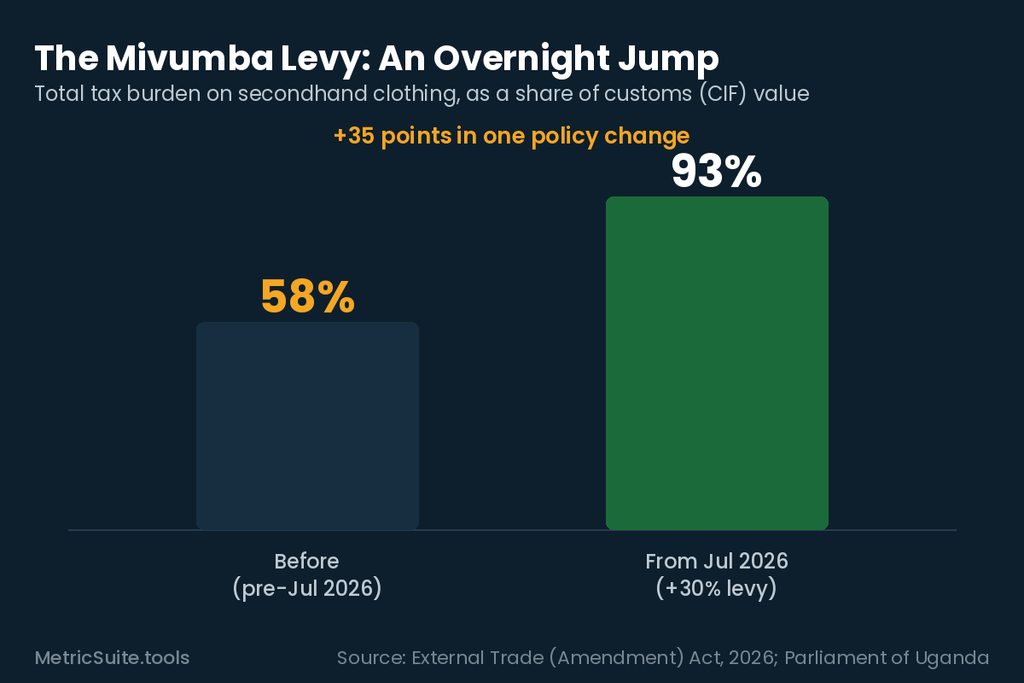
The new 30 percent environmental levy on secondhand clothing. If your business touches mivumba, this is the single biggest margin shift of 2026. Parliament passed the External Trade (Amendment) Act, 2026 on 21 April, introducing a 30 percent environmental levy on the CIF value of imported used clothing and worn articles, effective from the 2026/27 financial year. Layered on top of the existing 35 percent base duty and the VAT it feeds into, the total tax burden on a bale of used clothing has moved from roughly 58 percent of customs value to as high as 93 percent, almost overnight. A trader still costing bales on last year’s numbers is not running the same business anymore, whether or not they have noticed.
If you do not have a system yet, the MetricSuite Bookkeeping Workbook is a CA$19.99 Excel and Google Sheets template built for exactly this: tracking income, expenses, and outstanding customer balances without needing accounting software or training.
Buy MetricSuite Bookkeeping WorkbookNone of these three costs is hidden in the sense of being secret. They are published tax and tariff rules. They are hidden in the sense that almost nobody adds them up before they commit capital, and by the time the shortfall shows up in the bank balance, it looks like a sales problem rather than what it actually is: an arithmetic problem, decided months earlier.
A 10-Minute Self-Audit Checklist
Before the next stock order, or before this quarter closes, run through this list honestly. It will not fix a struggling business by itself, but it will tell you, in ten minutes, whether you are looking at a sales problem or a numbers problem.
- Separate accounts. Do you have a business mobile money line or bank account that is never used for household spending, even temporarily?
- Written records. Can you produce, right now, a list of everything you are owed and everything you owe, without relying on memory?
- True landed cost. For your last import order, did you calculate the final cost including duty, VAT, withholding tax, infrastructure levy, and import declaration fee, or just the supplier invoice and shipping?
- Break-even point. Do you know, in shillings, the minimum you must sell this month to cover rent, stock replenishment, staff, and loan repayments, before a single shilling counts as profit?
- Transaction cost tracking. Do you know what mobile money withdrawal fees and taxes cost your business per month, as a total, rather than per transaction?
- Sector-specific levies. If you trade in secondhand clothing, imported goods, or anything recently touched by a tax amendment, have you re-run your pricing since the change took effect, or are you still using last year’s numbers?
- Runway. If sales stopped tomorrow, how many months could the business cover its fixed costs from what it currently holds, separate from the owner’s personal savings?
If more than two of these came back as “no” or “not sure,” the business is not failing because the idea is wrong. It is failing because nobody has done the arithmetic, and that is fixable faster than almost anything else on this list.
What the Government and UBSP Are Actually Proposing
The Ministry of Trade’s push, working through UBSP, is aimed at the supply side of this problem: certifying advisers, setting quality standards for what counts as legitimate BDS, and making it easier for a business owner to tell a competent consultant from someone charging a low fee for bad advice. Marion Evelyn Akumu of FRIENDS Consult Limited raised the parallel point that awareness needs to improve too, particularly outside Kampala, so business owners actually know to seek out a qualified provider rather than the cheapest one available.
This is a slow, structural fix, and a needed one. It will not help the business that is six months from running out of cash today. For that business, the self-audit above, done honestly this week, does more immediate good than waiting for a certified adviser to become available.
Do the Math Before the Bank Balance Does It for You
The single most common thread running through the four triggers above is that they are all calculable in advance, and almost nobody calculates them in advance. Two numbers in particular are worth knowing cold before you commit capital in Uganda in 2026.
If you import any stock, the Uganda Import Duty Calculator runs the full EAC duty, VAT, withholding tax, infrastructure levy, import declaration fee, and the new 30 percent environmental levy where it applies, so you see the real landed cost before you place the order, not after.
If your business moves money through MTN MoMo regularly, the MTN MoMo Uganda Fee Guide breaks down exactly what the 0.5 percent withdrawal tax and agent fees cost at every transaction band, so you can plan cash-out timing instead of losing margin to it one withdrawal at a time.
Neither tool fixes a bad business model. Both remove the excuse of not knowing the number before it is too late to act on it.
FAQ
Why do businesses fail in Uganda?
Government data cited at a September 2026 Ministry of Trade stakeholders’ meeting shows 66 percent of Ugandan businesses fail within their first year. Officials point to a lack of coordinated Business Development Services, but the underlying financial causes are usually undercapitalisation, no separation between business and personal money, missing bookkeeping, and hidden costs like mobile money taxes and import duty stacking that were never priced into the business from the start.
What is Uganda’s startup failure rate?
66 percent of businesses fail within the first year, rising to roughly 80 percent by year three, according to figures presented by the Ministry of Trade, Industry and Cooperatives in September 2026. MSMEs make up around 90 percent of Uganda’s private sector, so this failure rate affects the large majority of the country’s registered businesses.
What are Business Development Services (BDS) in Uganda?
BDS refers to non-financial support for businesses, including training, mentorship, business planning, financial literacy and bookkeeping. The government is working with the new United Business Support Professionals (UBSP) association to certify BDS providers and raise standards, after finding the market flooded with uncertified consultants offering low-cost, low-quality advice.
How can Ugandan entrepreneurs improve financial literacy without paying for a consultant?
Start with the basics that do not require external help: open a separate account for the business, record every transaction, calculate your true break-even point, and add up the full tax and fee stack (duty, VAT, withholding tax, mobile money charges) before you price a product or place an order. A simple bookkeeping workbook or spreadsheet can cover most of this without waiting for certified advisory support to become available.
How much does mobile money tax actually cost a business in Uganda?
Uganda charges a 0.5 percent excise duty on every mobile money cash withdrawal, on top of the agent’s own fee and VAT charged on that fee. On a UGX 1,000,000 withdrawal, the combined cost is close to UGX 19,375. Businesses that cash out frequently in small amounts pay this stack repeatedly rather than in fewer, larger, cheaper withdrawals.
What is the new environmental levy on secondhand clothing in Uganda?
Parliament passed a 30 percent environmental levy on the CIF value of imported secondhand clothing and worn articles, effective from the 2026/27 financial year under the External Trade (Amendment) Act, 2026. Combined with the existing 35 percent base import duty and VAT, the total tax burden on used clothing imports has risen from around 58 percent to as high as 93 percent of customs value.
SOURCES
- Nafula, Jane. “Govt warns poor business advice hurting Ugandan enterprises.” Daily Monitor, 12 September 2026. https://www.monitor.co.ug/uganda/news/national/govt-warns-poor-business-advice-hurting-ugandan-enterprises-5592640
- “Turning the tide: How to transform business collapse into a comeback.” Daily Monitor, 12 August 2026. https://www.monitor.co.ug/uganda/business/prosper/turning-the-tide-how-to-transform-business-collapse-into-a-comeback-5555098
- “Gov’t rejects proposal to cut mobile money withdrawal tax.” The Observer, 13 April 2026. https://observer.ug/business/govt-rejects-proposal-to-cut-mobile-money-withdrawal-tax/
- “MTN Uganda Withdraw Charges 2026: Full Fee Chart.” MetricSuite.tools. https://metricsuite.tools/mtn-momo-fees-uganda-2026/
- “New tax on used clothes hits importers.” Daily Monitor, 14 April 2026. https://www.monitor.co.ug/uganda/business/prosper/new-tax-on-used-clothes-hits-importers-5421752
- “Govt tables tax Bills for FY2026/27.” Parliament of Uganda. https://www.parliament.go.ug/index.php/news/4384/govt-tables-tax-bills-fy202627
- “Parliament Approves 30% Levy on Mivumba, Raises VAT Threshold to Shs300m.” Uganda Online, citing Parliament of Uganda, 21 April 2026. https://www.ugandaonline.net/news/2026-04-21–parliament-approves-30-levy-on-mivumba-raises-vat-threshold-shs300m–24ea731638f3/
- “Uganda Import Duty Calculator 2026.” MetricSuite.tools. https://metricsuite.tools/uganda-import-duty-calculator/