The Dangote Petroleum Refinery IPO opened Nigeria’s capital market to retail investors in a way that has not happened before: a fully digital subscription process, built with diaspora and international access in mind from the start. But “digital” does not mean “frictionless.” Between BVN requirements, crypto network mismatches, and the gap between what a platform advertises and what its live app actually does, getting money into this offer takes more than opening an app and clicking buy.
This guide covers what the offer actually involves, why the standard diaspora investing apps do not work for most non-Nigerian diaspora investors, and the funding friction worth planning around before you send anything.
The Offer, in Numbers
- Shares on offer: 4.1 billion ordinary shares
- Offer price: ₦525 per share (about USD 0.40)
- Target raise: approximately ₦2.15 trillion (about USD 1.63 billion)
- Minimum subscription: 10 shares, or ₦5,250 (about USD 4)
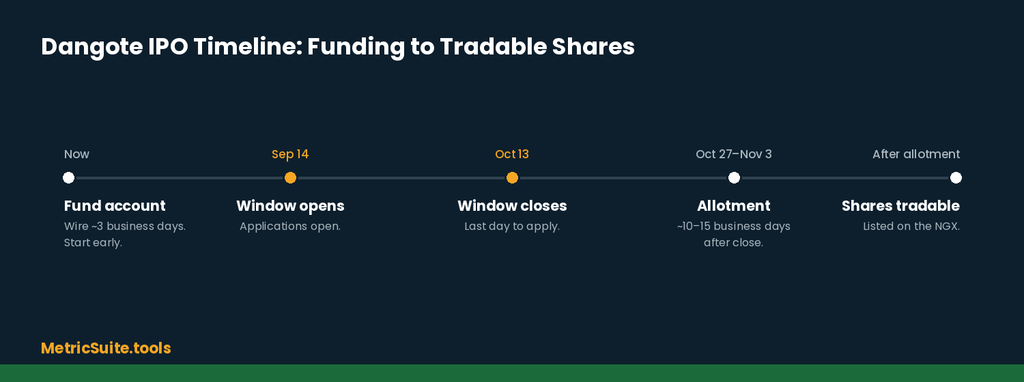
- Subscription window: September 14 to October 13, 2026
- Listing exchange: Nigerian Exchange (NGX)
- Trading debut: typically 10 to 15 business days after the offer closes, so expect a gap of several weeks between funding your account and actually holding tradable shares
The offer is being run as Nigeria’s first fully digital retail IPO, with subscription options built directly into banking apps and fintech platforms rather than requiring paper forms or in-person applications. That is the part that makes diaspora participation realistic in the first place. It is also the part that introduces the friction covered below, since “digital” here means going through a third-party app, each with its own account setup, KYC process, and funding rails.
Need a Freelancer for This?
Hire verified talent on Fiverr — starting from $5. No contracts, no hassle.
Browse Fiverr Freelancers →Why Most Diaspora Investing Apps Do Not Work Here
The well-known diaspora investing apps, the ones that let you buy US stocks or NGX-listed names from abroad, mostly require a Nigerian Bank Verification Number (BVN) and a Nigerian bank account to open a brokerage account. That is a real barrier if you do not have Nigerian citizenship or an existing financial footprint in the country.
There is a workaround: the Non-Resident BVN (NRBVN) program lets Nigerians abroad enrol remotely through an embassy or high commission, without traveling home. It works, but it takes a Nigerian passport (or documentation of Nigerian heritage), a biometric appointment, and typically two to four weeks to complete. That timeline does not fit inside a subscription window that closes October 13.
For diaspora investors without Nigerian citizenship at all, the BVN requirement is not a matter of waiting longer. It is a hard stop on the mainstream apps.
The Alternative: Passport-Based Platforms
A smaller set of platforms handle KYC using any government-issued passport instead of a Nigerian BVN or NIN, which removes the citizenship requirement entirely. Funding on these platforms typically runs through standard international rails: ACH transfer, wire transfer, card, or a supported stablecoin.
This is a newer, less established part of the market. Before funding any platform in this category, worth confirming directly, not just from the platform’s own marketing copy:
- What regulatory license the platform actually holds, and checking that license number against the regulator’s own public register yourself rather than trusting the site’s claim
- Whether KYC is genuinely required before funds move, real brokers require it by law, and a platform skipping it is a signal worth taking seriously
- Whether the live app matches the marketing pages. Advertised payment methods (credit card, for example) do not always show up as options once you are actually inside a live account
None of that means avoid these platforms outright. It means treat the regulatory and KYC claims as something to verify, not something to assume.
Funding Rails, Compared
| Rail | Typical speed | What to watch for |
|---|---|---|
| Wire transfer | About 3 business days | Most reliable option in practice. Start this early given the lag |
| Card / ACH | Fast when available | Advertised on marketing pages more often than it actually appears in the live app. Confirm inside your account before relying on it |
| USDT (crypto) | Fast in theory | Network-specific. Sending on the wrong network (Ethereum/ERC-20 instead of Tron/TRC-20, for example) can mean permanent loss of funds, not just a delay |
How I Funded My Own Application
I opened my account through mystocks.africa to fund my own Dangote Refinery IPO subscription. It’s the platform behind the funding steps above. This is my referral link, and I get a small credit if you sign up through it.
Open My mystocks.africa AccountThe crypto rail carries friction beyond the network issue. Some exchanges impose a 24 to 48 hour hold on withdrawals to a wallet address you have not sent to before, as a security measure. Others screen outbound transfers against a recognized-platform list under crypto Travel Rule compliance, and may block a transfer to a platform that is not on that list, which can look identical to a technical error from the user’s side even though nothing is actually broken.
Practical takeaway: if you are relying on crypto to fund an application, do not treat it as your only path this close to a deadline. Have a wire or card funding option ready as a backup.
What Actually Works
- Start funding before the window opens, not on the day it opens. A 3-day wire initiated on day one of a multi-week window gives you comfortable margin. A 3-day wire initiated with days left does not.
- Check your live account, not the marketing page, for what payment methods are actually available. The two are not always the same.
- If funding with crypto, confirm the exact network before sending anything. Match it exactly to what the receiving platform specifies.
- There is no first-come-first-served advantage. Oversubscribed retail offers are typically allocated pro-rata across everyone who applied within the window, not on a first-in basis. Getting your application in on day one versus week three should not change your allocation.
- Keep in mind the gap between funding, allotment, and actual tradable shares. Money moving into your account is not the same as owning shares, and owning shares is not the same as being able to trade them. Budget for several weeks between funding and a tradable position.
Reservations vs. the Real Application
Some platforms offer a “reserve an allocation” feature ahead of the official subscription window, distinct from the actual application. This is worth treating carefully; Nigerian financial press coverage of this specific offer has explicitly warned investors to distinguish between an official subscription and any unofficial request to reserve shares.
A reservation feature is not automatically a scam. Some of the signals of a more legitimate setup: it requires KYC, states that funds remain in escrow until allocation rather than being spent immediately, and discloses its fee upfront. Those are the details to check for before using one, not assumptions to make by default.
The one fact that does not change regardless of platform: the actual, official Dangote IPO application only exists once the subscription window opens. Before that date, there is no legitimate channel anywhere that can submit a binding order.
FAQ
When does the Dangote Refinery IPO open?
The subscription window opens September 14, 2026, and closes October 13, 2026.
Do I need a Nigerian bank account or BVN to invest?
Not necessarily. Some platforms accept KYC using any government-issued passport and fund in USD through international rails instead of requiring a Nigerian BVN or bank account.
What is the minimum investment?
10 shares at ₦525 each, which comes to ₦5,250, or about USD 4.
Can I fund my account with crypto?
Some platforms accept USDT, but confirm the exact network (for example Tron/TRC-20 versus Ethereum/ERC-20) before sending. Using the wrong network on a stablecoin transfer can result in permanent loss of the funds.
Is a “reserve your allocation” feature the same as the official application?
No. Treat it as a separate product from the actual subscription, and confirm it requires KYC and holds funds in escrow before using it. The real application only exists once the subscription window is officially open.
When will I actually be able to trade the shares?
Typically 10 to 15 business days after the subscription window closes on October 13, once allotment is processed and shares are credited.
Related Tools
- Nigerian Import Duty Calculator
- MTN MoMo Fee Tracker (Ghana and Uganda fee guides)
- Repatriation Cost Calculator
Sources
- Reuters via CNBC Africa, “Nigeria’s Dangote oil refinery signs IPO documents before landmark share sale”: https://www.cnbcafrica.com/2026/nigerias-dangote-oil-refinery-signs-ipo-documents-before-landmark-share-sale
- Nairametrics, “Dangote Refinery to price IPO shares at N525, targets $1.5 billion raise”: https://nairametrics.com/2026/09/04/dangote-refinery-to-price-ipo-shares-at-n525-targets-1-5-billion-raise/
- Nairametrics, “Dangote Refinery IPO is Nigeria’s first fully digital retail offer, Vetiva Capital”: https://nairametrics.com/2026/09/08/dangote-refinery-ipo-is-nigerias-first-fully-digital-retail-offer-vetiva-capital/
- BusinessDay, “Meet the deal makers behind Dangote Refinery’s historic IPO”: https://businessday.ng/markets/article/meet-the-deal-makers-behind-dangote-refinerys-historic-ipo/
- Vanguard News, “Dangote Refinery IPO: 10 steps to buy shares for N5,250”: https://www.vanguardngr.com/2026/09/dangote-refinery-ipo-10-steps-to-buy-shares-for-n5250/
- Legit.ng, “How to Buy Dangote Refinery IPO Shares from September 14 With N5,250 Minimum”: https://www.legit.ng/business-economy/industry/1729424-dangote-refinery-ipo-10-steps-buy-shares-september-14/
- Bamboo, “How Nigerians Abroad Can Invest in NGX Stocks” (Non-Resident BVN process): https://learn.investbamboo.com/how-nigerians-abroad-can-invest-in-ngx-stocks/