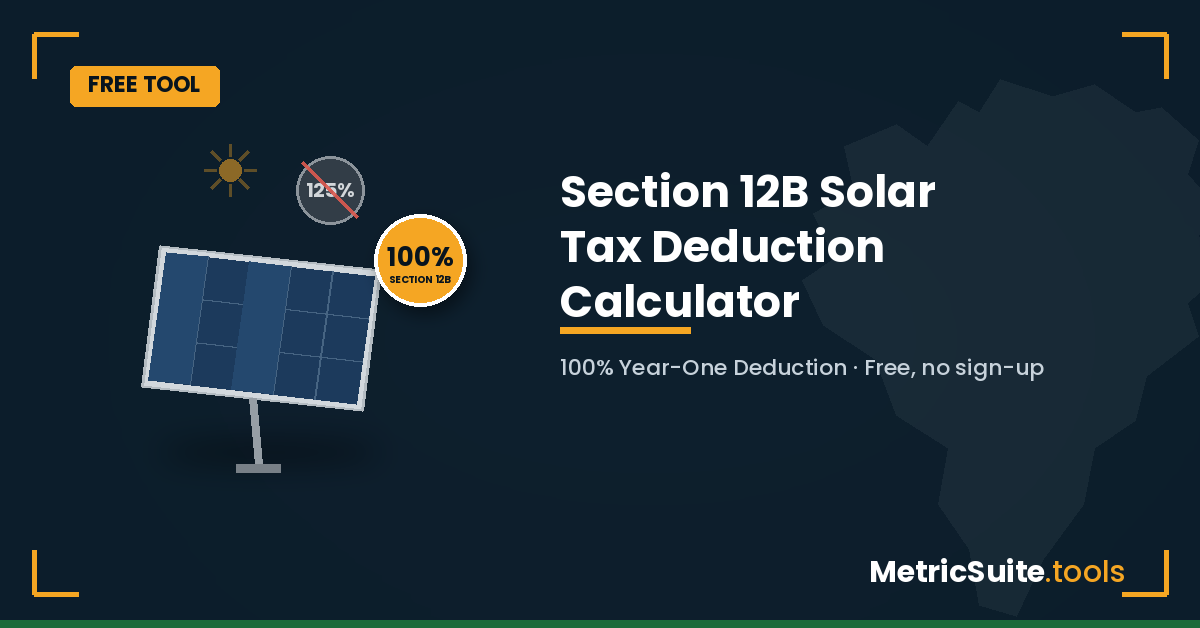
A freelance designer in Pretoria installs a R180,000 solar and inverter system for her home office, remembers reading something about a 125% solar tax deduction, and budgets her tax return around a number that no longer exists. Section 12BA, the enhanced 125% deduction, expired on 28 February 2025. What’s still available, permanently, is Section 12B at 100%, a smaller number than she expected, but a real and useful one.
Use the free Section 12B Solar Tax Deduction Calculator at MetricSuite.tools to calculate this instantly, no signup required. Enter your system cost, business-use share, and tax rate to see your deduction schedule and total tax saving.
Section 12B Solar Tax Deduction Calculator
For SA freelancers and solopreneurs installing solar or an inverter for a home office.
Panels, inverter, battery, racking, cabling, and installation.
If the system also powers your household, only the business share is deductible.
Your marginal individual rate if a sole proprietor, or 27% if trading through a company.
How to Use This Calculator
- Enter your total system cost. Panels, inverter, battery, racking, cabling, and installation all typically count. Design fees and roof repairs generally do not.
- Set your business-use share. If the system powers your household as well as your home office, only the business-apportioned share is deductible, not the full cost.
- Enter your tax rate. Sole proprietors use their marginal individual rate, companies use the flat 27% corporate rate.
- Choose your claim method. 100% in year one gets the full benefit fastest. 50/30/20 over three years spreads it, useful if this year’s income cannot fully absorb the deduction.
Why This Matters
Section 12B has been part of South African tax law since 2009, giving businesses accelerated depreciation on renewable energy assets used to produce income. In 2023, National Treasury layered a temporary enhancement on top of it, Section 12BA, offering a 125% first-year deduction to accelerate private investment during the worst of the load-shedding crisis. That enhancement only ever applied to assets brought into use between 1 March 2023 and 28 February 2025, and the 2025 and 2026 Budgets did not renew it. If you’re installing solar now, 12BA is not an option, regardless of what older articles or installer sales material might still say.
Section 12B itself remains genuinely useful. The old 1MW capacity threshold that used to force larger PV systems into a slower 50/30/20 write-off has been removed, so a full 100% year-one deduction is available for solar PV systems of essentially any size used in a trade.
The detail freelancers and solopreneurs miss most often is apportionment. Section 12B only covers the portion of an asset genuinely used to produce income. A home office solar setup that also powers the rest of the house is not 100% business use, and claiming the full cost when only part of it is business-related is exactly the kind of thing that draws a SARS query on larger claims. Working out a defensible business-use percentage before you claim, rather than defaulting to 100% and hoping, is the difference between a deduction that holds up and one that doesn’t.
Key Takeaways
- Section 12BA’s 125% enhanced deduction expired on 28 February 2025 and was not renewed. It does not apply to systems installed in 2026.
- Section 12B remains permanently available, a 100% year-one deduction for solar PV systems used in the production of income, with no size cap.
- Only the business-use portion of a home solar system is deductible, apportionment is required when the system also powers private household use.
- The total tax saving is the same whether you claim 100% in year one or spread it 50/30/20 over three years, only the timing changes.
- Spreading the deduction can make sense if your business does not yet have enough taxable income to absorb the full claim in year one.
FAQ
Can I still claim Section 12BA’s 125% deduction for a system I am installing now?
No. Section 12BA only applies to assets brought into use between 1 March 2023 and 28 February 2025. Any system installed after that date falls under Section 12B at 100%, not 12BA at 125%.
I installed solar in 2024 but have not filed that year’s return yet, can I still claim 12BA?
Potentially, depending on your financial year-end and where you stand with SARS assessment timelines. If this applies to you, raise it with a registered tax practitioner promptly rather than assuming the window has fully closed on your specific filing.
How do I work out my business-use percentage for a home office solar system?
There is no single formula SARS mandates, common defensible approaches include the floor area of your dedicated workspace as a share of the property, or metered/estimated energy consumption for business equipment against total household consumption. Whatever method you use, document it, since large claims can draw SARS scrutiny.
Does Section 12B cover the inverter and battery, or only the solar panels themselves?
Generally the whole system used to generate and store the electricity, panels, inverter, battery, racking, cabling, and installation, based on SARS binding private rulings on the predecessor provisions. Design and engineering fees, land preparation, and general roof repairs are typically excluded.
Should I claim 100% in year one or spread it over three years?
The total tax saving is identical either way. Claim 100% upfront if this year’s income can absorb the full deduction. Consider spreading it if claiming the full amount now would create or worsen an assessed loss you cannot efficiently use, since South Africa’s loss ring-fencing rules can limit how certain trades offset losses against other income. Get advice from a tax practitioner if you are unsure which situation applies to you.
Sources
- Webber Wentzel — South Africans Bask in New Tax Breaks for Solar Power
- Forest Energy — Section 12B Solar Tax Incentive 2026
- Elite Energy Solutions — Section 12B Tax Incentive for Solar: The 2026 CFO Guide
- Werksmans Attorneys — Budget Speech 2026/2027: Tax Overview
Need Help With Your Solar Tax Claim?
Find verified tax practitioners and accountants on Fiverr.