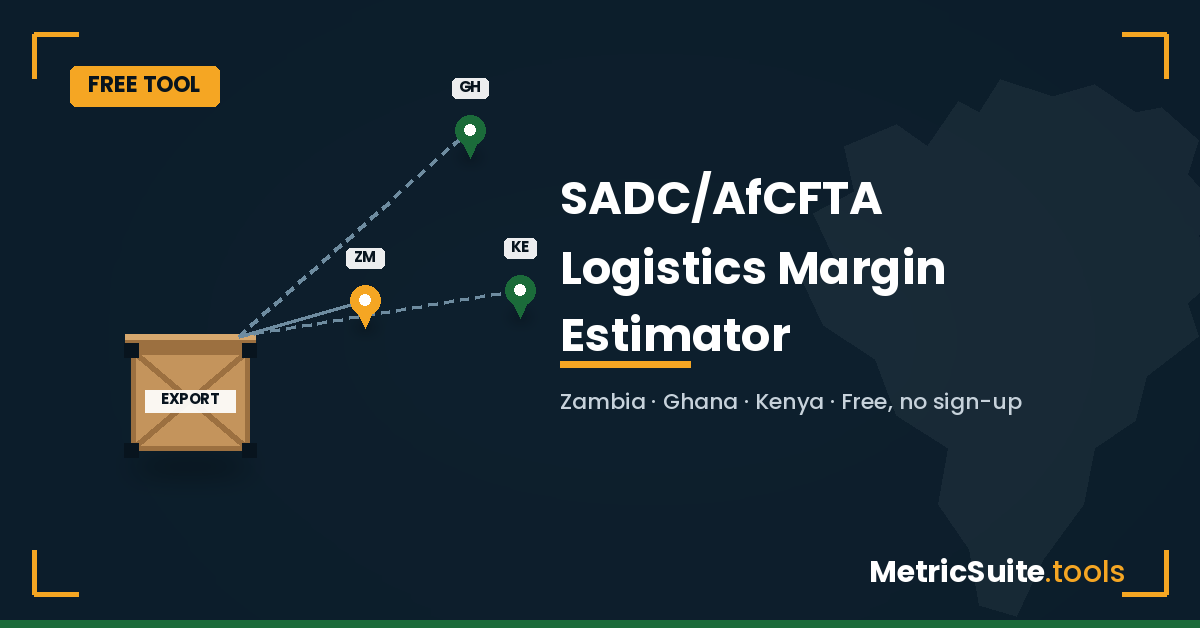
A Johannesburg manufacturer quotes a Zambian buyer and a Ghanaian buyer the same margin on the same product, assuming both markets work the same way under “African free trade.” They don’t. Zambia has been duty-free for South African goods since 2000 under the SADC Trade Protocol. Ghana has no such history with South Africa at all, no SADC, no COMESA, nothing until AfCFTA preferential trade actually started between the two countries in January 2024, and even now, not every product gets the same rate.
Use the free SADC/AfCFTA Logistics Margin Estimator at MetricSuite.tools to calculate this instantly, no signup required. Enter your cost of goods, freight, insurance, and target margin, and see the minimum export price for Zambia, Ghana, or Kenya side by side.
SADC/AfCFTA Logistics Margin Estimator
Minimum viable export price from South Africa into Zambia, Ghana, or Kenya.
Get an actual quote from your transporter or freight forwarder.
Typical marine cargo cover runs 0.3%–1.5% of insured value.
SADC Certificate of Origin gives duty-free entry into Zambia.
The minimum margin you need on the export price, not on cost.
How to Use This Calculator
- Pick your destination. Zambia, Ghana, and Kenya sit under genuinely different trade regimes relative to South Africa, the calculator adjusts its guidance for each.
- Enter your actual freight quote. This tool doesn’t estimate shipping cost for you, get a real number from your transporter or freight forwarder and enter it directly. Reference benchmarks are shown as hints, not substitutes for a quote.
- Set your insurance and duty rates. Marine cargo insurance typically runs 0.3%–1.5% of CIF value. Duty depends entirely on your destination and product, the tool explains which regime applies but won’t guess your rate for you.
- Read the minimum viable price, not just the landed cost. The final figure already includes your target margin, it’s the floor price below which the deal stops being worth doing.
Why This Matters
With export policy tightening some of South Africa’s traditional markets, regional African trade has become one of the more actively discussed growth paths for South African exporters heading into 2026. But “AfCFTA” isn’t one uniform system that suddenly makes all of Africa duty-free, and treating it that way leads to pricing mistakes.
Zambia is the easy case. South Africa and Zambia have traded under the SADC Trade Protocol since 2000, more than two decades before AfCFTA existed. A valid SADC Certificate of Origin still gets qualifying goods into Zambia duty-free, and that has nothing to do with AfCFTA at all.
Ghana and Kenya are a different story entirely. Neither shares a regional trade bloc with South Africa, no SADC, no COMESA, no EAC overlap. AfCFTA is the only mechanism that can give South African goods preferential treatment in either market, and South Africa only started trading preferentially with them on 31 January 2024, once SARS gazetted the tariff schedule covering roughly 90% of the tariff book. That’s real and active, but it’s not automatic 0% across the board, some tariff lines are still phasing down, and a small share are excluded from preferential treatment entirely. Pricing a Ghana or Kenya export as if it carries the same duty treatment as a Zambia shipment is a specific, avoidable mistake.
Freight adds its own complication. Intra-African sea freight is often less direct and more expensive than shipping from Asia, since fewer carriers run direct African coastal routes. A consolidated Durban-to-West Africa sea freight service can run in the region of R53/kg all-in with three to four weeks transit, numbers worth having in mind before assuming regional shipping is automatically the cheap option just because it’s shorter on a map.
Key Takeaways
- Zambia trades duty-free with South Africa under the SADC Trade Protocol, in force since 2000, unrelated to AfCFTA.
- Ghana and Kenya have no SADC, COMESA, or EAC overlap with South Africa. AfCFTA, active since 31 January 2024, is the only preferential mechanism for either market.
- AfCFTA preferential treatment currently covers roughly 90% of South Africa’s tariff book, not every product qualifies for 0%, confirm your HS code’s actual phase-down status.
- Duty is calculated on CIF value (goods plus freight plus insurance), not on the goods value alone.
- Intra-African shipping is often less direct and pricier than expected, get an actual freight quote rather than assuming proximity means cheap.
FAQ
Is AfCFTA the same thing as SADC for South African exporters?
No. SADC is an older, separate regional agreement that already gives South Africa duty-free trade with fellow SADC members like Zambia. AfCFTA is a continent-wide agreement that matters most for markets South Africa has no existing regional bloc with, like Ghana and Kenya. South Africa continues trading with SADC members under the SADC Trade Protocol rather than switching them to AfCFTA.
When did South Africa actually start trading preferentially with Ghana and Kenya?
31 January 2024, following SARS’s gazetting of the tariff schedule under the AfCFTA Guided Trade Initiative framework. Before that date, South African goods entering Ghana or Kenya faced standard, non-preferential duty rates.
Does AfCFTA mean 0% duty on everything I export to Ghana or Kenya?
No. The current preferential schedule covers roughly 90% of South Africa’s tariff book, with the remainder either still phasing down over several years or excluded from preferential treatment entirely. Check your specific product’s HS code status rather than assuming a blanket 0% rate.
Why does the calculator ask for a freight quote instead of estimating it?
Because shipping cost varies enormously by route, carrier, cargo type, and current market conditions, especially for intra-African sea freight where direct services are limited. An estimate confident enough to price a deal on needs to come from an actual forwarder quote, not a generic distance-based formula.
What’s a reasonable margin to target on a new export market?
That depends heavily on your industry and risk tolerance, this tool doesn’t recommend a number. What it does is make sure whatever margin you choose is calculated on the full landed cost, duty included, not just on your production cost, which is where many exporters underprice without realizing it.
Sources
- The dtic — AfCFTA
- tralac Trade Law Centre — South Africa’s Participation in the Guided Trade Initiative of the AfCFTA
- trade.gov — Ghana AfCFTA December 2025 Update
- MacMap — AfCFTA Rules of Origin and Regional Economic Communities
Need Help With Export Documentation or Clearing?
Find verified export consultants and clearing agents on Fiverr.