
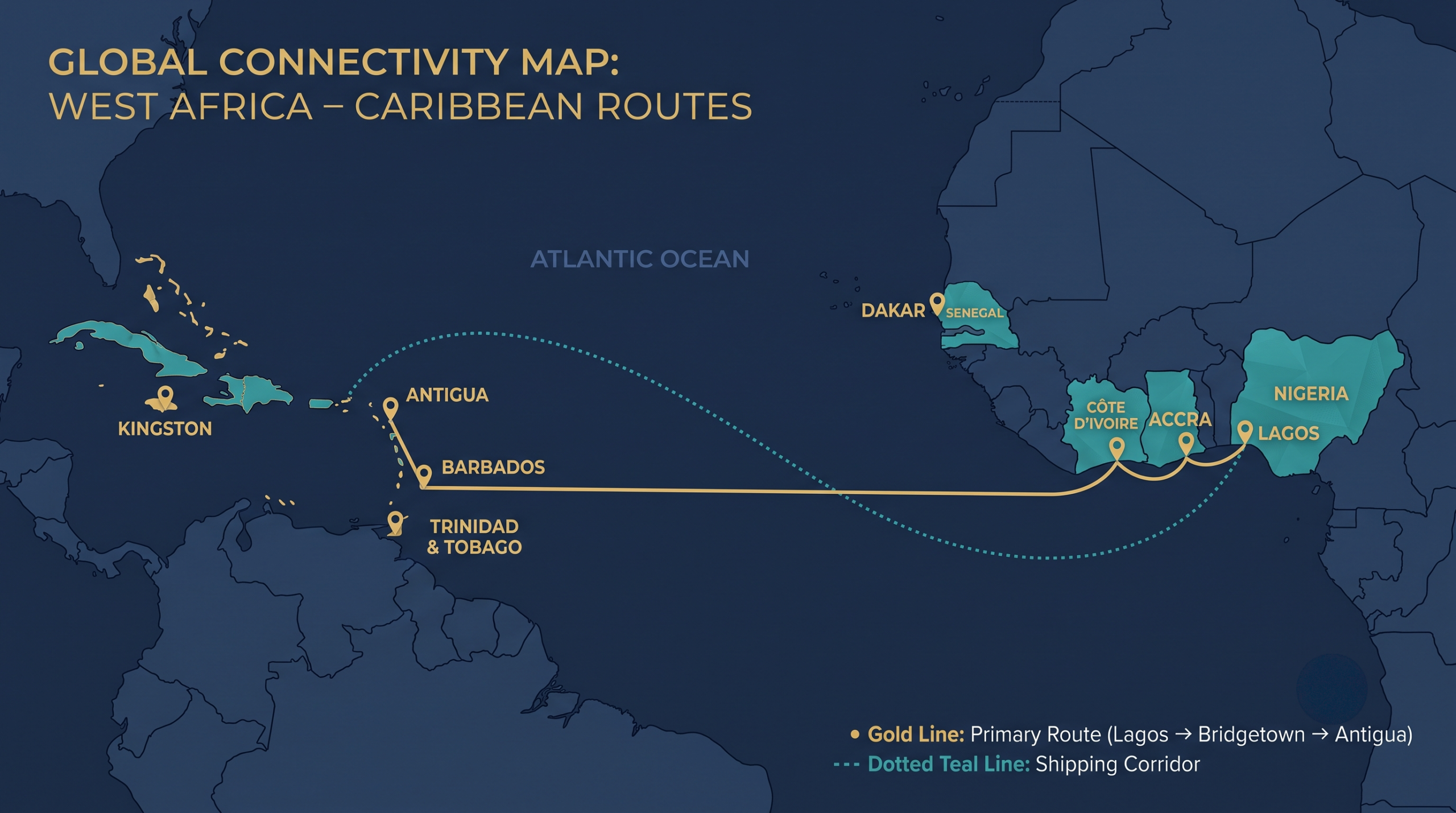
On May 24, 2026, a Boeing 777 carrying 284 passengers left Lagos and landed in Bridgetown, Barbados. It was the first scheduled commercial flight ever to connect West Africa directly to the Caribbean. Air Peace, Nigeria’s largest carrier, now operates the route twice monthly, continuing on to Antigua before returning. The airline has also acquired LIAT, the Caribbean’s own regional carrier, giving it actual distribution across the islands rather than a single long-haul route ending at one airport.
That flight is a small thing on its own. What it represents is not. For two regions with a shared history running through the transatlantic slave trade, and a combined population approaching 1.5 billion people, West Africa-Caribbean trade currently totals just US$729 million a year, according to joint research by the International Trade Centre and the African Export-Import Bank (Afreximbank). Neither region has ever sent more than 6% of its exports to the other in the past decade. This is what economists call a gravity model failure: two markets with real complementary needs, historical ties, and diaspora demand, trading at a fraction of what geography and culture alone would predict, largely because the infrastructure connecting them barely exists.
MetricSuite.tools was built for exactly this kind of gap. The platform already runs free import duty calculators for six African markets and four CARICOM economies, plus multi-currency pricing tools that convert cleanly across both regions. As West Africa-Caribbean trade grows past its current $729 million base, the businesses moving first will need to price shipments, convert currencies, and calculate landed costs across corridors that didn’t meaningfully exist a year ago. That’s the gap these tools are built to close.
Need a Freelancer for This?
Hire verified talent on Fiverr — starting from $5. No contracts, no hassle.
Browse Fiverr Freelancers →Why Trade Has Stayed This Small
The concentration of what little trade does happen tells the real story. More than half of Africa’s exports to the Caribbean are mineral products, with crude oil alone accounting for US$232 million, 27% of the total. On the other side, a single Trinidadian product, anhydrous ammonia fertilizer, makes up nearly half of everything the Caribbean sells to Africa: US$423 million, 49% of total exports. Strip out oil and fertilizer, and there is almost no bilateral trade left to speak of.
This is not a demand problem. It is a connectivity and finance problem. Until May 2026, no airline flew directly between the two regions. Ocean freight between West African ports and Caribbean ports typically routes through Europe or North America, adding weeks and cost to any shipment. Cross-border payments between an African naira or cedi account and a Caribbean dollar account have historically had to pass through US dollar correspondent banking, adding fees and delay to transactions that should, in principle, be straightforward. A 2025 Afreximbank-ITC communique explicitly named these as the structural barriers: inadequate transportation, limited access to trade finance, and regulatory misalignment.
What’s Actually Changing West Africa-Caribbean Trade
Three things have shifted in the past 18 months, and together they matter more than the flight alone.

First, the money. Afreximbank has raised its financing commitment to CARICOM from US$3 billion to US$5 billion, with more than US$700 million already deployed and a further US$2 billion in the pipeline. The bank opened a permanent CARICOM office in Barbados roughly two years ago and is building an African Trade Centre there. Jamaica became the thirteenth CARICOM state to join Afreximbank’s Establishment Agreement in 2025, giving its businesses direct access to that financing.
Second, the payment rails. Afreximbank and CARICOM central banks are jointly developing the CARICOM Payment and Settlement System (CAPSS), designed to link with Afreximbank’s existing Pan-African Payment and Settlement System (PAPSS). Once integrated, a business in Accra should be able to pay a supplier in Kingston in local currencies, without routing every transaction through the US dollar. This is the kind of unglamorous financial plumbing that usually matters more to trade volumes than any trade agreement, and it has been largely missing between these two regions until now.
→ Use the free Multi-Currency Pricing Calculator at MetricSuite.tools to calculate this instantly, no signup required.
Third, the forums and deals. The AfriCaribbean Trade and Investment Forum (ACTIF), running annually since 2022, has moved from talk to transactions: the 2024 edition in Nassau produced deals and memoranda of understanding worth more than US$4 billion, and the 2025 edition in Grenada added a further US$300 million across infrastructure, manufacturing, logistics, and agribusiness. The forum’s own 2025 communique called for an Africa-Caribbean Free Trade Arrangement and committed both sides to fast-tracking direct air and maritime links, air being the one now delivered.
What Still Doesn’t Exist
An honest accounting has to note what has not changed. There is still no direct maritime shipping route between West Africa and the Caribbean, meaning bulk cargo, the kind that actually moves large trade volumes, still has no direct path. The ITC’s own projection of US$1.8 billion in annual trade by 2028 depends explicitly on value addition, trade facilitation, and improved logistics materializing, not on political goodwill alone. And a single Nigerian airline running one route twice a month is a beginning, not an infrastructure.
Five Businesses Worth Building on This Corridor
Given where the gaps actually are, rather than where the enthusiasm is loudest, five categories stand out.
Heritage and diaspora tourism. Air Peace itself has framed the route partly around reconnecting Caribbean descendants with West African ancestry, and Ghana’s “Year of Return” tourism initiative already proved the demand exists at scale. A tour operator building a two-way circuit, Cape Coast and Elmina castles in Ghana paired with historical sites in Barbados or Jamaica, has a real, sourced customer base and a new direct flight to build the itinerary around.
→ Use the free Trip Budget & FX Burn-Rate Planner at MetricSuite.tools to calculate this instantly, no signup required.
West African food exports to the Caribbean. Cassava, plantain, palm oil, and shea butter all have existing Caribbean demand, and the drink Nigerians and Ghanaians know as zobo or bissap is the same hibiscus infusion Jamaicans call sorrel, sold under different names to markets that have never traded directly with each other.
Caribbean rum and spirits into West African markets. Nigeria alone has a large, growing consumer spirits market, and Caribbean rum brands currently have almost no direct distribution into it. The cargo capacity on the new Lagos route is real, even if underused for freight so far.
Trade and payments facilitation services. As CAPSS and PAPSS integration rolls out, businesses on both sides will need help navigating new payment rails, customs documentation, and duty calculations for a corridor neither side has much institutional experience with yet. This is a genuine consulting and services gap, not a hypothetical one.
Beauty, textiles, and creative goods. Afreximbank and the ITC have both named textiles and creative industries as shared strengths, and African-made shea butter, black soap, and hair care products already sell well in Caribbean beauty supply markets, often via European or American intermediaries rather than direct trade.
The Real Constraint Is Still Information
None of these five ideas require inventing new demand. The demand is documented in the ITC and Afreximbank’s own research. What has been missing is a direct route, a way to move money, and businesses willing to be early. The flight solved the first problem in May 2026. The payment infrastructure is being built now. The businesses have to solve the third one themselves.
Key Takeaways
- Direct Africa-Caribbean trade in goods is worth just US$729 million a year, concentrated almost entirely in African crude oil and Trinidadian fertilizer.
- The International Trade Centre projects this could reach US$1.8 billion annually by 2028 if logistics and trade facilitation improve.
- Air Peace’s Lagos-Barbados-Antigua route, launched May 24, 2026, is the first-ever scheduled direct flight between West Africa and the Caribbean.
- Afreximbank has raised its CARICOM financing commitment to US$5 billion and is building payment infrastructure (CAPSS) to link with its existing PAPSS system across Africa.
- Direct maritime shipping between the two regions still does not exist, which remains the biggest structural gap for bulk trade.
How much trade currently happens between West Africa and the Caribbean?
Total bilateral trade in goods between Africa and the Caribbean is about US$729 million a year, according to joint International Trade Centre and Afreximbank research, concentrated heavily in crude oil exports from Africa and fertilizer exports from Trinidad and Tobago.
Is there a direct flight between West Africa and the Caribbean now?
Yes. Air Peace launched the first-ever scheduled direct service between Lagos, Nigeria and Bridgetown, Barbados on May 24, 2026, continuing to Antigua, operating twice monthly.
What is CAPSS and why does it matter for trade?
CAPSS, the CARICOM Payment and Settlement System, is being developed by Afreximbank and CARICOM central banks to link with Africa’s existing PAPSS payment system, allowing businesses to settle cross-border payments in local currencies instead of routing everything through US dollar correspondent banks.
Why has Africa-Caribbean trade stayed so small despite shared history?
Primarily a lack of infrastructure: no direct shipping routes, no direct flights until 2026, and cross-border payment friction, rather than a lack of underlying demand for goods and services between the two regions.
What sectors do Afreximbank and the ITC consider the strongest opportunities?
Agriculture and agribusiness, tourism, energy, manufacturing, creative and cultural industries, financial services, and logistics are the sectors most consistently named across ACTIF forums and joint research.
Sources & References
- International Trade Centre and Afreximbank, Annual Africa-Caribbean Trade Could Reach US$1.8 Billion by 2028 (trade volume data, 2028 projection)
- Afreximbank, Fourth AfriCaribbean Trade and Investment Forum Communique, Grenada, July 2025 (structural barriers, deal values, forum outcomes)
- Time Africa, The Rise of Global Africa: Why Afreximbank Is Betting Billions on the Caribbean (CARICOM financing figures, Jamaica’s Afreximbank accession)
- ThisDayLive, Boosting Trade with West Africa-Caribbean Connectivity (Air Peace route details, Afreximbank involvement)
- Travel And Tour World, Air Peace Makes History with Lagos to Barbados Flights (flight launch details, LIAT acquisition)