Importing From China to Kenya: 6 Business Ideas for 2026
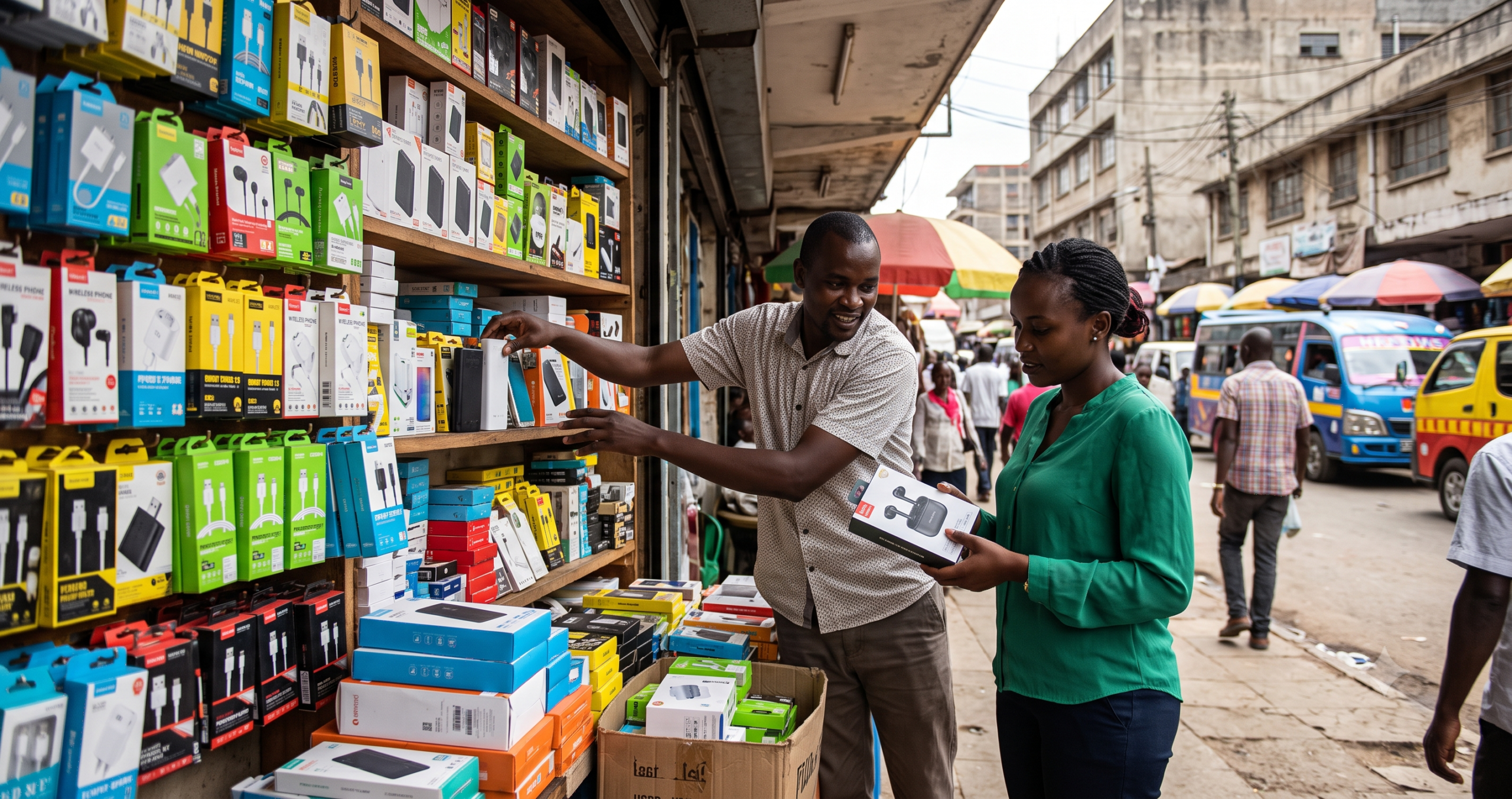
A trader on River Road in Nairobi CBD unpacks a fresh carton of phone chargers and earphones fresh off the SGR from Mombasa. She paid a supplier in Guangzhou in dollars, paid Kenya Revenue Authority in shillings, and now she is about to find out whether the math actually worked. That gap, between what you pay in China and what you can sell for in Nairobi, Kisumu, or Eldoret, is where most new importers either make a healthy margin or quietly lose money without noticing.
China is Kenya’s single largest source of imports. In the first nine months of 2025, Kenya’s imports from China reached roughly KSh 489 billion, according to Kenya National Bureau of Statistics data reported by local business press, and the country’s trade deficit with China kept widening as demand for machinery, electronics, and manufactured goods grew. That scale of trade is not just a macro statistic. It is the same supply chain that stocks Gikomba, Eastleigh, and River Road every week, and it is open to a first time importer with a few hundred dollars just as much as it is to a large distributor.
Before you place an order, you need to know your landed cost, not just your supplier’s quoted price. → Use the free Kenya Import Duty Calculator at MetricSuite.tools to calculate this instantly, no signup required.
Need a Freelancer for This?
Hire verified talent on Fiverr — starting from $5. No contracts, no hassle.
Browse Fiverr Freelancers →How Kenya taxes a shipment from China. Every general cargo import into Kenya is charged against its CIF value (cost, plus freight, plus insurance), not the price you agreed with your supplier. Import duty follows the East African Community Common External Tariff, with bands of 0%, 10%, 25%, or 35% depending on the product’s HS code. On top of duty, KRA charges VAT at 16% (on CIF plus duty), an Import Declaration Fee (IDF) of 2.5% of CIF, and a Railway Development Levy (RDL) of 2% of CIF, which funds the Mombasa to Nairobi railway. The figures below use these current rates, but your exact HS code determines your final duty band, so treat them as planning estimates rather than a KRA assessment.
The six businesses below are chosen because each one has a real, sourced market signal behind it in Kenya specifically, not a generic import idea copied from elsewhere.
1. Phone and Electronics Accessories: The Easiest Way Into Importing From China to Kenya
Why it works: Kenya now has 93 smartphones for every 100 phones in active use, and mobile money penetration sits at roughly 98% of adult mobile users, according to industry data reported by Techweez. Entry level Android phones now retail from under KES 5,000, and every one of those phones needs a charger, a case, a screen protector, or a power bank within months.
Startup cost (illustrative, general goods at 25% duty):
- Goods (FOB): $500
- Freight to Mombasa or JKIA: $100
- CIF value: $600
- Duty (25%), IDF (2.5%), RDL (2%), VAT (16%): roughly $297 combined
- Total landed cost: about $897 (approx. KES 116,100 / NGN 1,233,000 / GHS 10,080 / ZAR 14,670 / XOF 518,400)
→ Use the free Shipping Cost Estimator at MetricSuite.tools to calculate this instantly, no signup required, for your specific route and mode.
60 to 90 day scenario: Selling 300 to 400 accessory units at a 45% to 60% retail markup through a River Road stall or WhatsApp catalogue typically clears the landed cost within the first six to eight weeks, with the remaining weeks pure margin if stock turns.
First steps:
- Source three quotes on Alibaba for the same SKU before committing
- Confirm your HS code and duty band with a licensed clearing agent before shipping
- Start with a courier or LCL shipment, not a full container, until you know your sell through rate
2. Solar and Off Grid Power Kits
Why it works: Kenya is the most mature, largest market globally for plug and play off grid solar, according to the Global Off Grid Lighting Association (GOGLA), and the government exempts solar equipment from import duty entirely. Pay as you go financing, pioneered in Kenya, lets rural households buy a solar kit for a small deposit and daily mobile money payments.
Startup cost (0% duty, solar equipment exemption applies):
- Goods (FOB): $700
- Freight: $150
- CIF value: $850
- Duty: $0. IDF (2.5%), RDL (2%), VAT (16% of CIF): roughly $174 combined
- Total landed cost: about $1,024 (approx. KES 132,225 / NGN 1,404,250 / GHS 11,480 / ZAR 16,708 / XOF 590,400)
60 to 90 day scenario: A batch of 20 to 25 solar lantern or home system units, sold through agro dealers or church and chama networks in peri urban and off grid counties, typically sells through in 8 to 10 weeks at 30% to 40% margin, since the duty exemption keeps your landed cost close to FOB.
First steps:
- Confirm your specific product falls under the solar equipment duty exemption before ordering
- Partner with an existing PAYGo agent network rather than building collections infrastructure from scratch
- Stock phone charging lanterns first. They have the widest household appeal and fastest turnover
3. Boda Boda Spare Parts and Accessories
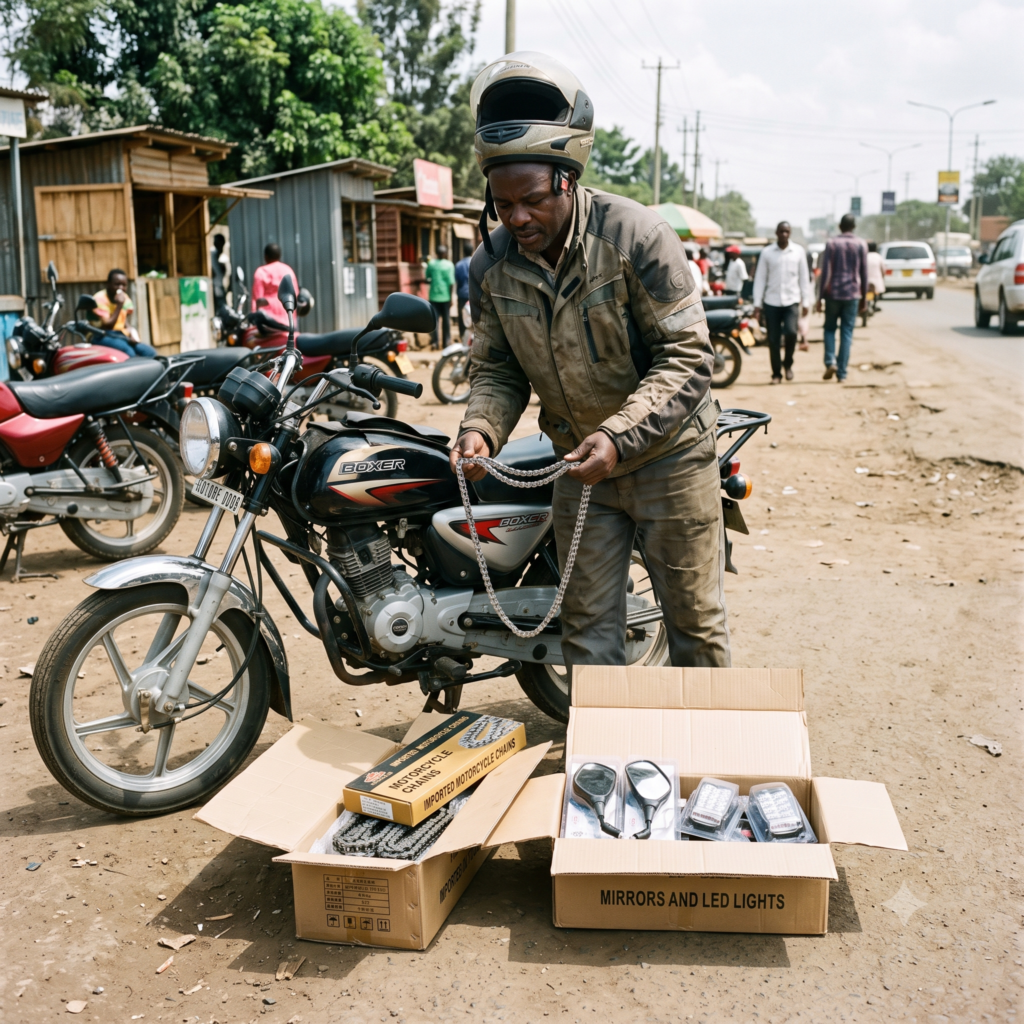
Why it works: Kenya’s boda boda sector counts roughly 2.4 million registered motorcycles and contributes an estimated 4.4% of national GDP, according to industry data cited by local press. New motorcycle registrations more than doubled in 2025 to 145,714 units in eleven months, per Kenya National Bureau of Statistics data, and every one of those bikes needs chains, tyres, lights, and mirrors within its first year.
Startup cost (completely knocked down parts, 10% duty band):
- Goods (FOB): $600
- Freight: $120
- CIF value: $720
- Duty (10%), IDF (2.5%), RDL (2%), VAT (16%): roughly $231 combined
- Total landed cost: about $951 (approx. KES 122,550 / NGN 1,301,500 / GHS 10,640 / ZAR 15,485 / XOF 547,200)
60 to 90 day scenario: Fast moving parts (chains, brake pads, mirrors, LED lights) sold to boda boda stages and small garages at a 50% to 70% markup typically turn over in four to six weeks, making this one of the faster cash cycles on this list.
First steps:
- Confirm your HS code qualifies for the 10% parts band rather than the 25% built up unit rate
- Build relationships directly with two or three boda boda stages before you order stock
- Stock consumables (chains, brake pads, bulbs) over big ticket parts for faster turnover
4. Beauty, Hair Extensions, and Cosmetics
Why it works: Kenya’s beauty and personal care market generated an estimated $2.3 billion in revenue in 2024, with a projected annual growth rate of 6.36% through 2029, according to Statista. Social media driven demand, particularly through Instagram and TikTok, is pulling more of that spend toward River Road and Eastleigh wholesale wig and extension suppliers.
Startup cost (finished cosmetic goods, 25% duty band):
- Goods (FOB): $400
- Freight: $100
- CIF value: $500
- Duty (25%), IDF (2.5%), RDL (2%), VAT (16%): roughly $248 combined
- Total landed cost: about $748 (approx. KES 96,750 / NGN 1,027,500 / GHS 8,400 / ZAR 12,225 / XOF 432,000)
60 to 90 day scenario: A mixed batch of wigs, closures, and cosmetics sold retail through Instagram and a salon partnership typically clears landed cost within 6 to 8 weeks at a 60% to 100% markup on individual items, since unit prices are high relative to weight and shipping cost.
First steps:
- Order physical samples before committing to a bulk wholesale order
- Partner with one or two salons for consignment placement rather than only relying on social media sales
- → Use the free AfCFTA Tariff Lookup at MetricSuite.tools to check whether any component parts qualify for preferential rates if sourced regionally
5. Kitchenware and Household Plastics
Why it works: Plastics and articles are already among Kenya’s top import categories from China by value, according to trade data compiled by Export Genius, reflecting steady demand from markets like Gikomba and Kamukunji for affordable household basics: storage containers, basins, buckets, and kitchenware.
Startup cost (general household goods, 25% duty band):
- Goods (FOB): $350
- Freight: $100
- CIF value: $450
- Duty (25%), IDF (2.5%), RDL (2%), VAT (16%): roughly $223 combined
- Total landed cost: about $673 (approx. KES 87,075 / NGN 924,750 / GHS 7,560 / ZAR 11,003 / XOF 388,800)
60 to 90 day scenario: Household plastics sold by the piece or in bulk lots to Gikomba stall holders typically move at thinner margins (20% to 35%) but very fast volume, often clearing a first order within 4 to 6 weeks through repeat wholesale buyers.
First steps:
- Start with a small, varied sample lot to see which SKUs move fastest in your specific market
- Negotiate wholesale terms with two or three Gikomba stall holders before your first full order
- Budget for breakage and damaged stock, which is common with plastics on sea freight
Need Help Setting Up?
Get an Import & Finance Pro on Fiverr
Hire vetted freelancers to handle sourcing research, landed cost spreadsheets, bookkeeping, and business registration, for your China to Kenya import business. Starting from $5.
Browse Finance & Business Pros on Fiverr →Affiliate link, MetricSuite may earn a commission at no extra cost to you.
6. Baby Products and Children’s Essentials
Why it works: Children under 15 make up around 39% of Kenya’s population, according to the 2019 census analysis published with support from KNBS and UNFPA, underpinning steady, recurring demand for baby clothing, feeding items, and infant essentials in a market that is only growing more urban.
Startup cost (finished baby goods, 25% duty band):
- Goods (FOB): $450
- Freight: $100
- CIF value: $550
- Duty (25%), IDF (2.5%), RDL (2%), VAT (16%): roughly $272 combined
- Total landed cost: about $822 (approx. KES 106,425 / NGN 1,130,250 / GHS 9,240 / ZAR 13,448 / XOF 475,200)
60 to 90 day scenario: Baby clothing and feeding accessories sold through a WhatsApp Business catalogue and school gate or clinic partnerships typically clear landed cost within 8 to 10 weeks at a 40% to 55% markup, with repeat buyers driving most of the later weeks’ revenue.
First steps:
- Check labelling and safety standards for feeding items with the Kenya Bureau of Standards before importing
- Track your real profit per item, not just revenue, from the first sale
- → Use the free Social Commerce Profit Tracker at MetricSuite.tools to see your actual margin per platform
Conclusion
Importing from China to Kenya rewards traders who calculate before they order, not after. Every business above depends on the same discipline: know your CIF value, know your duty band, and know your total landed cost before you wire a deposit to a supplier in Guangzhou or Yiwu.
Pick one business from this list, run the numbers on a small first order, and treat it as a test rather than a bet. → Use the free Kenya Import Duty Calculator at MetricSuite.tools to calculate this instantly, no signup required, before you place your next order.
Key Takeaways
- China supplied roughly KSh 489 billion in imports to Kenya in the first nine months of 2025, making it the country’s largest single import source.
- Kenya charges import duty (0%, 10%, 25%, or 35% by HS code), 16% VAT, a 2.5% IDF, and a 2% RDL, all calculated on CIF value.
- Solar equipment is fully exempt from import duty, which materially improves margins for the off grid power business.
- Boda boda spare parts benefit from a lower 10% duty band when imported as completely knocked down parts rather than built up units.
- Calculating landed cost before ordering, not after, is the single biggest factor separating profitable importers from those who lose margin without noticing.
How much money do I need to start importing from China to Kenya?
A realistic first order runs from about KES 87,000 (household plastics) to KES 132,000 (solar kits), including goods, freight, duty, and clearing. Start with a sample lot rather than a full container.
What is the cheapest way to ship goods from China to Kenya?
Sea freight through Mombasa is cheapest for bulky or heavy cargo. Air freight or courier is worth the extra cost only for light, high value goods like electronics accessories or hair extensions.
How is import duty calculated in Kenya?
Duty is charged on the CIF value (cost, insurance, and freight), using EAC Common External Tariff bands of 0%, 10%, 25%, or 35% depending on your product’s HS code, plus 16% VAT, a 2.5% IDF, and a 2% RDL.
Do I need a registered business to import into Kenya?
Small consignments can clear informally, but a KRA PIN and, for repeat or larger imports, a registered business make clearing faster and let you reclaim VAT where applicable.
Which Chinese platform is best for a first time Kenyan importer, Alibaba or 1688?
Alibaba is English language and supports international payment, which is safer for beginners. 1688 is often cheaper but Chinese only and harder to pay, so most first time Kenyan importers start on Alibaba.
This article is general business information, not financial or legal advice.
References
- Kenya National Bureau of Statistics trade data, via Eastleigh Voice: https://eastleighvoice.co.ke/business/268147/kenyas-trade-deficit-with-china-widens-to-sh4756-billion-as-imports-surge
- PwC Worldwide Tax Summaries, Kenya, Other Taxes (IDF, RDL, VAT): https://taxsummaries.pwc.com/kenya/corporate/other-taxes
- Pamoja Imports, Kenya import duty from China 2026: https://pamojaimports.com/kenya-import-duty-from-china/
- Business Daily Africa, motorcycle registrations 2025: https://www.businessdailyafrica.com/bd/corporate/shipping-logistics/motorcycle-registrations-overtake-2024-numbers-on-easing-credit-5325722
- Breaking Kenya News, boda boda sector GDP contribution: https://www.breakingkenyanews.com/2026/05/13/average-age-of-kenyans-accessing-boba-boda-credit-is-33-years-report/
- Techweez, Kenya smartphone and mobile money penetration: https://techweez.com/2026/04/07/kenya-smartphones-penetration-feature-phone-decline/
- GOGLA, via TaiyangNews, off grid solar sales 2025: https://taiyangnews.info/business/gogla-off-grid-solar-kit-sales-reach-record-high-2025
- The Progress Playbook, Kenya off grid solar duty exemption: https://theprogressplaybook.com/2024/08/06/how-off-grid-solar-financing-plans-are-expanding-energy-access-in-kenya/
- Statista, Beauty and Personal Care market outlook, Kenya: https://www.statista.com/outlook/cmo/beauty-personal-care/kenya
- Export Genius, Kenya imports from China by product category: https://www.exportgenius.in/kenya-import-china
- KNBS and UNFPA, State of Kenya Population 2020: https://kenya.unfpa.org/sites/default/files/pub-pdf/state_of_kenya_population_report_2020.pdf