
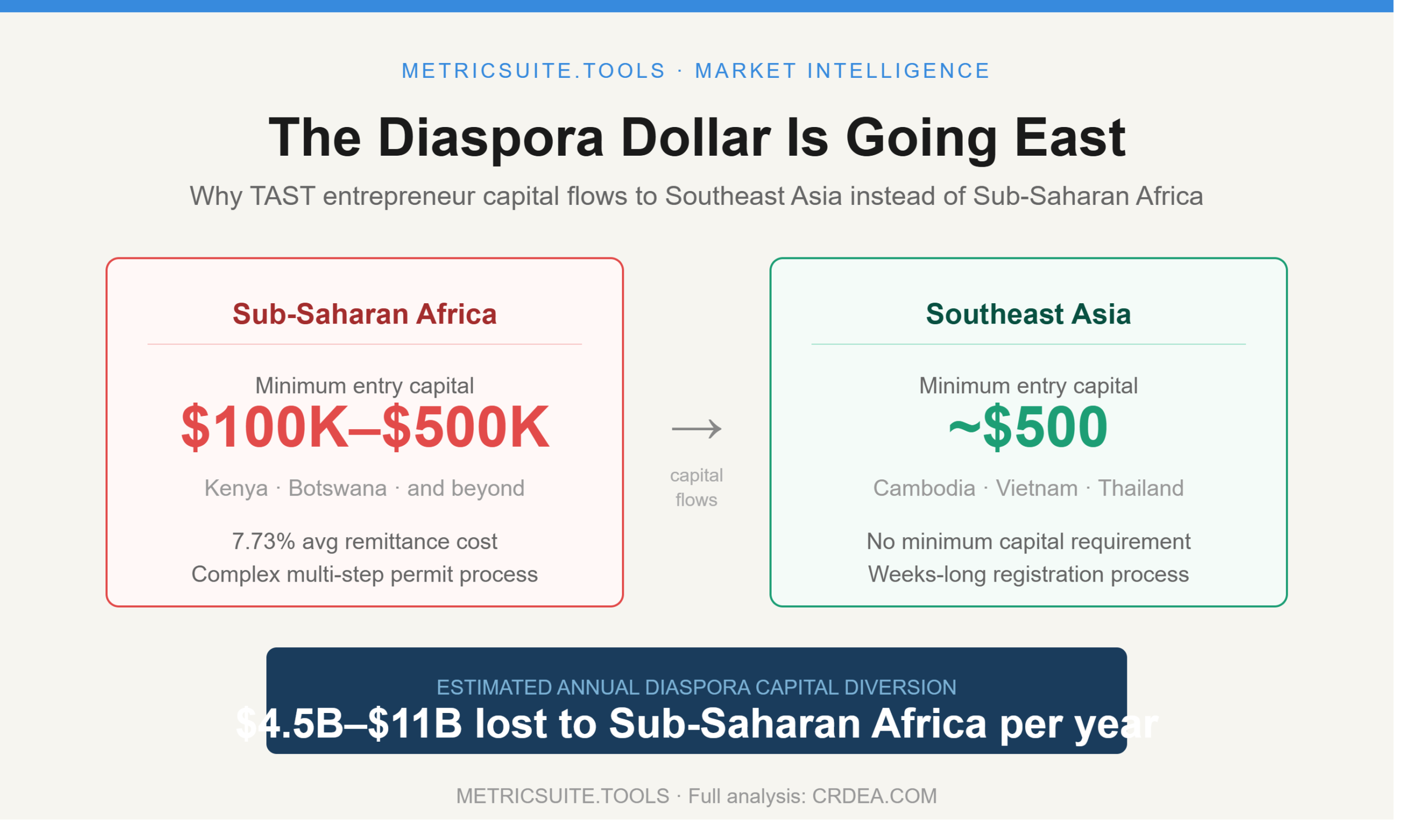
African Markets Are Losing the Diaspora Dollar to Southeast Asia: What the Data Shows
By the MetricSuite Editorial Team
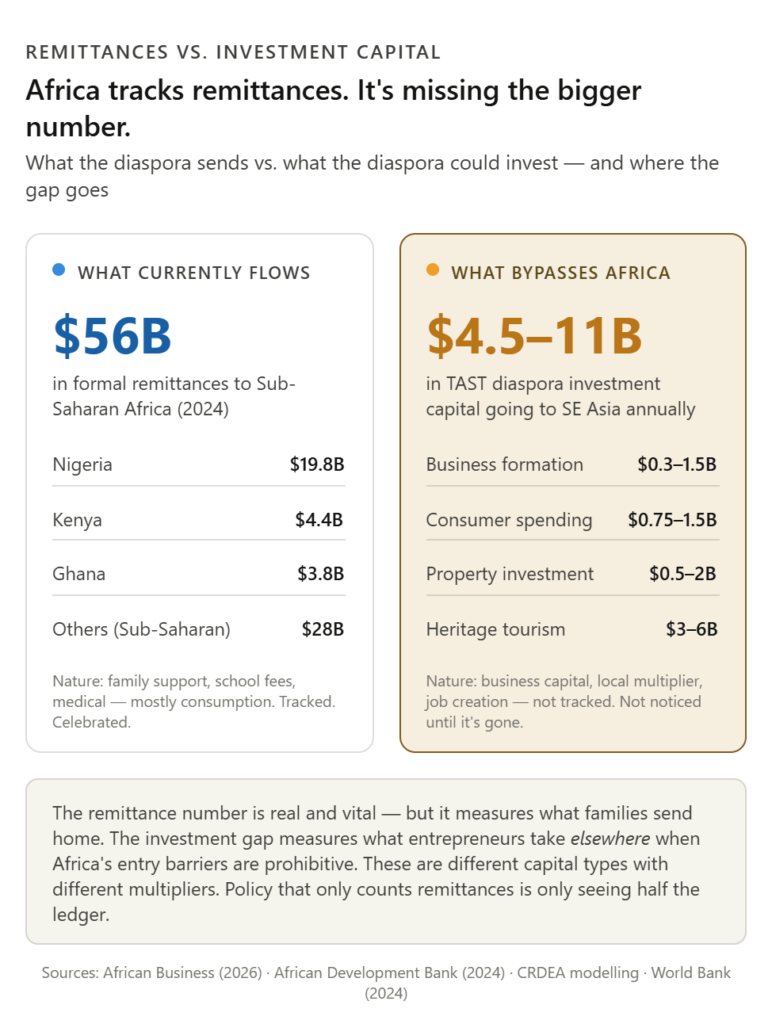
Sub-Saharan Africa received $56 billion in formal remittances in 2024. That figure — which dwarfs foreign direct investment and overseas development aid into the continent — is the most cited proof that the African diaspora is economically engaged with its homeland.
But remittances are family transfers. They pay school fees and hospital bills. They are not, for the most part, business capital.
Need a Freelancer for This?
Hire verified talent on Fiverr — starting from $5. No contracts, no hassle.
Browse Fiverr Freelancers →A separate and largely unmeasured flow is happening simultaneously: TAST descendants — Black Americans, Black Canadians, Black British — who are economically positioned to invest in businesses abroad are choosing Southeast Asia over Sub-Saharan Africa. Not because of sentiment, but because of cost.
For African entrepreneurs, that matters. Here is the data.
The Population Behind the Capital
The descendants of the Transatlantic Slave Trade (TAST) who live in the United States, Canada, and the United Kingdom represent a combined economic bloc that is rarely talked about in African business media:
- Black American buying power: projected at $2.1 trillion by 2026
- Black-owned businesses in the US: approximately 3.12 million, generating $206 billion in annual revenue
- Black entrepreneurs in the US: estimated 5 million, representing 14.5% of the business-owning population
The 1–3% of this population that is actively engaged with the idea of relocating or establishing businesses abroad represents between 550,000 and 1.6 million people with capital, skills, and — critically — a stated preference for Africa that the continent is failing to convert.
Ghana’s Year of Return showed what happens when even a fraction of this group is activated: $1.9 billion into one economy, from one campaign, in one year, from approximately 760,000 visitors.
That was mostly tourism. The investment layer — business formation, property acquisition, local consumer spending — would be larger, and longer-lasting.
The Cost of Entry: Africa vs. Southeast Asia
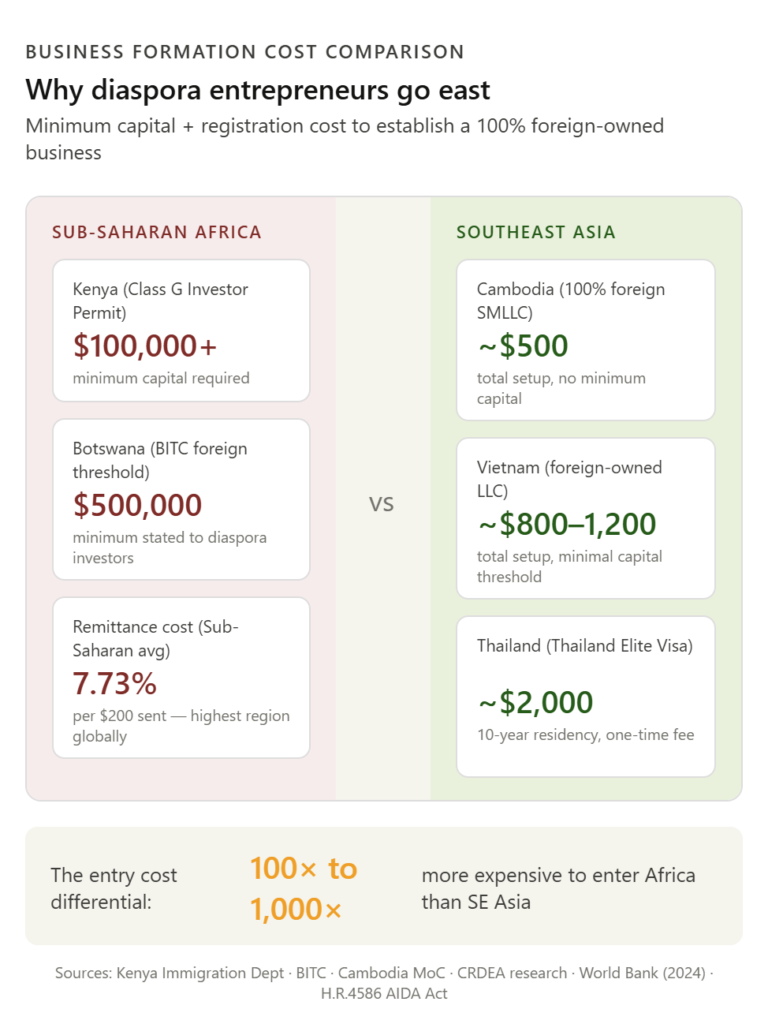
The reason this capital is going east instead of south is not cultural. It is transactional. The cost of establishing a foreign-owned business in Sub-Saharan Africa is substantially higher — and in some cases, prohibitively so — compared to Southeast Asia.
| Jurisdiction | Min. Capital Requirement | Est. Setup Cost | Residency Path |
|---|---|---|---|
| Kenya (Class G) | ~$100,000 (investor permit) | $1,500–$4,000+ | Tied to business |
| Botswana | $500,000 (stated to investors) | $3,000–$6,000+ | Complex |
| Ghana | Reducing (legislation pending) | $1,000–$3,000 | Improving |
| Cambodia | None | ~$500 | 30-day, renewable |
| Vietnam | None for LLC | ~$800–$1,200 | Multi-year business visa |
| Thailand | Minimal | ~$1,000–$2,000 | 10-yr Elite Visa |
Beyond setup, Sub-Saharan Africa remains the most expensive region in the world for sending remittances, averaging 7.73% per transaction vs. 5.97% for Latin America. That friction compounds across every financial interaction an entrepreneur makes.
A TAST entrepreneur with $30,000 in startup capital can launch a legitimate, 100% foreign-owned business in Phnom Penh in a matter of weeks. The same entrepreneur faces a $100,000 threshold just to qualify for an investor permit in Nairobi.
What This Means for African Entrepreneurs
The loss is not only to African governments. It is to African markets.
Conservative estimates of what flows away from Sub-Saharan Africa annually due to this barrier include:
- $3B–$6B in diaspora tourism and heritage travel
- $300M–$1.5B in business formation capital
- $750M–$1.5B in local consumer spending from resident diaspora entrepreneurs
- $500M–$2B in property and real estate investment
Total: $4.5B–$11B per year. Over a decade, the cumulative cost approaches $60–$150 billion.
For African entrepreneurs, the practical implications run in two directions:
The loss: A diaspora returnee who sets up a food manufacturing business in Accra instead of Kuala Lumpur is a potential partner, client, and local employer. When they choose Southeast Asia, they take that economic activity — and those partnerships — with them.
The opportunity: African entrepreneurs who understand this dynamic can position themselves as the bridge. If you run an African SME in hospitality, food production, logistics, or distribution, there is a growing and underserved market of diaspora entrepreneurs trying to figure out how to operate on the continent despite the barriers. Local expertise, local relationships, and local market access are exactly what they need.
The Policy Backdrop
Ghana’s pending legislation to remove minimum capital requirements for foreign-owned businesses signals that some governments are beginning to understand the cost of exclusion. Kenya’s investor permit framework is under active discussion at the policy level, including direct advocacy from coalitions like CRDEA (Coalition for the Repatriation of Descendants of Enslaved Africans).
These shifts, if enacted and marketed effectively, could redirect billions in annual capital flows.
For African SMEs, watching this policy landscape is not academic. It will determine who shows up to do business in your market over the next decade — and whether the substantial TAST entrepreneurial class ends up a partner in the African economy or a competitor from a Southeast Asian base instead.
Read the full policy analysis — including the methodology behind the $60B estimate and CRDEA’s framework for investor permit reform — at [crdea.com/policy-advocacy/tast-diaspora-capital-bypassing-africa].
Data sources: African Development Bank (2024); Ghana Tourism Authority / Year of Return (2019); World Bank Remittance Data (2024); Nielsen/NIQ Black Buying Power (2025); U.S. Congress H.R.4586 AIDA Act; CRDEA policy modelling.
MetricSuite provides free business and financial calculators for African entrepreneurs and global freelancers. Explore our Kenya Import Duty Calculator, Ghana Import Duty Guide, and Africa Business Tools to support your next move.