6 Profitable Businesses You Can Start in Sub-Saharan Africa With $250
Most business advice aimed at African entrepreneurs starts with the assumption that you have a bank account, a credit score, and seed capital measured in the tens of thousands. You do not have time for that conversation. Here is a more useful one: what can you actually build with $250 USD — roughly KES 32,000, NGN 400,000, or GHS 3,800; right now, in your city or town, without a formal loan?
The answer is more than you think. These are not theoretical models, they are businesses that sub-Saharan African entrepreneurs are running profitably today, often alongside a day job, using mobile money, social media, and local market knowledge as their infrastructure.
Why $250 Is a Real Entry Point in Sub-Saharan Africa
The cost structure of African markets creates genuine opportunity for sub-$300 businesses. Informal distribution is still dominant across most of the continent. Consumer trust is built person-to-person. Mobile money has collapsed the need for a bank account or POS terminal. And low formal employment rates mean a massive pool of consumers who also need to earn — making peer-to-peer commerce the default, not the exception.
Need a Freelancer for This?
Hire verified talent on Fiverr — starting from $5. No contracts, no hassle.
Browse Fiverr Freelancers →The six businesses below share four traits: low physical overhead, fast cash conversion cycles, demand that is currency-crisis-resistant, and scalability that does not require external funding to reach your first meaningful income milestone.
1. Mobile Money Float Agent
Start-up cost: $80–$150 | Payback period: 2–4 weeks
In Nigeria, Kenya, Ghana, Tanzania, and Uganda, mobile money agents are a critical piece of financial infrastructure. MTN MoMo, M-Pesa, Airtel Money, and Wave have tens of millions of active users who still need physical cash-in and cash-out points. You earn a commission on every transaction, typically 0.5% to 1.5% of the transaction value.
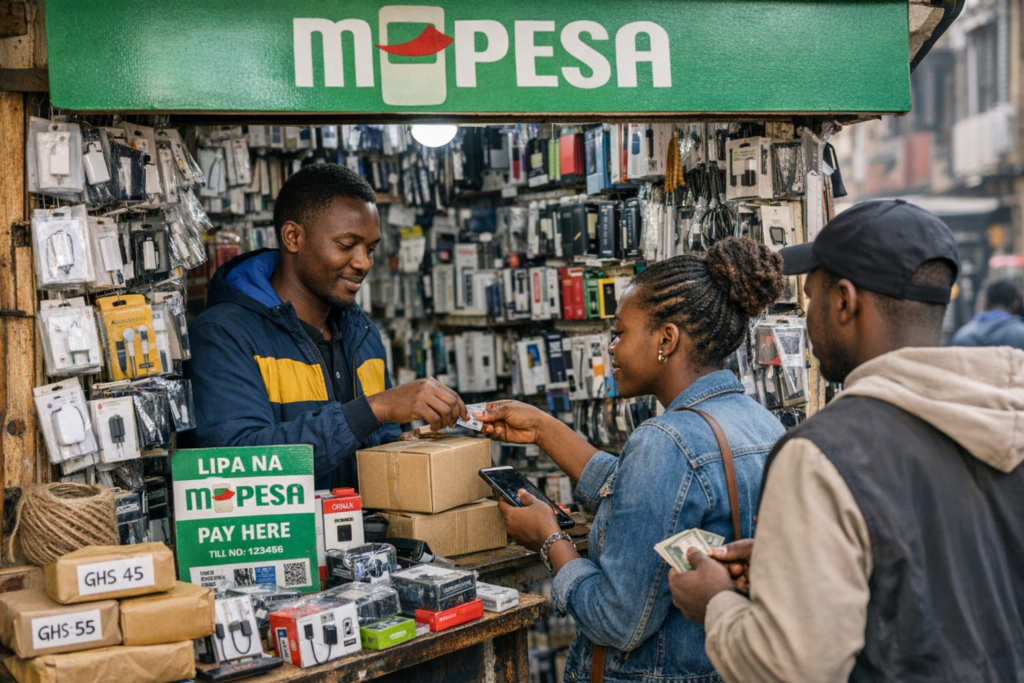
Your $250 goes directly into your float: the cash you keep on hand to convert mobile wallet balances to physical currency and vice versa. A busy agent doing KES 50,000 (roughly $380) in daily transactions in Nairobi can earn KES 500–750 per day in commissions. That is a 15–20% monthly return on float capital, which almost nothing else in financial markets can match.
The risk is float depletion and theft. Keep your float split between your handset wallet and physical cash. Never hold more cash than you can comfortably carry, and register with an established network (not a third-party aggregator) to protect your commissions.
→ Use the free Mobile Money Fees Comparison at MetricSuite.tools to compare commission structures across networks before you choose which one to sign up with — no signup required.
2. WhatsApp and Instagram Reselling (Social Commerce)
Start-up cost: $50–$150 inventory | Payback period: 1–3 weeks
Social commerce is the dominant retail model across West Africa, East Africa, and Southern Africa for entrepreneurs without a physical storefront. You source products cosmetics, clothing, phone accessories, food items from a wholesaler or manufacturer, photograph them, and sell through WhatsApp Broadcast Lists, Instagram, Facebook Marketplace, or TikTok Shop. You collect payment via mobile money and deliver via boda boda, okada, or personal drop-off.
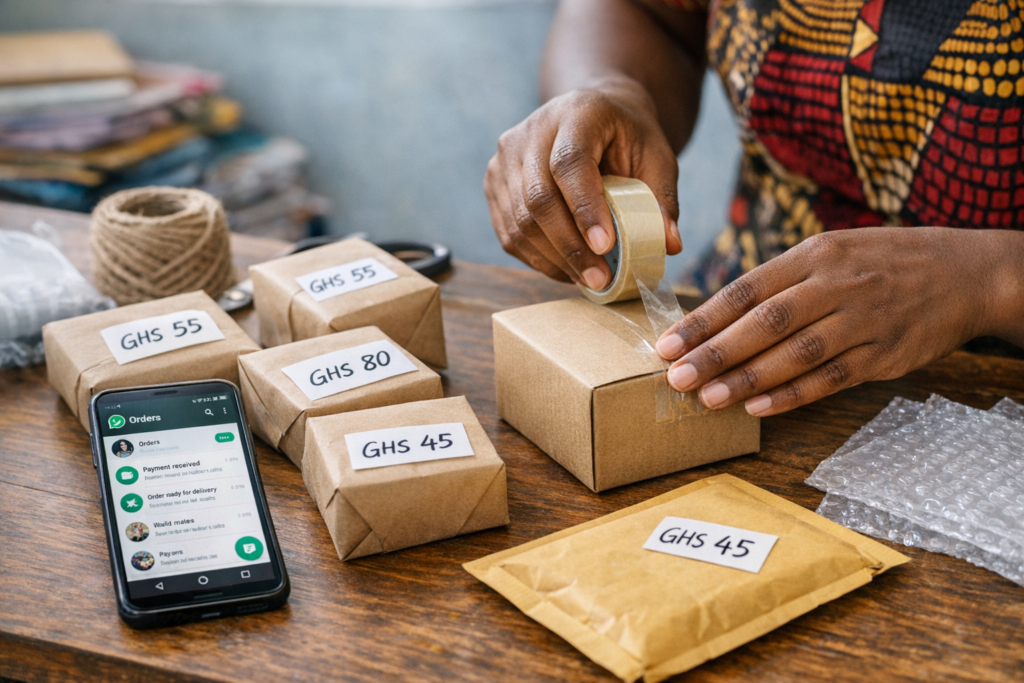
Your gross margins in this model typically run 30–60%, depending on category. Cosmetics and beauty products are the highest-margin entry point in most markets — NGN 5,000 landed cost, NGN 9,000–12,000 retail, with demand that is consistent regardless of the broader economy.
The business fails when entrepreneurs confuse revenue with profit. You must track your landed cost per unit — including transport, packaging, and mobile money transfer fees — to know your actual margin.
→ Use the free Social Commerce Profit Tracker at MetricSuite.tools to track per-product margins and see exactly where your cash is going — no signup required.
3. Phone Screen Protector and Accessories Installation
Start-up cost: $80–$200 | Payback period: 1–2 weeks
Smartphone penetration in sub-Saharan Africa passed 50% in 2023 and is rising. Every one of those phones is a potential customer. Screen protectors, phone cases, charging cables, and earphones are fast-moving, low-perishability goods with strong margins. Installation of screen protectors done properly, without bubbles, is a skill most consumers will pay for rather than risk ruining their screen.
A bulk order of 50 tempered glass screen protectors from a Guangzhou supplier via Alibaba or a local importer in Lagos, Accra, or Nairobi runs $40–$60. You sell and fit each one for the equivalent of $3–$6, giving you 100–200% gross margin. Work a high-foot-traffic location, a market, a transport hub, a university gate and you can turn 20–30 units per day.
The scalability path here is clear: add a second operator, expand to tablet and laptop accessories, and introduce basic phone repair services (screen replacements, charging port cleaning) as your technical skills develop.
4. Produce Arbitrage and Market Trading
Start-up cost: $100–$200 | Payback period: 1 week
Price differentials between farm-gate and urban retail prices across most of sub-Saharan Africa are extraordinary. In Kenya, tomatoes that cost KES 20/kg at a Nakuru farm gate sell for KES 60–80/kg at a Nairobi market stall. In Ghana, plantain bought in Brong-Ahafo for GHS 3/bunch retails in Accra for GHS 10–15. You do not need a truck. You need a reliable supplier relationship, a buyer relationship at the other end, and transport that you can arrange through a cooperative or shared logistics.
This business requires early mornings, physical energy, and tolerance for spoilage risk. But the margin structure — 200–300% from farm gate to retail, is one of the most compelling in any sector accessible without capital or credentials. Start with one commodity in one corridor that you understand intimately. Do not diversify until you have mastered one product’s seasonality, pricing cycles, and spoilage characteristics.
5. Freelance Digital Services (Local Market Focus)
Start-up cost: $0–$100 for tools and data | Payback period: Immediate
The global freelance market is competitive. The African local market for digital services is not — and it is growing fast. Small businesses, churches, schools, political campaigns, and local government offices across Nigeria, Ghana, Kenya, South Africa, and Tanzania need social media management, graphic design (flyers, banners, certificates), data entry, CV writing, and basic website management. They cannot afford an agency. They will hire you.

Your $250 covers a basic laptop repair or upgrade if needed, a data subscription, a Canva Pro subscription ($13/month), and enough airtime to prospect by phone. A single client paying NGN 30,000/month for social media management — well within market rate in Lagos or Abuja — covers your costs and returns profit from week one.
The platform arbitrage opportunity is also real: skills developed locally can be sold internationally on Fiverr, Upwork, or Contra once you have a portfolio. Your local pricing builds your samples; international rates build your income.
→ Use the free Freelance Day Rate Calculator at MetricSuite.tools to set a rate that covers your costs, taxes, and income target — not just what feels “competitive” — no signup required.
Need help getting your business off the ground?
From logo design to bookkeeping to your first website — find affordable African and global freelancers ready to support your business on Fiverr.
Browse Business Freelancers on Fiverr →6. Packaged Food and Homemade Condiments
Start-up cost: $100–$200 | Payback period: 2–4 weeks
Packaged food produced at home or in a shared kitchen is one of the most proven business models for first-generation African entrepreneurs — and it remains viable precisely because consumer preference for known, trusted, local-flavour products is deeply embedded in the culture. Pepper sauce, groundnut paste, kilishi, chin chin, puff puff, zobo, bissap, and fermented porridges like ogi and uji all have existing demand and thin formal competition at the micro-producer level.
Your $250 covers raw materials, basic packaging (pouches or jars, labelled by hand initially), and a few dozen units of product to seed your WhatsApp catalogue. Sell to family, colleagues, churches, and market women first — these are your proving grounds. Once you have consistent reorder behaviour, you have a real product.
Regulatory compliance (NAFDAC in Nigeria, KEBS in Kenya, FDA in Ghana) is your scaling gate, not your starting gate. Build the recipe, build the demand, then register. Most inspectors at the micro-producer level are looking for evidence of seriousness, not a factory.
The One Thing That Kills $250 Businesses
It is not competition. It is not the economy. It is tracking. Entrepreneurs who fail to track cash flow, cost of goods, and actual profit, not just revenue — cannot make decisions. They cannot tell if the business is working. They cannot know when to add a second product, hire a helper, or pivot.
Set up a basic spreadsheet from day one. Use free tools. Know your numbers every single week.
Conclusion: Profitable Businesses in Africa Under $250 Are Real — If You Run Them Like Businesses
The six profitable businesses in this list are not passive income schemes. They are operations that require attention, discipline, and market knowledge. But none of them require a loan, a formal office, or a business partner. Each one can be started this week, in most sub-Saharan African cities and towns, with money you likely already have access to.
Pick one. Start. Track everything. The second $250 is always easier than the first.
Key Takeaways
- A mobile money float agent can earn 15–20% monthly return on $150 in capital in active markets like Nairobi or Accra
- Social commerce via WhatsApp and Instagram offers 30–60% gross margins on beauty and lifestyle products with zero storefront cost
- Produce arbitrage between farm-gate and urban retail prices in Kenya, Ghana, and Nigeria commonly runs 200–300% gross margin
- Freelance digital services require less than $100 in tools and can generate income from day one in local African markets
- Every business on this list depends on cash flow tracking — not capital — as its primary success variable