
The 2026 E-commerce Margin Audit: Is Your Marketplace Profit a Mirage?
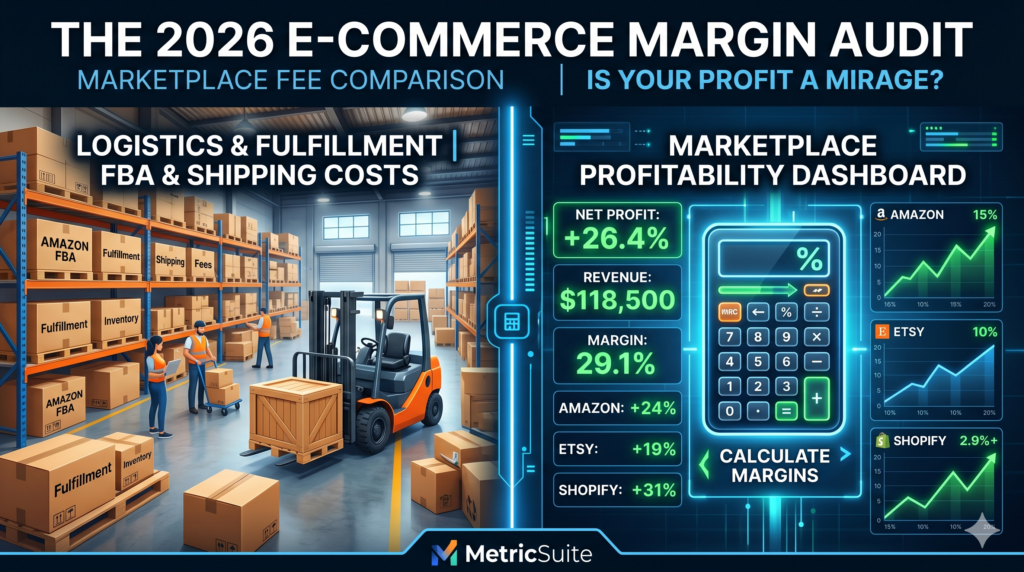
In the current e-commerce landscape, revenue is a vanity metric; net profit is the only reality. As we navigate 2026, the complexity of global logistics and platform fee structures has reached a tipping point. For the pragmatic entrepreneur—particularly those managing bi-continental supply chains or preparing for long-term asset repatriation—understanding the “leakage” in your fulfillment funnel is the difference between a scalable business and a high-stress hobby.
The primary challenge isn’t just selling; it’s keeping what you earn. Between Amazon’s new 3.5% fuel surcharges, Etsy’s aggressive offsite ad taxing, and Shopify’s increasing app-dependency costs, your margins are under a coordinated assault. This guide provides a clinical breakdown of the 2026 fee environment to help you execute a more profitable strategy.
1. Amazon FBA: The Efficiency Trap
Amazon remains the undisputed heavyweight of “hands-off” fulfillment, but that convenience comes with a compounding cost. As of April 17, 2026, Amazon implemented a 3.5% fuel and logistics-related surcharge on all fulfillment fees across the US and Canada.
Need a Freelancer for This?
Hire verified talent on Fiverr — starting from $5. No contracts, no hassle.
Browse Fiverr Freelancers →For a standard 2lb item, you aren’t just looking at the base $5.44 fulfillment fee; you are now navigating a landscape where “Overmax” handling fees and seasonal storage hikes can consume up to 45% of your gross item price. If you are shipping products that aren’t optimized for size-tier thresholds, you are effectively subsidizing Amazon’s logistics network.
The Execution Move: You must audit every SKU against the current 2026 size tiers. If a product is 0.1 inches over a threshold, you are losing dollars per unit on every sale. Use the Marketplace Fee & Profitability Tool to run these “what-if” scenarios before committing to new inventory.
2. Etsy: The Creative Tax and the Ad Trap
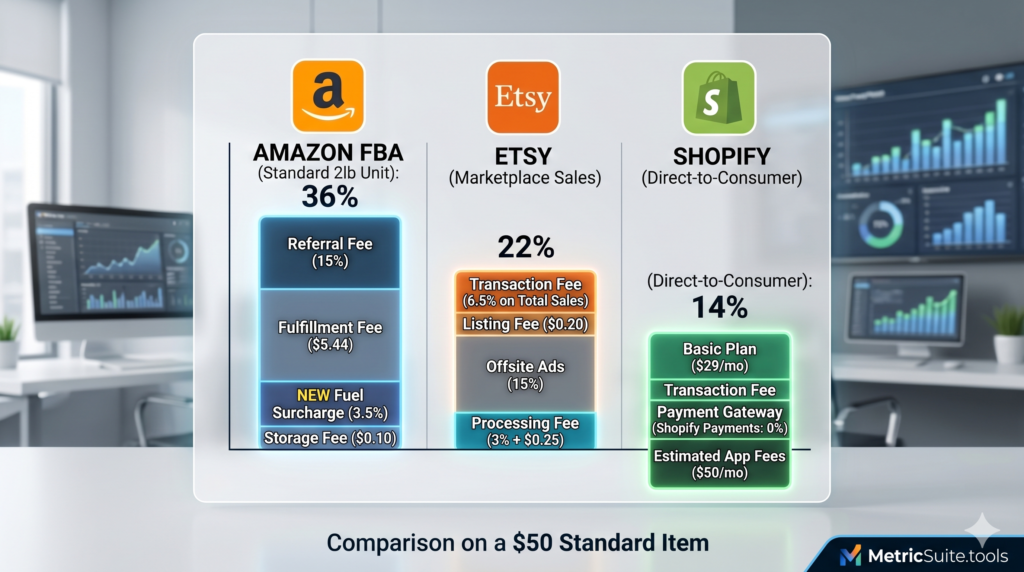
Etsy has matured from a craft fair into a data-driven marketplace, and its fees reflect that. The core 6.5% transaction fee (which crucially includes the price you charge for shipping) is just the baseline. For successful sellers—those hitting over $10,000 in trailing 12-month sales—the 12% to 15% Offsite Ads fee becomes mandatory and non-negotiable.
When you factor in the 3% + $0.25 payment processing fee and the $0.20 listing fee that renews every four months, a $50 item can easily attract $10 to $15 in total platform fees.
The Strategic Reality: Etsy is excellent for high-margin, low-weight items where the “brand story” allows for premium pricing. However, for commoditized goods, the platform’s “Regulatory Operating Fees” (varying by jurisdiction) can make it a graveyard for profit.
3. Shopify: The Cost of Independence
Shopify is often touted as the “cheaper” alternative because transaction fees are lower (2.4% to 2.9% on the Advanced and Basic plans, respectively). However, the hidden drain on Shopify is operational overhead. To match the functionality of a marketplace, most Shopify owners spend between $100 and $500 monthly on apps for SEO, cross-selling, and loyalty programs. Furthermore, unless you use Shopify Payments, you face an additional “third-party gateway” fee ranging from 0.6% to 2%.
If you are transitioning away from marketplaces to build a “borderless” brand, you must account for the shift in Customer Acquisition Cost (CAC). On Amazon, the platform provides the traffic; on Shopify, you must buy it.
Pro Tip: When calculating your Shopify switch, use theStripe & PayPal Fee Calculatorto see the real impact of your payment processor choice on your daily liquidity.
4. The Global Logistics Reality (2026 and Beyond)
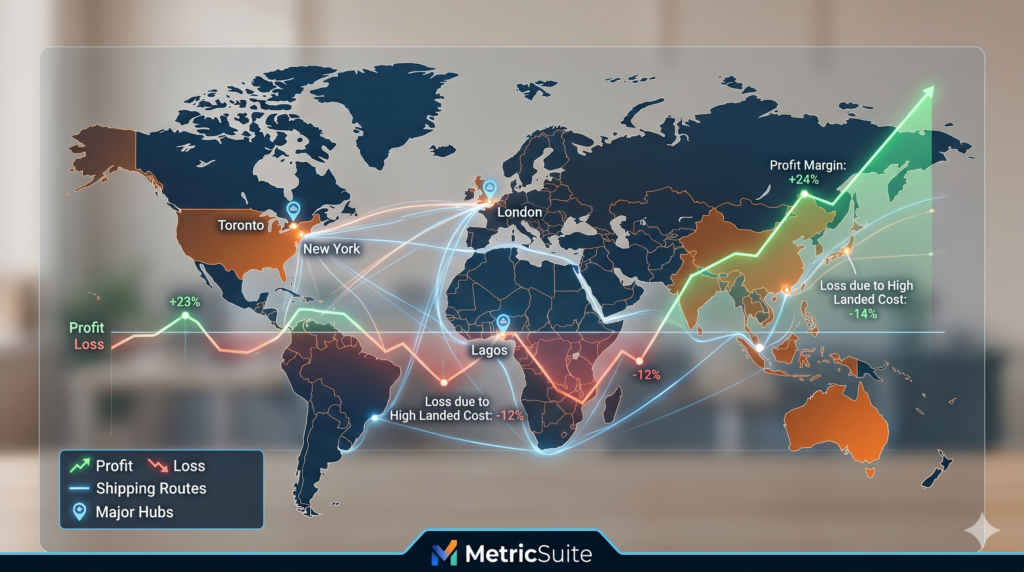
For operators managing a bi-continental lifestyle—perhaps sourcing in North America while building roots in Africa—the “landed cost” is the only number that matters. Shipping is no longer a static expense; it is a volatile variable influenced by fuel surcharges and trade policy shifts.
A “Healthy” e-commerce business in 2026 typically maintains:
- Gross Margins: 55% – 70%
- Net Profit Margins: 18% – 26%
If your net profit is below 15%, your business is at risk of being wiped out by a single logistics disruption or a platform policy change.
Action Item: Every quarter, perform a full “Margin Audit.” Use the Margin & Markup Calculator to ensure your retail price accurately reflects the rising COGS and fulfillment surcharges. If your margin is shrinking, you must either renegotiate with suppliers or raise your prices. In a high-inflation environment, holding your prices steady is a recipe for bankruptcy.
5. Decision Matrix: Which Platform Wins?
- Choose Amazon FBA if your product is standardized, has high turnover, and fits “Small Standard” tiers. The logistics speed is a conversion multiplier that can justify the 15% referral fee.
- Choose Etsy if your product is unique, lightweight, and has a high “perceived value.” Avoid Etsy for heavy items; the fee on shipping will kill your margin.
- Choose Shopify if you have an established audience and want to build long-term brand equity. It is the only platform that offers true protection against “neo-colonial” marketplace policies that can shut down your store overnight without recourse.
References & Data Sources
- Amazon Seller Central (2026): “US FBA Fulfillment Fee Changes & Fuel Surcharges.”
- Etsy Investor Relations: “2025/2026 Seller Fee and Marketplace Transparency Report.”
- TrueProfit Analysis: “2026 E-commerce Profit Benchmarks across 5,000+ Global Stores.”
- Shopify Business Intelligence: “The Real Cost of App-Dependent Scaling in 2026.”