What Does an Employee Really Cost in Africa?
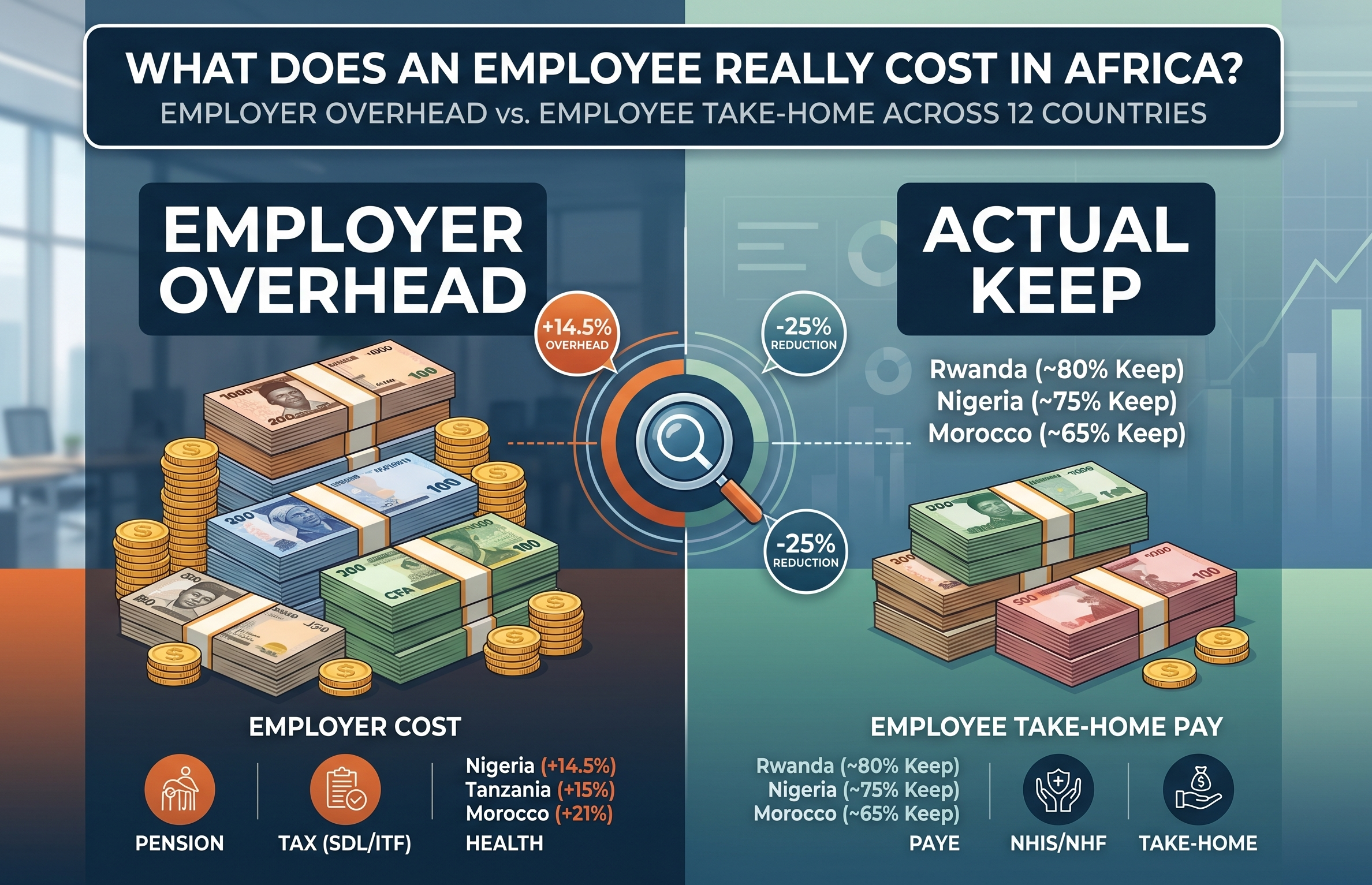
When African business owners budget for a new hire, most look at the monthly salary and stop there. The reality is very different. In Nigeria, statutory employer contributions (pension 10%, NSITF 1%, ITF 1%, NHF 2.5%, NHIS 10%) add 14.5%+ on top of gross salary. In Tanzania, employer costs jump 15% above gross (NSSF 10% + SDL 4.5% + WCF 0.5%). In South Africa, UIF + SDL + pension matching adds another 9.5%.
And on the employee side, take-home pay is often 20–35% less than what you agreed as “salary.” In Nigeria under the new NTA 2025 (effective January 2026), a ₦500,000/month employee takes home roughly ₦380,000–₦410,000 after PAYE, pension, NHF, and NHIS. Most employees don’t understand why.
This calculator shows both sides of the equation — what the employer truly pays AND what the employee actually keeps — across 12 African countries, with full payslip breakdowns.
African Employee True Cost Calculator
See what the employer really pays vs what the employee actually keeps. Full payslip with PAYE, pension, social security, and every statutory deduction.
Tax brackets updated March 2026. Covers Nigeria's new NTA 2025 rates.
Employee Details
Employer Overhead Rates by Country
The “hidden” cost above gross salary varies significantly across the continent:
- Tanzania: +15% employer overhead (NSSF 10% + SDL 4.5% + WCF 0.5%). Highest in East Africa.
- Nigeria: +14.5% (Pension 10% + NSITF 1% + ITF 1% + NHF 2.5%). Plus NHIS 10% of basic for employers who participate.
- Egypt: +18.75% (Social insurance, capped). But the cap means the effective rate drops for high earners.
- Morocco: +21% (CNSS 8.98%+6.4% + AMO 4.11% + training 1.65%). One of Africa’s highest.
- Ghana: +13% (SSNIT Tier 1 employer portion).
- South Africa: +9.5% typical (UIF 1% + SDL 1% + pension ~7.5%).
- Kenya: +10.25% (NSSF 6% capped + SHA 2.75% + Housing Levy 1.5%).
- Uganda: +10% (NSSF only).
- Rwanda: +5.8% (Pension 5% + Maternity 0.3% + CBHI 0.5%). Africa’s lightest employer burden.
- Ethiopia: +11% (Pension only).
- Senegal: +18.4% (IPRES 8.4% + CSS 7% + work accident 3%).
- Cameroon: +17.9% (CNPS 8.4% + Family 7% + accident 2.5%).
Nigeria’s New Tax System (NTA 2025, Effective January 2026)
Nigeria’s tax system underwent its biggest reform in decades with the Nigeria Tax Act 2025, signed June 2025 and effective January 1, 2026. Key changes for payroll:
- ₦800,000 annual tax-free threshold — anyone earning ₦66,667/month or less pays zero income tax. Previously, the effective threshold was much lower.
- Consolidated Relief Allowance (CRA) abolished — replaced by Rent Relief capped at ₦500,000 or 20% of rent paid.
- New progressive bands: 0% → 15% → 18% → 21% → 25% (the old system went up to 24%).
- Pension deduction unchanged: 8% employee + 10% employer on Basic + Housing + Transport (~60% of gross).
- NHF: 2.5% of basic salary.
- NHIS: 5% employee + 10% employer on basic salary.
For most employees earning ₦200,000–₦1,000,000/month, the new system results in slightly lower PAYE than the old CRA system. For very high earners (₦5M+/month), the new 25% top rate slightly increases their burden.
What Employees Actually Keep (Take-Home Percentages)
Approximate take-home as percentage of gross salary, for a mid-level employee:
- Rwanda: ~80% take-home (lowest deductions in Africa)
- Uganda: ~73% take-home
- Kenya: ~72% take-home
- South Africa: ~72% take-home (varies significantly by income level due to progressive rates)
- Ghana: ~70% take-home
- Nigeria: ~75% take-home (improved under NTA 2025 for mid-level earners)
- Egypt: ~70% take-home (social insurance capped)
- Tanzania: ~68% take-home
- Morocco: ~65% take-home
- Cameroon: ~72% take-home
- Ethiopia: ~68% take-home
- Senegal: ~67% take-home
Tips for Employers
- Budget the full employer cost, not just gross salary. When making an offer of ₦500,000/month in Nigeria, your actual cash outflow is ~₦572,500/month (gross + employer contributions). Plan for this.
- Understand the difference between “cost to company” and “gross salary.” In South Africa, “CTC” already includes employer contributions. In Nigeria, “gross salary” does NOT include employer pension and levies — they’re on top.
- Pension thresholds matter. In Nigeria, pension is mandatory for companies with 3+ employees. In Kenya, NSSF contributions are capped at KES 7,000/month per side. Know your caps.
- Run this calculator before making salary offers. Many African SMEs discover statutory costs after hiring and end up either non-compliant or over-budget.
Tips for Employees
- Ask for your payslip breakdown. You have a right to see exactly where your salary goes.
- Check if your employer is remitting pension. In Nigeria, some employers deduct pension but don’t remit it to PFAs. Verify on your PFA portal.
- Understand your tax band. Under Nigeria’s NTA 2025, if you earn ₦66,667/month or less, you should pay ZERO income tax. If your employer is still deducting, raise it.
- Rent relief requires documentation. Under the new Nigerian system, you need a valid tenancy agreement and receipts to claim up to ₦500,000 annual rent relief.
Frequently Asked Questions
How much does it cost to employ someone in Nigeria beyond their salary? Approximately 14.5% on top of gross salary for mandatory employer contributions: pension (10%), NSITF (1%), ITF (1%), and NHF (2.5%). If the employer participates in NHIS, add another 10% of basic salary. For a ₦500,000/month employee, expect to pay ₦565,000–₦590,000 total.
What is the new tax-free threshold in Nigeria for 2026? Under the Nigeria Tax Act 2025 (effective January 1, 2026), the first ₦800,000 of annual chargeable income is completely tax-free. This means employees earning roughly ₦66,667/month or less pay zero income tax.
Which African country has the lowest employer overhead? Rwanda, at approximately 5.8% above gross salary (pension 5% + maternity 0.3% + community health ~0.5%). Uganda is next at 10% (NSSF only).
Which African country has the highest employer overhead? Morocco, at approximately 21% above gross salary (CNSS, AMO health, and training levies combined). Senegal (18.4%) and Egypt (18.75% capped) are also high.
How is PAYE calculated in Ghana? Ghana uses progressive income tax rates from 0% to 35% on annual chargeable income (after SSNIT Tier 1 deduction). The first GHS 5,880/year is tax-free. Employee SSNIT contributions are 5.5% (Tier 1) + 5% (Tier 2) of basic salary.
What is South Africa’s “cost to company” model? In South Africa, many employers quote “CTC” (cost to company) which already includes the employer’s UIF, SDL, and pension contributions. This is different from Nigeria and Kenya where “gross salary” excludes employer costs. Always clarify which model an offer uses.
Do I need to register for pension in Nigeria? Yes, if your company has 3 or more employees. Both employer (10%) and employee (8%) contributions are mandatory on pensionable emoluments (Basic + Housing + Transport allowances, typically ~60% of gross salary).
What changed with Kenya’s health insurance in 2024–2025? NHIF was replaced by SHA (Social Health Authority) contributions at 2.75% of gross salary for both employee and employer. The Housing Levy of 1.5% each side was also upheld by the courts and remains in effect.